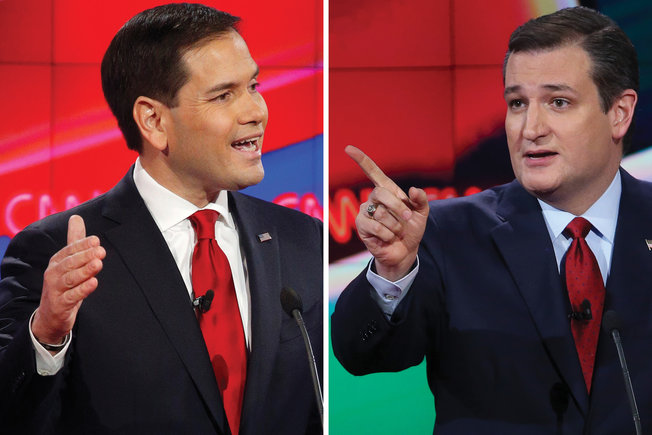
Contrasting Ted Cruz’s flaw with Marco Rubio’s flaw

Ted Cruz vs Marco Rubio
Marco Rubio vs Ted Cruz: the fatal flaws

This article from Asia Times was sent to me by my friend Patrick, and I really loved it. The article finds what’s wrong with each of the candidates, and I agree with their assessment.

First Ted Cruz.

I guess I’ve said before that I disagree with Cruz on foreign policy. His record shows that he opposed data collection on Americans to toughen up national security, and that he opposed the interventions in Libya, Egypt and Syria.

Here’s the excerpt:

Cruz first drew the wrath of the Establishment in the fall of 2014 when he averred that the US had stayed too long in Iraq, adding that the US should not try to turn Iraq into Switzerland. That is not merely heresy, but an existential threat to an Establishment that went all in on the Bush Freedom Agenda, up through and including the abortive, misnomered “Arab Spring.” Americans forgive a lot, but they don’t easily forgive a leadership that sends American soldiers into harm’s way on behalf of a failed social experiment.

Yes. All true. I don’t agree with Cruz on most of those views. I wanted us to stay the course in Afghanistan and Iraq. I didn’t want us in Libya or Egypt, but I wanted us to invade Syria after they crossed the red line and to stay there as long as it took to get Iranian influence out. I want our armed forces to destroy regimes that harbor terrorists and stay over there, even if we don’t engage in nation-building. Also, I am all for warrant-less aggregate data collection and enhanced interrogation techniques. Now, I think I’m in the minority there, and more people agree with Cruz’s libertarian streak, but I’m a hawk. I believing in projecting American power against our enemies.

I sent this post to Lindsay for validation, and she said that Cruz voted for expanding gathering information through cell phones and other communication, but no searches without a warrant. Cruz is a stickler for the Constitution, that’s why he opposes warrant-less searches, but I don’t think of aggregate data collection as a warrant-less search. To me, you gather the data, and then you restrict searches on it to specific numbers that you have a warrant for – but you gather the data first, so that it’s there for you to search on it.

Now the author also says that “it is likely that Cruz would try to widen the gap between America’s military technology and the rest of the world’s.” And that’s correct. Cruz would do that. So I’m not in complete disagreement with him, only the things I said.

Now Marco Rubio.

OK, now, I’ve blogged before about Marco Rubio’s mistakes:

And in addition to that, I found two more this week. Marco Rubio also supports sugar subsidies, which is just crony capitalism. And he got a D rating from pro-marriage activist Maggie Gallagher regarding his response to the Obergefell decision, which redefined marriage for all 50 states. (Cruz opposes all subsidies, e.g. – ethanol, and he got an A- rating on his response to the gay marriage Supreme Court decision).

The article explains the common thread in all 8 of these mistakes by Rubio.

It says:

Endearing, boyish, photogenic and eloquent, Marco Rubio is the candidate that Central Casting sent the Establishment from the studio pool. Rubio, a middling student at university and a Florida machine politician throughout his career, says his lines well but does not have an original thought about foreign policy. That is why the Establishment likes him. Cruz knows that the Establishment is naked, and is willing to say so. That’s why they don’t like him. They aren’t supposed to. They look at him the way a rice bowl looks at a hammer.

Marco Rubio just allows himself to get swept up in fashionable causes, and that’s why he bands together with Democrats on their priorities so often.

This quotation from a recent Matt Walsh column hits the nail on the head about why some people prefer Rubio to Cruz:

People say Ted Cruz is awkward, boring, weird looking, and lacks any semblance of style or charm. And they’re right. I agree with those observations. The guy is a total bummer on a personality level. If we were in fifth grade I probably wouldn’t invite him to my sleepover.

Rubio supporters dismiss the items in my list of Rubio failures with a shrug. Who cares, they say. They want to make the decision about who should be President as if they were having a sleepover. Who should I invite? I’ll invite the guy isn’t much smarter than me, and who goes along with me, when I want to be mischievous. Not that Ted Cruz, he went to Princeton and Harvard Law, and clerked for Justice J. Michael Luttig and Chief Justice William Rehnquist. He was Solicitor General of Texas, and argued and won cases that defended conservative causes at the Supreme Court – when it was majority liberal. He’s too stuck-up, successful and strict  for my sleepover. He worries too much about the Constitution and doing the right thing, and will never have any fun if it means breaking the rules. I’m voting for Rubio to come to my sleepover! Fun and thrills!

So, this is the core problem with Marco Rubio, and it explains why the establishment loves him. He has average intelligence, and limited accomplishments. He draws opinions from the people around him, and is driven by peer-pressure and media acclaim to act against conservative interests. That’s why he sides with Democrats on issues like amnesty, Libya, campus due process, gay marriage, etc. It’s popular, and Rubio does what the cool kids want him to do.

But we’re not picking a kid to come to our sleepover, America. We’re picking the President of the United States. I think Rubio would make a great Vice President under President Cruz, and then he can run for President again in 2024.

CNN was the first to run the story about Ben Carson’s retreat to Florida

Why do people think that CNN are biased leftist clowns?

I didn’t want to write about this, but one of my Democrat co-workers who is always pestering me with any misstep by my favorite candidates (Jindal, Walker, Cruz) brought it up. I doubt he knows what the national debt is, but he is always very aware of all the latest nit-picky issues. Anyway, here we go with the post I did not want to write, and thanks to my friend Kris (who is not my evil co-worker) for encouraging me to write it.

So everyone knows the story. A staffer on the Cruz campaign sent out a message saying that Carson was going to be returning to Florida and skipping New Hampshire and South Carolina. The staffer forwarded this message to Cruz caucus-goers, and they used it to appeal to Carson supporters to vote for Cruz. So where did the story originate? Did the nasty Cruz campaign make it up?

No, it came from CNN.

Here’s the post from Breitbart News containing the timeline, with screenshots of CNN tweets and videos of CNN anchors.

Breitbart says this:

The following is a definitive timeline of events on Monday night. All times are local Iowa time–i.e. Central Standard Time (CST).

6:41-6:43 p.m. CNN’s Chris Moody tweets news about Ben Carson (three tweets)

The part we care about is this:

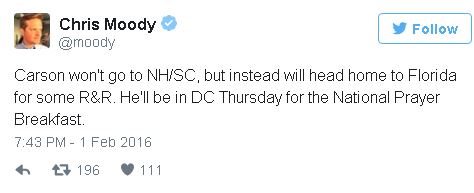
CNN's Chris Moody starts the story
CNN Senior Reporter Chris Moody starts the story at 6:43 Central / 7:43 Eastern

No word about where the story came from, but the source seems to be Ben Carson, or someone representing his campaign. How else would Chris Moody get this information except from the campaign itself? And that would mean that Carson, who has never run for office before and has a disorganized campaign, just made a mistake. Or someone on his campaign staff did.

Anyway, at 6:44 PM Iowa local time, CNN anchors ran with the story next, based on the tweet of their “Senior Reporter”:

And here’s the transcript:

Tapper: Thanks, Wolf. Well, CNN has learned some news about the man who, at least according to polls, is in fourth place here in Iowa. Now, Dana, a week from tomorrow, we’re all going to be doing this again for the New Hampshire primary. So almost every single candidate is going to be going directly from here to New Hampshire to campaign–except for the man in fourth place, who a few months ago was in first place here, Dr. Ben Carson. What have we learned?

Bash: That’s right. We should say that our Chris Moody is breaking this news, that Ben Carson is going to go back to Florida, to his home, regardless of how he does tonight here in Iowa. He’s going to go there for several days. And then afterwards, he’s not going to go to South Carolina. He’s not going to go to New Hampshire. He’s going to come to Washington, D.C., and he’s going to do that because the National Prayer Breakfast is on Thursday. And people who have been following Ben Carson’s career know that that’s really where he got himself on the political map, attending that prayer breakfast, and really giving it to President Obama at the time. And he became kind of a hero among conservatives, among evangelicals especially.

Tapper: But it’s very unusual–

Bash: Very unusual.

Tapper: –to be announcing that you’re going to go home to rest for a few days, not going on to the next site. Plus, he’s already announced that he’s going to be coming out and speaking at 9:15 local and 10:15 Eastern, no matter whether or not we know the results, because he wants to get home and get ahead of the storm.

Bash: Look, if you want to be President of the United States, you don’t go home to Florida. I mean, that’s bottom line. That’s the end of the story. If you want to signal to your supporters that you want it, that you’re hungry for it, that you want them to get out and and campaign, you’ve got to be out there doing it too. And he’s not doing it. it’s very unusual.

Tapper: Very unusual news that CNN has just learned. CNN’s Chris Moody breaking the story. Wolf, back to you in Washington.

This was reported 16 minutes before the caucuses began. There is a ticker in the CNN video above. This was the origin of the story. The story did not originate with the Cruz campaign, it originated with the radical leftists on CNN.

Carson later tweeted that he was NOT suspending his campaign, that he was going home to Florida to “get fresh clothes”. Oh yes, I always fly home to get fresh clothes. It is just a ridiculous thing to say. It is not at all clear that the Cruz or Rubio campaigns SAW this tweet, which happened at 6:53 PM – their e-mail to their campaign workers came out a mere three minutes later.

In any case, at 6:56  PM, the Cruz campaign e-mails supporters what was reported on CNN, that Carson was “taking time off from the campaign trail”.

So, that’s how it went down, and as you can see, Cruz is innocent, and so is his staff. The guilty party is CNN for running the story that Carson had to correct for them. But before CNN could correct their mistake, the Cruz campaign had already acted on the CNN story. CNN didn’t even try to correct the story until after the Cruz campaign had sent out their messages. CNN did clarify their initial report, but much much later, around 7:30 PM. And this 7:30 PM tweet was the FIRST clarification that the Cruz campaign saw.

By the way, the only report that I have seen about the source of the rumor reported by CNN links the rumor to the MARCO RUBIO campaign, and you can read about that here. The tweet from the Rubio supporter has since been deleted, but the screenshot survives in the post I linked above.

Finally, one last thing. Cruz, being the man who stood up to big ethanol in Iowa and won, has already proved his integrity and character. But there’s more. The most obvious thing to do in the face of a made-up scandal like this is to pick a low-level staffer and punish them. But Cruz looked at the facts that I wrote above, and decided to stick by his staffer. This man always does the right thing – it’s like he doesn’t even care what happens to his whole campaign so long as he does the moral thing. And this is being noticed. Here is a post by a Trump supporter who switched his vote to Cruz, based on Cruz’s decision to stand by his innocent campaign staff.

If you like honor, Ted Cruz is your guy. I’m not going to regret supporting this guy.

A Harvard University student explains how evidence changed her mind about God

Harvard University student discovers apologetics

Here’s a must-read article  about the effectiveness of apologetics on college campuses in Christianity Today.

Excerpt:

I don’t know when I first became a skeptic. It must have been around age 4, when my mother found me arguing with another child at a birthday party: “But how do you know what the Bible says is true?” By age 11, my atheism was so widely known in my middle school that a Christian boy threatened to come to my house and “shoot all the atheists.” My Christian friends in high school avoided talking to me about religion because they anticipated that I would tear down their poorly constructed arguments. And I did.

As I set off in 2008 to begin my freshman year studying government at Harvard (whose motto is Veritas, “Truth”), I could never have expected the change that awaited me.

It was a brisk November when I met John Joseph Porter. Our conversations initially revolved around conservative politics, but soon gravitated toward religion. He wrote an essay for the Ichthus, Harvard’s Christian journal, defending God’s existence. I critiqued it. On campus, we’d argue into the wee hours; when apart, we’d take our arguments to e-mail. Never before had I met a Christian who could respond to my most basic philosophical questions: How does one understand the Bible’s contradictions? Could an omnipotent God make a stone he could not lift? What about the Euthyphro dilemma: Is something good because God declared it so, or does God merely identify the good? To someone like me, with no Christian background, resorting to an answer like “It takes faith” could only be intellectual cowardice. Joseph didn’t do that.

And he did something else: He prodded me on how inconsistent I was as an atheist who nonetheless believed in right and wrong as objective, universal categories. Defenseless, I decided to take a seminar on meta-ethics. After all, atheists had been developing ethical systems for 200-some years. In what I now see as providential, my atheist professor assigned a paper by C. S. Lewis that resolved the Euthyphro dilemma, declaring, “God is not merely good, but goodness; goodness is not merely divine, but God.”

Joseph also pushed me on the origins of the universe. I had always believed in the Big Bang. But I was blissfully unaware that the man who first proposed it, Georges Lemaître, was a Catholic priest. And I’d happily ignored the rabbit trail of a problem of what caused the Big Bang, and what caused that cause, and so on.

By Valentine’s Day, I began to believe in God. There was no intellectual shame in being a deist, after all, as I joined the respectable ranks of Thomas Jefferson and other Founding Fathers.

I wouldn’t stay a deist for long. A Catholic friend gave me J. Budziszewski’s book Ask Me Anything, which included the Christian teaching that “love is a commitment of the will to the true good of the other person.” This theme—of love as sacrifice for true good—struck me. The Cross no longer seemed a grotesque symbol of divine sadism, but a remarkable act of love. And Christianity began to look less strangely mythical and more cosmically beautiful.

Now, I’m going to get into a lot of trouble for saying this, but I think that if you are a Christian and you are in a secular university, then you really need to have put in the effort to study the areas of science, history and philosophy that are relevant to the Christian faith. This is regardless of your personal abilities or field of study. We must all make an effort regardless of how comfortable we are with things that are hard for us to learn.

Granted, most people today are not interested in truth, because we just have this cultural preoccupation with having fun and feeling good and doing whatever we want to do whenever we want to do it. Most atheists I’ve met are like that, but some are more honest, open-minded, and they just have never encountered any good reasons or evidence to think that God exists and that Jesus is anything other than a man. There are a lot of atheists like that who are just waiting to hear some decent evidence. Our job is to prepare for them and then engage them, if they are willing to be engaged.

I think that definition of love she cited – self-sacrifice for the true good of another person – is important. I don’t think that ordinary Christians like you or me spends time on apologetics because we “like” it. I know lots of Christians who are in tough, expensive academic programs trying to get the skills they need to defend truth in areas that matter. They do this because they know that there are people out there who are interested in truth, and who are willing to re-prioritize their lives if the truth is made clear to them. We need to be willing to serve God by doing hard things that work.

Positive arguments for Christian theism