
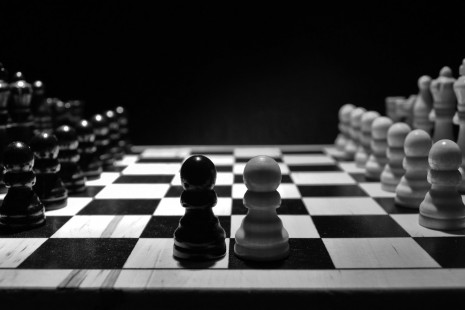
The drowning stranger illustration challenges atheistic morality

Learning about right and wrong, good and evil

This is by Matt from Well Spent Journey blog.

Excerpt:

Here’s a thought experiment.

_____

Imagine that you’re a healthy, athletic, 20-year-old male. It’s the morning after a thunderstorm, and you’re standing on the banks of a flooded, violently churning river.

You notice an object floating downstream.

As it moves closer, you suddenly realize that this object is a person. The head breaks the surface, and you see a panic-stricken elderly woman gasping for air. You’ve never met her before, but vaguely recognize her as an impoverished widow from a neighboring village.

You look around for help, but there’s no one in sight. You have only seconds to decide whether or not to jump in after her – recognizing that doing so will put your own life in significant peril.

_____

Is it rational for you to risk your life to save this stranger? Is it morally good to do so?

For the Christian, both of these questions can be answered with an emphatic “yes”.

The Christian is called to emulate the example set forth by Jesus, who not only risked, but sacrificed his life for the sake of others. The Christian believes that the soul is eternal, and that one’s existence doesn’t come to an abrupt end with death.  Additionally, he can point to the examples of countless Christian martyrs who have willingly sacrificed their own lives.

For the secular humanist, the answers to these questions are much more subjective. When I previously asked 23 self-identifying atheists, “Is it rational for you to risk your life to save a stranger?” only 4 of them responded with an unqualified “yes”.

Biologically speaking, the young man in our scenario has nothing to gain by jumping after the drowning woman. Since she’s poor and elderly, there are no conceivable financial or reproductive advantages involved. Evolutionary biologists often speak of “benefit to the tribe” as a motivation for self-sacrifice…yet the young man’s community would certainly place greater practical value on his life than that of a widow from a neighboring village.

Secular humanists argue that people are capable of making ethical decisions without any deity to serve as Moral Lawgiver. On a day-to-day basis, this is undeniably true. We all have non-religious friends and neighbors who live extremely moral and admirable lives.

In the scenario above, however, secular ethics break down. The secular humanist might recognize, intuitively, that diving into the river is a morally good action. But he has no rational basis for saying so. The young man’s decision is between empathy for a stranger (on the one hand) and utilitarian self-interest & community-interest (on the other).

In the end, there can be no binding moral imperatives in the absence of a Moral Lawgiver. If the young man decides to sit back and watch the woman drown, the secular humanist cannot criticize him. He’s only acting rationally.

When I read this, I was of one of the questions from one of my earliest posts, where I list a dozen interview questions to ask atheists. His question is very much like one of my questions. You may like the others in my list, as well.

It seems to me that on atheism, the only answer you can give for why you would do the right thing is “because it makes me happy”. And as we see with abortion – 56 million unborn children dead – it very often doesn’t make atheists happy to save someone else’s life. Not if it means any infringement on their own happiness. Every time an atheist votes Democrat, they are voting to declare that people who get in their way should not be saved. And atheists (the “nones”, anyway) are one of the largest Democrat voting blocs. According to the 2012 Secular Census, 97% of secularists deny that unborn children have a right to life. And the 2013 Gallup poll found that “nones”, people with no religion, are most likely to be pro-abortion. (Note that “nones” are not necessarily atheists, they may have some beliefs, but they are not observant). It’s not rational to inconvenience yourself to save others on atheism. You have one life to live, be happy, survival of the fittest.
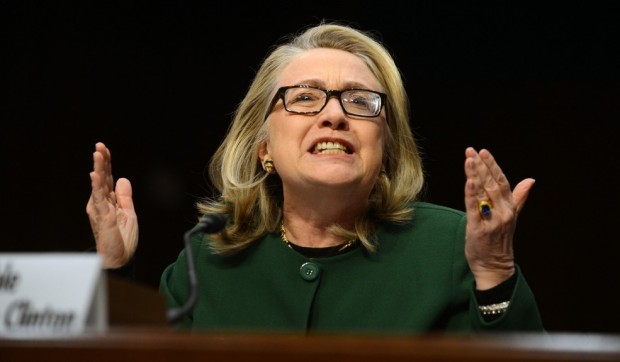
All evidence points to Hillary Clinton as source of Internet video lie

What difference does national security make?

Investors Business Daily reports on the latest e-mails requested and received by Judicial Watch, a government watch-dog organization. The title for this post is a shortening up of a line from Judicial Watch, by the way.

Excerpt:

History recorded that the White House’s United Nations Ambassador Susan Rice appeared a few days after the terrorist incident on a number of Sunday television news shows saying that attack, which killed four Americans, including the U.S. ambassador to Libya, was provoked by an Internet video.

It was just a few Islamic hotheads, she suggested, who took a protest over the video too far. We were assured the violence was in no way connected to President Obama’s Libya policy.

Judicial Watch, however, has been combing through the emails and finds they tell a different story.

They indicate a cover-up occurred. Judicial Watch President Tom Fitton said the documents that keep piling up “show the Obama White House was behind the big lie, first promoted by Hillary Clinton, that an Internet video caused the Benghazi terrorist attack.”

“Top White House aide Ben Rhodes, Hillary Clinton, and many key Obama officials pushed others to tie the Internet video to the attacks,” he said.

“It is little wonder that Mrs. Clinton and the entire Obama administration have fought so hard to keep these documents from the American people. All evidence now points to Hillary Clinton, with the approval of the White House, as being the source of the Internet video lie.

It was a lie that bloomed into a conspiracy. The new documents released to Judicial Watch show “the Obama administration engaged domestic and foreign Islamist groups and foreign nationals to push the Internet video narrative.”

It appears the White House even successfully recruited the Turkish government, or at least Turkish Foreign Minister Ahmet Davutoglu, to help spread the lie.

Another email, says Judicial Watch, “evidently from the Office of the Secretary of Defense” and sent to National Security Council spokesperson Bernadette Meehan and other top White House officials, “shows that the administration took no action to deploy military assets almost five hours after the attack began.”

This corroborates early and continued speculation that the men were left on their own to die.

Why would the administration want to spin this tragic incident in such a way? Why did it want to, in the words of White House operative Rhodes, “underscore that these protests are rooted in an Internet video”?

Because, as Rhodes said, it did not want to admit the attack was part of “broader failure of policy.”

The administration knew the Benghazi attack was a terrorist act, but it couldn’t dare admit it because that would call into question the Obama policy and expose as a lie the president’s claim that Libya was a success.

The Washington Times writes that the State Department is now admitting that Hillary lied about her e-mail server not containing any classified information.

Excerpt:

The State Department on Wednesday conceded that two dozen of Hillary Clinton’s emails did contain classified information, a fact that could trigger a U.S. policy that authorizes the government to take control of her private server and sanitize the contents.

A former senior intelligence official told The Washington Times the policy also requires the government to check other Internet paths her secret information could have taken.

The procedures are spelled out by the National Security Agency’s special panel on controlling leaked secrets, called the Committee on National Security Systems. It published a policy, “Securing Data and Handling Spillage Events,” that fits Mrs. Clinton’s unauthorized private server kept at her home while she was secretary of state, according to the retired officer’s reading of the regulations.

Why would anyone think that she would make a good President? It seems to me that she made a poor decision (Libya invasion), lied to cover up her poor decision (Youtube video),  and lied when she said that her e-mails did not contain classified information.

New study: open relationships in the gay community

Story from the San Francisco Chronicle.

Excerpt:

A new study released this week by the Center for Research on Gender & Sexuality at San Francisco State University put statistics around what gay men already know: Many Bay Area boyfriends negotiate open relationships that allow for sex with outsiders.

[…]”I think it’s quite natural for men to want to continue to have an active and varied sex life,” said 50-year-old technology consultant Dean Allemang from Oakland, who just ended a 13-year-open relationship and has begun another with a new boyfriend.

“I don’t own my lover, and I don’t own his body,” he said. “I think it’s weird to ask someone you love to give up that part of their life. I would never do it.”

Hoff, who just received a $3.5 million grant from the National Institute of Mental Health to continue the study for five more years, initially started her research based on findings that HIV infection is on the rise among male couples.

“So much of the HIV prevention effort is aimed at a different set – men in dance clubs or bathhouses having anonymous sex,” she said. “HIV prevention might want to expand its message to address relationships; we have to look at risk in a greater context.”

In her study of gay couples, 47 percent reported open relationships. Forty-five percent were monogamous, and the remaining 8 percent disagreed about what they were.

Another researcher quoted in the story explains how same-sex marriage is compatible with an “open relationship”, and that this interpretation of marriage would be a redefinition of traditional marriage.

Related to that, there is this radio interview with a gay activist.

Excerpt:

“It’s a no-brainer that (homosexual activists) should have the right to marry, but I also think equally that it’s a no-brainer that the institution of marriage should not exist. …(F)ighting for gay marriage generally involves lying about what we are going to do with marriage when we get there — because we lie that the institution of marriage is not going to change, and that is a lie.

The institution of marriage is going to change, and it should change. And again, I don’t think it should exist. And I don’t like taking part in creating fictions about my life. That’s sort of not what I had in mind when I came out thirty years ago.

I have three kids who have five parents, more or less, and I don’t see why they shouldn’t have five parents legally… I met my new partner, and she had just had a baby, and that baby’s biological father is my brother, and my daughter’s biological father is a man who lives in Russia, and my adopted son also considers him his father. So the five parents break down into two groups of three… And really, I would like to live in a legal system that is capable of reflecting that reality, and I don’t think that’s compatible with the institution of marriage.”

The word marriage means, one man, one woman, for life. And both parents sacrifice to raise the children they create. And no frivolous divorce, either. And if you ask me, it should also mean no sex before marriage, formal courtship, approval of both sets of parents, and the wife stays home when the children under five.