
Survey: women explain why they avoid having children

Is it OK to tell women they are wrong?
Are women today genuinely interested in marriage and children, or do they have other plans?

This article comes from the leftist Huffington Post.

They write:

The Huffington Post and YouGov asked 124 women why they choose to be childfree. Their motivations ranged from preferring their current lifestyles (64 percent) to prioritizing their careers (9 percent) — a.k.a. fairly universal things that have motivated men not to have children for centuries. To give insight into the complex, layered decisions women make, HuffPost asked childfree readers to discuss the reasons they have chosen not to have kids and gathered 270 responses here.

They grouped the responses into 5 categories:

  1. I want to prioritize my career
  2. I don’t like children
  3. I had a bad relationship with my parents
  4. I don’t want the financial responsibility
  5. I like my life as it is

And here are some of the ones that I thought were the most interesting, and pay attention to the ones that include fear-of-missing-out travel, which I blogged about before:

Category 1:

I am a first-generation college graduate in my family. My mother was a single mom my entire childhood, and I was there to see that struggle. Being a parent, for a woman, means for life. Being a parent, for men, seems to be something very different. I understand raising children is a big life change and I don’t want to sell myself short on my potential to become something more and maybe even create change. I am childfree because I want to travel, move, pursue my career wholly and be able to push myself to be an inspiration to other women. If a child comes into my life, it won’t be until I am happy and successful in my work life, and not until I am secure with my finances and a marriage. I don’t want to one day wake up as an old woman wishing I had waited to have children so I could live my own life first, make mistakes, learn new things and find myself. Today kids are not for me.

Category 2:

I’m nearly 47; my boyfriend (domestic partner) of 17 years is nearly 50. I’ve never been pregnant and have taken every precaution to remain childfree. I tolerate other people’s children when I have to. I’m happiest when there are NO children around. I definitely don’t want them in my home. I like my life as it is. My boyfriend and I are both scientists. We also raise snakes and spiders! We like to travel. We travel to ride roller coasters (members of ACE — American Coaster Enthusiasts) and to attend rock concerts. I am also a performer in a senior winter guard. My plate overfloweth! I see no reason to procreate. I would be unhappy. Why be unhappy?

Category 3:

I have a great relationship with my husband. We have the time and money to travel, and that gives us precious memories. I had a bad relationship with my dad, and maybe I’m scared to treat my children like that. I’m very happy with my decision. I have a great relationship with myself too.

Category 4:

My spouse and I have talked in depth about having children. However, we both decided that our desire to travel the world is a financial burden in itself. If we have kids, we will never have the means to travel, and at the end of our life, we would rather be 100 percent committed to fulfilling our own realistic dreams rather than only able to provide a subpar life for a child. Comes down to the fact we are selfish, but at least we recognize this and made the choice early enough to avoid damaging a kid

Category 5:

The thought of having to do kiddie crap every weekend makes me want to shoot myself. I like having the extra money to save for retirement and not worry about braces, summer camp or college tuition. I can travel on a moment’s notice. I can give my all to my job and not have to worry about daycare, sick days, or having to leave my co workers to pick up my slack. I’m the “cool aunt” to all my nieces and nephews. I have more time to do the things that make me happy and productive. My relationship with my guy is not strained due to the constant neediness of children. I don’t want to put my body through pregnancy and childbirth. I can give my dog all the attention he needs and deserves.

If I had to choose one comment to represent the entire survey, it would be this one:

The moment you have children, you’re life ceases to be about yourself. Kids always take priority and I feel like I can do more for this world than just generate offspring.

Or maybe this one:

I honestly feel too lazy. I haven’t achieved enough, and if I had a child I would “just be a mom,” which isn’t enough for me or what I want out of life.

I think this is the real reason why young, unmarried women choose not to prepare or plan for marriage and children . Marriage and children “some day” is like planning for your retirement by winning the lottery. Marriage and children “some day” is an excuse to signal to family and friends that you will eventually want the responsibility of a husband and kids, but that you are justified in being self-centered right now.

We need to move beyond a survey to quantify this, and this U.S. Census data does that:
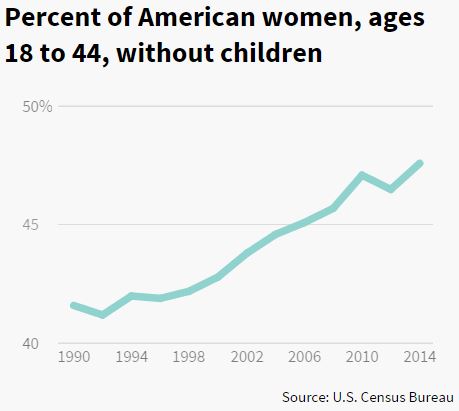
Childless by choice, not because of men
Childless by choice, not because of men failing to “man up”

These quotations are very troubling if you are a young man who has been serious about obtaining STEM degrees, saving money by not traveling, and making a plan to have a marriage and family that will serve God. I am seeing real hostility in young, unmarried Christian women to the idea that marriage will impose responsibilities, expectations and obligations on them. And their parents, relatives, friends and co-workers are doing nothing to detect and counter this attitude. As Lindsay argued on this blog before, the marriage / children plan is an excellent way for Christians to make a difference. It will take a lot of work, but it makes much more of a difference for the kingdom than just doing whatever makes you feel happy.

UPDATE: Commenter Bee comments below:

Sad to say this but many Christian voices are encouraging Christian women to travel, date around and delay marriage and childbirth. Here are several negative voices:

Mandy Hale is a Christian woman who is mid 30’s, never married and has wasted years in travel and bad relationships. She has a large twitter following. She promotes her travel oriented, feelings oriented lifestyle.

http://thesinglewoman.net/about/

Christian counselor Stephen Arteburn tells of encouraging his daughter to travel and date around and not think about marriage until her late 20’s. Unfortunately, no one can flip a switch on their 28th birthday and quickly get married to a quality guy. Also, late marriage for women means having more than 1 or 2 children is risky.

http://www.amazon.com/This-One-Simple-Dates-Finding-ebook/dp/B006BEETVK/ref=sr_1_5?ie=UTF8&qid=1436189794&sr=8-5&keywords=steve+arterburn&pebp=1436189798009&perid=07F1AJ7WTWBV04G0N41V

Bskillet81 found evangelical american princesses (EAP) obsessed with travel, entitlement, feelings, and personal fulfillment.

https://societyofphineas.wordpress.com/2014/11/24/evangelical-american-princess/

I just read some of Mandy’s quotes from GoodReads and she is certifiably nuts.

Do unemployment benefits discourage people from working?

I noticed that the latest jobs report showed that the percentage of work-eligible Americans working was at a 38-year-low.

CNS News reports:

A record 93,626,000 Americans 16 or older did not participate in the nation’s labor force in June, as the labor force participation rate dropped to 62.6 percent, a 38-year low, according to the Bureau of Labor Statistics.

In June, according to BLS, the nation’s civilian noninstitutional population, consisting of all people 16 or older who were not in the military or an institution, hit 250,663,000. Of those, 157,037,000 participated in the labor force by either holding a job or actively seeking one.

Now, let me ask you this. Does paying people to not work cause more people to not work? It seems to me that whatever you subsidize, you get more of, and whatever you tax, you get less of.

Now look at this article from the radically-leftist New York Times.

It says:

Before this recession, most economists probably thought that some amount of unemployment benefits were just and compassionate, and offered a sense of security even to people who were lucky enough to retain their jobs, despite the fact that the program would raise unemployment rates and reduce both employment and economic output.

In other words, unemployment benefits shrink the economy to some degree, but shrinking the economy a bit may be a price worth paying.

Unemployment benefits were thought to reduce employment and output because, by definition, working people were ineligible for the benefits. In particular, an unemployed person who finds and starts a new job, or returns to working at his previous job, is supposed to give up his unemployment benefits. Economists had found that a large fraction of unemployed people delay going back to work solely because the unemployment insurance program was paying them for not working.

Here’s a new study explaining how the “generosity” of the big government Democrat Party actually encourages people to avoid working, and to remain dependent on the government for their “income”.

A study published by two labor economists, Stepan Jurajda and Frederick J. Tannery, looked at employment histories for unemployment insurance recipients in Pittsburgh in the early 1980s. Unemployment rates got quite high in Pittsburgh in those days, reaching 16 percent at one point, and staying over 10 percent for two and a half years.

The chart below summarizes their findings for Pittsburgh.

The chart displays the fraction of persons (in Pittsburgh) receiving unemployment benefits who began working again, as a function of the number of weeks until their unemployment benefits were scheduled to be exhausted. For example, a “hazard” value of “0.04″ for week “-14″ means that, among unemployed persons with 14 weeks remaining until their benefit exhaustion date, 4 percent of them either began working a new job or returned to their previous job.

The chart:

Unemployment offers a disincentive to find work
Unemployment benefits offer a disincentive for Americans to find work

The most troubling thing about this is what is not said in the chart or the study – think about the children growing up in these households where their parents, especially the fathers, are not working. What are they learning about self-sufficiency and the role of government? They are the ones who we are going to task with paying for our lavish entitlement programs in the future. Are people who think that dependency on government is normal being trained to pay for the exploding costs of Social Security and Medicare?

Should Christians seek to help the poor by growing a secular government?

I found a paper (PDF) on the University of Washington web site that makes the case for why Christians ought to care about more than just social issues when it comes to politics and elections.

Here’s the abstract:

What accounts for cross-national variation in religiosity as measured by church attendance and non-religious rates? Examining answers from both secularization theory and the religious economy perspective, we assert that cross-national variation in religious participation is a function of government welfare spending and provide a theory that links macro-sociological outcomes with individual rationality. Churches historically have provided social welfare. As governments gradually assume many of these welfare functions, individuals with elastic preferences for spiritual goods will reduce their level of participation since the desired welfare goods can be obtained from secular sources. Cross-national data on welfare spending and religious participation show a strong negative relationship between these two variables after controlling for other aspects of modernization.

Here’s the conclusion:

It is quite apparent that there is a strong statistical relationship between state social welfare spending and religious participation and religiosity. Countries with higher levels of per capita welfare have a proclivity for less religious participation and tend to have higher percentages of non-religious individuals. People living in countries with high social welfare spending per capita even have less of a tendency to take comfort in religion, perhaps knowing that the state is there to help them in times of crisis.34 As laid out in the theory above, there is likely a substitution effect for some individuals between state-provided services and religious services. Religion will still be there to serve the spiritual needs of people seeking answers to the philosophic mysteries of life, but those who value those spiritual goods less than the tangible welfare benefits churches provide will be less likely to participate in religious services once secular substitutes become available. Given that religious practice and values are often passed down from generation to generation, the weakening of practice in one generation will likely translate into weaker practice in subsequent generations. Does this mean that secularization theory is correct in its prediction that religion will gradually fade away? Doubtful. Realizing that there is still a yearning among many people to understand the mysteries of life, religion is not likely to dissipate at any time soon. Government simply cannot offer credible substitutes for these less tangible, supernatural goods. The explosion in spirituality once religion was made legal in former Soviet bloc countries lends credence to this assertion (Greeley 1994). As religious markets become more deregulated in various parts of the world, it is likely that new religious movements will take advantage of increased liberty and discover ways to expand.

Perhaps one of the most important lessons from the findings above is that the religiosity of a society is not simply determined by sociological factors. Government policy can play an important role in shaping the religiosity of a nation. Policies aimed at regulating the activities of religious organizations — from tax laws to zoning regulations — have important effects on the firms that supply religious goods and services. Many of these policies are designed consciously to promote or inhibit religious practice. Alternatively, welfare policy has been shown here to unintentionally affect the demand for religious services, likely over the course of generations. And, finally, since an extensive welfare state is considered by many to be a hallmark of modernized societies, the microfoundational analysis presented above provides a way of incorporating a component part of the secularization thesis (which relies heavily on notions of modernization) into the religious economy perspective.

Have you ever heard a sermon that addresses the size of government and individual liberty and prosperity? I haven’t. You’d have to be reading Christian scholars like Wayne Grudem or Jay Richards to find that. The typical church you attend either praises big government or says nothing about it. After all, we can keep making withdrawals on the liberties we have right now without ever worrying about having to make any deposits, right? Everything will be fine, and it’s easier not to have to think about what’s down the road to serfdom, so long as the scenery is nice for us right now. Religion is primarily about comfort, not truth. Right?

The funny thing is that when I talk to most Christians about this, especially non-Americans, they simply don’t have the knowledge of economics to understand how big government affects liberty, prosperity and security. Few of my international friends read people like F.A. Hayek and Thomas Sowell, and there are not that many people reading them here at home, either. Maybe we should be, though.