Is the point of religious belief just to be sincere or to also be correct?

The Poached Egg linked to this interesting post by Al on the Please Convince Me blog.

Excerpt:

We live in a pluralistic society and so it is fitting, generally speaking, that all beliefs are accorded equal respect. Unfortunately, this mindset seems to have convinced many people today that all beliefs have equally validity. As it relates to matters “spiritual,” the modern skeptic thinks that no religion has the corner on truth (assuming that such a thing as “truth” actually exists). “What works for you is fine, but don’t try imposing those values on me” is a common approach. “All religions basically say the same thing,” they say, “so as long as you are sincere in your beliefs, that’s all that really matters.” What they mean, of course, is that religion has nothing to teach. It is, instead, some sort of placebo and as long as you really “believe in it,” your particular view on eternity is as good as any other.

Christianity, by contrast, does not stake out an ambiguous position. Man is in deep trouble, due to his rebellion against his Creator, and he needs a savior to get him out of the mess he’s in. Without that savior, he’s headed for a bad place, and he can’t help himself. The “good news” is that help is out there, if we are only open to it.

So, which view conforms to the way things really are? Is there one right religion, or should we remain complacent in the belief that a sincere belief will work out just fine at the end of the day?

Perhaps the first place to look for an answer to this question is within nature itself. None of us constructed this universe we happen to find ourselves in, but it certainly appears to be operating under a set of rules. If there is a “rule-maker,” perhaps he has left some clues for us within the structure of his creation, just as an artist might leave a distinctive message within a work of art. But looking to nature provides no support for the skeptic’s view, for nowhere in nature does it appear that a sincerely held, but mistaken, belief can “save” you. I may be convinced that the ledge I am standing on is sturdy, but the force of gravity is not lessened by my belief, if it is mistaken. If I have diabetes and three vials are sitting in front of me – one with water, one with insulin and one with arsenic – the “saving” power of the liquid depends not on what I think it contains, but on what it actually contains. If I mistakenly believe that the pool I am diving into is full of water, I may still suffer permanent paralysis despite the sincerity of my belief.

Take for example submarine officers from the US and Soviet navies. Both were operating nuclear power plants using the same scientific principles and both had confidence that their ships could protect them from radiation. For each officer, this confidence was based on trust that the ship’s “saving” power – its design and safeguards – was adequate to the task. The American sub employed such safeguards while the Soviet navy cut corners. Any particular American officer may have doubted his safety, while his Soviet counterpart may have had total confidence. In the end, what mattered was not the sincerity of the beliefs, but the object in which the belief was placed. And predictably, countless Soviet sailors suffered radiation sickness while their American counterparts did not.

I think there are some places where it’s fine to just belief whatever you want and every belief is valid. For example, when deciding what to eat or what to wear. But there is no reason to think that the project of developing religious beliefs is like that. Religious beliefs are about the world out there,  but preferences about food or clothes are about the person – his or her own internal state.

A good lecture on truth claims and religion

Here’s an audio lecture featuring one of my favorite Christian professors, Dr. Walter Bradley. The title of his lecture is “Truth in Religion”. He tries to make the case that the kind of truth that religion ought to be concerned with is objective truth, not subjective truth.

The MP3 file is here. (31 minutes + Q&A)

Here’s a summary:

  • what is pluralism?
  • what is multiculturalism?
  • what is relativism?
  • some propositions are true culturally – just for certain groups in certain times (cultures)
  • some proposition are true trans-culturally – true independently of what anyone wants or feels
  • Mathematical truth is trans-cultural – it is true regardless of cultural fashions
  • Scientific truth is trans-cultural – it is true regardless of cultural fashions
  • Some truths are not like this – cooking traditions, clothing traditions and greeting traditions
  • These kinds of truths are NOT trans-cultural, they vary by culture
  • The question is – is religion true like math and science, or true depending on the culture
  • Some people think that your religion depends on where you were born or what your family believes
  • Religions make conflicting claims about the way the world really is, so they can’t all be true
  • And these conflicts are at the core of the religions – who God is, how can we be related to him, etc.
  • So if religions convey trans-cultural truth, then either one is true or none are true
  • If they are not trying to convey trans-cultural truth, then they are not like math and science
  • Let’s assume that religion is the same as trans-cultural truth
  • How can we know which religion is true? 1) the laws of logic, 2) empirical testing against reality
  • Logical consistency is needed to make the first cut – self-contradictory claims cannot be true
  • To be true trans-culturally, a proposition must at least NOT break the law of non-contradiction
  • According to Mortimer Adler’s book, only Christianity, Judaism and Islam are not self-contradictory
  • All the others can be excluded on the basis of overt internal contradictions on fundamental questions
  • The others that are self-contradictory can be true culturally, but not trans-culturally
  • The way to proceed forward is to test the three non-contradictory religions against science and history
  • One of these three may be true, or they could all be false
  • We can test the three by evaluating their conflicting truth claims about the historical Jesus
  • Famous skeptics have undertaken studies to undermine the historical Jesus presented in the Bible
  • Lew Wallace, Simon Greenleaf and Frank Morrison assessed the evidence as atheists and became Christians
  • There is a lot of opposition in culture to the idea that one religion might be true
  • But if you take the claims of Jesus at face value, he claims to be the unique revelation of God to mankind
  • Either he was telling the truth about that, or he was lying, or he was crazy
  • So which is it?

You can read papers from Dr. Bradley here.

Obamanomics: a closer look at the economic achievements of Barack Obama

From Investors Business Daily.

Full text:

May’s weak jobs report further confirms the president’s policies are failing to help the economy. This is, indeed, the worst recovery since the Depression.

Negative superlatives associated with this presidency keep piling up. The toll so far:

  • The share of Americans who’ve been out of work a long time — now at 42% of the unemployed — is the highest since the Great Depression (source: Labor Department).
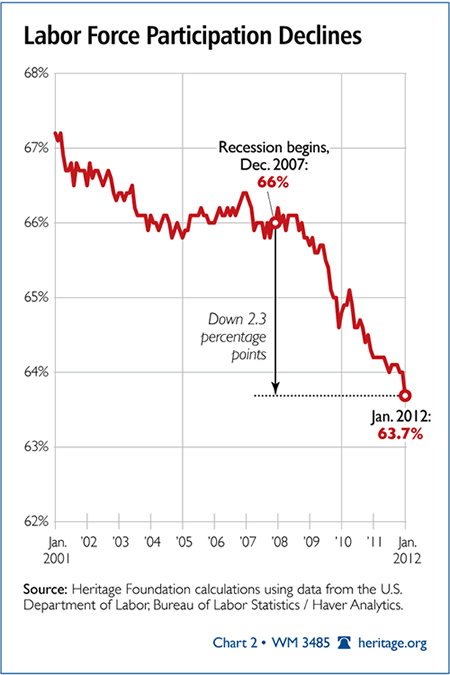
  • The proportion of the civilian working-age population actually working, at 58%, is the smallest since the Carter era (Labor Department).
  • Growth in nonfarm payroll jobs since the recovery began in June 2009 is the slowest of any comparable recovery since World War II (Hoover Institution).
  • The rate of new business startups — the engine of job growth — has plunged to an all-time low of 7.87% of all businesses (Census Bureau).
  • 3 in 10 young adults can’t find jobs and live with their parents, highest since the 1950s (Pew Research).
  • 54% of bachelor’s degree-holders under the age of 25 are jobless or underemployed, the highest share in decades (Northeastern University).
  • Black teen unemployment, now at 37%, is near Depression-era highs (Labor Department).
  • Almost 1 in 6 Americans are now poor — the highest ratio in 30 years — and the total number of poor, at 49.1 million, is the largest on record (Census).
  • The share of Hispanics in poverty has topped that of blacks for the first time, 28.2% to 25.4% (Census).
  • The number of Americans on food stamps — 45 million recipients, or 1 in 7 residents — also is the highest on record (Congressional Budget Office).
  • Total government dependency — defined as the share of Americans receiving one or more federal benefit payments — is now at 47%, highest ever (Hoover).
  • The share of Americans paying no income tax, at 49.5%, is the highest ever (Heritage Foundation, IRS).
  • The national homeownership rate, now at 65.4%, is the lowest in 15 years (Census).
  • The 30-point gap between black and white Americans who own their own homes is the widest in two decades and one of the widest on record (Census).
  • Federal spending, now at 23.4% of GDP, is the highest since WWII (CBO).
  • Excluding defense and interest payments, spending is the highest in American history, at 17.6% of the economy (First Trust Economics).
  • The federal debt, at 69% of GDP, is the highest since just after WWII (CBO).
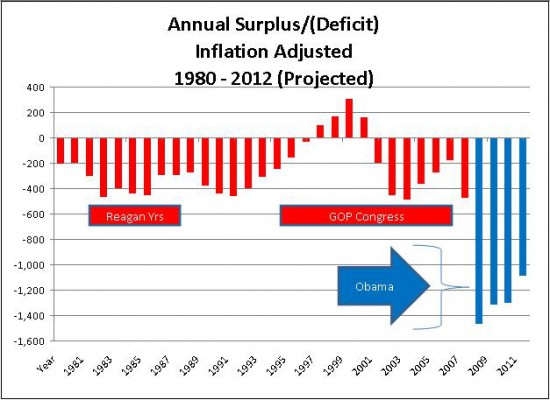
  • The U.S. budget deficit, now at 9.5% of the economy, is the highest since WWII (CBO).
  • U.S. Treasury debt has been downgraded for the first time in history, meaning the U.S. government no longer ranks among risk-free borrowers (S&P).

This is what Obamanomics has wrought. Fiscal promiscuity. Trickle-up poverty. Shared misery.

Here’s the Obama legacy in two charts:

US Labor Force Participation down 4.9 million people

The updated labor force participation is actually lower now than in January.

And:

Barack Obama: Budget Deficits

What I find alarming is that Obama is still polling competitively with his Republican rival.

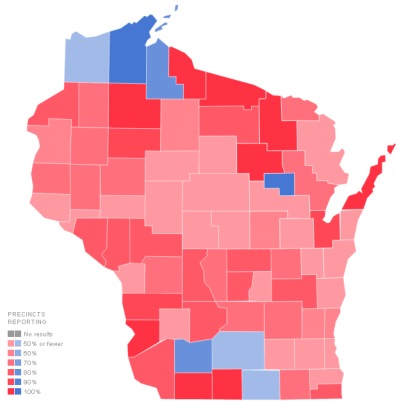
Scott Walker defeats Tom Barrett to win 2012 Wisconsin recall election

Wisconsin Recall Election Results 2012 Map

Human Events reports.

Excerpt:

The cheers were almost deafening at the Expo Center, Gov. Scott Walker’s headquarters, Tuesday night as CNN projected that the Republican governor had won Wisconsin’s nationally-watched recall election.

[…]Walker’s fellow Republican, Lieutenant Governor Rebecca Kleefisch, appeared headed for an easy win.  However, results in the four Republican-held state senate seats on the ballot remained uncertain and a Democratic victory in either could end the GOP’s control of the now-evenly divided state senate.

Most GOP activists and state political pundits who spoke to Human Events credited Walker’s political team with energizing party activists throughout the Badger State and turning out his likely backers. In addition, national Republicans led by Republican National Committee Chairman (and Walker’s fellow Wisconsinite) Reince Priebus, weighed in for the embattled governor.  All four Republican presidential candidates voiced solidarity with Walker when they stumped in the state’s presidential primary earlier this year, and GOP Govs. Chris Christie of New Jersey and Nikki Haley of South Carolina stumped for Walker in the special election.

[…]Perhaps sensing defeat, national Democrats aside from Clinton distanced themselves from Milwaukee Mayor Tom Barrett.  Democratic National Committee Chairwoman Debbie Wasserman Schultz told reporters on May 25 “there aren’t going to be any repercussions nationally” if Walker wins and, five days later, White House Press Secretary Jay Carney seconded her opinion.  President Obama did nothing for Barrett until the day before the voting, when he sent out a one-sentence endorsement of him on Twitter.

The current results as of 10:30 PM show 58-41 in favor of Walker.

It’s very important to understand that this victory will have national repercussions for Barack Obama and the big-spending Democrats.

Look:

But Walker’s triumph may yield other benefits for the GOP in Wisconsin and the conservative movement overall.  Although Barack Obama carried the state’s 10 electoral votes in 2008 and leads Mitt Romney in most statewide polls, Republicans are now expected to make a major effort to put Wisconsin in the Romney column in November.  With the number of reliable campaign volunteers clearly enhanced and motivated by the Walker effort,  the Romney camp’s chances of wining the state are enhanced.

As Steve Walters, senior producer of the Wisconsin Eye public television program, told Human Events: “I can’t believe Romney won’t make Wisconsin a priority after tonight.”

Waukesha County Executive Dan Vrakas, whose county had a turnout of more than 70 percent and supported Walker handily, agreed, predicting “Romney will be here next week.  The state went from being leaning blue to leaning red overnight.  Gov. Walker put fire in the belly of a lot of people.”

Among Republican activists we spoke to, there was also a fresh confidence in the ability of any of their four candidates this fall to pick up the open Senate this November.

What has been really encouraging for me to see is how the majority of union workers stopped paying dues to the unions as soon as Walker enacted the right-to-work reform which allows people to work without being forced to pay dues to wealthy, corrupt union bosses. I think it really opened my eyes to the fact that just because a person is a member of a union, it doesn’t mean they like it.

Here is a map of the results county-by-county. You can also read my previous post about Scott Walker’s pro-business reforms which lowered the unemployment rate in Wisconsin.