“The private sector is doing fine,” Obama said at a press conference on Friday. “Where we’re seeing weaknesses in our economy, have to do with state and local government — oftentimes, cuts initiated by governors or mayors who are not getting the kind of help that they have in the past from the federal government and who don’t have the same kind of flexibility as the federal government in dealing with fewer revenues coming in.”
State and local leaders were not the only ones to blame for a bad economy, as the president also blamed Republicans in Congress.
What are the facts? Is Obama right?
Here is a comparison of public and private pay in Ohio, for example:
Ohio Average Pay: Public vs. Private
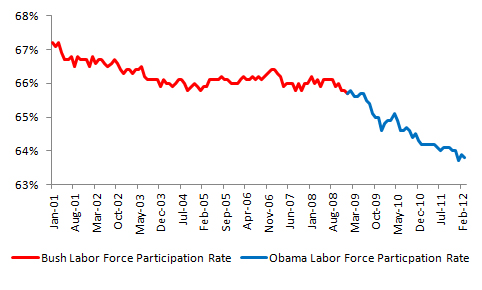
Does Obama know how to create jobs? Let’s compare him to Bush:
Labor Force Participation 2012 (click for larger image)
There is no recovery. We haven’t created any jobs. We’ve actually lost 5 million jobs since the Democrats took over the House and Senate in January 2007.
When George W. Bush was President, we had unemployment around 4 or 5 percent for 8 years, which deficits as low as $160 billion in 2007. Barack Obama has had four budget deficits of a trillion or more in a row, and his unemployment rate has been double Bush’s rate. Bush has an MBA from Harvard and had private sector job creation experience. Obama doesn’t know anything about economics. He’s a lawyer who benefited from affirmative action, and who has never released his grades. You can’t elect an unqualified person and get performance.
We’re taking a break this Friday from our regularly scheduled Friday movie to present a documentary on D-Day, since June 6th was the the anniversary of D-Day. This is my favorite D-Day documentary. I watched it when I was a young man. It features the famous World War 2 historian Stephen Ambrose.
IMDB mean rating: 8.2/10.
IMDB median rating: 8/10.
The documentary is in 3 parts.
Part 1:
Part 2: (this one covers the Pointe du Hoc operation at the beginning)
A considered and empathetic opposition to same-sex marriage has nothing to do with phobia or hatred, but that doesn’t stop Christians, conservatives, and anybody else who doesn’t take the fashionable line from being condemned as Neanderthals and bigots. This is a lesson that Canadians have learned from painful experience.
Same-sex marriage became law in Canada in the summer of 2005, making the country the fourth nation to pass such legislation, and the first in the English-speaking world. In the few debates leading up to the decision, it became almost impossible to argue in defense of marriage as a child-centered institution, in defense of the procreative norm of marriage, in defense of the superiority of two-gender parenthood, without being thrown into the waste bin as a hater. What we’ve also discovered in Canada is that it can get even worse than mere abuse, and that once gay marriage becomes law, critics are often silenced by the force of the law.
The article is full of examples of how pro-marriage opinions were stifled and crushed by the state, once same-sex marriage was made legal.
Here’s an excerpt:
Four years ago, a Christian organization in Ontario that works with some of the most marginalized disabled people in the country was taken to court because of its disapproval of an employee who wanted to be part of a same-sex marriage. The government paid the group to do the work because, frankly, nobody else was willing to. As with so many such bodies, it had a set of policies for its employees. While homosexuality was not mentioned, the employment policies did require that employees remain chaste outside of marriage, and marriage was interpreted as the union of a man and a woman. The group was told it had to change its hiring and employment policy or be closed down; as for the disabled people being helped, they were hardly even mentioned.
In small-town British Columbia, a Knights of Columbus chapter rented out its building for a wedding party. They were not aware that the marriage was to be of a lesbian couple, even though the lesbians were well aware that the hall was a Roman Catholic center — it’s increasingly obvious that Christian people, leaders, and organizations are being targeted, almost certainly to create legal precedents. The managers of the hall apologized to the couple but explained that they could not proceed with the arrangement, and agreed to find an alternative venue and pay for new invitations to be printed. The couple said that this was not good enough, and the hall management was prosecuted. The human-rights commission ruled that the Knights of Columbus should not have turned the couple down, and imposed a small fine on them. The couple have been vague in their subsequent demands, but feel that the fine and reprimand are inadequate.
As I write, two Canadian provinces are considering legislation that would likely prevent educators even in private denominational schools from teaching that they disapprove of same-sex marriage, and a senior government minister in Ontario recently announced that if the Roman Catholic Church did not approve of homosexuality or gay marriage, it “would have to change its teaching.” What has become painfully evident is that many of those who brought same-sex marriage to Canada have no respect for freedom of conscience and no intention of tolerating contrary opinion, whether that opinion is shaped by religious or by secular belief.



 WINTERY KNIGHT