Labor unions continued to receive the overwhelming majority of waivers from the president’s health care reform law since the Obama administration tightened application rules last summer.
Documents released in a classic Friday afternoon news dump show that labor unions representing 543,812 workers received waivers from President Barack Obama‘s signature legislation since June 17, 2011.
By contrast, private employers with a total of 69,813 employees, many of whom work for small businesses, were granted waivers.
The Department of Health and Human Services revised the rules governing applications for health reform waivers June 17, 2011, amid a steady stream of controversial news reports, including The Daily Caller’s story that nearly 20 percent of last May’s waivers went to businesses in House Minority Leader Nancy Pelosi’s district in California.
The labor unions receiving waivers include those that are monitored under the 1947 Taft-Hartley Act, and those that are not. The waivers granted since June 17 are valid until 2013, but recipients must make sure their employees understand the “limits of their coverage,” according to HHS documents.
HHS granted waivers on a year-by-year basis under its initial application process, but waivers granted after June 17 are valid for a maximum of two-and-a-half years.
By and large, unions backed the health care overhaul, a law from which nearly a half million of their workers are now exempt.
By the way, be skeptical of what people on the left say – it’s not necessarily what they actually do.
I wrote a post a while back showing that what liberals say in public is primarily designed to make them look good to others and feel good about themselves – but they don’t live the way they talk. E.g. – Michael Moore owned stock in Haliburton, Noam Chomsky took money from the Pentagon, Nancy Pelosi evades environmental restrictions in a business she owns, etc. Liberals can be hypocrites. Sometimes, they are just selling an image to their followers.
The thorough, chapter-by-chapter review of the book is here at Apologetics 315.
Excerpt:
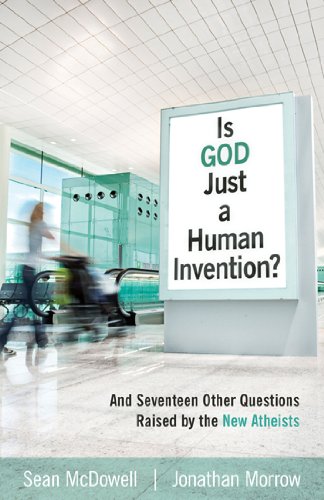
One of the brashest challenges that religious truth has experienced over the past several decades is the remarkable rise of the pugnacious New Atheists. Sean McDowell and Jonathan Marrow, new generation Christian apologists, have undertaken the task of contesting this anti-theistic upsurge. And in Is God Just a Human Invention? And Seventeen Other Questions Raised by the New Atheists the authors have pulled together a wide range of research that powerfully critiques the arguments from the combative non-theists.
[…]The authors deal with the scientific and philosophical challenges to Christian theism in a reasoned and respectful manner.
[…]Is God Just a Human Invention? is loaded with exceptional quotes from Christian and non-Christian thinkers. Additionally, the book furnishes very short essays at the back of each chapter from various erudite Christian scholars that augment the thesis of what was advanced by the authors.
This volume combines simplicity and applicability without forfeiting precision. The authors lead the reader into the full girth of the many contemporary discussions concerning the defense of Christianity. They offer several of the leading arguments for Christian theism while toppling some of the most belligerent of the objections promoted by the New Atheists. They have written, with abundant care, to attain a thoroughness that is not often established in popular books. The wisdom and excellence with which each chapter is written makes this a crucial volume for the budding apologist’s library.
Here are the 18 topics, and after each topic a Christian scholar discusses the relevance of each topic.
Is Faith Irrational? (Commentary by: Gregory Koukl)
Are Science and Christianity at Odds? (Commentary by: John Warwick Montgomery)
Are Miracles Possible? (Commentary by: Gary R. Habermas)
Is Darwinian Evolution the Only Game in Town? (Commentary by: William A. Dembski)
How Did the Universe Begin? (Commentary by: R. Douglas Geivett)
How Did Life Begin? (Commentary by: Fazale R. Rana)
Why Is the Universe Just Right for Life? (Commentary by: Jay W. Richards)
Has Science Shown There Is No Soul? (Commentary by: Dale Fincher and Jonalyn Fincher)
Is God Just a Human Invention? (Commentary by: Garry DeWeese)
Is Religion Dangerous? (Commentary by: Douglas Groothuis)
Does God Intend for Us to Keep Slaves? (Commentary by: Paul Copan)
Is Hell a Divine Torture Chamber? (Commentary by: Frank Turek)
Is God a Genocidal Bully? (Commentary by: Clay Jones)
Is Christianity the Cause of Dangerous Sexual Repression? (Commentary by: Kerby Anderson)
Can People Be Good Without God? (Commentary by: Mark D. Linville)
Is Evil Only a Problem for Christians? (Commentary by: Randy Alcorn)
What Good Is Christianity? (Commentary by: Glenn S. Sunshine)
Why Jesus Instead of the Flying Spaghetti Monster? (Commentary by: Darrell L. Bock)
If you’re looking for a good book on Christian apologetics for beginners, this is a great choice.
By the way, my Dad is currently reading my copy of this book! So it’s fine for normal people.
I have some book reviews that people have sent me in my inbox, so maybe I should be reading them and posting them too! I get a bit behind on e-mail, though.
Quin Hilyer explains, in the pro-Romney National Review, of all places.
Excerpt:
On taxes, for instance, Santorum has always been superb. The Club for Growth’s white paper on Santorum, calling his tax stances “very strong,” confirms that “Santorum has consistently supported broad-based tax cuts and opposed tax increases either by sponsoring key legislation or by casting votes on relevant bills.”
His record on a host of other conservative issues is as solid as that of any politician in the past two decades. He has been firmly and repeatedly against all sorts of regulatory abuse, against McCain-Feingold and other restrictions on political speech, for school choice, for tort reform, for a strong military, and for a balanced-budget amendment.
Obviously he has been as stalwart a defender of social conservatism, for 20 full years, as any other public figure. And as virtually every conservative involved in the judicial wars during Santorum’s time in the Senate has confirmed, in person or in print, Santorum and his staff were the go-to people in the Senate when you needed to find tireless, committed advocates for conservative jurists. Santorum is, wrote Ed Whelan of the Ethics and Public Policy Center, “the candidate in whom I have by far the greatest confidence” in terms of how likely he would be “to appoint excellent Supreme Court justices and lower-court judges and to work tenaciously to get them confirmed.”
Meanwhile, as Santorum frequently (and entirely accurately) reminds anybody who will listen, his work on the single most important conservative policy reform of the past half century, the 1996 welfare-to-work effort that cut spending and poverty rates simultaneously, was seminal, indefatigable, and remarkably effective. Iowa’s Sen. Chuck Grassley explained to the Des Moines Register a week ago that he was unconvinced about welfare reform until Santorum paid him an office call and “took a lot of time to convince me of his point of view… The sincerity and effort that he has to get his point across in the presidential campaign is almost a total reflection of how he operated as a United States senator.” Grassley yielded and voted for reform.
More broadly, until Rep. Paul Ryan’s recent prominence, nobody in Congress has been as passionate and fearless an advocate for entitlement reform as Santorum. Medicaid block grants. Investment accounts for Social Security. Medicare payments controlled by the beneficiaries rather than third-party payers. Choice rather than government mandates. Indeed, Santorum was the first candidate this year to fully embrace Ryan’s proposed reforms — with this exception, as he reminded me in a phone interview on Thursday: “I’ve criticized Ryan on one thing: waiting ten years [for many of the reforms to kick in]. We can’t afford to wait. We’ve got to start now.”
[…]As for overall spending and his much-discussed history of support for “earmarks” (a position also shared by tightwad Ron Paul), conservative groups’ ratings show that Santorum was better than the average Republican, despite representing a state far bluer than those of most of his Republican colleagues. He demonstrated particular courage in his support for the Freedom to Farm Act and in frequent opposition to floor amendments that would have put additional spending in appropriations bills. Denizens of Capitol Hill in the 1990s fondly remember Santorum’s repeated use of a prop during floor debate called the “Spendometer,” which he used to make a persuasive (and entertaining) case against wasteful federal largesse.
Out of office, he vociferously opposed TARP, the various “stimulus” packages, and the bailouts of car companies and of Fannie Mae and Freddie Mac. All those stances were perfectly in line with the voting record he had established in the House and Senate.
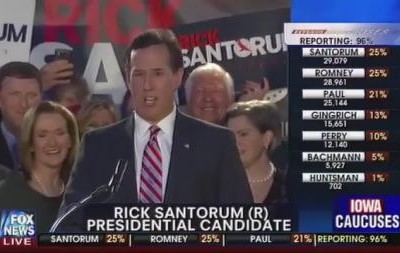
Social conservative leader and former presidential candidate Gary Bauer will endorse Rick Santorum in South Carolina, he confirmed to The Hill on Saturday.
Bauer said that he didn’t want to get into the details of the endorsement since it was officially still embargoed, but confirmed his support and said he’ll work to get other social conservatives on board for Santorum.
“I want to do whatever I can to convince my colleagues that Sen. Santorum is the right man,” he told The Hill.
[…]Bauer has organized a Friday meeting with top social conservatives in Texas to see if they can coalesce behind one candidate. He said the point of the meeting is not to try to stop Mitt Romney from being the Republican nominee, but that he believes Santorum would be the best candidate to beat President Obama, as well as the best commander in chief.
It’s worth remembering what Rick Santorum did to encourage critical thinking in public school science education, too. This is good news for us who want to have evidence for and against things like naturalistic macro-evolution and anthropogenic catastrophic global warming presented to students. That’s above and beyond the basics of conservatism, right there – and he’s solid on school choice.
The best thing about Santorum, though, is that he has a working class background and he isn’t afraid to debate with people instead of just speaking about his beliefs and generalities. He tries to convince people, and to reason things out with them.

 WINTERY KNIGHT