Harvard economist says stimulus was designed to reward Democrat constituencies

EVERYONE  PLEASE GO VOTE TODAY! (NOVEMBER 2nd, 2010)

Hans Bader at the Competitive Enterprise Institute comments on a new published paper by Harvard economist Jeffrey Miron, which explains why the stimulus failed to stimulate the economy and to create more jobs.

The paper is here. (PDF)

Excerpt:

Harvard economist Jeffrey Miron explains why the $800 billion stimulus package failed in a recent article.

What’s interesting about Dr. Miron’s critique is that he shows how the stimulus was a failure even if you take for granted liberal assumptions about economic policy (such as Keynesian economic theory), since it was so badly designed and executed that it failed to achieve its goals, spending wastefully while failing to revive the economy.  Indeed, the stimulus was so poorly tailored to the economy (and the goal of reducing unemployment) that Miron concludes that it was designed to reward politically connected “constituencies” and special-interest groups, like public-employee unions, rather than being focused on ”economic stimulus.”

Other Harvard economics professors like Robert Barro have also criticized the stimulus package. Barro called it “the worst bill that has been put forward since the 1930s.”  Former Obama economic advisor Martin Feldstein, a Harvard professor who is a big believer in stimulus packages in principle, said that the stimulus designed by Obama and congressional Democrats was “poorly done

Much stimulus money has been wasted.  It has gone to prisoners and dead people, wasteful welfare spending, abandoned bridges to nowhere, and unnecessary government buildings.  The stimulus subsidized foreign green jobs and wiped out jobs in America’s export sector.

The “’stimulus’ is not the road to economic recovery. It’s the problem, not the solution, writes Nobel Prize winning economist Vernon L. Smith.” Other Nobel Laureates like Gary Becker have also criticized the stimulus package.  200 economists signed a statement publicly opposing the stimulus package in an ad published in the Washington Post and New York Times.

So the stimulus bill was a failure because it was not designed to grow the economy or create jobs.

What was the real purpose of the stimulus bill?

George Mason University professor Veronique de Rugy looked at recovery.org and found that Democrat districts got more stimulus money than Republican districts.

Here’s the first chart:
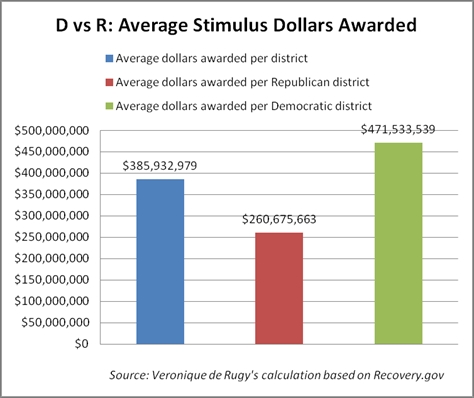
Stimulus spending by voting district affiliation

She writes:

…based on my new analysis of the Recovery.org data, Democratic districts are getting 1.8 times more money on average than Republican districts. Using Recovery.gov data, and cleaning it up seriously to be able to use it, we find that Republican districts are getting on average $260.6 million in stimulus awards while democratic districts are getting on average $471.5 million. The average is award per district is $385.9 million.

Interestingly, my data also confirms that the stimulus funds are not allocated based on unemployment rates or even variations in unemployment rates. So basically,  if the administration believes that government spending can create jobs, the allocation of the funds doesn’t show it.

And here’s the second chart showing which government departments got stimulus money.

Stimulus spending by government department
Stimulus spending by government agency

She writes:

Based on the Recovery.gov data, more than two third of the 594,754.3 jobs “created or saved” with the stimulus funds were “created or saved” in the Department of Education (see chart).  Basically, what the administration meant by shovel ready projects was funding for your next door teacher.

[…]A third of all union jobs are in Education

33 percent of the education industry is unionized

The union boss, Andy Stern, was appointed to be on the president’s debt commission.

The stimulus bill was never about stimulating the economy. It was about rewarding Democrat special interest groups. Remember, people who disagree with Obama are his “enemies”. And that means he isn’t there to govern for all the people equally. He’s there to reward his people. With Your Money.

Is Barack Obama a socialist? What is his connection to socialism?

Are Barack Obama and Hugo Chavez very different?

Here is an interview with Stanley Kurtz of National Review regarding his new book exploring the real Barack Obama and his past interest in socialism.  (H/T Muddling Towards Maturity)

The answers to this interview are too awesome to quote here. So I will quote some of the questions, and you should click through and read the WHOLE THING.

Questions:

LOPEZ: Why was the 1983 Socialist Scholars Conference “so formative an influence on Obama’s political career”?

LOPEZ: What actual evidence do you have that Obama attended the annual Socialist Scholars Conferences in New York between 1983 and 1985?

LOPEZ: What is socialism? What is socialism to Barack Obama? How has that changed since 1983? How has it stayed the same?

LOPEZ: How important is black liberation theology to understanding Barack Obama? And where does Jeremiah Wright fit in here?

LOPEZ: Was Bill Ayers his mentor or not?

LOPEZ: How important is ACORN to understanding Barack Obama and the Democratic party today? Is ACORN still a factor?

LOPEZ: Barack Obama wrote in Dreams from My Father: “Political discussions, the kind that at Occidental had once seemed so intense and purposeful, came to take on the flavor of the socialist conferences I sometimes attended at Cooper Union or the African cultural fairs that took place in Harlem and Brooklyn during the summers — a few of the many diversions New York had to offer, like going to a foreign film or ice-skating at Rockefeller Center.” You read a lot into “diversions.” How? Why? Is he really that smart?

LOPEZ: So is Saul Alinsky really, truly important to understanding our president?

LOPEZ: What does the Midwest Academy have to do with the milestone health-care legislation the president signed this March?

LOPEZ: Do you have insights into what exactly Barack Obama makes of the abortion debate and where that fits into a full picture of him? Despite a radicalism there, he’s been stealth about it, somewhat consistently, in his national career.

OK, here is an excerpt from the interview.

LOPEZ: What actual evidence do you have that Obama attended the annual Socialist Scholars Conferences in New York between 1983 and 1985?

KURTZ: Obama tells us himself in Dreams from My Father that he attended socialist conferences at the Cooper Union. Detailed evidence from socialist archives shows that there was only one socialist conference at the Cooper Union, and that was the Socialist Scholars Conference of 1983. Obama’s name also appears on a list of pre-registrants for the 1984 Socialist Scholars Conference. There is less evidence that he attended the Socialist Scholars Conference of 1985, although I think it’s likely that he did. Not only did Obama attend the previous two conferences, evidence indicates that in 1985 he was studying the writings of Harry Boyte, an important theorist of community organizing who spoke at the 1985 conference. Boyte, by the way, advised Obama’s 2008 presidential campaign. I carefully dissect the evidence for Obama’s conference attendance in the book.

LOPEZ: What is socialism? What is socialism to Barack Obama? How has that changed since 1983? How has it stayed the same?

KURTZ: These are the big questions. In the 1980s, the failure of Sixties and Seventies radicalism and the ascent of Ronald Reagan forced America’s socialists to take another tack. They de-emphasized strategies of nationalization and focused instead on local organizing as the way to move the country toward socialism. Now, instead of nationalizing a company, the idea was to get community organizers onto boards of directors, or to force banks to run loans through groups like ACORN. This was socialism “from below,” and it is the strategy that captivated Obama.

Obama’s socialist community-organizing colleagues followed French Marxist theorist André Gorz. Gorz advocated a strategy he called “non-reformist reforms,” proposing a series of seemingly minor tweaks to the system that were in fact designed to undermine capitalism and usher in socialism over time. This led Obama’s socialist mentors to devise an early version of the “public option,” although at the time they applied the idea to the energy sector, not health care. The socialism of Obama’s mentors was incremental and intentionally disguised. In the book, I argue that Obama follows many of his socialist mentors’ ideas to this day.

OK, here is ONE MORE answer at the end of the interview.

LOPEZ: If there’s one thing you could drive home to Americans about the president, what would it be?

KURTZ: He hasn’t been telling us the truth about his political convictions.

We need to start to understand Democrats by looking at their voting records, the policies they push, their positions, their past affiliations, and their life experiences. You don’t know anything about Barack Obama until you read books like these that go beyond the mainstream media puff pieces and Comedy Central slapstick interviews. You need to delve into who the man really is and what he intends to do to this country. The prosperity, liberty and security of your children depends on your diligence today. Inform yourself and persuade others.

And don’t forget to vote on Tuesday, and then buy the Stanley Kurtz book and the David Freddoso book. Then read them.

What is natural law and why do conservatives believe in it?

Bill Whittle has posted part 4 of his excellent series on what conservatives believe.

Today’s episode is on natural law and the rule of law.

Here are the previous parts:

This is wonderful for Christians to watch. When you watch them, think about how your life goals are much easier with these policies as opposed the policies in North Korea or Cuba. Your liberties, including your precious religious liberty, all hangs on these ideas. You cannot conduct a Christian life if you are taxed too much, or if the government indoctrinates your children in government-run schools, or if you cannot even afford books on apologetics and theology because you have no money left over after buying food. Think about your Christian life as an enterprise – what do you need from the government, the courts and the private sector in order to succeed?