
Tag Archives: Youth

Minimum wage: doing what feels good doesn’t produce good results

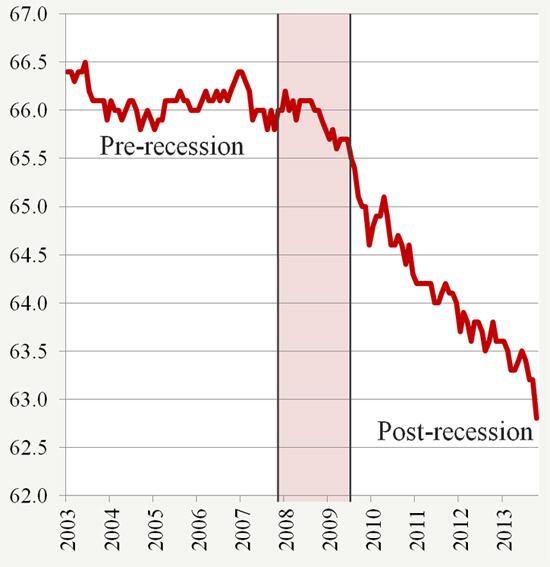
Labor Force Participation down to 62.8%

Will Obama’s plan to raise minimum wage help people?

From the Daily Caller. (H/T Conway)

Excerpt:

The Obama administration’s proposal to raise the minimum wage to $10.10 an hour could result in as many 1,084,000 jobs eliminated from the work force, according to a new study conducted by the Employment Policies Institute (EPI)

“No amount of denial by the president and his political allies — and no number of ‘studies’ published by biased researchers — can change the fact that minimum wage hikes eliminate jobs for low-skill and entry-level employees. Non-partisan economists have agreed on this consensus for decades, and the laws of economics haven’t changed,” Michael Saltsman, research director at EPI, said in a statement.

He offered an alternative to the president’s plan: “Instead of raising small businesses’ labor costs and creating more barriers to entry-level employment, the president and the Senate should focus on policies that help reduce poverty and create jobs.”

The  study was released in the wake of an expected vote on a Senate bill that aims to raise the federal minimum wage from the current $7.25 an hour to $10.10 an hour — a nearly 40 percent increase.

Many Democrats argue that increasing the federal minimum will reduce poverty without having an adverse effect on unemployment.

EPI’s report, which used analysis from economists at Miami and Trinity University, reached a different conclusion.

Researchers used recently updated Census Bureau data from 2012 and 2013 to calculate how each individual state would be impacted by the proposed wage hikes. As a lump sum, Americans would see a loss of at least 360,000 jobs, and perhaps even over one million if hourly wages are increased to $10.10.

The number of job losses would be the most dramatic in large states, such as California and Texas. Economists found that California could lose as many as 100,016 jobs and Texas could see up to 128,617 jobs disappear from its economy.

But’s it’s not just this proposal that is the problem, it’s his past policies.

After FIVE YEARS of Obamanomics, we still have a record 100 MILLION people still out of work from when he became President. There has been NO RECOVERY since the housing bubble, which was caused by the Democrats in Congress. Policies like raising the minimum wage only make that worse, although it sounds great to Obama’s low information supporters.

Minimum wage raises cause higher unemployment
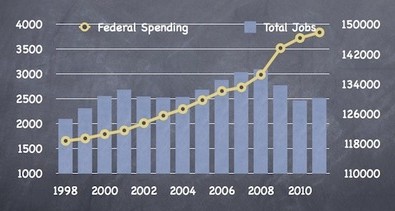
Government Spending Vs Jobs

From Investors Business Daily.

Excerpt:

How amusing to watch Democrats wring their hands over what they can do to get businesses to create jobs, when one of the biggest job killers is the minimum wage they keep hiking.

Recall that it was Democrats who raised the federal wage floor a whopping $2.10 an hour in the middle of the recession. The record 41% increase has led to record unemployment among young people, especially black teens.

Congress started ratcheting up the minimum wage from $5.15 an hour in mid-2007, arguing it would help abate poverty. But retailers looking to slash costs eliminated low-skilled, entry-level jobs rather than pay the mandated increases.

Now 1.5 million fewer teens are working. Last year’s unemployment rate for workers ages 16 to 19 shot up to 26% from 2007’s 15%.

As for black teens, their joblessness soared to a record 43% after the final raise to $7.25 took effect in mid-2009. It helped put more than half of young black men out of work — a first.

The president proposes cranking the minimum wage even higher to $9.50. Then he wants to raise it every year thereafter as a “living wage” indexed to inflation.

Yes, this is the problem that happens when you elect someone who knows nothing whatsoever about economics. And when I say nothing, I mean he is in disagreement with virtually all economists across the ideological spectrum.

A large majority of economists agree

Moderate economist Gregory Mankiw of Harvard University lists the policies that are accepted by virtually all economists.

Here’s Greg’s list, together with the percentage of economists who agree:

  1. A ceiling on rents reduces the quantity and quality of housing available. (93%)
  2. Tariffs and import quotas usually reduce general economic welfare. (93%)
  3. Flexible and floating exchange rates offer an effective international monetary arrangement. (90%)
  4. Fiscal policy (e.g., tax cut and/or government expenditure increase) has a significant stimulative impact on a less than fully employed economy. (90%)
  5. The United States should not restrict employers from outsourcing work to foreign countries. (90%)
  6. The United States should eliminate agricultural subsidies. (85%)
  7. Local and state governments should eliminate subsidies to professional sports franchises. (85%)
  8. If the federal budget is to be balanced, it should be done over the business cycle rather than yearly. (85%)
  9. The gap between Social Security funds and expenditures will become unsustainably large within the next fifty years if current policies remain unchanged. (85%)
  10. Cash payments increase the welfare of recipients to a greater degree than do transfers-in-kind of equal cash value. (84%)
  11. A large federal budget deficit has an adverse effect on the economy. (83%)
  12. A minimum wage increases unemployment among young and unskilled workers. (79%)
  13. The government should restructure the welfare system along the lines of a “negative income tax.” (79%)
  14. Effluent taxes and marketable pollution permits represent a better approach to pollution control than imposition of pollution ceilings. (78%)

You can find out more about how raising the minimum wage increases unemployment, especially for young people and minorities, from this comprehensive, 50-year, government study.

This is why it is important for voters to understand economics. When you raise the price of labor, fewer employers will purchase labor. Supply and demand. This is so basic, that I am surprised that someone as educated as Obama doesn’t understand it. It’s probably because he has virtually no experience working in the private sector.

Only 11% of new Obamacare enrollees were previously uninsured

From the Wall Street Journal.

Excerpt:

Early signals suggest the majority of the 2.2 million people who sought to enroll in private insurance through new marketplaces through Dec. 28 were previously covered elsewhere, raising questions about how swiftly this part of the health overhaul will be able to make a significant dent in the number of uninsured.

Insurers, brokers and consultants estimate at least two-thirds of those consumers previously bought their own coverage or were enrolled in employer-backed plans.

The data, based on surveys of enrollees, are preliminary. But insurers say the tally of newly insured consumers is falling short of their expectations, a worrying trend for an industry looking to the law to expand the ranks of its customers.

About 48 million Americans were uninsured in 2012. The health law is expected to cut 25 million from that total by expanding state-run Medicaid programs and the pool of privately insured people who buy through state marketplaces, also called exchanges.

Only 11% of consumers who bought new coverage under the law were previously uninsured, according to a McKinsey & Co. survey of consumers thought to be eligible for the health-law marketplaces. The result is based on a sampling of 4,563 consumers performed between November and January, of whom 389 had enrolled in new insurance.

One reason for people declining to purchase plans was affordability. That was cited by 52% of those who had shopped for a new plan but not purchased one in McKinsey’s most recent sampling, performed in January. Another common problem was technical challenges in buying the plans, which 30% mentioned.

I thought that the point of Obamacare was to reduce the number of uninsured Americans. Well, I guess if you know 129 million people out of their current insurance, and some of those people who are now uninsured will be obligated by law to buy Obamacare health care plans, then that counts as reducing the uninsured, right? I mean – they were uninsured when you knocked them out of their current health plan, right? It makes sense. Like me robbing you of $500 and then giving you $50 back. Good deal, right?

Previously, the Wall Street Journal reported on how the number of young people enrolling was WAY below estimates, which will increase the losses of the private insurance companies.

Excerpt:

Just under a quarter of the roughly 2.2 million people who signed up for private plans nationwide by Dec. 28 were between the ages of 18 and 34, while one-third were in the 55-to-64 range, just short of the age at which most qualify for Medicare, the federal government program for the elderly.

[…]Under the 2010 Affordable Care Act, consumers no longer pay premiums based on their health risks. To prevent a sharp rise in premiums in 2015 and beyond, carriers say they need strong enrollment from younger people who are likely to be healthier. That would balance out the bills racked up by sicker and older people.

[…]“There’s no way to spin it: Youth enrollment has been a bust so far,” said Brendan Buck, a spokesman for House Speaker John Boehner (R., Ohio). “When they see that Obamacare offers high costs for limited access to doctors—if the enrollment goes through at all—it’s no surprise that young people aren’t rushing to sign up.”

Previously, I blogged about a study that showed that young people have to pay are much higher than pre-Obamacare health plans. That’s why fewer of them are enrolling than the Democrats expected. If the insurance companies take losses on this shortfall, then they will need to be bailed out by the government – and the Obamacare bill provides for this bailout. As it stands right now, Moody’s has downgraded health insurance companies  from stable to negative.

Why is the unemployment rate for young people so high?

A few of the policies that are causing the problem are explained in this article from the American Enterprise Institute. I have highlighted the policies that discourage employers in the snippet I excerpted below.

Excerpt:

If Washington is serious about helping this vulnerable population, it should focus on increasing workers’ take home pay and lowering the business employment costs. Conventional wisdom preaches increasing minimum wages. But a far more effective policy would be to simply exempt younger workers and their employers from paying taxes related to their employment.

People in the workforce typically get their start when they are young – beginning with some entry level job where they learn basic job skills, develop effective work habits, and earn a modest wage. This important first step gives them a chance at earning wages and achieving a level of success that facilitates advance up the economic ladder. Work habits and skills are generally learned early in life or unfortunately for too many, not learned at all.

The long term damage caused by this lack of employment is very large. Income mobility has declined. The sad fact is the probability of people at the bottom moving up the income ladder is lower than it was 20 and 30 years ago. Many studies have demonstrated that three factors determine most of the difference between those who start in poverty and stay there and those who don’t – finishing high school; avoiding becoming a teenage parent, and getting a full-time job. Those who do all three have only a 2 percent chance of living in poverty and a 75 percent chance of joining the middle class.

Many economists and social scientists have suggested both demand and supply reasons why youth unemployment is so high. On the demand side, the national safety net – Food Stamps, Earned Income Tax, welfare and subsidy programs of all kinds – substantially reduce the relative benefit of working. In other words, the wage premium for working versus taking advantage of benefit programs on an after-tax basis is simply too small to encourage many people to work.

If a young person enters the work force at the minimum wage, he grosses $7.25 per hour. From this, in a place like Los Angeles, he pays federal and state income taxes and Medicare and Social Security payroll taxes which total $1.11. So, out of the $7.25 earned, he keeps just over $6. If he is single and without children, he won’t qualify for the Earned Income Tax Credit (EITC) or food stamps.

On the supply side, the cost of employing young people is high relative to their economic contribution to potential employers. An entry-level employee costs his employer much more than $7.25. In addition to his wages, the employer also pays Social Security and Medicare taxes, plus unemployment insurance, that add on an average of 92 cents. So today, the new employee costs the business $8.13 per hour, of which the young employee keeps only three-quarters.

This cost will increase further when the Affordable Care Act kicks in. Beginning in 2015, if the employer has more than 50 employees, he will have to provide health insurance for full-time workers or pay a $2,000 fine – which comes to $.96 per hour. That will make an abysmal employment situation even worse.

Overall, public policy ought to be aimed at encouraging businesses to create entry level jobs. Perversely, attempts to increase the minimum wage and institute so-called living wages would do the exact opposite. If government wanted to help create a permanent economic underclass, it would implement exactly the policies that are in place. All of us who want people to enjoy earned success ought to be outraged at these government policies.

This is important, because very often the policies proposed by people on the left are not designed to solve the problem. Thomas Sowell argues that the real purpose of leftist policies is for leftist leaders to feel self-important by getting applause from those who are economically ignorant. They push policies that sound good but that don’t actually work.

The good news is that young people are waking up. According to a Harvard University survey, 57% of young adults now disapprove of Obamacare. Even they are starting to think about what is happening to them. Maybe they can avoid the slavery that awaits them under the Democrat’s massive program of intergenerational theft, but I’m not optimistic. They have really short attention spans, and you don’t learn the fundamentals of economics on Instagram and Pinterest.