Tag Archives: Wisdom

Are Christians responsible for making plans and making good decisions?

Here’s a wonderful post on decision making and the will of God posted on Neil’s blog. In his post, Neil explains the Biblical model for making good decisions.

Excerpt:

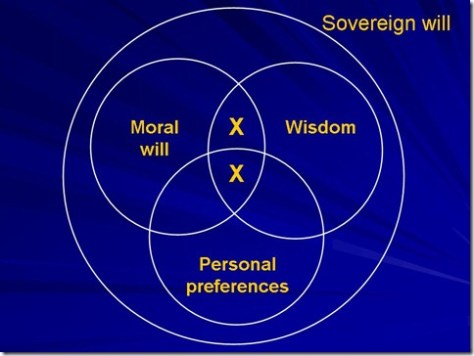
Really short version: Aside from direct and clear personal revelation from God, you don’t have access to his sovereign will when making decisions.  Therefore you must look at other factors.  If it isn’t moral, don’t do it.  If it is moral but not wise, don’t do it.  If it is moral and wise, then use your personal preferences.

Using this model you can end up with a wise and biblical decision, but you have avoided the traps of the “God told me to ____” routine.  People who run around saying that God told them this and that convey a super-spirituality that can leave less mature believers wondering if they really have a relationship with God (i.e., “God doesn’t tell me every little thing to do, so maybe I don’t really know him.”).

He has a helpful picture posted as well:
This is actually a very important topic for me, because I like making plans and making good decisions. I like being the quarterback or squad leader of my own life. I like to pick objectives and then make plans to achieve them. (Nothing too exotic, just simple stuff like saving money or reading more books)

Actually, I really oppose the idea that God has a magical fairy tale will for each person that will make them happy and fulfilled. For me, life isn’t like that. I don’t expect God to lead me along like a child at a scavenger hunt. I expect to survey the battlefield where I am and then do something to make a difference. There are lots of things you can do that will please God. Should you focus on your career and sponsor apologetics conferences? Or should you use your spare time preparing Sunday school lessons? There are lots of good things you could do to please God. Your job is to pick the one that will be the most effective. It doesn’t matter if it makes you happy, it only matters if it’s effective and if you are good at it.

Who is Rifleman Dodd?

A while back, I was busily working my way through the U.S. Marine Corps Official Reading List, and I came across a book by C.S. Forester called Rifleman Dodd, or alternatively titled Death to the French. It’s a work of historical fiction that takes place during the Napoleonic wars. The story is about a British marksman named Dodd, who is cut off from his own lines during a withdrawal maneuver. He is subsequently left to fend for himself behind enemy lines. An ordinary man might be full of despair and forget about his mission entirely. But Dodd is no ordinary man. Not only does he find a way to survive by finding food to eat, water to drink and places to sleep, but he also tries to remember his orders and to think about what he can do to advance the cause of his General, the Duke of Wellington.

Here’s an excerpt from a gritty book review:

It’s about a green-coated British infantry rifleman in the Napoleonic Wars, an age when rifles were a novelty and most of the army was red-coated and carried muskets. Private Matthew Dodd gets separated from his regiment during a retreat and finds himself stranded behind enemy (French) lines in Portugal. With the occasional aid of some natives, but mostly on his own, he harasses the French with his rifle and tries to prevent them from building a bridge across the Tagus River. It’s a remarkable tale of survival and solitary achievement, of a rank-and-file soldier who lives by his wits and slowly learns to make plans without orders, and shows leadership qualities and a knowledge of warfare.

I think we’re in the same situation as Dodd.

There is no point in us looking for breadcrumb trails to happiness at this point. That’s not the point of Christianity. The point of Christianity is friendship with God, imitation of Christ, honoring moral obligations, self-sacrificial love for your neighbor (and even your enemies!), and dedication to the truth – whether anyone else likes you or not. It’s not supposed to make you happy, and it’s not necessarily going to be a normal life like everyone else has. Things may not work out the way you’d like them to.

We seem to be making such a big deal about compassion and forgiveness in the Christian life these days – such a big emphasis on our feelings. Almost like we have forgotten that we have obligations to our friend. A relationship doesn’t mean that one person does whatever they feel like, completely disregarding the character and goals of the other person and then is automatically granted forgiveness whenever they want it. That’s not a friendship – that’s using someone else for your own ends.

For a lot of people today, Christianity only comes into play after you’ve made a mistake and you’re feeling guilty. For example, suppose you decide to go to a party with your secular friends, then you drink too much, and you do something sexual that you shouldn’t have done. Or maybe you watched some prosperity gospel preacher on TV, then made irresponsible business decisions thinking that God would bail you out and make you rich, and you went bankrupt. Most people think Christianity is for this situation: you’re a Christian so that you don’t have to feel guilty about sin. And so that you can tell people that God forgives you, so that they can’t think anything bad about you, either. You sort of get your idea about what you should be doing in order to feel good from the culture, and God is just there to forgive it all when it blows up in your face.

But in my case, putting myself in a situation like that is not even possible. I’m more likely to try to plan to do something for God. Like, I might try to mentor a young Christian by sending them books. Or, I might try to teach a class in apologetics at my church. These are things that are for God, not for me. I’m not just being dragged along by the culture, and trying to find happiness by feeling good (e.g. – with alcohol) or being liked by non-Christians. And if my plans fail because the mentoree doesn’t grow up into anything, or nobody comes to my apologetics class, that’s when I go to God and say “I screwed up. but can I still be in your army?” And God always says yes to that. You don’t have to be the best player on the team for the Coach to like you. He already likes you.

One of the great things about being a Christian is that you can never lose your identity as a Christian by failing to do something for him that you planned to do. That’s what forgiveness is for. If you set out to do something for God’s glory, and you mess it all up, that’s OK. But I do think that, like Dodd, our ambition should not be about just making ourselves happy, or making non-Christians like us. We should be trying to make plans and carry them out for God.

That’s how I understand forgiveness. It’s not just something that’s there for you to use to fix your feelings when you’ve been irresponsible while seeking your own happiness in secular ways. It’s also there when you’re trying to do something good for God, and you fail. A lot of times in life you try your best, but you fail, and then you lose something that you really wanted. With God, when you try your best for his glory, and fail, you don’t lose your identity as a member of his team. I think that not losing your identity in Christ is even more important than not feeling guilty about selfish decision making.

So, have you got a plan to serve your General? Let’s focus more on what operations we’re planning for God than on being happy and being popular with non-Christians. Your life should not be all about you, with God just there to make your bad feelings go away. Your life should be about God’s goals and God’s interests.

Lori Alexander is right: serious Christian men prefer debt-free virgins without tattoos

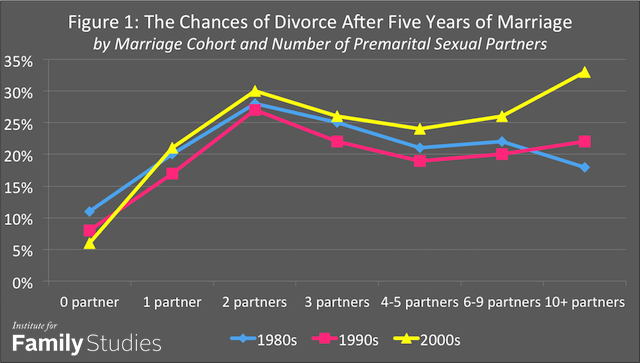
Marriage stability vs sexual partners,(Teachman et al. JAMF, August 2010)

Christian writer Lori Alexander recently wrote a blog post (H/T Lindsay) urging Christian women to do 3 things:

  1. be a virgin before marriage
  2. be debt-free before marriage
  3. don’t get any tattoos

She also urged women to be cautious about college, because it often gets them into debt. I disagree with her a little here. I always urge young women to earn a STEM degree in college, then work a few years to pay off their loans (if any) before marrying. This is because women, like men, need to have the experience of doing something hard that they don’t “feel” like doing, in order to grow. STEM degrees teach young people that the world doesn’t revolve around them, and that their feelings don’t matter when trying to solve a problem in the real world. It’s a very useful way for women and men to break themselves out of the desire for free and easy happiness that is so common in our time.

Lori’s article drew enormous opposition from both secular and Christian sources. So far, the only people defending her are men’s rights sites, like Dalrock (Christian) and Spawny (non-Christian). Every other “Christian” blog or news site that I read disagreed her article, and argued that premarital sex was no big deal, that having debt was no big deal, and that having tattoos was no big deal.

Let’s take a look at her three points, then I’ll explain why her article is largely correct, and why she is correct about what she asserts about the criteria that godly men have for women.

Even one non-husband premarital sex partner raises risk of divorce

Virginity

Regarding her first point, virginity is commanded by the Bible, it’s in line with peer-reviewed studies on marriage quality and stability. The reason that people find this difficult is that they want the freedom to give in to sexual desires without feeling shame. They want to believe that there is no permanent effect. It doesn’t help that parents and pastors are terrified of telling young people, and young women in particular, that promiscuity harms marital stability. Right now, the culture is drowning in feminism. Feminism tells women that the traditional male roles of provider, protector, and spiritual leader are “sexist”. The “best” men are good-looking pro-abortion bad boys. If a Christian woman is not able to think through the meaning of sex with respect to marriage enough to control herself, it seriously harms the stability of her future marriage.

Starting and Mid-Career salaries by profession (click for larger image)

Debt-free

Regarding her second point, almost everything a serious Christian man might plan to do for Christ with his marriage is impacted by finances. From education, to marriage timing, to number of children, to home ownership, early investment, to the success of children. to age of retirement. Less money means fewer choices, and less ability to counter challenges. Think of how important money for legal defense is to Christian-owned businesses who are being persecuted, for example. The reason that many people find the Bible’s teaching on stewardship difficult is that they don’t want to exercise self-control with money if they don’t feel like it. They want to waste money seeking fun and thrills, and then act like their poverty could not be avoided. Being debt-free is an indicator of practical wisdom and self-control in a woman.

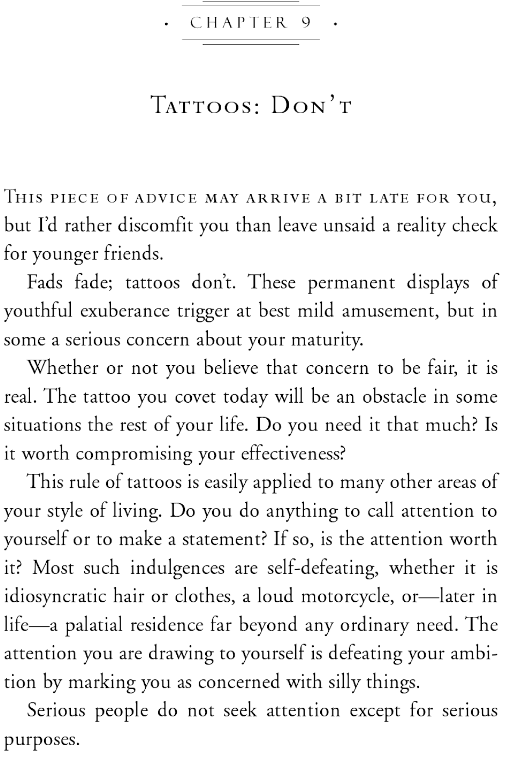
Hugh Hewitt's "In, But Not Of", Chapter 9: Tattoos, Don't
Chapter 9 of Hugh Hewitt’s “In, But Not Of: A Guide to Christian Ambition”

Tattoos

Tattoos are a problem for serious Christian men for several reasons. First, they cost money and for no gain, and can even cause you losses in your career. Second, most people get them because of low self-esteem or vanity or to look rebellious or to look dangerous. None of these motivations should be acted upon by someone with a robust Christian worldview. The money could be better used on charity, or investments, etc. Women show what their priorities really are by how they spend their money and time. Show me a woman’s bookshelf, and I’ll tell you how seriously she has thought about what it means to be a Christian in all areas of life. Instead of showing me your tattoos to demonstrate your “spirituality”, show me your apologetics books, to demonstrate your intellectual engagement. And tell me how you used that information to engage in conversations with educated non-Christians to answer their challenges to your faith. That way I’ll know that you use your money to train do hard things in order to have an influence for Christ in serious, practical, effective ways. A woman who can defend her faith and discuss Christianity with non-Christians is demonstrating her ability to raise Christian children in a secular society.

A family praying and reading the Bible

The goal of marriage is to serve God

Today, young people have been taught to follow their hearts, and to deny that there is any authority or practical wisdom that should govern their decisions. They always imagine themselves to be exempt from moral rules, statistics, cause and effect, etc. They think they know better than everyone else – even though they do almost no research on their own. Every adviser who tells them to study computer science instead of creative writing is wrong. Their same-age friends know more about what causes divorces than peer-reviewed research papers. And money should be spent on skydiving and zip-lining, regardless of what financial experts like Dave Ramsey might say.

A woman who has made many mistakes cannot fix those mistakes with words. Rationalizations, evasions, and blame-shifting do not work to show that there has been real repentance. The man can only assess whether grace has caused any real re-prioritization of goals by evaluating her outward actions over a long period of time. Furthermore, if a woman who has made mistakes attacks those who correct her from Bible’s teachings on chastity, stewardship, etc., then it’s a sign that there is no real repentance.

Choosing a wife wisely doesn’t mean that Christian men treat OTHER Christian women poorly. Christian men love all the Christian women. We care for them and support them. But when a man chooses a wife, he is choosing someone who will have more influence on his ability to serve God than anyone else. In my case, the goals for my marriage involve making a difference with apologetics in the church, having many children who will receive the educations and careers they need to have an influence, influencing government to promote Christian-friendly policies, charitable giving, mentoring young Christians, modeling a good marriage to others, and having a home that can serve to host discussions about issues that matter. These things are not free – they take careful planning and execution to achieve.

Lori’s advice is  intended for men who are serious about making their marriage produce a return for God. Men who are chaste themselves. Men who accept the Bible as an authority. Men who earned STEM degrees, instead of easy nonsense degrees that don’t lead to good careers. Men who earn 6-figure salaries, who buy houses for cash, and who are on track have a 7-figure net worth by age 50. Men who made good decisions cannot risk marrying someone who hasn’t prepared for marriage. The wrong woman in the home could ruin the man’s effort to produce a marriage that gives glory to God.

Not every man intends to achieve something for God with his marriage, but those who do need to choose a woman who has demonstrated ability at doing the job. For example, if the job requires marital fidelity, then chastity is a good indicator that the woman has the necessary self-control. If the job requires frugality, and practicality, then being debt-free, having a STEM degree, and having some private sector work experience are good indicators that she’s qualified for the role. Nothing valuable in life is ever been achieved by being lazy, wild and irresponsible. Serious Christian men look for wives who have applied themselves to difficult tasks that they didn’t feel like doing, who achieved success by remaining committed to the plan, in spite of their unhappy feelings and unmet desires.

We have a problem in the church such that we aren’t serious about teaching young people to develop marriage-ready character and to make serious plans for marriage. We are teaching them to follow their hearts, and that their feelings and desires are clues about God’s will for their happiness. We are teaching them to be uncomfortable with responsibilities, expectations and obligations to others. We are teaching them not to do their own research. We are teaching them not to make practical, wise plans. We are teaching them to ATTACK those who try to get them to be serious about doing what is likely to work. This approach is not working.

My own criteria for a wife are more demanding than Lori’s. My advice there is only for serious Christian men who want their marriage to serve God.

The surprising pro-masculinity message in the “Far From the Madding Crowd” film

Man helping a woman with proper handgun marksmanship

So, I have about a half-dozen older and/or experienced Christian women who advise me and assist me in various ways. The wisest and most experienced is calm and thoughtful Dina. She has a very stressful job dealing with demanding women, and what she admires most in men is “masculinity”, which she defines as a man’s ability to tell a woman what is right and wrong, what God expects from her, what she should be doing with her life, and guiding her and providing for her through the steps to get there.

What makes Dina angry is when a man makes a fool of himself for youth and beauty, abdicating his role as moral and spiritual leader because of attraction / lust. According to Dina, men who have self-control think about what a woman should do that is morally right, with the goal of her producing a return for God. Men who are swayed by youth and beauty are willing to give up that leadership role in exchange for attention and/or sex.

So, with that said, Dina asked me to watch a recently-made movie called “Far From the Madding Crowd“, based on a novel by Thomas Hardy. I immediately said “no” because I know about Thomas Hardy from Tess of the D’Urbervilles, where he presents Tess as the helpless victim of Providence. I really hate that view of women, where they can do reckless, selfish things and then blame everyone but themselves for the destructive consequences of their own free-will decisions. But Dina said “wasn’t I right about the debate between David Robertson and Matt Dillahunty?” I said yes, and watched the movie. And of course, she was right, as she almost always is. This movie is a punch in the face to the radical feminism that seems to have infected so many young women, even in the church.

Here is a review of the movie by Rebekah, posted at her blog. Unfotunately, the post has been deleted, but here is an excerpt.

Rebekah writes:

What does this 19th century tale offer to modern audiences?  This latest rendering emphasizes something actually surprising and unexpected given that it is made in our age of radical feminism.  It is Gabriel Oak’s character that shines the most, not the proto-feminist Bathsheba.  […]In Bathsheba and Gabriel we see how men and women support one another in such a way as to ensure a flourishing in any role that fate might thrust on them.

[…]The relationship between Gabriel and Bathsheba, though unequal in earthly terms of authority and wealth, is one of mutual dependence.  We see Oak taking on a role of both counselor and conscience with Bathsheba – roles that in her striving towards independence she struggles to admit her need for.  She is not unlike the modern feminist in this regard, nor is she unlike all of us in our relationship with the Lord.  Her struggle is best seen in the various times she repels Gabriel only to find herself in desperate situations in which only he can help.  The filmmakers’ clever use of a recurring theme of Bathsheba galloping after Gabriel on a horse when he is needed is particularly moving (and surprising) here.  In the end, the film resists the urge to pander to our more extreme modern views on what women require to thrive.

Gabriel Oak also seems to be an embodiment of the biblical virtue of selflessness.  We see in his actions towards Bathsheba the Philippians admonition to refrain from “being motivated by selfish ambition or vanity,” but rather “in humility, be moved to treat one another as more important than yourself.” Indeed, vanity itself can be seen as a fateful character flaw of every major character apart from Gabriel.  He alone is able to move past rejection and carry on.  In fact, he is required to go so far as to be under the authority of the very woman who rejected his offer of marriage and, despite his continuing affections for her, witness her being courted and then married by another far less worthy man, Frank Troy.  No other major character is able to accomplish this challenge to their pride.  Though Bathsheba does eventually overcome the rejection of her husband, she only does so after tremendous tragedy and with the selfless and steady support of Gabriel.

Gabriel respects her independence, but, like a good shepherd, stays close by to protect and guide her.  Though he cannot protect her from her free-will choices, he does warn her.  He then remains faithful to her in the midst of the trouble she brings upon herself.  In this, he is not unlike our God, for he allows her to stray, all the while letting her know of a better course when asked.  And, she does ask.

In an important scene at a party, where Bathsheba must decide whether or not to marry a particularly obsessive suitor, when she asks, “Tell me what to do, Gabriel,” he simply tells her to “Do what is right.”  Is that not like our Lord?  Gentle shepherd, indeed, for our wild, independent hearts.  In this, I see Gabriel as most suitable for the role as the husband written of in the epistle to the Ephesians.  He loves Bathsheba “just as Christ loved the church and gave himself for her…”

Men and women both struggle with self-centeredness, but men usually work themselves out of it by studying hard things in school, and doing hard work that pays. Men have a natural desire to provide for others, and it is actually a duty laid out for them in the Bible. As a result of studying and working at things they don’t like, men typically are better at resisting their feelings and desires. In fact, if you ever want to make a woman less self-centered and emotional, leading her to study STEM and work a demanding job is a good plan. Dina has multiple STEM degrees, and a very difficult, challenging work history.

I would be suspicious of men who don’t prioritize providing, (as in 1 Tim 5:8), because working and saving gives a man practical experience at self-denial. When a man gets accustomed to working to share with others, it helps helps him to lead a woman to do the same: deny her feelings and desires, and make prudent decisions that will allow her to love and serve others – including God – in a sustainable way. Over the long-term, this practice of effective, self-sacrificial love will be worth more to the woman than the short-term pursuit of fun and thrills. To provide for a woman means to look into her future, and make a decision today to set aside something that will help her to deal with what the future has in store for her.

Dina’s advice to young women

I asked Dina to take a look at the draft of this post before I hit “Schedule” and Dina said:

What I would advise to all young women is not to expect a Gabriel Oak to be waiting for you at the end of your reckless years of hooking up, partying and wasting your youth on fun and men who have no desire to lead you to God or guide you to goodness. Don’t expect the hot stud that your friends approve of to turn into someone with the character of Oak with the magic powers of your premarital sex life. Find a man who doesn’t give in to your every whim, because if he does, you will only resent him for it, and blame him, for being what you thought you wanted him to be.  Find a man who leads, one who demonstrates self control, self denial, who can provide and protect. And most importantly, respect him for doing it.

Emphasis mine.

Sound advice from the Dina, young ladies. By the way, Dina’s favorite drama is the BBC production of “North and South” from 2004. I also give it a 10/10.