The problem with the Obama administration is that they keep making policy based on their intentions, instead of known results. They’ve allocated nearly 39 billion for green energy subsidies – that’s as much money as the entire annual Minnesota state budget. That’s a lot of money being taken away from job creators in the private sector.
So what can we learn about “green energy” from other countries? Is it good value for the money?
Well, we know that in Spain, the green jobs programs failed.
Excerpt:
Subsidizing renewable energy in the U.S. may destroy two jobs for every one created if Spain’s experience with windmills and solar farms is any guide.
For every new position that depends on energy price supports, at least 2.2 jobs in other industries will disappear, according to a study from King Juan Carlos University in Madrid.
U.S. President Barack Obama’s 2010 budget proposal contains about $20 billion in tax incentives for clean-energy programs. In Spain, where wind turbines provided 11 percent of power demand last year, generators earn rates as much as 11 times more for renewable energy compared with burning fossil fuels.
The premiums paid for solar, biomass, wave and wind power – – which are charged to consumers in their bills — translated into a $774,000 cost for each Spanish “green job” created since 2000, said Gabriel Calzada, an economics professor at the university and author of the report.
“The loss of jobs could be greater if you account for the amount of lost industry that moves out of the country due to higher energy prices,” he said in an interview.
The Heritage Foundation cites a study from Denmark, which shows that wind power has also failed.
Excerpt:
But according to a new study from the Danish Centre for Political Studies (CEPOS), commissioned by the Institute for Energy Research, the road to increased wind power is less traveled for a reason. The study refutes the claim that Denmark generates 20 percent of its power from wind stating that its high intermittency not only leads to new challenges to balance the supply and demand of electricity, but also provides less electricity consumption than assumed. The new study says, “wind power has recently (2006) met as little as 5% of Denmark’s annual electricity consumption with an average over the last five years of 9.7%.” Furthermore, the wind energy Denmark exports to its northern neighbors, Sweden and Norway, does little to reduce carbon dioxide emissions because the energy it replaces is carbon neutral.
The study goes on to say that the only reason wind power exists in Denmark is “through substantial subsidies supporting the wind turbine owners. Exactly how the subsidies have been shared between land, wind turbine owners, labor, capital and its shareholders is opaque, but it is fair to assess that no Danish wind industry to speak of would exist if it had to compete on market terms.”
But there’s a cost involved. When government spends more money, it necessarily diverts labor, capital and materials from the private sector. Just like promises are made in the United States about green jobs creation, the heavily subsidized Danish program created 28,400 jobs. But “this does not, however, constitute the net employment effect of the wind mill subsidy. In the long run, creating additional employment in one sector through subsidies will detract labor from other sectors, resulting in no increase in net employment but only in a shift from the non-subsidized sectors to the subsidized sector.”
And because these resources are being diverted away from more productive uses (in terms of value added, the energy technology underperforms compared to industrial average), “Danish GDP is approximately $270 million lower than it would have been if the wind sector work force was employed elsewhere.”
And the libertarian Cato Institute doesn’t think that any renewal energy program will work.
Excerpt:
A multi-billion-dollar government crusade to promote renewable energy for electricity generation, now in its third decade, has resulted in major economic costs and unintended environmental consequences. Even improved new generation renewable capacity is, on average, twice as expensive as new capacity from the most economical fossil-fuel alternative and triple the cost of surplus electricity. Solar power for bulk generation is substantially more uneconomic than the average; biomass, hydroelectric power, and geothermal projects are less uneconomic. Wind power is the closest to the double-triple rule.
The uncompetitiveness of renewable generation explains the emphasis pro-renewable energy lobbyists on both the state and federal levels put on quota requirements, as well as continued or expanded subsidies. Yet every major renewable energy source has drawn criticism from leading environmental groups: hydro for river habitat destruction, wind for avian mortality, solar for desert overdevelopment, biomass for air emissions, and geothermal for depletion and toxic discharges.
Current state and federal efforts to restructure the electricity industry are being politicized to foist a new round of involuntary commitments on ratepayers and taxpayers for politically favored renewables, particularly wind and solar. Yet new government subsidies for favored renewable technologies are likely to create few environmental benefits; increase electricity-generation overcapacity in most regions of the United States; raise electricity rates; and create new “environmental pressures,” given the extra land and materials (compared with those needed for traditional technologies) it would take to significantly increase the capacity of wind and solar generation.
A recession is not the time to be making policies based on what sounds nice. We need to do what works in a recession.
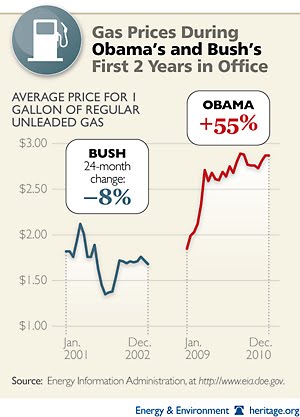
An all-of-the-above, drill-here-drill-now policy would increase supply at a time when demand for oil is growing in India and China. Increasing domestic supply would create jobs and lower energy prices – an excellent thing to do in a recession. But Obama is busy putting in drilling moratoriums and subsidizing green energy, instead. We elected someone who thought that “climate change” was a justification for raising electricity rates would necessarily skyrocket. He is fine with electricity prices skyrocketing. And that’s what we’ve gotten from him.
Be effective and influential:

 WINTERY KNIGHT