Tag Archives: Western Civilization

Does the Bible teach a flat Earth?

Here’s an article from Jeffrey Burton Russell.

Excerpt:

It must first be reiterated that with extraordinary few exceptions no educated person in the history of Western Civilization from the third century B.C. onward believed that the earth was flat.

A round earth appears at least as early as the sixth century BC with Pythagoras, who was followed by Aristotle, Euclid, and Aristarchus, among others in observing that the earth was a sphere. Although there were a few dissenters–Leukippos and Demokritos for example–by the time of Eratosthenes (3 c. BC), followed by Crates(2 c. BC), Strabo (3 c. BC), and Ptolemy (first c. AD), the sphericity of the earth was accepted by all educated Greeks and Romans.

Nor did this situation change with the advent of Christianity. A few–at least two and at most five–early Christian fathers denied the sphericity of earth by mistakenly taking passages such as Ps. 104:2-3 as geographical rather than metaphorical statements. On the other side tens of thousands of Christian theologians, poets, artists, and scientists took the spherical view throughout the early, medieval, and modern church. The point is that no educated person believed otherwise.

Historians of science have been proving this point for at least 70 years (most recently Edward Grant, David Lindberg, Daniel Woodward, and Robert S. Westman), without making notable headway against the error. Schoolchildren in the US, Europe, and Japan are for the most part being taught the same old nonsense. How and why did this nonsense emerge?

In my research, I looked to see how old the idea was that medieval Christians believed the earth was flat. I obviously did not find it among medieval Christians. Nor among anti-Catholic Protestant reformers. Nor in Copernicus or Galileo or their followers, who had to demonstrate the superiority of a heliocentric system, but not of a spherical earth. I was sure I would find it among the eighteenth-century philosophes, among all their vitriolic sneers at Christianity, but not a word. I am still amazed at where it first appears.

No one before the 1830s believed that medieval people thought that the earth was flat.

The idea was established, almost contemporaneously, by a Frenchman and an American, between whom I have not been able to establish a connection, though they were both in Paris at the same time. One was Antoine-Jean Letronne (1787-1848), an academic of strong antireligious prejudices who had studied both geography and patristics and who cleverly drew upon both to misrepresent the church fathers and their medieval successors as believing in a flat earth, in his On the Cosmographical Ideas of the Church Fathers (1834). The American was no other than our beloved storyteller Washington Irving (1783-1859), who loved to write historical fiction under the guise of history. His misrepresentations of the history of early New York City and of the life of Washington were topped by his history of Christopher Columbus (1828). It was he who invented the indelible picture of the young Columbus, a “simple mariner,” appearing before a dark crowd of benighted inquisitors and hooded theologians at a council of Salamanca, all of whom believed, according to Irving, that the earth was flat like a plate. Well, yes, there was a meeting at Salamanca in 1491, but Irving’s version of it, to quote a distinguished modern historian of Columbus, was “pure moonshine. Washington Irving, scenting his opportunity for a picturesque and moving scene,” created a fictitious account of this “nonexistent university council” and “let his imagination go completely…the whole story is misleading and mischievous nonsense.”

But now, why did the false accounts of Letronne and Irving become melded and then, as early as the 1860s, begin to be served up in schools and in schoolbooks as the solemn truth?

The answer is that the falsehood about the spherical earth became a colorful and unforgettable part of a larger falsehood: the falsehood of the eternal war between science (good) and religion (bad) throughout Western history. This vast web of falsehood was invented and propagated by the influential historian John Draper (1811-1882) and many prestigious followers, such as Andrew Dickson White (1832-1918), the president of Cornell University, who made sure that the false account was perpetrated in texts, encyclopedias, and even allegedly serious scholarship, down to the present day. A lively current version of the lie can be found in Daniel Boorstin’s The Discoverers, found in any bookshop or library.

The reason for promoting both the specific lie about the sphericity of the earth and the general lie that religion and science are in natural and eternal conflict in Western society, is to defend Darwinism. The answer is really only slightly more complicated than that bald statement. The flat-earth lie was ammunition against the creationists. The argument was simple and powerful, if not elegant: “Look how stupid these Christians are. They are always getting in the way of science and progress. These people who deny evolution today are exactly the same sort of people as those idiots who for at least a thousand years denied that the earth was round. How stupid can you get?”

But that is not the truth.

What’s scary about this is that I have actually debated with atheists who have cited Bugs Bunny cartoons showing the Columbus flat-Earth scene as an authority for this persistent myth. I think it’s safer to stick with a historian. Dr. Russell has written a book about “The Myth of the Flat Earth” and he has also been published by Oxford University Press and Cornell University Press and Princeton University Press – unlike the Bugs Bunny cartoon artists.
On wargames, history and heroes: “this story shall the good man teach his son”

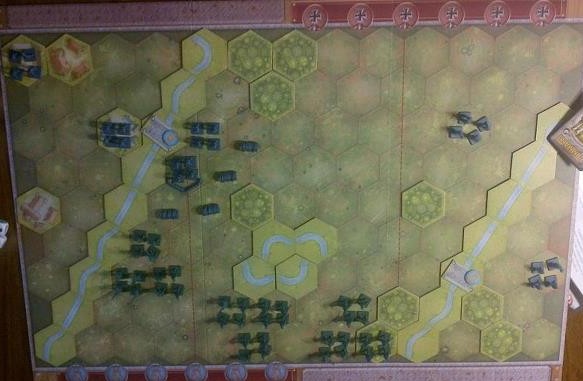
Memoir '44: Pegasus Bridge setup
Memoir ’44: Pegasus Bridge setup

Last night, I played through the Pegasus Bridge scenario from the Memoir ’44 wargame with Dina a few times. We actually played the online version of the game, using Steam. She was very gracious to play a wargame with me, which I don’t think is necessarily the first thing on most women’s lists of things to do on a Thursday night! I appreciated her agreeing to learn how to play and then playing with me several times. I think that Christians need to plan and execute more “together” activities like that – activities that involve interaction, co-operation, communication and engagement. We try to avoid doing things where we are both spectators. Playing wargames is not the only thing we do – we also do Bible study and cooking lessons (for me), for example.

Anyway, the point of this post is to express the deeper meaning behind playing wargames. I think that it is important to recognize and celebrate those who have demonstrated good character, whether it be now, or in the past. I think that it is important for us to search out the best role models ourselves, so that they will influence the way we act in our own lives. The second world war was a clear example of good versus evil. Anyone on the Allied side who demonstrated bravery and courage should be celebrated for safeguarding the security, liberty and prosperity that we enjoy today. In the case of Pegasus bridge, the hero is Major John Howard of the British paratroops.

Here is a quick re-cap of his exploits that day from the New York Times:

Maj. John Howard, the commander of glider-borne British infantrymen who seized the strategically vital Pegasus Bridge in the first battle of the D-Day invasion of Normandy, died Wednesday in a hospital in Surrey, England. He was 86 and had lived in Burford, near Oxford.

Under cover of night on June 6, 1944, six gliders carrying 181 officers and men of the Second Oxfordshire and Buckinghamshire Light Infantry landed on the eastern flank of a 60-mile invasion front on the northern coast of France. The regiment had a heritage going back to the battles of Bunker Hill and New Orleans, to Waterloo and to World War I. Now its soldiers were in the vanguard of the invasion of Hitler’s Europe.

Major Howard’s D Company was ordered to seize two bridges, one over the Caen Canal and the other spanning the parallel Orne River. If the Germans held on to those bridges, panzer units could move across them in a counterattack isolating 10,000 British paratroopers jumping behind the British invasion beach known as Sword, where infantry forces would arrive at daybreak. And Major Howard’s men sought to strike swiftly to prevent the Germans from blowing up the bridges if they were overwhelmed; the British needed those bridges to resupply their airborne units.

British Halifax bombers towed the gliders over the English Channel, then cut them loose.

Major Howard’s lead glider landed at 12:16 A.M., only 50 yards from the Caen Canal bridge, but the glider’s nose collapsed on impact, knocking everybody aboard unconscious for a few seconds. The soldiers quickly emerged, and over the next five minutes the men directly under Major Howard killed the surprised German defenders.

The nearby Orne River bridge was captured by other troops in Major Howard’s unit, and soon the words ”Ham and Jam,” signifying mission accomplished, were radioed to the airborne.

Two British soldiers were killed and 14 wounded in the operation.

Over the next 12 hours, British paratroopers and commandos reinforced Major Howard’s men, and British forces were able to move toward the city of Caen, their flank having been protected by the capture of the bridges.

On July 16, Major Howard received the Distinguished Service Order, Britain’s second-highest award for valor. On the 10th anniversary of D-Day, he received the Croix de Guerre Avec Palme from the French Government, which had renamed the Caen Canal span Pegasus Bridge, for the flying horse symbolizing the British airborne. The road crossing the bridge was later renamed Esplanade Major John Howard.

Why is this important? Well, it’s important to think on the things that are excellent. There are so many things in the culture that are not excellent that we are confronted with every day. We have to make it our business to do things together where goodness is celebrated. Especially when manly virtues like courage are celebrated. We don’t do that much anymore. And I think there’s a connection between wargames and Christian apologetics that we need to deliberately encourage.

Here’s an excellent passage from Shakespeare’s “Henry V” that makes the point:

This day is called the feast of Crispian:
He that outlives this day and comes safe home,
Will stand a tip-toe when this day is named,
And rouse him at the name of Crispian.
He that shall live this day, and see old age,
Will yearly on the vigil feast his neighbours,
And say, ‘To-morrow is Saint Crispian:’
Then will he strip his sleeve and show his scars,
And say, ‘These wounds I had on Crispin’s day.’
Old men forget: yet all shall be forgot,
But he’ll remember with advantages
What feats he did that day. Then shall our names,
Familiar in his mouth as household words,
Harry the King, Bedford and Exeter,
Warwick and Talbot, Salisbury and Gloucester,
Be in their flowing cups freshly remembered.
This story shall the good man teach his son;
And Crispin Crispian shall ne’er go by,
From this day to the ending of the world,
But we in it shall be rememberèd;
We few, we happy few, we band of brothers;
For he to-day that sheds his blood with me
Shall be my brother; be he ne’er so vile
This day shall gentle his condition:
And gentlemen in England, now a-bed
Shall think themselves accursed they were not here,
And hold their manhoods cheap whiles any speaks
That fought with us upon Saint Crispin’s day. (4.3.43)

This is from the famous speech in which King Henry charges his men to fight well before the famous Battle of Agincourt.

You can read more about the history of the British Airborne division and Pegasus bridge. The famous historian of the second world war Stephen E. Ambrose also wrote a history of the Pegasus bridge battle, called “Pegasus Bridge: June 6, 1944“. You won’t find many military historians better than Stephen E. Ambrose!

You might be surprised how many men are interested in military history and wargames, precisely because men instinctively look up to men like John Howard who embody qualities like bravery and courage. We have a dearth of moral character in this society. And we don’t do much to teach young men about manly virtues, even in the church. I think that it is important for us to think of creative ways for us to present good character to our young men. Young women should also learn about good character, because they must separate out the good men from the bad when they are courting.

Thanks to Dina for helping me to edit this post!

Arthur Brooks: true fairness means rewarding merit, not spreading the wealth

Arthur Brooks is an economist, a Christian and the President of my third favorite think tank, the American Enterprise Institute. He has been making a push lately to convince conservatives to become more articulate when making the case for the free enterprise system. One of his major ideas is that happiness is not related to the amount of money you have, but it’s related to how well you can achieve your own prosperity and independence by your own labor. His research shows that people are happiest when they feel in control of their own prosperity, even if they have less wealthy than people who depend on the government to take money away from others so they don’t have to work.

Here’s an article he posted on AEI entitled “True fairness means rewarding merit, not spreading the wealth”.

Excerpt:

There are two main ways to define fairness: fairness in terms of opportunity, and fairness in terms of outcomes. The first means leveling the playing field, and the second means spreading the wealth around. The first means lifting people up on the basis of merit, and the second means bringing successful people down.

[…]In a 2005 Syracuse University poll, researchers asked a cross-section of Americans if they b14elieve that “everyone in American society has an opportunity to succeed, most do, or only some have this opportunity.” Some 71 percent of respondents said that all or most Americans can get ahead.

This is consistent with most of our experiences. It’s almost impossible to argue that American success is not earned. We can all think of times when our hard work has gotten us ahead or when we’ve been punished at work or in life for making poor decisions. Even if America’s not perfectly meritocratic, we all see how hard work pays off.

Now, of course, America is far from perfectly fair. But that‘s because life isn’t fair. For instance, all other things being equal, taller men and prettier women make higher salaries than their shorter, plainer counterparts. Believe it or not, there are studies that show these things (as if we needed them). More seriously, some people have substandard elementary education or childhood nutrition, which creates a lifelong disadvantage. Worse still, some children are born into families that don’t emphasize the values that beget opportunity: honesty, hard work, and education.

We need to address these inequities. Still, we shouldn’t abandon the idea of meritocratic fairness just because not everybody has completely equal opportunity. But this is what the president appears to be asking us to do.

America is built around the shared values and aspirations of mobility, opportunity, and merit. Even if only, say, half the outcomes in our life are due to merit, that’s still the half within our control. We should focus on increasing the role of merit, not dismiss the idea because it’s imperfect. Without a belief in meritocratic fairness, we have little incentive to work hard, be honest and optimistic, and create value in our lives and the lives of others. Fatalism and envy are simply not American values.

We need to make the case for the free enterprise system now, using moral arguments like this, otherwise we are going to find ourselves treading the path of countries like Greece, where almost no one works and almost everyone depends on the government to take care of them. It’s not sustainable.