Tag Archives: Welfare

What kinds of anti-poverty programs really work?

Christians ought to be concerned about poverty. Is there a way to help the poor without making them dependent on the government?

Yes! In this article, the American Enterprise Institute discusses a great program called the Doe Fund, which is run in New York City.

Excerpt:

[…][F]or more than 25 years, the organization run by George and Harriet McDonald has helped homeless men. The program they run is based on a clear contract between the shelter managers and the homeless men. “You get up every day and go to work and stay drug free-and we will pay you and house you and feed you. It’s as simple as that,” Mr. McDonald said at his shelter on 155th street in Harlem. Doe Fund facilities are funded by revenue generation from their maintenance and cleaning business, government funding for homeless services, and private donations. The breakdown is roughly one-third each.

Anyone who enters one of the four Doe Fund facilities in New York City is handed a paper entitled: “Some of the Rules that You Will hear ALL the time.” Among the regulations are Rule No. 4: No standing or loitering in front of the building at any time of the day. Rule No. 10: You must not drink or drug while you are in the program. Rule No. 11: No cellular phones are allowed while you are working.

In return for a roof over their heads and a salary, residents of the Doe Fund shelters clean and maintain commercial strips all over New York City-real jobs, with real demands and shifts that start at 6 a.m. The Doe Fund crews add an extra touch not provided by the sanitation and park employees of New York City, and every day workers face real customers who include not only local business groups who pay for their services but also residents and pedestrians who benefit from the improved quality of life.

Hourly wages start at $8.15, which gives shelter residents a chance to save, as room and board are provided. Some men accumulate as much as $5,000 while they are in the six- to nine-month program.

According to the McDonalds, over the past three years 57% of the men who completed the six-month program got jobs at an average wage of $10.86 an hour. And 65% of those retained the job for at least six months. A 2010 Harvard University evaluation found similar results. For a program that works with homeless men, many of whom have served prison sentences, those are solid results.

In addition to a strong work and drug-free requirement (enforced by random drug tests), the Doe Fund also requires the men who are fathers to provide financial support to their children and to identify themselves to the city’s child-support enforcement office to be sure they comply with their child-support orders.

What is important about the Doe Fund is that it explicitly links aid with a strong enforcement of the rules. Doe Fund managers enforce the rules by restricting noncompliant residents to the shelter, reducing benefits or referring them to another city shelter where these opportunities are not offered. The Doe Fund is not alone in its approach-there are similar setups across the country, but in most such programs it’s still rare to tie behavior to consequences.

Now, this is the kind of anti-poverty program that I support. It’s not just handing out money with no strings attached. It’s easing people into the work force in a structured environment. I think that deep down, poor people really want to work, and this program is exactly how we should be getting them started at that.

But there is one thing that might hurt this program, and the article mentions it. Can you guess what it is? Look at the hourly wages these entry-level workers are being paid.

Here’s what it is:

It is troubling that at the same time the president has announced a new focus on helping young minority men, one of his administration’s top legislative priorities is a substantial hike in the federal minimum wage-a mandate on employers that is likely to reduce job opportunities for the very young men the president wants to help with My Brother’s Keeper.

If we really wanted to help the poor, we should be LOWERING the minimum wage, and then maybe the government can make up the difference. I would much rather have the government subsidizing work by topping off lower salaries than subsidizing bad behaviors.
Arthur Brooks: why is the American public shifting from optimism to envy?

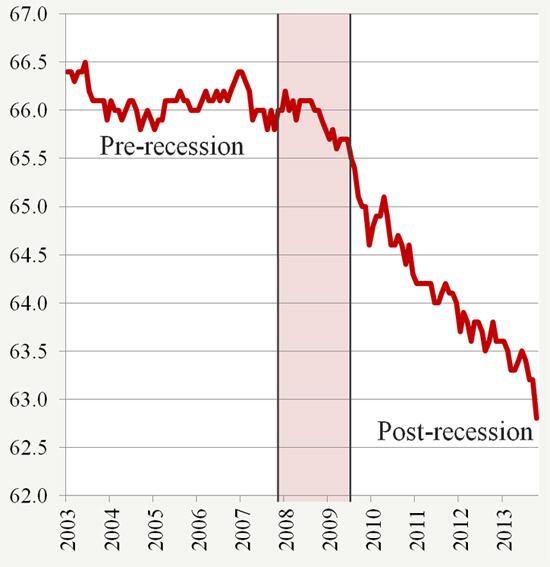
Labor Force Participation down to 62.8%

An editorial by Arthur Brooks appeared today in the leftist New York Times. His topic is the shift from optimism to envy, why it is happening, and whether envy makes us happier than optimism.

Excerpt: (links removed)

The Irish singer Bono once described a difference between America and his native land. “In the United States,” he explained, “you look at the guy that lives in the mansion on the hill, and you think, you know, one day, if I work really hard, I could live in that mansion. In Ireland, people look up at the guy in the mansion on the hill and go, one day, I’m going to get that bastard.”

[…]Unsurprisingly, psychologists have found that envy pushes down life satisfaction and depresses well-being. Envy is positively correlated with depression and neuroticism, and the hostility it breeds may actually make us sick. Recent work suggests that envy can help explain our complicated relationship with social media: it often leads to destructive “social comparison,” which decreases happiness. To understand this, just picture yourself scrolling through your ex’s wedding photos.

My own data analysis confirms a strong link between economic envy and unhappiness. In 2008, Gallup asked a large sample of Americans whether they were “angry that others have more than they deserve.” People who strongly disagreed with that statement — who were not envious, in other words — were almost five times more likely to say they were “very happy” about their lives than people who strongly agreed. Even after I controlled for income, education, age, family status, religion and politics, this pattern persisted.

It’s safe to conclude that a national shift toward envy would be toxic for American culture.

Unfortunately, in the wake of the Great Recession, such a shift may well be underway, given the increasing anxiety about income inequality and rising sympathy for income redistribution. According to data from the General Social Survey, the percentage of Americans who feel strongly that “government ought to reduce the income differences between the rich and the poor” is at its highest since the 1970s. In January, 43 percent of Americans told the Pew Research Center that government should do “a lot” to “reduce the gap between the rich and everyone else.”

Why the shift? The root cause of increasing envy is a belief that opportunity is in decline. According to a 2007 poll on inequality and civic engagement by the Maxwell School of Citizenship and Public Affairs at Syracuse University, just 30 percent of people who believe that everyone has the opportunity to succeed describe income inequality as “a serious problem.” But among people who feel that “only some” Americans have a shot at success, fully 70 percent say inequality is a major concern.

People who believe that hard work brings success do not begrudge others their prosperity. But if the game looks rigged, envy and a desire for redistribution will follow.

This is the direction we’re heading. According to Pew, the percentage of Americans who feel that “most people who want to get ahead” can do so through hard work has dropped by 14 points since about 2000. As recently as 2007, Gallup found that 70 percent were satisfied with their opportunities to get ahead by working hard; only 29 percent were dissatisfied. Today, that gap has shrunk to 54 percent satisfied, and 45 percent dissatisfied. In just a few years, we have gone from seeing our economy as a real meritocracy to viewing it as something closer to a coin flip.

There is a good lesson in this for people who want what is best for the poor. Simply receiving money from others is not going to make poor people happy. What we need to focus on is providing the poorest people with opportunities. For example, we need to reduce barriers that employers face to hire them, and we need to make the school system focus more on skill-building and less on indoctrination in leftist ideology.

Democrats like to give lots of speeches on income inequality, stoking the fires of envy, while doing nothing to help people learn useful skills in school and to help employers hire people more easily, setting them on the path of lifelong independence. For example, Democrats oppose school choice, as when they killed the D.C. voucher program that helped poor black students. Less school choice helps public schools to be insulated from competition, so that they can focus on what they want (bigger government, so they get paid more) rather than what parents want (bad teachers fired, students to learn useful skills, more male teachers in the classroom, a focus on vocational skills rather than ideology). Just this past week, the ultra-leftist mayor of New York city kicked charter schools out of the city. Why? Because if children learn useful skills in better schools, then they will be less dependent on government, and less responsive to “envy rhetoric”.

Democrats also passed Obamacare, which punishes businesses with taxes if they allow part-time workers to work for more than 30 hours a week. Many jobs were lost because of this, and many people are now struggling to pay higher premiums for plans with higher deductibles and co-pays. Now the Democrats are talking about raising the minimum wage, which is going to put even more pressure on employers to lay off workers, because they can’t afford to pay them more for the same work. For Democrats, this is all to the good, though. Because if the poor don’t have jobs, or can’t work enough hours, they start to see the economic game as “rigged” and they are more responsive to “envy rhetoric”.

What we need to see is that it’s not the Democrats’ objective to help people find jobs. They gain when people become more envious, like in European countries, and start to vote to grow the size and power of government to redistribute wealth. Speeches about income inequality never have the goal of giving people jobs. None of Obama’s policies aim to do that. That’s why he won’t build the Keystone XL pipeline, or boost domestic energy development here at home. Instead, they want to extend unemployment benefits and pass the costs on to the next generation. Their goal is to get you unemployed or on disability or on welfare, so that you will vote for the government to continue to take your neighbor’s money. That manufactured envy is what keeps the Democrats in power.

CBO report: Obama’s proposed minimum-wage increase could kill 500,000 jobs

Three stories from Investors Business Daily, and one of them is about the dreaded stagflation.

First one, on the CBO report.

Excerpt:

On Tuesday, the Congressional Budget Office made another blockbuster pronouncement, this one concluding that the White House minimum wage hike to $10.10 an hour really does kill jobs.

The $10.10 option, when fully implemented, “would reduce total employment by about 500,000 workers, or 0.3%,” CBO says. Job losses could be as high as 1 million.

This followed last week’s CBO calculation that the impact of ObamaCare on the labor market will be about 2 million fewer workers over time, due to higher costs on employers and employees of mandated coverage and the availability of subsidized insurance to nonworkers.


Second article, about how the Democrats seem to be trying to create dependency in order to buy votes from people who cannot pay their own way.

Excerpt:

January’s labor report confirmed yet another month with over 100 million Americans not working. In fact, more than 100 million Americans have not been working in Obama’s workers’ paradise for all of 2012 and 2013, a unique achievement in American history.

[…]How has Obama managed to “liberate” so many workers from work? Through Social Security disability, which has increased by more than 21%, extending “unemployment” benefits to two years and by eliminating work requirements as a condition of receiving federal benefits.

The number of Americans on food stamps has soared by 50% under Obama to close to 50 million, largely because work requirements, asset checks and other restraints on abuse have been relaxed. Indeed, more than twice as many more Americans have gotten food stamps under Obama than have gotten jobs. Under ObamaCare, the same transformation is now under way for Medicaid.

Today, federal and state taxpayers pay a trillion dollars every year to the lowest 20% on the income ladder basically not to work. Under Obama total welfare spending has doubled since 2008. (Note that the administration is suing the state of Louisiana to turn over the names of everyone on welfare, precisely for Obama’s voter-turnout database.)

[…]CBO estimates that the slower economic growth from this reduced labor supply will mean $1.4 trillion less in federal tax revenue over the next 10 years. So ObamaCare will increase the deficit after all.

Third article, explaining that the failed policies of the Democrats have been tried before – by Carter.

Excerpt:

Since the Obama “recovery” started 4-1/2 years ago, inflation appears to have been relatively tame, with core prices climbing just 7% from June 2009 to December 2013.

But as CBS News discovered when it looked a little closer, the overall number is deceptive. In fact, it found food prices soaring.

The official inflation data confirm this. Overall, food prices are up 9% since June 2009, according to the Bureau of Labor Statistics. And the cost of many staples is skyrocketing. Pork prices have climbed 14%; poultry is up 12%; eggs, 27%; milk, 20%.

Meanwhile, energy prices have climbed 18% during the recovery, and the price of gasoline is up a whopping 31.5%. Then there’s college tuition, up 23%.

At the same time, wages aren’t budging. In fact, measured in real terms, the median household income is 4% below where it was four-1/2 years ago. And while the official unemployment rate is down, that’s due to millions quitting the workforce altogether.

Yes, the economy has created 6.6 million jobs since June 2009. But the ranks of those not in the labor force climbed nearly 11 million, driving the labor force participation rate down from 65.7% to today’s 63% — a level not seen since 1978.

You might remember from the Carter era that stagflation was the name given to describe a period of slow or stagnant economic growth, low labor force participation and high prices (inflation). The only solution to this is to raise interest rates, which is very painful. But the longer we keep interest rates low, and keep government spending high, and keep taxing and regulating businesses into oblivion, the worst the medicine is going to be when we are forced to take it.