Tag Archives: War

Former DEA chief warns of cooperation between Hezbollah and drug cartels

From CNS News.

Excerpt:

The Iranian-supported Shi’ite terrorist group Hezbollah has spread its influence all the way to the U.S. border with Mexico, a House Foreign Affairs Committee hearing on Iran’s influence in the Western Hemisphere heard on Thursday.

Michael Braun, a former chief of operations at the Drug Enforcement Agency, said Hezbollah had developed relationships with the powerful Mexican drug cartels to “move their agenda forward.” He cited a plot, recently uncovered by the DEA, involving an Iranian operative in Mexico allegedly planning to assassinate the Saudi ambassador in Washington, D.C.

“Hezbollah are absolute masters at forming close relationships with existing organized crime groups around the world that helps them facilitate what they need to do to move their agendas forward,” Braun told CNSNews.com following the hearing. “And if anyone thinks for a moment that they don’t have their eye on the southwest border and all of our country, then they couldn’t be more wrong.”

In his prepared remarks Braun, who also served as interim director of the Department of Justice’s Drug Intelligence Fusion Center, said Hezbollah and other terrorist groups understand that the Mexican cartels are already operating successfully inside the United States.

“If anyone thinks for one moment that these terrorist organizations do not understand that the Mexican drug trafficking cartels now dominate drug trafficking in our country – reportedly in more than 250 cities – than they are very stupid or very naive,” he said.

“And these groups most assuredly recognize the strategic value of exploiting that activity, and all that has been built to support it, for moving their vision forward in this part of the world.”

This is disturbing particularly given the news of Iran’s new Spanish-language TV channel in Venezuela.

Iran and Hezbollah

The Washington Times reports on arms sales from China to Iran.

Excerpt:

China is continuing to provide advanced missiles and other conventional arms to Iran and may be doing so in violation of U.N. sanctions against the Tehran regime, according to a draft report by the congressional U.S.-China Commission. “China continues to provide Iran with what could be considered advanced conventional weapons,” the report of the U.S.-China Economic and Security Review Commission says. According to the report, which will be made public Nov. 16, China sold $312 million worth of arms to Iran, second only to Russia, after Congress passed the Iran Freedom Support Act in 2006 that allows the U.S. government to sanction foreign companies that provide advanced arms to Iran. The report also noted that, after Russia began cutting back arms transfers to Iran in 2008, China became the largest arms supplier to the Iranian military. Most of the weapons transfers involved sales of Chinese anti-ship cruise missiles, including C-802 missiles that China promised the United States in 1997 would not be exported to Iran. China also built an entire missile plant in Iran last year to produce the Nasr-1 anti-ship cruise missile.

The Nasr-1 has a range of 19 miles. The C-802 has a range of 75 miles. That means that the C-802 has about the same range as a Harpoon SSM. Not good. I am not worried about the Nasr-1, but the C-802 is a problem. These weapons could be used by terrorists to attack allied naval vessels. In fact, the New York Times reported that Hezbollah, a terrorist group linked to Iran,used the C-802 missile to sink an Israeli Saar 5 corvette back in 2006.

Excerpt:

The power and sophistication of the missile and rocket arsenal that Hezbollah has used in recent days has caught the United States and Israel off guard, and officials in both countries are just now learning the extent to which the militant group has succeeded in getting weapons from Iran and Syria.

While the Bush administration has stated that cracking down on weapons proliferation is one of its top priorities, the arming of Hezbollah shows the blind spots of American and other Western intelligence services in assessing the threat, officials from across those governments said.

American and Israeli officials said the successful attack last Friday on an Israeli naval vessel was the strongest evidence to date of direct support by Iran to Hezbollah. The attack was carried out with a sophisticated antiship cruise missile, the C-802, an Iranian-made variant of the Chinese Silkworm, an American intelligence official said.

At the same time, American and Israeli officials cautioned that they had found no evidence that Iranian operatives working in Lebanon launched the antiship missile themselves.

But neither Jerusalem nor Washington had any idea that Hezbollah had such a missile in its arsenal, the officials said, adding that the Israeli ship had not even activated its missile defense system because intelligence assessments had not identified a threat from such a radar-guided cruise missile.

[…]Officials said it was likely that Iran trained Hezbollah fighters on how to successfully fire and guide the missiles, and that members of Iran’s Al Quds force — the faction of the Revolutionary Guards that trains foreign forces — would not necessarily have to be on the scene to launch the C-802.

At the same time, some experts said Iran was not likely to deploy such a sophisticated weapon without also sending Revolutionary Guard crews with the expertise to fire the missile.

Note that this is the same Quds force that likely trained Iraqi terrorists in the use of IEDs and is suspected of being involved with the recent attack on the Saudi ambassador on American soil.
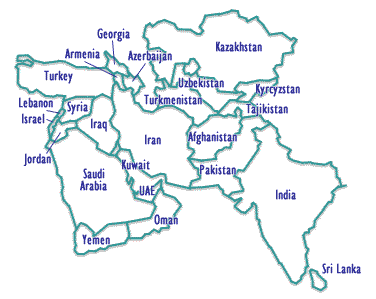
Rick Santorum would not stand idle while Iran develops nuclear weapons

Map of the Middle East

From Fox News.

Excerpt:

Republican presidential candidate Rick Santorum said Saturday the U.S. was wrong to condemn the killing of an Iranian nuclear scientist this week.

The Obama administration’s public posture on the death Wednesday of Mostafa Ahmadi Roshan does not reflect the hard line Santorum supports in keeping Iran from obtaining nuclear weapons, the former Pennsylvania senator said while campaigning in conservative upstate South Carolina.

“Our country condemned it. My feeling is we should have kept our mouth shut,” Santorum told about 200 people packed into a popular breakfast diner in Greenville.

Santorum is vying to emerge as conservatives’ alternative to former Massachusetts Gov. Mitt Romney in the Jan. 21 South Carolina primary. Romney leads in public and private polls of likely voters, although former House Speaker Newt Gingrich is within striking distance, with a week to go before balloting begins.

However, Santorum has risen here since his breakthrough near-tie with Romney in the Iowa caucuses on Jan. 3. He has a robust state organization and is making aggressive inroads with evangelical conservatives, like many of those who were at the Country Ham House Saturday morning.

And while Santorum stresses values issues, he has also argued for a tough stand on Iran’s nuclear capability. Responding to a question in Greenville, he said he supports missile strikes to stop its nuclear program, if Iran refuses to submit to inspections.

“If these are people who are developing a weapon to be used to either destroy the state of Israel or to spread terror — a reign of terror — around the world, we shouldn’t be sitting on the sidelines and letting it happen,” he said. “They cannot have a nuclear weapon, because you, in Greenville, will not be safe.”

That’s what I’ve been saying for months. There are things we could be doing to show them that having nuclear weapons and interfering in Syria and Iraq are not good ideas for them. Covert operations, arming student groups, pro-West broadcasts, little “accidents” at Iranian training camps in Venezuela. Nice country you got there, guv’nor. Would be a shame if anything were to ‘appen to it.

Related posts

Ron Paul’s isolationist foreign policy views echo Neville Chamberlain

From Doug Ross at Director Blue, 10 fun facts about Ron Paul.

Here’s fact #7:

And so I asked Congressman Paul: if he were President of the United States during World War II, and as president he knew what we now know about the Holocaust, but the Third Reich presented no threat to the U.S., would he have sent American troops to Nazi Germany purely as a moral imperative to save the Jews?

And the Congressman answered:

“No, I wouldn’t. I wouldn’t risk American lives to do that. If someone wants to do that on their own because they want to do that, well, that’s fine, but I wouldn’t do that.”

Paul then looked at me, and I politely thanked him for his time. He smiled at me again and nodded his head, and many of his young followers were also smiling, and nodding their heads in agreement. Clearly, I was the only one in the room who was disturbed by his response.

When I first presented the story of Paul’s comments about the Holocaust to major news media outlets two years ago, they were so stunned they were afraid to publish my story, and as a result it has remained unpublished until now.

I went to great lengths afterwards to learn more about the basis for Paul’s comments. I spoke to Eric Dondero, a former senior aide for Paul, in February 2010. Dondero is quoted in a Weekly Standard article today about Paul’s isolationist beliefs.

When I called Dondero again this morning, and told him I was finally going forward with the story, he told me that Paul had made similar comments to him.

“He told me numerous times it was not worth it to intervene to save the Jews in World War II,” Dondero said. “I don’t think that’s because he’s an antisemite. It’s because he’s an extreme isolationist and he’s trying to be 100% principled–he doesn’t think there’s any reason to intervene for human rights or any other reason anywhere on the planet.”

Calls to Rep. Paul’s congressional office and campaign office last week and this morning were not returned.

It’s not just the Holocaust, either. It’s the wholesale abandonment of the United Kingdom to conquest by Nazi Germany. And it’s not just the United Kingdom. It’s the complete takeover of the Asia-Pacific theater, and Australia, and New Zealand, by Imperial Japan. That’s what Ron Paul would have let happen.

Historians will tell you that Hitler could have been contained if Western leaders had responded militarily when he broke the Locarno treaties by remilitarizing the Rhineland in 1936. Do you think that Ron Paul would have gone to war in 1936 to stop Hitler – when he was still relatively weak? The Polyanna isolationism of Ron Paul is exactly what causes world wars. People like Ron Paul ignore aggressors when they make small invasions and then in a few years we have a world war on our hands. Ron Paul is a warmonger – his naive isolationism gets us into world wars by emboldening and coddling tyrants with a naive stick-your-head-in-the-sand foreign policy. Ron Paul doesn’t know anything about the threat of terrorism – his foreign policy is based on economics theories authored by people who died before nuclear weapons were invented. You can’t trust someone who makes foreign policy using theories, but who is ignorant of the real dangers we face.

“Those who do not learn from history are doomed to repeat it”
– George Santayana 

It’s not a surprise to me that Ron Paul is popular with young people who don’t understand military history and the threat of terrorism. They don’t know who Neville Chamberlain was, or they would recognize Ron Paul as the second coming of Neville Chamberlain.

Thomas Sowell explains what causes wars

Let’s take a look at the lessons of history and find out what really causes wars.

Here’s an article from Townhall.

Excerpt:

On the international scene, trying to assuage aggressors’ feelings and look at the world from their point of view has had an even more catastrophic track record. A typical sample of this kind of thinking can be found in a speech to the British Parliament by Prime Minister Neville Chamberlain in 1938: “It has always seemed to me that in dealing with foreign countries we do not give ourselves a chance of success unless we try to understand their mentality, which is not always the same as our own, and it really is astonishing to contemplate how the identically same facts are regarded from two different angles.”

Like our former ambassador from the Carter era, Chamberlain sought to “remove the causes of strife or war.” He wanted “a general settlement of the grievances of the world without war.” In other words, the British prime minister approached Hitler with the attitude of someone negotiating a labor contract, where each side gives a little and everything gets worked out in the end. What Chamberlain did not understand was that all his concessions simply led to new demands from Hitler — and contempt for him by Hitler.

What Winston Churchill understood at the time, and Chamberlain did not, was that Hitler was driven by what Churchill called “currents of hatred so intense as to sear the souls of those who swim upon them.” That was also what drove the men who drove the planes into the World Trade Center.

Pacifists of the 20th century had a lot of blood on their hands for weakening the Western democracies in the face of rising belligerence and military might in aggressor nations like Nazi Germany and imperial Japan. In Britain during the 1930s, Labor Party members of Parliament voted repeatedly against military spending, while Hitler built up the most powerful military machine in Europe. Students at leading British universities signed pledges to refuse to fight in the event of war.

All of this encouraged the Nazis and the Japanese toward war against countries that they knew had greater military potential than their own. Military potential only counts when there is the will to develop it and use it, and the fortitude to continue with a bloody war when it comes. This is what they did not believe the West had. And it was Western pacifists who led them to that belief.

Then as now, pacifism was a “statement” about one’s ideals that paid little attention to actual consequences. At a Labor Party rally where Britain was being urged to disarm “as an example to others,” economist Roy Harrod asked one of the pacifists: “You think our example will cause Hitler and Mussolini to disarm?”

The reply was: “Oh, Roy, have you lost all your idealism?” In other words, the issue was about making a “statement” — that is, posturing on the edge of a volcano, with World War II threatening to erupt at any time. When disarmament advocate George Bernard Shaw was asked what Britons should do if the Nazis crossed the channel into Britain, the playwright replied, “Welcome them as tourists.”

Most people think that Thomas Sowell is a libertarian, but he isn’t a full libertarian. He just reports the evidence. If the evidence is pro-war, then he’s pro-war. Ronald Reagan and Margaret Thatcher called this view “peace through strength”. There is only one reason why evil people do not attack – because they think that good people have the firepower to make them pay dearly for their aggression, and – and this is very important – the will to use it. We need to be wary of people like Ron Paul who minimize patriotism and heroism, and charge proponents of military power with “imperialism”.

Here’s an article that explains it more.

Excerpt:

In France, after the First World War, the teachers’ unions launched a systematic purge of textbooks, in order to promote internationalism and pacifism.

Books that depicted the courage and self-sacrifice of soldiers who had defended France against the German invaders were called “bellicose” books to be banished from the schools.

Textbook publishers caved in to the power of the teachers’ unions, rather than lose a large market for their books. History books were sharply revised to conform to internationalism and pacifism.

The once epic story of the French soldiers’ heroic defense against the German invaders at Verdun, despite the massive casualties suffered by the French, was now transformed into a story of horrible suffering by all soldiers at Verdun— French and German alike.

In short, soldiers once depicted as national heroes were now depicted as victims— and just like victims in other nations’ armies.

[…]France, where pacifism and internationalism were strongest, became a classic example of how much it can matter.

During the First World War, France fought on against the German invaders for four long years, despite having more of its soldiers killed than all the American soldiers killed in all the wars in the history of the United States, put together.

But during the Second World War, France collapsed after just six weeks of fighting and surrendered to Nazi Germany.

At the bitter moment of defeat the head of the French teachers’ union was told, “You are partially responsible for the defeat.”

Charles de Gaulle, Francois Mauriac, and other Frenchmen blamed a lack of national will or general moral decay, for the sudden and humiliating collapse of France in 1940.

At the outset of the invasion, both German and French generals assessed French military forces as more likely to gain victory, and virtually no one expected France to collapse like a house of cards — except Adolf Hitler, who had studied French society instead of French military forces.

Did patriotism matter? It mattered more than superior French tanks and planes.

Everybody wants peace. Everyone – on both sides of the issue. But it is not weakness but strength that deters wars. Strength, and the will to defeat evil.