Tag Archives: War

Ron Paul’s isolationist foreign policy views echo Neville Chamberlain

From Doug Ross at Director Blue, 10 fun facts about Ron Paul.

Here’s fact #7:

And so I asked Congressman Paul: if he were President of the United States during World War II, and as president he knew what we now know about the Holocaust, but the Third Reich presented no threat to the U.S., would he have sent American troops to Nazi Germany purely as a moral imperative to save the Jews?

And the Congressman answered:

“No, I wouldn’t. I wouldn’t risk American lives to do that. If someone wants to do that on their own because they want to do that, well, that’s fine, but I wouldn’t do that.”

Paul then looked at me, and I politely thanked him for his time. He smiled at me again and nodded his head, and many of his young followers were also smiling, and nodding their heads in agreement. Clearly, I was the only one in the room who was disturbed by his response.

When I first presented the story of Paul’s comments about the Holocaust to major news media outlets two years ago, they were so stunned they were afraid to publish my story, and as a result it has remained unpublished until now.

I went to great lengths afterwards to learn more about the basis for Paul’s comments. I spoke to Eric Dondero, a former senior aide for Paul, in February 2010. Dondero is quoted in a Weekly Standard article today about Paul’s isolationist beliefs.

When I called Dondero again this morning, and told him I was finally going forward with the story, he told me that Paul had made similar comments to him.

“He told me numerous times it was not worth it to intervene to save the Jews in World War II,” Dondero said. “I don’t think that’s because he’s an antisemite. It’s because he’s an extreme isolationist and he’s trying to be 100% principled–he doesn’t think there’s any reason to intervene for human rights or any other reason anywhere on the planet.”

Calls to Rep. Paul’s congressional office and campaign office last week and this morning were not returned.

It’s not just the Holocaust, either. It’s the wholesale abandonment of the United Kingdom to conquest by Nazi Germany. And it’s not just the United Kingdom. It’s the complete takeover of the Asia-Pacific theater, and Australia, and New Zealand, by Imperial Japan. That’s what Ron Paul would have let happen.

Historians will tell you that Hitler could have been contained if Western leaders had responded militarily when he broke the Locarno treaties by remilitarizing the Rhineland in 1936. Do you think that Ron Paul would have gone to war in 1936 to stop Hitler – when he was still relatively weak? The Polyanna isolationism of Ron Paul is exactly what causes world wars. People like Ron Paul ignore aggressors when they make small invasions and then in a few years we have a world war on our hands. Ron Paul is a warmonger – his naive isolationism gets us into world wars by emboldening and coddling tyrants with a naive stick-your-head-in-the-sand foreign policy. Ron Paul doesn’t know anything about the threat of terrorism – his foreign policy is based on economics theories authored by people who died before nuclear weapons were invented. You can’t trust someone who makes foreign policy using theories, but who is ignorant of the real dangers we face.

“Those who do not learn from history are doomed to repeat it”
– George Santayana 

It’s not a surprise to me that Ron Paul is popular with young people who don’t understand military history and the threat of terrorism. They don’t know who Neville Chamberlain was, or they would recognize Ron Paul as the second coming of Neville Chamberlain.

Thomas Sowell explains what causes wars

Let’s take a look at the lessons of history and find out what really causes wars.

Here’s an article from Townhall.

Excerpt:

On the international scene, trying to assuage aggressors’ feelings and look at the world from their point of view has had an even more catastrophic track record. A typical sample of this kind of thinking can be found in a speech to the British Parliament by Prime Minister Neville Chamberlain in 1938: “It has always seemed to me that in dealing with foreign countries we do not give ourselves a chance of success unless we try to understand their mentality, which is not always the same as our own, and it really is astonishing to contemplate how the identically same facts are regarded from two different angles.”

Like our former ambassador from the Carter era, Chamberlain sought to “remove the causes of strife or war.” He wanted “a general settlement of the grievances of the world without war.” In other words, the British prime minister approached Hitler with the attitude of someone negotiating a labor contract, where each side gives a little and everything gets worked out in the end. What Chamberlain did not understand was that all his concessions simply led to new demands from Hitler — and contempt for him by Hitler.

What Winston Churchill understood at the time, and Chamberlain did not, was that Hitler was driven by what Churchill called “currents of hatred so intense as to sear the souls of those who swim upon them.” That was also what drove the men who drove the planes into the World Trade Center.

Pacifists of the 20th century had a lot of blood on their hands for weakening the Western democracies in the face of rising belligerence and military might in aggressor nations like Nazi Germany and imperial Japan. In Britain during the 1930s, Labor Party members of Parliament voted repeatedly against military spending, while Hitler built up the most powerful military machine in Europe. Students at leading British universities signed pledges to refuse to fight in the event of war.

All of this encouraged the Nazis and the Japanese toward war against countries that they knew had greater military potential than their own. Military potential only counts when there is the will to develop it and use it, and the fortitude to continue with a bloody war when it comes. This is what they did not believe the West had. And it was Western pacifists who led them to that belief.

Then as now, pacifism was a “statement” about one’s ideals that paid little attention to actual consequences. At a Labor Party rally where Britain was being urged to disarm “as an example to others,” economist Roy Harrod asked one of the pacifists: “You think our example will cause Hitler and Mussolini to disarm?”

The reply was: “Oh, Roy, have you lost all your idealism?” In other words, the issue was about making a “statement” — that is, posturing on the edge of a volcano, with World War II threatening to erupt at any time. When disarmament advocate George Bernard Shaw was asked what Britons should do if the Nazis crossed the channel into Britain, the playwright replied, “Welcome them as tourists.”

Most people think that Thomas Sowell is a libertarian, but he isn’t a full libertarian. He just reports the evidence. If the evidence is pro-war, then he’s pro-war. Ronald Reagan and Margaret Thatcher called this view “peace through strength”. There is only one reason why evil people do not attack – because they think that good people have the firepower to make them pay dearly for their aggression, and – and this is very important – the will to use it. We need to be wary of people like Ron Paul who minimize patriotism and heroism, and charge proponents of military power with “imperialism”.

Here’s an article that explains it more.

Excerpt:

In France, after the First World War, the teachers’ unions launched a systematic purge of textbooks, in order to promote internationalism and pacifism.

Books that depicted the courage and self-sacrifice of soldiers who had defended France against the German invaders were called “bellicose” books to be banished from the schools.

Textbook publishers caved in to the power of the teachers’ unions, rather than lose a large market for their books. History books were sharply revised to conform to internationalism and pacifism.

The once epic story of the French soldiers’ heroic defense against the German invaders at Verdun, despite the massive casualties suffered by the French, was now transformed into a story of horrible suffering by all soldiers at Verdun— French and German alike.

In short, soldiers once depicted as national heroes were now depicted as victims— and just like victims in other nations’ armies.

[…]France, where pacifism and internationalism were strongest, became a classic example of how much it can matter.

During the First World War, France fought on against the German invaders for four long years, despite having more of its soldiers killed than all the American soldiers killed in all the wars in the history of the United States, put together.

But during the Second World War, France collapsed after just six weeks of fighting and surrendered to Nazi Germany.

At the bitter moment of defeat the head of the French teachers’ union was told, “You are partially responsible for the defeat.”

Charles de Gaulle, Francois Mauriac, and other Frenchmen blamed a lack of national will or general moral decay, for the sudden and humiliating collapse of France in 1940.

At the outset of the invasion, both German and French generals assessed French military forces as more likely to gain victory, and virtually no one expected France to collapse like a house of cards — except Adolf Hitler, who had studied French society instead of French military forces.

Did patriotism matter? It mattered more than superior French tanks and planes.

Everybody wants peace. Everyone – on both sides of the issue. But it is not weakness but strength that deters wars. Strength, and the will to defeat evil.
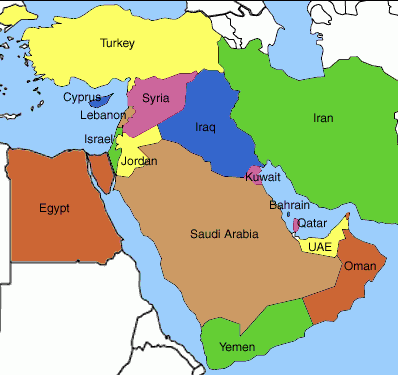
Islamic extremists dominate Egypt’s parliamentary elections

Map of the Middle East

From the Wall Street Journal.

Excerpt:

Unofficial initial results from the first two days of Egypt’s parliamentary elections pointed to a dominant showing for Islamist candidates, fulfilling most analysts’ expectations that conservative religious politicians could have the upper hand in next year’s drafting of a new Egyptian constitution.

Initial tallies put the powerful Muslim Brotherhood’s political arm, the Freedom and Justice Party, or FJP, in a leading position, followed by the Nour Party, which represents the ultraconservative Salafi school of Islam, FJP said.

An FJP official said the party’s vote-counting observers expect the group to win as much as 50% of the vote. A Nour Party spokesman said the early returns point to a Salafi capture of about 10% to 15% of seats in the incoming Parliament.

The Egyptian Bloc, a list of liberal parties dominated by the left-leaning Social Democrat Party and the pro-market Free Egyptians Party, appeared to be in third place. Official early results are expected to be announced on Thursday, the High Elections Commission said.

The results are far from final—a second and third round of elections covering two-thirds of Egypt’s 27 governorates are scheduled to take place in December and January. Individual candidate races that didn’t secure at least 51% will face runoffs beginning next week.

But the early results indicate that Egypt—the largest Arab country and under former President Hosni Mubarak one of the region’s staunchest defenders of secular governance—is set to pivot toward political Islam. The next voting rounds include mostly smaller Egyptian cities and villages, where Islamist rule is popular.

Such an outcome would surprise few Egyptians or political observers. Egypt’s deeply religious population grated under the ousted regime’s secular policies, and Tunisia and Morocco have recently awarded pluralities to moderate Islamist parties.

[…]Both Salafi and Brotherhood representatives said it was too early to say whether the two groups would form a coalition in Parliament—an alliance that would give Islamists a powerful majority.

This is what Obama bought us by taking his eye off the ball in Iraq, Afghanistan, Syria, Pakistan and Iran. We had no business firing a shot in Libya and Egypt. There was no strategic reason for us to be there.

How to easily develop your knowledge of the way the world works

If you’re not reading IBD editorials every day, you are missing out. I agree with them on practically everything they write. I try to stay in touch with what’s happening in the world, with respect to economics and foreign policy, and Investors Business Daily is indispensable. (And sometimes, they even cover social issues like school choice, affirmative action and stem cell research). It’s not just the news that I want, it’s the analysis. They fit every data point into an argument – and that makes the world a very interesting place.

Here are four sample articles.

Did the latest European bailout fix anything?

Excerpt:

Led by the Fed, top central banks added dollars to the global financial system on Wednesday as Europe’s crisis deepened. We hate to rain on anyone’s parade, but this won’t solve the EU’s problems.

The central banks’ bold action, though met with wild enthusiasm by financial markets, amounts to little more than a multibillion dollar Band-Aid on a deep, dangerous wound.

[…]But even as they juggle and sell off their portfolios of bad loans, major banks in Europe, the U.S. and Asia are being forced to raise capital to meet new international banking standards. The result: a credit crunch.

In short, the global financial system is near collapse, and the central banks are madly pumping dollars into it to keep the collapse from happening.

It’s an emergency, we get it. But while such actions might help in the short run, they won’t in the long run.

The EU faces the same problems today as it did yesterday, and no amount of central bank money-printing changes that.

Namely, its 17 members, used to an ever-expanding welfare state and leisure-class lifestyle, can’t sustain that way of life with their chronically weak economies and aging, low-productivity workforces.

Contrary to recent actions, the EU’s problems aren’t short-term and financial, but long-term and fiscal.

The same kind of problems that we are having USA, as we have moved from 160 billion dollar deficits under Bush in 2007 to approximately 1.4 trillion dollar deficits in ever year that Obama has been President. Maybe we can learn some lessons from the mistakes that others have made and are making instead of making those mistakes again ourselves?

If global warming is real, where are all the hurricanes?

Excerpt:

Sunday will be the 2,232nd consecutive day that the U.S. has gone without being hit by a major hurricane. This is a big enough deal to be covered by the mainstream media. But of course it won’t be.

On Dec. 4, a new record will be set for the number of days between landfalls of category 3 or stronger storms. The previous streak, according to Roger Pielke Jr., began on Sept. 8, 1900, and ended on Oct. 19, 1906, when the Great Galveston Hurricane hit.

The record won’t be broken by just a day or even a week. Pielke, a professor of environmental studies at University of Colorado, says it will be crushed.

“Since there won’t be any intense hurricanes before next summer, the record will be shattered, with the days between intense hurricane landfalls likely to exceed 2,500 days,” he writes in his blog.

Why is this significant? Because the global warming alarmists have been telling us that man’s carbon dioxide emissions would bring bigger storms.

[…]The mainstream media has happily trafficked this nonsense, but it’s not likely to mention Pielke’s point even though it would be appropriate in stories covering our very mild hurricane season, which ended Wednesday.

Why won’t they do it? Because it’s inconsistent with their narrative. It’s like the latest batch of Climategate emails, which show again a group of scientists manipulating the process for political gain. News that contradicts the alarmists’ tale simply isn’t news to the media.

If you think that global warming alarmism has no effect on you, then you need to realize that it is being used to justify all kinds of job-killing regulations. If you want to know why companies ship jobs overseas and expand their operations outside the United States, then look no further than the EPA.

Is existing U.S. oil drilling in the EPA’s crosshairs?

Excerpt:

The latest salvo in the administration’s war on energy may be new rules and permits to regulate a process to get oil and gas from porous rock, sacrificing jobs and economic growth while under review.

There are a few areas of the U.S. that are booming. Two of these are in North Dakota and Pennsylvania, states that sit atop two massive shale rock formations, the Bakken and the Marcellus.

Extraction of oil and natural gas from these formations have created jobs and economic growth in the midst of a stagnant and parched economy.

[…]Yet the Environmental Protection Agency, bowing to environmentalists’ pressure and faithful to the administration mantra that fossil fuels are harmful and obsolete, is preparing to nip this economic boom in the bud by regulating it to death.

[…]Pennsylvania’s Department of Labor and Industry estimates fracking in the Marcellus created 72,000 jobs between the fourth quarter of 2009 and the first quarter of 2011. Drilling in the Bakken formation along the North Dakota-Montana border helps explain North Dakota’s unemployment rate of 3.2%, the nation’s lowest.

The Gulf Coast energy industry has never fully recovered from a similar moratorium and a new glacial permitting process.

Similarly, the job-creating Keystone XL pipeline project to bring Canadian tar sands oil to American refineries is stalled on environmental grounds.

It’s not enought that Obama blocks the creation of hundreds of thousands of new energy sector jobs – and wastes money on alternative energy companies connected to his campaign fundraisers – but now he might be going after existing energy production jobs, too.

Should we continue to send our “ally” Pakistan foreign aid?

Excerpt:

In what’s become a common occurrence, the Pakistani military — in an unprovoked attack — fired on coalition troops based across the border in Afghanistan. We responded by hitting two Pakistani border posts. The airstrikes killed two dozen Pakistani soldiers, sparking anti-American riots and threats of reprisal by Islamabad.

[…]So why still coddle Pakistan, diplomatically? Several reasons, not the least of which is Pakistan’s arsenal of nuclear weapons and cold war with India. But it’s mainly because we need its permission to transport military supplies across its border into landlocked Afghanistan, the terror swamp believed most worthy of draining.

More than 40% of the fuel, food, ammunition, equipment and other supplies sent to U.S. forces in Afghanistan are shipped via Pakistani ports and roads. Islamabad also gives us access to airspace — including landing rights at three air bases, where we launch the Predator drone aircraft targeting Pakistani-based terrorist camps in lieu of U.S. boots on the ground.

Islamabad could easily deny us those landing rights and cut off supply routes at any time, hamstringing our Afghan operations. Sure enough: Islamabad did exactly that over the weekend. After the coalition air strike that killed 24 of its troops, Pakistan blocked two coalition supply routes running through Pakistan. It also gave the U.S. two weeks to vacate the Shamsi air base in Balochistan, which has been used for drone sorties.

These moves make reducing our dependence on Pakistan all the more critical.

The Pentagon should hike supplies coming into Afghanistan from the north through Central Asia. To fund the added expense, it could use the billions in aid Pakistan is secretly using against us by funding and arming Afghan insurgents. It could also use a chunk of U.S. aid dollars to build larger fuel-storage facilities on the ground in Afghanistan, so that military operations can withstand major disruptions to supplies.

So there you have it – four great articles on the European crisis, global warming science, the employment situation at home, and foreign policy. And you get this analysis for free every day with Investors Business Daily. You can check out their editorials at this link, and bookmark it. Even if you don’t read the Heritage Foundation’s blog “The Foundry” and the American Enterprise Institute blog “The American”, you can still stay well informed by reading IBD every day. If you are interested in raw news without the analysis, then read CNS News.

It’s very important for Christians to understand that we have to be seen by others as aware and informed on other topics in order to be seen as aware and informed on religious issues. Part of that involves studying apologetics and being familiar with opposing arguments and evidence. Part of it is being informed about social issues like abortion, marriage and education. But part of it is just being a well-informed person in general. When topics like politics and economics and national security come up, our goal should not be to take whatever position is popular, or whatever position will make us look “nice”. We should have our own position, and we should be informed enough about the world to participate in – and even to dominate – conversations on those topics. We have to be the people who know how the world works.