
Tag Archives: Venezuela

Venezuela orders soldiers armed with assault rifles to impose price controls

Venezuela: price controls don't work
Assault weapons vs Amazon and Ebay: socialism in practice

From the left-leaning USA Today.

Excerpt:

 Thousands of Venezuelans lined up outside the country’s equivalent of Best Buy, a chain of electronics stores known as Daka, hoping for a bargain after the socialist government forced the company to charge customers “fair” prices.

President Nicolás Maduro ordered a military “occupation” of the company’s five stores as he continues the government’s crackdown on an “economic war” it says is being waged against the country, with the help of Washington.

Members of Venezuela’s National Guard, some of whom carried assault rifles, kept order at the stores as bargain hunters rushed to get inside.

[…]Images circulating online as well as reports by local media appeared to show one Daka store in the country’s central city of Valencia being looted.

“I have no love for this government,” said Gabriela Campo, 33, a businesswoman, hoping to take home a cut-price television and fridge. “They’re doing this for nothing but political reasons, in time for December’s elections.”

Maduro faces municipal elections on Dec. 8. His popularity has dropped significantly in recent months, with shortages of basic items such as chicken, milk and toilet paper as well as soaring inflation, at 54.3% over the past 12 months.

Economists are expecting a devaluation soon after the election, likely leading to even higher inflation.

This will surely encourage more businesses to come to Venezuela to create jobs, and compete with other businesses in order to lower prices and increase quality for consumers. Oh wait, no it won’t. It’s just going to causes businesses to scale back, expand in other countries, and go out of business entirely – taking jobs with them.
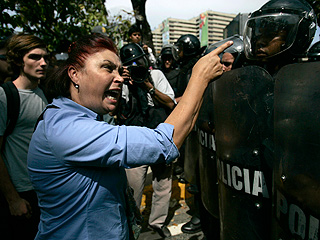
The real face of communism

Earlier, Venezuela nationalized some oil drilling plants, as well:

Petroleos de Venezuela SA, the state oil company, seized about $1 million worth of equipment from Superior Energy Services Inc. (SPN:US), the Houston-based company said.

PDVSA expropriated two hydraulic units that were idled after the Caracas-based company missed payments, Greg Rosenstein, head of corporate development, said by phone from New Orleans. The units operated in eastern Venezuela’s Anzoategui state, Associated Press reported Nov. 1.

[…]Under President Hugo Chavez, who died of cancer in March, Venezuela initiated a nationalization process, seizing assets from companies including Exxon Mobil Corp. (XOM:US) and ConocoPhillips. (COP:US)

Schlumberger Ltd. (SLB:US), the world’s largest oil-services company, said in March it would reduce work in Venezuela because of mounting overdue payments from PDVSA. Schlumberger subsequently reached an agreement and announced on May 24 that it would provide a $1 billion rolling credit for a joint venture in Venezuela.

That will encourage oil companies to come to Venezuela and pay royalties to the government, and give jobs to more Venezuelans. Oh wait, no it won’t. It’s just going to cause companies to scale back their investments, expand in other countries, stop hiring, lay off more people, and pull out of Venezuela. I’m sorry but this is standard leftist economic policy.
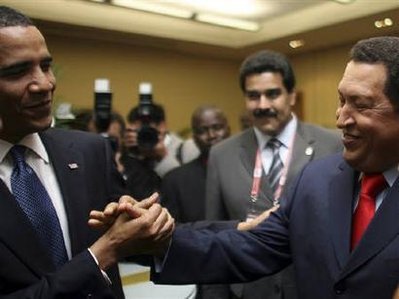
Are Barack Obama and Hugo Chavez very different?

Remember the last time that Venezuela seized privately-owned oil companies? They eventually had a nice explosion at the oil drilling facility, because the government doesn’t know how to run a business better than the people who created that business. You can see it today here, as Obama nationalizes the health care industry and tries to substitute his own web site. He thinks he knows how to create web sites. The man who has never run so much as a lemonade stand in his entire life, and is an authority on how to read a teleprompter and play golf. You do NOT put people like this is in charge of the economy.
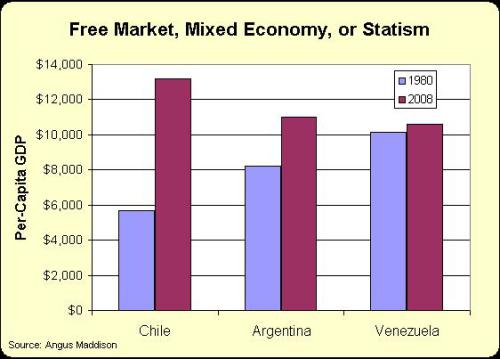
Comparing Chile to Argentina and Venezuela

The strange thing is that the economies of Chile embraced free market capitalism, free trade, private property, and the rule of law. Unlike Venezuela and Argentina, they are doing vastly better economically. Look at that chart, which I got from libertarian economist Dan Mitchell. You can’t refute that, because economics is real. No one can hide from the facts.

Related posts

An honest look at the many contributions of Hugo Chavez to Venezuela

Are Barack Obama and Hugo Chavez very different?

From Reason magazine. (H/T Ian L.)

Excerpt: (links removed)

Hugo Chávez’ presidency has been a disaster for the Venezuelan people. Chávez’ “Socialism of the 21st Century” changed Venezuela from one of the most prosperous and politically free countries in Latin America to one of the least competitive and most repressive countries worldwide. Venezuelans who go to the polls today will ponder many of the President’s policy failures, including a long list of Chávez’nblunders in the last year alone.

Under Chávez’ rule, oil-rich Venezuela has become one of the least economically competitive countries in the world. In 2012, the country ranked 126 of 144 in a study by the World Economic Forum. According to the report, Venezuela now has some of the lowest scores worldwide in functioning of public institutions, trust in the justice system and domestic competition. It has some of the highest scores in terms of regulation, trade tariffs, and rules that deter foreign investment. The country has an inflation rate of 26 percent, and has also suffered several food shortages this year.

Venezuelan infrastructure has been falling apart under Chávez. On August 15th, the Cupira bridge near Caracas collapseddespite repeated warnings from engineers that it was in disrepair. Last month, poor drainage infrastructure led to nationwide flooding, resulting in over 400 families losing their homes and 1,500 people ending up in shelters. Chávez also mismanages Venezuela’s oil wealth. Since the government effectively took control of the national oil company in 2004, it has become much less efficient and production is 25 percent lower than when Chávez took office. Accidents are common—an offshore oil rig sank into the sea in 2010 and an oil refinery explosion in August killed at least 48 people. Despite sitting atop the world’s largest proven oil reserves, Venezuela nowimports and rations gasoline.

According to USA Today, Venezuela has the fourth highest murder rate in the world and is now the most violent South American country. Between the time Chávez took power in 1998 and 2012, kidnappings have risen from a few hundred annually to a record of 16,000 in 2011. Homicide rates have nearly tripled and suspect arrests have fallen by 61 percent. Only eight in every 100 murder investigations lead to an arrest. Murder of police officers has risen by 45 percent  in the last year alone. Violence is much worse for Venezuela’s inmates despite Chávez’ campaign promises of prison reform. A prison riot on August 24 left 26 people dead and 43 injured after inmates took over the compound and held it for four hours. Venezuelans are 20 times more likely to be killed in penitentiaries than outside of them. More than three hundred people have died and 572 have been injured in Venezuelan prisons this year alone.

Venezuelans have also witnessed alarming revocations of political liberties during Chávez’ presidency. On September 10th, Chávez decided to withdraw from the Inter-American Court of Human Rights. He regularly targets media who expose his failures. He recently arrested two journalists for writing a satirical article about his leadership. In addition, he demanded the names of voters who participated in the opposition’s primary election last February, just as he did to those who unsuccessfully voted to remove him from office in 2004. Chávez has banned foreign funding for civil society watch dogs, which will make electoral transparency in upcoming elections difficult.

UPDATE: Reformed Seth sent me this article from Human Rights Watch as well.

Excerpt:

Hugo Chávez’s presidency (1999-2013) was characterized by a dramatic concentration of power and open disregard for basic human rights guarantees.

After enacting a new constitution with ample human rights protections in 1999 – and surviving a short-lived coup d’état in 2002 – Chávez and his followers moved to concentrate power. They seized control of the Supreme Court and undercut the ability of journalists, human rights defenders, and other Venezuelans to exercise fundamental rights.

By his second full term in office, the concentration of power and erosion of human rights protections had given the government free rein to intimidate, censor, and prosecute Venezuelans who criticized the president or thwarted his political agenda. In recent years, the president and his followers used these powers in a wide range of prominent cases, whose damaging impact was felt by entire sectors of Venezuelan society.

Many Venezuelans continued to criticize the government. But the prospect of reprisals – in the form of arbitrary or abusive state action – forced journalists and human rights defenders to weigh the consequences of disseminating information and opinions critical of the government, and undercut the ability of judges to adjudicate politically sensitive cases.

[…]Chávez also rejected international efforts to promote human rights in other countries. In recent years, Venezuela consistently voted against UN General Assembly resolutions condemning abusive practices in North Korea, Burma, Iran, and Syria. Moreover, Chávez was a vocal supporter of Syria’s Bashar al-Assad, Libya’s Muammar Gaddafi, and Iran’s Mahmoud Ahmadinejad, bestowing upon each of these leaders the “Order of the Liberator,” Venezuela’s highest official honor.

Under Chávez, Venezuela’s closest ally was Cuba, the only country in Latin America that systematically represses virtually all forms of political dissent. Chávez identified Fidel Castro – who headed Cuba’s repressive government until his health deteriorated in 2006 – as his model and mentor.

That’s the dream of people on the left like Sean Penn. They love the idea of doing away with liberty and human rights. They want to force their secular leftist ideology on everyone at gunpoint.

Everyone who is praising this communist dictator today should be ashamed. None of them would move out of the United States to live in Venezuela – it’s nothing but hypocrisy.

Related posts

What causes Colombia’s economy to grow? What causes Venezuela’s economy to shrink?

Political Map of South America

Would you like to have a growing economy? Then follow the lessons of Colombia.

Excerpt:

Colombia expects lower fiscal deficits in 2013 than in 2012, while economic growth is projected at 4.8 percent for both years, Finance Minister Juan Carlos Echeverry said on Thursday.

Latin America’s No. 4 oil producer has seen a strong recovery from the global economic crisis, recouping three investment-grade credit ratings and continuing to reap strong inflows in the mining and oil sectors.

Presenting the latest fiscal plan, Echeverry said the government had revised down the 2012 central government fiscal deficit target to 2.4 percent of gross domestic product from 2.8 percent previously, and the consolidated deficit to 1.2 percent of GDP from 1.8 percent. The consolidated deficit includes the central and regional governments.

The central government deficit target is seen at 2.2 percent of GDP in 2013, with the consolidated deficit at 1 percent.

“This fiscal plan is serious, reasonable, we’re not extracting liquidity from the economy, but injecting liquidity into the economy,” Echeverry told reporters.

The government expects the economy to grow 4.8 percent this year and next. Economic expansion was 5.9 percent in 2011, the fastest growth rate in four years, helped by high foreign investment and strong consumer spending growth.

Colombia has attracted billions of dollars in foreign direct investment over the past decade, mostly into the oil and mining sectors after U.S. military aid helped security forces deal crippling blows to leftist guerrillas and cocaine cartels.

Consumer prices have remained at steady levels in recent months, and economists expect 2012 annual inflation to fall within the central bank’s target of 2 percent to 4 percent.

The fiscal plan forecasts full-year inflation at 3 percent this year and next.

Under Obama, the United States has been running deficits of between 8-10% GDP. Revenue is the same as usual, but spending to reward reckless, irresponsible behavior has skyrocketed.

Would you like to avoid a shrinking economy? Then avoid the policies of Venezuela.

Excerpt:

Venezuela has devalued its currency, joining Iran, Argentina and others whose wars on math brought the same result. Some call this a “restorative.” It’s not. It’s what happens when big government hits a wall.

Venezuela’s monster 47% devaluation from 4.3 to 6.3 bolivars to the dollar, reportedly ordered by President Hugo Chavez from his hospital bed in Cuba, marks the reckoning for his regime’s big-spending ways in Venezuela’s low-growth economy.

[…]This devaluation is characteristic of all tyrannies, which benefit by effectively expropriating the savings of the private sector through monetary means rather than the more common thuggery.

Chavez’s meltdown is coming for the same reason devaluations are also shaking Argentina, which is undergoing a new fiscal disaster of its own, Egypt, which is going through a slo-mo devaluation that’s pushing up the price of food and prompted its Islamofascist rulers to actually urge people to eat less food, and Iran, whose madhouse economics has triggered hyperinflation.

It’s how dictators do business. This is Chavez’s sixth devaluation in the last decade of his big-spending power, following devaluations in 2002, 2003, 2004, 2005, 2010 and 2011. Every one of these devaluations inflates away some of his debts — but at the expense of the country’s savings and investment, which are snapped away through inflation.

What’s more, this devaluation, which was done to plug his deficit spending and prop up the state oil company, will only cover 60% of the country’s deficit, meaning more devaluations ahead this year, likely to take the bolivar to 8 by year end.

Venezuelan officials, predictably, claimed it was “good” as well as an “improvement” that protects the middle class against “speculators,” echoing the party line of establishment economists such as Joseph Stiglitz, former Bill Clinton adviser and chief economist of the International Monetary Fund, who in the past has called devaluations an economic ” restorative.”

Tell that to the panic buyers across Venezuela. There, terrified consumers who are buying goods ahead of expectations of soaring prices, while the poor have seen their life savings wiped out.

When Obama took office, a US dollar was worth over 1.20 Canadian. Today it’s worth about 98 cents. He has been devaluing the currency in order to pay for massive government spending. Private savings of individuals have been devalued, as a result. Inflation is a hidden tax on those who earn and save.

In the United States, we are doing the exact opposite of Colombia. We are embracing Venezuela policies, and expecting Colombia results. Why are we stupid enough to believe words instead of results? Socialism doesn’t work. Capitalism does work. We should choose what works.