My friend Terrell sent this article to me from the Lafayette Journal & Courier. It talks about a change to Purdue’s student assistance program that will help students to think twice about what they are majoring it, and whether it will pay off.
Excerpt:
Purdue University is close to bringing income share agreements to campus by the next academic year.
Purdue Research Foundation is finalizing a contract with a partner firm that will fund student tuition in return for a percentage of income for several years after graduation, Brian Edelman, PRF’s chief financial officer, said Tuesday.
Purdue announced in August it was seeking a partner to launch the agreements as an alternative to student loans. The university received seven “expressions of interest” and narrowed the search down to one finalist, although Edelman said it’s too early to identify the firm and how the partnership might work.
But more details about how Purdue might implement the alternative have come available. PRF will complete a sample term sheet in the next few weeks and begin planning with a pilot of 100-300 students as early as this spring, Edelman said. Those students could receive funding for the entire 2016-17 year.
During a University Senate meeting Monday, Edel estimated what a contract might look like for students: A $10,000 investment might cost 3 percent to 5 percent of income for five to seven years. An individual earning $48,500 a year — the median income among college graduates in 2013, according to the National Center for Education Statistics — would be on the hook for as little as $7,275 or as much as $16,975, depending on the terms.
This part made me laugh:
Other faculty members expressed concern that such agreements might favor STEM or business students, who typically have higher incomes and better job prospects after graduation, and steer the university and faculty toward producing graduates who earn more income.
Well of course the faculty don’t want students to think about getting a return on their degree – because then most of them would be out of a job! College education only makes sense if you can get a return on your investment. In theory, you could study anything and get a return on your investment. In practice, you’re better off with STEM degrees – lower post-graduation unemployment, and better starting and median salaries.
Look:
Starting and Mid-Career salaries by profession (click for larger image)
I love this idea by Purdue, it will really help students to think about what they are studying, and that is good for taxpayers, because something tells me that we are going to get the bill for the $1 trillion in outstanding student loans.
Bernie Sanders, Hillary Clinton and the rest of the Democratic leadership are constantly complaining that college education costs too much. What they never bother to explain, however, is why.
Two economists set out to do so, and Bernie and company will not like what they found.
Grey Gordon and Aaron Hedlund, economists at Indiana University and the University of Missouri, developed a method to test various explanations for the share rise in tuition costs. Is it state funding cuts? Or the increased wage premium for a college degree? Or is it related to general cost increases in the services industries?
Not exactly. In a working paper published by the National Bureau of Economic Research the economists report that these factors contributed insignificantly to the rapid rise in tuition between 1987 and 2010.
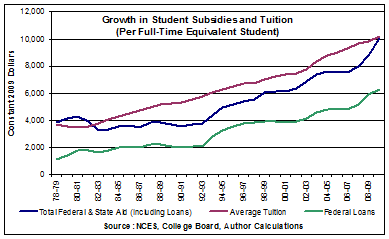
What did account for almost all of it was, ironically enough, the massive explosion in federal aid over the past several decades. Federal aid — in the form of subsidized loans, grants and tax credits — shot up 134% in the past 15 years, according to the College Board. It’s climbed 22% just under President Obama.
Combined with state aid, the government is pouring more than $239 billion a year into programs designed to make college less expensive.
What the authors found is that all this aid money has simply let college administrators spend more and jack up tuition to pay for it, without hurting enrollment. The result is there to see for anyone who visits a college campus these days — gourmet kitchens, luxurious dorms, shiny new administrative buildings, beautiful landscapes, state of the art workout facilities, etc.
The authors call this the “Bennett hypothesis,” after former Education Secretary William Bennett, who wrote in 1987 that “increases in financial aid in recent years have enabled college and universities blithely to raise their tuitions.”
Not only does the increased federal aid lead to higher tuition, the authors found, but it perversely leads to “more debt, and in the absence of higher labor market returns, more loan default inevitably occurs.”
In other words, the Democrats’ plan to provide still greater amounts of federal aid will only make matters worse.
Basically, college administrators know that people are willing to pay X to go to university.
This hypothesis – that it is government subsidies that drive up tuition rates – is supported in the radically leftist New York Times, of all places.
This is by Paul F. Campos, law professor at the radically leftist UC Boulder.
He writes:
[…][T]he astonishing rise in college tuition correlates closely with a huge increase in public subsidies for higher education. If over the past three decades car prices had gone up as fast as tuition, the average new car would cost more than $80,000.
[…]As the baby boomers reached college age, state appropriations to higher education skyrocketed, increasing more than fourfold in today’s dollars, from $11.1 billion in 1960 to $48.2 billion in 1975. By 1980, state funding for higher education had increased a mind-boggling 390 percent in real terms over the previous 20 years. This tsunami of public money did not reduce tuition: quite the contrary.
The more money that is attached to students, the more money universities charge – simple.
But where is the money going? Is it mostly going to research? To the classroom? To hire more and better professors?
No:
Interestingly, increased spending has not been going into the pockets of the typical professor. Salaries of full-time faculty members are, on average, barely higher than they were in 1970. Moreover, while 45 years ago 78 percent of college and university professors were full time, today half of postsecondary faculty members are lower-paid part-time employees, meaning that the average salaries of the people who do the teaching in American higher education are actually quite a bit lower than they were in 1970.
By contrast, a major factor driving increasing costs is the constant expansion of university administration. According to the Department of Education data, administrative positions at colleges and universities grew by 60 percent between 1993 and 2009, which Bloomberg reported was 10 times the rate of growth of tenured faculty positions.
Even more strikingly, an analysis by a professor at California Polytechnic University, Pomona, found that, while the total number of full-time faculty members in the C.S.U. system grew from 11,614 to 12,019 between 1975 and 2008, the total number of administrators grew from 3,800 to 12,183 — a 221 percent increase.
Do you wonder why college is so liberal? It’s because instead of hiring professors to teach you how to do useful work for money, they are hiring useless administrators who just enforce politically correct secular leftism onto the students.
UPDATE: My friend Drew posted this in the comments:
What should young people considering college do? If you’re going to college or trade school, go to a low-cost school. Do a STEM degree or do a trade that pays well. Try to get tuition assistance even if it means going to a less prestigious school. And work at every opportunity you get in the most serious job you can find. Don’t spend your money – save it. Especially don’t spend your money on fun, vacations and alcohol. As soon as you grow up, you’re going to wish you could have it all back.
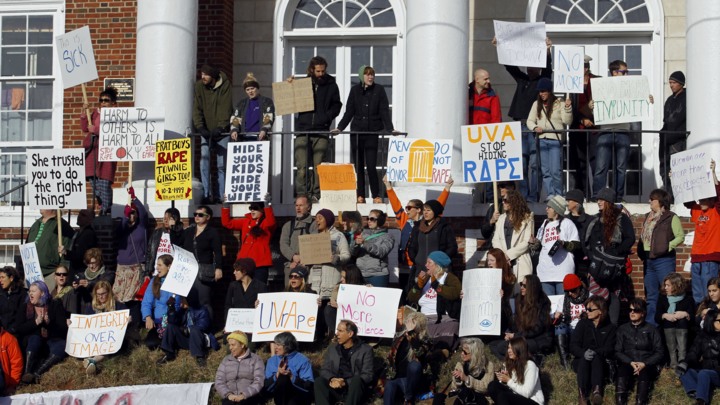
UVA students protesting a rape accusation that was later revealed to be a hoax
Consider this clip:
This is a post by Dr. George Yancey, and he’s writing about the 5-minute video clip above.
Dr. Yancey writes:
Here is a great example of what I term education dogma. Note that the students are chanting about not being silenced while they are obviously silencing the speaker. My understanding of this situation is that the speaker published something that challenges some of the assertions about a campus rape culture. Such a challenge is an affront to the dogma of the students. Therefore, these students do not feel that the speaker has a right to speak on a different topic. The violation of beliefs they accept without question or doubt creates their incentive to shut down the proceedings.
[…]For the dogmatic, ideas that violate the notions defended by education dogma are deemed “dangerous” and too much for the tender ears of our students. So in additional to shouting down speakers there have been calls for “trigger warnings” and “safe spaces” so that individuals do not have to listen to dangerous ideas. The true danger of these ideas is their threat to certain dogmatic beliefs of our students. These students are unwilling to consider the possibly that they are wrong, or perhaps not as right as they might believe. .
[…]As I watch that video I did not see intellectual powerhouses but I symbolically saw individuals who were yelling nonsense with their hands over their ears so that they would not hear an idea that may confront their presuppositions about reality.
Here, Dr. Yancey compares the secular leftist students to religious fundamentalists: (links removed)
For all practical purposes the students saw the speaker as a heretic. The use of the term heretic can bring up images of torturing, imprisoning and killing of those who disagree. This is not occurring. However, it is reasonable to ask whether the seemingly restraint of the students from such drastic actions is due to their moral compass or to the fact that they do not have the social power to engage in such actions. Education dogma has led to attempting to kick offending businesses off campus, attempts to fire professors, and the official “shunning” of students who hold the “wrong ideas.” Those with education dogma do punish those who violate their beliefs to the highest extent possible given their current level of institutional powers.
So if the holding your hands over your ears and screaming doesn’t work, there is always calling the police, or using other means of coercion. Scary, especially when you consider the history of the secular left in communist countries where God is dead, and the state is all-powerful. How far would these leftist students go to silence people who disagreed with them?
More:
[…][H]igher education occurs in a specific social institution that promotes certain subcultural values and beliefs. Participants in these institutions are expected to accept these values and beliefs without question. These beliefs are not the result of gaining more facts but instead are the dogmatic adaptation of certain social values provided to them by this subculture.
The trouble here is that they don’t want more facts – that’s why they are holding their hands over their ears and screaming.
It makes me think of my own intellectual journey… the way I got started in apologetics in college was by reading transcripts of William Lane Craig debates that I found on the Leadership University web site. What was exciting was reading both sides and seeing what each person would say to respond. Would you go to a football game where only one side showed up? What if you already knew the score in advance, would you still go? What if one team didn’t play very hard, would that be worth watching? What makes intellectual inquiry fun and interesting is that two sides show up and play their best. Otherwise, it’s just brainwashing, not a search for truth. When I write a summary with a good atheist like Peter Millican, I actually feel like I have learned something – I have learned how far I can push each of my arguments, and what I need to study going forward. I care to learn more about what is discussed in a real debate.
This is the striking part of his essay:
Students are responsible for seeking out alternative perspectives and developing an attitude of inquiry allowing them to interrogate their own presuppositions. But their college and university teachers should be held to account since more than a few college professors have done a horrible job introducing critical thinking skills. These teachers come in with a certain set of assumptions and if students agree with those assumptions then they can leave college without any disturbance to their pre-college ideology. Then we have the gall to call that critical thinking. It is anything but critical thinking. It is confirmation thinking and we do our students a disservice with such an approach.
This is why I get so frustrated by non-STEM disciplines. I think those non-STEM areas are the places where what he described is most likely to happen. When you walk into a computer science classroom, you are there to learn something that you will be doing for money in a couple of years. You can go home and use what you just learned to write a sorting program, or improve the speed of your database queries, or write a mobile application and put it out for use. I just don’t get that feeling of usefulness from non-STEM disciplines, aside from maybe analytical philosophy, which is just computer science anyway (symbolic logic). The critical thinking in computer science comes from trying things yourself and seeing what works and doesn’t work in real life. Where is the testing against reality in non-STEM disciplines? There is none.
And then here is something hopeful for conservatives:
Ironically a conservative Christian Republican has a better opportunity to learn critical thinking in college than a progressive humanist Democrat because of the opportunity he/she gains to consider new ideas. When we allow students with certain perspectives to go through college without challenging them we not only promote dogma, we also do those students the disservice of never helping them to engage in the critical thinking necessary to intellectually grow. They are reduced to being a sounding board that regurgitated the latest expression of political correctness.
This is where all my hope lies. I really hope that the leftists educate their next generation into imbecility by refusing to let them consider different points of view. We conservatives must be the ones who consider both sides, and then rise above the mob of fools. To innovate, you have to do things better, and to do things better, you have to do things differently.


 WINTERY KNIGHT