Tag Archives: Union

Treasury Department threatens private companies for responding to Obamacare incentives

Investors Business Daily reports on how the Treasury Department is threatening private companies who lay off employees because of the costs imposed on them by Obamacare.

Excerpt:

In what may be considered an ObamaCare loyalty oath, the Treasury Department orders employers to attest that any employee layoffs are not due to its imposed costs under penalty of perjury.

The first rule of business is to stay in business, something which is accomplished by doing what government is incapable of doing — controlling costs and making a profit by giving customers a product or service they need or want.

ObamaCare is obviously a product neither business nor the individual wants, so coercion is necessary under penalty of law.

Enforced by the Internal Revenue Service, individuals must enroll in government-approved plans or be fined.

Individuals are not allowed, despite presidential promises, to keep the plans and doctors they like and can afford.

Instead, they must accept plans they don’t like and can’t afford, some getting subsidies extracted from other taxpayers or China. They must grin and bear their reduced health care choices and higher costs.

Even though ObamaCare’s employer mandate has once again been illegally and unconstitutionally extended by the president who would be king, business still faces ObamaCare’s punitive cost increases down the road and its own form of government coercion.

Layoffs are an unfortunate but sometimes necessary means for a business to control costs and stay in business.

On Monday, a Treasury Department unconcerned with the necessities of the free market said that businesses will need to “certify” that they are not shedding full-time workers simply to avoid the mandate and its costs.

Officials said employers will be told to sign a “self-attestation” on their tax forms affirming this, under penalty of perjury.

What happens when a government passes regulations that make it harder for employers to lay off workers if they are forced to? Well, companies stop hiring workers, and expand their operations elsewhere. That’s exactly what has happened in countries like France, where the government makes it nearly impossible to get rid of workers, even when circumstances warrant it. So the net effect of policies that reduce the freedom to hire/fire as needed is to raise unemployment.

Here’s the economist Aparna Mathur of the American Enterprise Institute to explain.

Excerpt:

Labor market regulations often take the form of employment protection rules that govern the hiring and firing of workers. These were originally introduced to enhance workers’ welfare; for instance, by reducing unfair dismissals. The same provisions that protect employees, however, translate into cost for employers, leading an employer to think twice (at least) before hiring a new employee.

Theoretical economic models have shown that, in general, the effect of such laws is to reduce job flows (broadly, the sum of jobs created and jobs destroyed). In my paper, I show that these reduced job flows could have negative effects on investments in education because they reduce the expected returns on a job search; and they lower the value of education as a signaling device.

Under rigid labor market regulations, employers have a stronger disincentive to create new jobs, so there are fewer available jobs on the market. As a result, one’s likelihood of earning a productive wage is reduced. Moreover, firings under a system of strong labor market regulations are less frequent than they would be otherwise, so even workers with jobs expect to face fewer opportunities to search for re-employment. As a result, they will have less use of education as a signaling device to secure their next job.

With flexible labor markets and higher job mobility, these conditions are reversed. Job flows are higher, leading to more vacancies per unemployed worker. This yields a higher expected return on a job search for educated workers since the likelihood of finding a job is higher. Further, workers are either fired or they quit more frequently (i.e., job destruction is higher), leading to a greater use (or need) of education as a signaling device.

Put simply, imagine a developing country with rigid labor markets leading to few vacancies. For a low-income worker, the cost of getting educated may outweigh the prospective benefits since the likelihood of finding a job in this scenario is fairly low. On the other hand, for the same worker, if the likelihood of finding a job goes up when labor market restrictions are removed, the incentive to invest in education may be higher since the returns to investing in this costly activity are higher. Countries such as France, Germany, and Italy, which consistently have strict labor regulations, would do well to heed these results (see figure). It is also true in general that developing countries have stricter labor regulations than the OECD economies.

All these regulations sound so good, but we have to think beyond stage one in order to see the real results of the happy-sounding speeches. These things are understood by economists, but we didn’t elect an economist.
Minimum wage: doing what feels good doesn’t produce good results

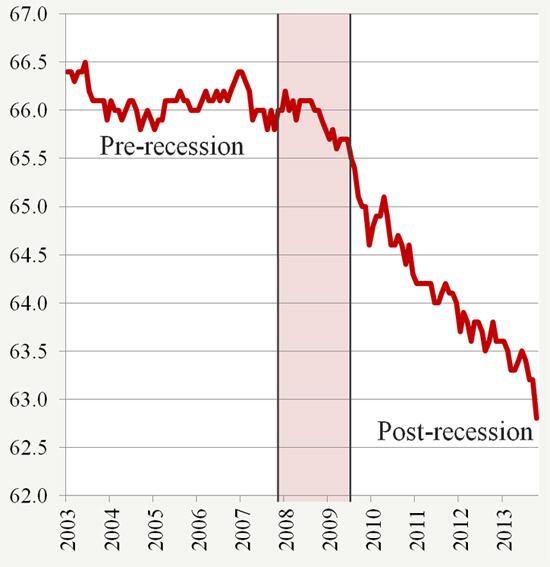
Labor Force Participation down to 62.8%

Will Obama’s plan to raise minimum wage help people?

From the Daily Caller. (H/T Conway)

Excerpt:

The Obama administration’s proposal to raise the minimum wage to $10.10 an hour could result in as many 1,084,000 jobs eliminated from the work force, according to a new study conducted by the Employment Policies Institute (EPI)

“No amount of denial by the president and his political allies — and no number of ‘studies’ published by biased researchers — can change the fact that minimum wage hikes eliminate jobs for low-skill and entry-level employees. Non-partisan economists have agreed on this consensus for decades, and the laws of economics haven’t changed,” Michael Saltsman, research director at EPI, said in a statement.

He offered an alternative to the president’s plan: “Instead of raising small businesses’ labor costs and creating more barriers to entry-level employment, the president and the Senate should focus on policies that help reduce poverty and create jobs.”

The  study was released in the wake of an expected vote on a Senate bill that aims to raise the federal minimum wage from the current $7.25 an hour to $10.10 an hour — a nearly 40 percent increase.

Many Democrats argue that increasing the federal minimum will reduce poverty without having an adverse effect on unemployment.

EPI’s report, which used analysis from economists at Miami and Trinity University, reached a different conclusion.

Researchers used recently updated Census Bureau data from 2012 and 2013 to calculate how each individual state would be impacted by the proposed wage hikes. As a lump sum, Americans would see a loss of at least 360,000 jobs, and perhaps even over one million if hourly wages are increased to $10.10.

The number of job losses would be the most dramatic in large states, such as California and Texas. Economists found that California could lose as many as 100,016 jobs and Texas could see up to 128,617 jobs disappear from its economy.

But’s it’s not just this proposal that is the problem, it’s his past policies.

After FIVE YEARS of Obamanomics, we still have a record 100 MILLION people still out of work from when he became President. There has been NO RECOVERY since the housing bubble, which was caused by the Democrats in Congress. Policies like raising the minimum wage only make that worse, although it sounds great to Obama’s low information supporters.

Minimum wage raises cause higher unemployment

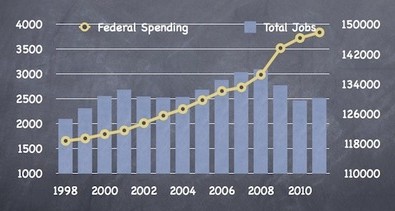
Government Spending Vs Jobs

From Investors Business Daily.

Excerpt:

How amusing to watch Democrats wring their hands over what they can do to get businesses to create jobs, when one of the biggest job killers is the minimum wage they keep hiking.

Recall that it was Democrats who raised the federal wage floor a whopping $2.10 an hour in the middle of the recession. The record 41% increase has led to record unemployment among young people, especially black teens.

Congress started ratcheting up the minimum wage from $5.15 an hour in mid-2007, arguing it would help abate poverty. But retailers looking to slash costs eliminated low-skilled, entry-level jobs rather than pay the mandated increases.

Now 1.5 million fewer teens are working. Last year’s unemployment rate for workers ages 16 to 19 shot up to 26% from 2007’s 15%.

As for black teens, their joblessness soared to a record 43% after the final raise to $7.25 took effect in mid-2009. It helped put more than half of young black men out of work — a first.

The president proposes cranking the minimum wage even higher to $9.50. Then he wants to raise it every year thereafter as a “living wage” indexed to inflation.

Yes, this is the problem that happens when you elect someone who knows nothing whatsoever about economics. And when I say nothing, I mean he is in disagreement with virtually all economists across the ideological spectrum.

A large majority of economists agree

Moderate economist Gregory Mankiw of Harvard University lists the policies that are accepted by virtually all economists.

Here’s Greg’s list, together with the percentage of economists who agree:

  1. A ceiling on rents reduces the quantity and quality of housing available. (93%)
  2. Tariffs and import quotas usually reduce general economic welfare. (93%)
  3. Flexible and floating exchange rates offer an effective international monetary arrangement. (90%)
  4. Fiscal policy (e.g., tax cut and/or government expenditure increase) has a significant stimulative impact on a less than fully employed economy. (90%)
  5. The United States should not restrict employers from outsourcing work to foreign countries. (90%)
  6. The United States should eliminate agricultural subsidies. (85%)
  7. Local and state governments should eliminate subsidies to professional sports franchises. (85%)
  8. If the federal budget is to be balanced, it should be done over the business cycle rather than yearly. (85%)
  9. The gap between Social Security funds and expenditures will become unsustainably large within the next fifty years if current policies remain unchanged. (85%)
  10. Cash payments increase the welfare of recipients to a greater degree than do transfers-in-kind of equal cash value. (84%)
  11. A large federal budget deficit has an adverse effect on the economy. (83%)
  12. A minimum wage increases unemployment among young and unskilled workers. (79%)
  13. The government should restructure the welfare system along the lines of a “negative income tax.” (79%)
  14. Effluent taxes and marketable pollution permits represent a better approach to pollution control than imposition of pollution ceilings. (78%)

You can find out more about how raising the minimum wage increases unemployment, especially for young people and minorities, from this comprehensive, 50-year, government study.

This is why it is important for voters to understand economics. When you raise the price of labor, fewer employers will purchase labor. Supply and demand. This is so basic, that I am surprised that someone as educated as Obama doesn’t understand it. It’s probably because he has virtually no experience working in the private sector.

Wisconsin governor Walker’s reforms hit the left in their wallets

Canadian Prime Minister Stephen Harper
Canadian Prime Minister Stephen Harper is mean

First, let’s talk about Stephen Harper. I sometimes blog about conservative Canadian prime minister Stephen Harper, who Dennis Prager calls “the leader of the free world”. He has a record of putting into place laws that cut off the ability of the left to get campaign funding without consent from the people supplying the money.

Here’s an article from Canada’s National Post.

Excerpt:

While the political showdown making news this month has pitted Prime Minister Stephen Harper against Senator Mike Duffy, a more important battle is shaping up for the 2015 election. It’s between the Conservative Party and organized labour — as evidenced by the resolutions the party will be debating at its policy convention in Calgary this week.

Proposals include allowing secret ballots during strikes, banning the use of dues for political purposes, requiring increased financial disclosure by unions, and passing right-to-work legislation. The resolutions are moved by electoral district associations in Alberta, Ontario and Quebec, and together represent what appears to be the largest block of resolutions on any one theme.

Why the focus on organized labour, and why now? In part, it’s ideological. While small-c conservatives respect freedom of association, they also respect the freedom not to associate. The labour movement’s rules — particularly the RAND formula, which obliges workers in unionized workplaces to join whether they want to or not — restricts workers’ freedom of choice. Unions also spend dues on causes that workers may not support, and demand workers follow their direction on strike action, even if workers may be opposed or not be able to afford the loss in pay.

[…]The Conservatives have pledged to balance the federal budget by the time they go to the polls. One of the elements of their plan is downsizing government, which pits them directly against the Public Service Alliance of Canada. For two years now, PSAC has been fighting against Conservative cuts to the bureaucracy and the party’s policy of reduction by attrition. PSAC’s rallies and campaigns, however, have done nothing to dent the Tories’ resolve (long overdue, considering that they substantially grew the size of the bureaucracy during the early years of their mandate). Curtailing PSAC’s power and voice would help the Tories achieve their downsizing goals for both the short and long term.

Back in 2006, Stephen Harper banned political contributions from corporations and unions. Nasty! And he’s not done yet, according to this article. It’s good to win, and win, and win again. I am tired of conservatives losing, even in other countries.

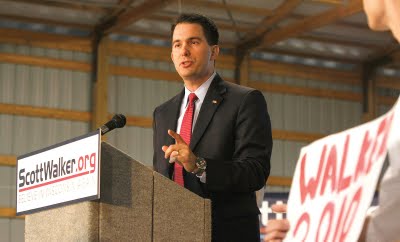
Governor Scott Walker

Now when I look around at the Republican Party, I rarely see the same will to do effective things that will cripple the left financially. It’s like Republicans don’t want to offend people, especially journalists. They want to be liked at cocktail parties.

But there is one Republican who is fine with being hated by his enemies, and he is getting a lot of attention from conservatives ahead of the 2016 election.

Wisconsin Governor Scott Walker
Wisconsin Governor Scott Walker is also mean

Here’s the story from the Associated Press.

Excerpt:

The 2011 state law that all but ended collective bargaining for most public workers has hit Wisconsin’s second largest union particularly hard.

The latest tax documents available show combined income of American Federation of State, County and Municipal Employees (AFSCME) dropped 45 percent in 2012 _ the first full year of the law, according to The Capital Times.

In 2011, the four councils that make up the state organization reported a combined income of $14.9 million. In 2012 that dropped to $8.3 million. Dues revenue dropped 40 percent to $7.1 million.

Walker and supporters of the law said it was a way to help local governments reduce the costs of employee benefits, but the legislation also included measures aimed at financially weakening unions by ending automatic dues deductions.

The union’s Council 40 executive director, Rick Badger, says that while the declines in revenue stemming from the law were expected, he has been encouraged by the number of workers who have continued to pay voluntary dues.

“In fact, what (the law’s) architects might find surprising is our resilience,” he wrote in an email. He said thousands of “front-line workers are remaining engaged in fighting for their rights despite heavy-handed political attempts to silence them.”

While public unions no longer enjoy the official bargaining power that they exercised in recent decades, he said many public workers continue to value their presence as advocates for their rights and welfare.

AFSCME is second only to the Wisconsin Education Association Council, or WEAC, in members in Wisconsin. It has long been a powerful player in state politics, funneling money directly to campaigns and running independent television ads in support of pro-labor candidates, as well as providing a legion of employees and member volunteers who made sure their union brethren voted on Election Day.

The law has also hit other big unions in the state. For instance, WEAC, the state’s largest teachers union, saw its revenue drop from $26 million in 2011 to $20 million in 2012.

This is definitely someone we conservatives need to look at in 2016. He has had to face the left in a blue-ish state, and he won.

During the Christmas vacation, I read governor Walker’s new book, which was a Christmas present from my friend ECM. If you want to learn more about governor Walker, I recommend picking that up. I actually got the audio version, and it’s read by governor Walker himself.

Related posts