
Tag Archives: Unemployment

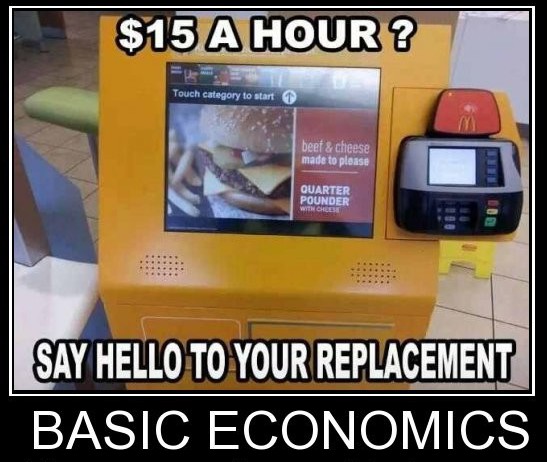
Proposed minimum wage increases will lead to increased automation in restaurants

Basic economics: when you raise the price of something, people buy less of it

This is from the leftist Washington Post, of all places. Not the place you would normally look for knowledge of basic economics.

Excerpt:

The [restaurant / fast food] industry could be ready for another jolt as a ballot initiative to raise the minimum wage to $15 an hour nears in the District and as other campaigns to boost wages gain traction around the country. About 30 percent of the restaurant industry’s costs come from salaries, so burger-flipping robots — or at least super-fast ovens that expedite the process — become that much more cost-competitive if the current federal minimum wage of $7.25 an hour is doubled.

[…]Many chains are already at work looking for ingenious ways to take humans out of the picture, threatening workers in an industry that employs 2.4 million wait staffers, nearly 3 million cooks and food preparers and many of the nation’s 3.3 million cashiers.

[…]Labor isn’t the only ingredient that factors into the price of a Big Mac: There’s also real estate, which has been getting more expensive, especially in the hot urban markets where restaurants are seeking to locate. Wholesale food costs, meanwhile, have escalated 25 percent over the past five years.

The avalanche of rising costs is why franchisers are aggressively looking for technology that can allow them to produce more food faster with higher quality and lower waste. Dave Brewer is chief operating officer with Middleby Corp., which owns dozens of kitchen equipment brands, and is constantly developing new ways to optimize performance and minimize cost.

“The miracle is, the wage increase is driving the interest,” Brewer said. “But the innovation and the automation, they’re going after it even before the wages go up. Why wait?”

All that innovation helps restaurants streamline other parts of their operations — and draw more customers. Electronic menus can be constantly updated so that items that are out of stock can be removed. Connecting the point of the sale to the oven’s operating system allows precise amounts of food to be cooked, which helps cut down on costs. Other inventions save energy, reduce maintenance and better dispose of grease. On the digital side, restaurants are working on apps that include reward systems and location tracking that prompt customers to eat with them more frequently.

[…]The labor-saving technology that has so far been rolled out most extensively — kiosk and ­tablet-based ordering — could be used to replace cashiers and the part of the wait staff’s job that involves taking orders and bringing checks. Olive Garden said earlier this year that it would roll out the Ziosk system at all its restaurants, which means that all a server has to do is bring out the food.

Robots can even help cut down on the need for high-skilled workers such as sushi chefs. A number of high-end restaurants use machines for rolling rice out on sheets of nori, a relatively menial task that takes lots of time. Even though sushi chefs tend to make more than $15 an hour, they could be on the chopping block if servers need to make $15 an hour, too.

“For our operation, we’re not buying entry-level labor, but if entry-level labor goes up a huge amount, everything goes up,” said Robert Bleu, the president of True World Group, a seafood distributor and consultant that also owns a sushi restaurant in Chicago. “I don’t consider rice-forming a high art. You can escape some of the drudgery.”

Let’s review the facts on minimum wage.

Abstract from new National Bureau of Economic Research study:

We estimate the minimum wage’s effects on low-skilled workers’ employment and income trajectories. Our approach exploits two dimensions of the data we analyze. First, we compare workers in states that were bound by recent increases in the federal minimum wage to workers in states that were not. Second, we use 12 months of baseline data to divide low-skilled workers into a “target” group, whose baseline wage rates were directly affected, and a “within-state control” group with slightly higher baseline wage rates. Over three subsequent years, we find that binding minimum wage increases had significant, negative effects on the employment and income growth of targeted workers.

[…]Over the late 2000s, the average effective minimum wage rose by 30 percent across the United States. We estimate that these minimum wage increases reduced the national employment-to-population ratio by 0.7 percentage point.

That comes out to 1.4 million workers who lost their jobs, thanks to minimum wage mandates. And those are primarily young, unskilled workers who are affected – people trying to get a start in the workplace and build their resumes, so they can move up.

Harvard economist Greg Mankiw explains the top 14 views that a majority professional economists agree on, and here’s #12:

12. A minimum wage increases unemployment among young and unskilled workers. (79%)

And these facts affect more than the restaurant / fast food business. Here’s an example from ABC News of another business that is having to shut its doors: independent bookstores. It always seems that the people on the lowest “start” rungs of the economic-independence ladder are most affected by bad liberal economic policies.
Bobby Jindal: policies of Hillary Clinton and Bernie Sanders are the same as Greece

Louisiana Governor Bobby Jindal

Here’s an excellent editorial by Louisiana governor Bobby Jindal in left-leaning Time magazine.

He writes:

It’s simple math to understand what is happening in Greece right now. When Greece joined the euro, it benefited from the financial support of its more fiscally responsible neighbors in the euro zone. Rather than taking the opportunity to enact the structural reforms that could have increased growth — reforms that it still has not undertaken — Greece instead went on a spending spree funded by other people’s money.

Greece has been cooking the books with complicated financial instruments for years. But the problems don’t stop there. Greece’s Rubik’s Cube tax code and rampant corruption make tax evasion widespread. Golden parachute public pensions that allow public sector workers to retire as early as 45 drain dollars out of the government coffers while incentivizing a still healthy and work-age workforce to live on the public dime. It’s hard to have sufficient tax paying workers when about 75% of Greek public-sector employees retire by the age 61.

Did the new socialist government run by 40-year-old child Alex Tsipras fix anything?

They made it worse:

After taking office in January, the Alexis Tsipras administration reversed promised privatization of state-owned assets like the Port of Piraeus. In 2011, the IMF predicted Greece could bring in 50 billion euros ($56 billion) from the sale of state assets, not to mention the savings from moving those employees off the public wage and benefit system. To date, it has raised about 3 billion euros.

Business has no interest in creating jobs when crushed by government regulation. Tspiras promised to raise the minimum wage, despite the economy spiraling out of control. It’s not surprising the March unemployment rate stood at 25.6%.

Privatization is a thing that conservatives do, because we don’t like the idea that government workers get automatic pay from compulsory taxation. We prefer that whoever is providing services be in the private sector, as independent from government influence as possible. That way, they actually have to compete with other providers to earn your money – something a government monopoly never has to do.

Anyway, back to Greece socialism. Who would be stupid enough to raise taxes, raise minimum wage, increase spending and promise people more free stuff as a way of getting out of debt?

These two unqualified clowns, that’s who:

Clinton and Sanders are math deniers, like most of the Democrats in D.C. They want to grow the government economy instead of the real American economy. Rather than pursuing tax reform to improve growth or entitlement changes to reduce future expenditures, Clinton and Sanders are focused on spending trillions on Obamacare, giving free college to everyone, and raising the federal minimum wage.

Since January 2007, Democrats have added well over $10 trillion to the national debt, running it up to $18.5 trillion, higher than the entire GDP of the country. What have we got for that? Fewer people in the labor force, and more people dependent on government, that’s what. But oh, you can marry your siblings and pets now, because lurve, so that’s something.

OK, so let’s talk about Bobby Jindal. Initially, I had him slotted in as my #2 candidate with Scott Walker on top. But Walker has had two months and hasn’t done anything super conservative. Meanwhile, Jindal has offered a lot of red meat to conservatives on marriage and right to life, and now we have this aggressive condemnation of socialism, too. I think Jindal is now my top pick, and Walker is next, then Cruz. Fiorina is looking better at this point and is #4, and Rubio is off my list entirely.

Do unemployment benefits discourage people from working?

I noticed that the latest jobs report showed that the percentage of work-eligible Americans working was at a 38-year-low.

CNS News reports:

A record 93,626,000 Americans 16 or older did not participate in the nation’s labor force in June, as the labor force participation rate dropped to 62.6 percent, a 38-year low, according to the Bureau of Labor Statistics.

In June, according to BLS, the nation’s civilian noninstitutional population, consisting of all people 16 or older who were not in the military or an institution, hit 250,663,000. Of those, 157,037,000 participated in the labor force by either holding a job or actively seeking one.

Now, let me ask you this. Does paying people to not work cause more people to not work? It seems to me that whatever you subsidize, you get more of, and whatever you tax, you get less of.

Now look at this article from the radically-leftist New York Times.

It says:

Before this recession, most economists probably thought that some amount of unemployment benefits were just and compassionate, and offered a sense of security even to people who were lucky enough to retain their jobs, despite the fact that the program would raise unemployment rates and reduce both employment and economic output.

In other words, unemployment benefits shrink the economy to some degree, but shrinking the economy a bit may be a price worth paying.

Unemployment benefits were thought to reduce employment and output because, by definition, working people were ineligible for the benefits. In particular, an unemployed person who finds and starts a new job, or returns to working at his previous job, is supposed to give up his unemployment benefits. Economists had found that a large fraction of unemployed people delay going back to work solely because the unemployment insurance program was paying them for not working.

Here’s a new study explaining how the “generosity” of the big government Democrat Party actually encourages people to avoid working, and to remain dependent on the government for their “income”.

A study published by two labor economists, Stepan Jurajda and Frederick J. Tannery, looked at employment histories for unemployment insurance recipients in Pittsburgh in the early 1980s. Unemployment rates got quite high in Pittsburgh in those days, reaching 16 percent at one point, and staying over 10 percent for two and a half years.

The chart below summarizes their findings for Pittsburgh.

The chart displays the fraction of persons (in Pittsburgh) receiving unemployment benefits who began working again, as a function of the number of weeks until their unemployment benefits were scheduled to be exhausted. For example, a “hazard” value of “0.04″ for week “-14″ means that, among unemployed persons with 14 weeks remaining until their benefit exhaustion date, 4 percent of them either began working a new job or returned to their previous job.

The chart:

Unemployment offers a disincentive to find work
Unemployment benefits offer a disincentive for Americans to find work

The most troubling thing about this is what is not said in the chart or the study – think about the children growing up in these households where their parents, especially the fathers, are not working. What are they learning about self-sufficiency and the role of government? They are the ones who we are going to task with paying for our lavish entitlement programs in the future. Are people who think that dependency on government is normal being trained to pay for the exploding costs of Social Security and Medicare?