Tag Archives: UK

UK woman explains why she chose a man who savagely attacked her

Is this man a good candidate for father/husband roles?

Trina sent me this astonishing post about a woman whose boyfriend literally gouged her eyes out. The article is written by one of my favorite authors, Dr. Theodore Dalrymple. It appears in City Journal, the famous journal of the centrist Manhattan Institute.

There are no graphic images in the article, but there is very vulgar and violent language in some parts. The author of the article is sympathetic with her suffering, but we can learn a lot from her story about how to choose a good man.

Fatherless

First, we learn that Ms. Nash grew up fatherless and the bills were paid by the state – she had no idea that women should prefer men who work hard, self-sacrificially, to be able to provide for a family:

Nash was born in Cornwall, one of six children to a mother whose relationships with men were tumultuous. “I’d seen my mum go through hundreds of break-ups and be badly treated by men,” she tells us. The mother’s complex love life left little time for her children, for, as Nash observes, “I was much closer to [my grandmother] than my mum, who never seemed to have time for us.” How many of the six children shared the same father we never learn, and indeed Nash makes no mention of a father of any of them, including her own. It appears that she came into a radically fatherless world, and though she does not say so, it is likely that at least some of her brothers and sisters were half-siblings; and again, though she does not say so, it is likely that the principal economic support of the family was the state, whose paid-out benefits meant that it was, in effect, father to the children. Nash grew up in public housing and seems to have lived in such subsidized housing all her life.

Not seeing her father providing for the family and loving her mother left her with no way to tell good men apart from bad men:

She tells us early in the book that she is a single mother of two children. Speaking of her first child, she says, “I may have had [him] when I was very young but my kids mean the world to me and not for one moment did I regret becoming a mum at sixteen.”

[…]The next sentence reads: “My choice in men, however, left a lot to be desired.” And when she reaches the beginning of the narrative of her blinding, she writes, “I had [moved back to my town of birth] with two sons by different dads and a series of dead-end relationships.” It is obvious that the suitability of men to be fathers to her children arose for her neither before nor after their births, because she deemed fathers inessential or even useless, as economically they obviously were, given her likely financial support from the state. That is why her choice in men “left a lot to be desired”: nothing of long-term significance for her hung on it, or seemed to hang on it, so that the only criterion of choice was immediate attraction—commonly known as lust. 

This is the problem with feminism that I am always warning you all about. If women are taught that there are no specific behaviors that men are responsible for, (because that’s sexist), then they will prefer men solely on surface  criteria like appearance, feelings and peer-approval. They will not choose men who can actually do the jobs that men do: protect, provide, lead on moral and spiritual issues.

Alcohol

Drinking too much contributed to her poor choices with men:

We arrive now at her choice of Jenkin as consort. As it happened, Nash had met him at a party some years previously, just following his release from prison after serving four and a half years “for stomping on a guy’s head and giving him brain damage,” as her best friend put it—adding that “he’s a bloody psycho.” And Nash’s first experience of him was not altogether favorable: after they spent hours talking about music and “our mutual love of rapper 2pac,” he tried to force himself sexually upon her. It was not love at first sight, therefore: it was love at second sight.

That second sight came when “I’d had a few glasses of wine” at a restaurant and a “few shots of tequila” at a nightclub, where she ran into him again, so that she “could barely hear in my head those words of warning [about Jenkin by her best friend years earlier] for all the alcohol I had knocked back.”

[…]When he asked for her telephone number, “I didn’t hesitate for a second. I felt I could trust him.

She felt (feelings) that she could trust him. But there was no evidence that he could be a good father and husband.

Lust

So, why did she feel she could trust him?

What was so attractive about Jenkin? It was his size and muscles. He was six feet, four inches tall, and “his chest was so big his T-shirt clung to him like cellophane, highlighting his pectoral muscles. His blue jeans molded to his thighs, showing off his pert bum.” Nash’s subsequent rationalizations for staying with him were but a smokescreen for the rawness of her desire.

[…]But Jenkin struck Nash as a “great big teddy bear” with “puppy-dog eyes.” On waking up after her first night of sex with him, however, she noticed the tattoos on his chest and arms: “Down his right arm was an image of a hooded executioner raising his sword like he was about to slaughter someone. . . . On his left chest was a tattoo of a tiger ripping someone’s head off. Down his left arm was OUTLAW in big bold black letters.” Still, though she knew he had served a long prison sentence for seriously injuring someone, she “chuckled at the thought that Shane fancied himself as a bit of an outlaw.” His night of love with her resulted in him failing to get up in the morning, whereupon he lost his job as a painter and decorator, and he never found, or sought, another.

No woman who believed in traditional gender roles could ever think that this man would make a good husband. He is unemployed, unchaste, a convicted violent criminal, a drunkard and a brute.

Violence

The article then talks for a while about the drinking, partying and domestic violence between Nash and Jenkin. He accuses her of cheating, spits in her face repeatedly, throws a brick through her car window.

There were plenty of signs:

Jenkin exhibits almost every conceivable warning sign of vicious future violence. He takes anabolic steroids. He arrives one day with a crossbow—a formidable weapon—claiming that some Lithuanians with whom he has had a dispute want to kill him. He spends his days playing violent video games and his nights watching horror films of terrible sadism, including some that graphically depict people having their eyes gouged out with bare hands—scenes that obviously excite him and that he demands Nash watch with him. Nash learns that Jenkin had stabbed his own dog to death—a Rottweiler, needless to say—when he grew tired of it.

Jenkin actually attacked her before the eyes were gouged out. And she lied in court saying he was innocent and that she fallen down the stairs. And she took him back after he was acquitted of the first attack. The second time he attacked, it cost her her eyes. And all was done in front of her children.

The article ends with this:

In her book, Tina Nash describes how she tried bravely to get on with life after being blinded. After she finished the book, she found a new boyfriend. He has just been sent to prison for assaulting her.

Here’s a news story about the new boyfriend.

The point of me posting this is as a warning to those who believe that there are no differences between men and women – no specific things that men are supposed to do for a woman that she should choose him for. A man has to be able to work in order to provide. He should be protective and gentle with women, children and animals. He should be loving and caring. He should know God and be prepared to defend God. He should have strong convictions about theology and the moral law.

A woman learns about the qualities of good men by reading stories about good men, e.g. – Austen, Dickens, Elizabeth Gaskell, etc., and also from watching her father be a protector, provider and moral/spiritual leader in the home. It is very important that her father perform the standard male roles for her mother in front of her. That’s how daughters learn what it means to be a good man, and how men are supposed to love women well. It doesn’t mean letting a woman be spoiled and selfish all the time. But she should always feel safe and loved, no matter what she does.

By the way, you can read Dalrymple’s first book for free online. All the chapters are linked in this post.

Wayne Grudem explains what the Bible says about self-defense

Theology that hits the spot

Reformed Baptist theologian Wayne Grudem speaks on the Bible and the right of self-defense.

About Wayne Grudem:

Grudem holds a BA from Harvard University, a Master of Divinity from Westminster Theological Seminary, and a PhD from the University of Cambridge. In 2001, Grudem became Research Professor of Bible and Theology at Phoenix Seminary. Prior to that, he had taught for 20 years at Trinity Evangelical Divinity School, where he was chairman of the department of Biblical and Systematic Theology.

Grudem served on the committee overseeing the English Standard Version translation of the Bible, and in 1999 he was the president of the Evangelical Theological Society. He is a co-founder and past president of the Council on Biblical Manhood and Womanhood. He is the author of, among other books, Systematic Theology: An Introduction to Biblical Doctrine, which advocates a Calvinistic soteriology, the verbal plenary inspiration and inerrancy of the Bible, the body-soul dichotomy in the nature of man, and the complementarian (rather than egalitarian) view of gender equality.

The MP3 file is here.

The PDF outline is here.

Topics:

  • what about turning the other cheek? doesn’t that undermine self-defense?
  • what does Jesus say about the right to self-defense in the New Testament
  • did Jesus’ disciples carry swords for protection during his ministry?
  • why did Jesus tell his disciples to sell their cloaks and buy swords?
  • what about Jesus stopping Peter from using force during Jesus’ arrest?
  • shouldn’t we rely on police instead of our own personal weapons?
  • what about brandishing a handgun vs actually trying to shoot someone?
  • what are violent crime rates in pro-gun USA and in the anti-gun UK?
  • does outlawing guns cause violent crime to increase or decrease?
  • do academic studies show that gun control decreases crime?
  • do academic studies show that concealed carry laws decreases crime?
  • what do academic studies show about defensive handgun usage?
  • do many children die from guns in the home compared to other causes?
  • doesn’t the US Constitution limit the usage of guns to the army and police?
  • what did the Founding Fathers believe about lawful ownership of firearms?
  • What should be the goal of someone who uses a weapon in self-defense?

This is a good example of applying the Bible to real life. We need more of that!

On wargames, history and heroes: “this story shall the good man teach his son”

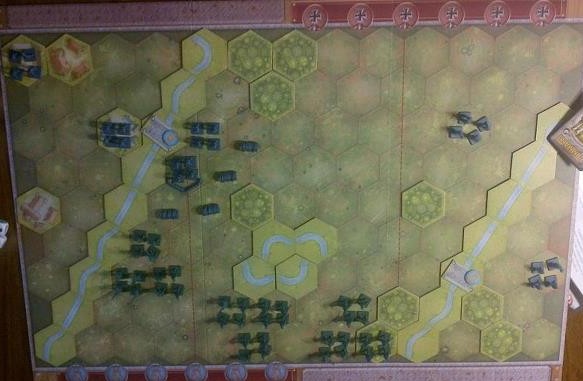
Memoir '44: Pegasus Bridge setup
Memoir ’44: Pegasus Bridge setup

Re-posting this old post because Dina and I spent Friday night playing games again! And this is one of my favorite posts. Last night was Portal 2 and Orcs Must Die! 2.

Last night, I played through the Pegasus Bridge scenario from the Memoir ’44 wargame with Dina a few times. We actually played the online version of the game, using Steam. She was very gracious to play a wargame with me, which I don’t think is necessarily the first thing on most women’s lists of things to do on a Thursday night! I appreciated her agreeing to learn how to play and then playing with me several times. I think that Christians need to plan and execute more “together” activities like that – activities that involve interaction, co-operation, communication and engagement. We try to avoid doing things where we are both spectators. Playing wargames is not the only thing we do – we also do Bible study and cooking lessons (for me), for example.

Anyway, the point of this post is to express the deeper meaning behind playing wargames. I think that it is important to recognize and celebrate those who have demonstrated good character, whether it be now, or in the past. I think that it is important for us to search out the best role models ourselves, so that they will influence the way we act in our own lives. The second world war was a clear example of good versus evil. Anyone on the Allied side who demonstrated bravery and courage should be celebrated for safeguarding the security, liberty and prosperity that we enjoy today. In the case of Pegasus bridge, the hero is Major John Howard of the British paratroops.

Here is a quick re-cap of his exploits that day from the New York Times:

Maj. John Howard, the commander of glider-borne British infantrymen who seized the strategically vital Pegasus Bridge in the first battle of the D-Day invasion of Normandy, died Wednesday in a hospital in Surrey, England. He was 86 and had lived in Burford, near Oxford.

Under cover of night on June 6, 1944, six gliders carrying 181 officers and men of the Second Oxfordshire and Buckinghamshire Light Infantry landed on the eastern flank of a 60-mile invasion front on the northern coast of France. The regiment had a heritage going back to the battles of Bunker Hill and New Orleans, to Waterloo and to World War I. Now its soldiers were in the vanguard of the invasion of Hitler’s Europe.

Major Howard’s D Company was ordered to seize two bridges, one over the Caen Canal and the other spanning the parallel Orne River. If the Germans held on to those bridges, panzer units could move across them in a counterattack isolating 10,000 British paratroopers jumping behind the British invasion beach known as Sword, where infantry forces would arrive at daybreak. And Major Howard’s men sought to strike swiftly to prevent the Germans from blowing up the bridges if they were overwhelmed; the British needed those bridges to resupply their airborne units.

British Halifax bombers towed the gliders over the English Channel, then cut them loose.

Major Howard’s lead glider landed at 12:16 A.M., only 50 yards from the Caen Canal bridge, but the glider’s nose collapsed on impact, knocking everybody aboard unconscious for a few seconds. The soldiers quickly emerged, and over the next five minutes the men directly under Major Howard killed the surprised German defenders.

The nearby Orne River bridge was captured by other troops in Major Howard’s unit, and soon the words ”Ham and Jam,” signifying mission accomplished, were radioed to the airborne.

Two British soldiers were killed and 14 wounded in the operation.

Over the next 12 hours, British paratroopers and commandos reinforced Major Howard’s men, and British forces were able to move toward the city of Caen, their flank having been protected by the capture of the bridges.

On July 16, Major Howard received the Distinguished Service Order, Britain’s second-highest award for valor. On the 10th anniversary of D-Day, he received the Croix de Guerre Avec Palme from the French Government, which had renamed the Caen Canal span Pegasus Bridge, for the flying horse symbolizing the British airborne. The road crossing the bridge was later renamed Esplanade Major John Howard.

Why is this important? Well, it’s important to think on the things that are excellent. There are so many things in the culture that are not excellent that we are confronted with every day. We have to make it our business to do things together where goodness is celebrated. Especially when manly virtues like courage are celebrated. We don’t do that much anymore. And I think there’s a connection between wargames and Christian apologetics that we need to deliberately encourage.

Here’s an excellent passage from Shakespeare’s “Henry V” that makes the point:

This day is called the feast of Crispian:
He that outlives this day and comes safe home,
Will stand a tip-toe when this day is named,
And rouse him at the name of Crispian.
He that shall live this day, and see old age,
Will yearly on the vigil feast his neighbours,
And say, ‘To-morrow is Saint Crispian:’
Then will he strip his sleeve and show his scars,
And say, ‘These wounds I had on Crispin’s day.’
Old men forget: yet all shall be forgot,
But he’ll remember with advantages
What feats he did that day. Then shall our names,
Familiar in his mouth as household words,
Harry the King, Bedford and Exeter,
Warwick and Talbot, Salisbury and Gloucester,
Be in their flowing cups freshly remembered.
This story shall the good man teach his son;
And Crispin Crispian shall ne’er go by,
From this day to the ending of the world,
But we in it shall be rememberèd;
We few, we happy few, we band of brothers;
For he to-day that sheds his blood with me
Shall be my brother; be he ne’er so vile
This day shall gentle his condition:
And gentlemen in England, now a-bed
Shall think themselves accursed they were not here,
And hold their manhoods cheap whiles any speaks
That fought with us upon Saint Crispin’s day. (4.3.43)

This is from the famous speech in which King Henry charges his men to fight well before the famous Battle of Agincourt.

You can read more about the history of the British Airborne division and Pegasus bridge. The famous historian of the second world war Stephen E. Ambrose also wrote a history of the Pegasus bridge battle, called “Pegasus Bridge: June 6, 1944“. You won’t find many military historians better than Stephen E. Ambrose!

You might be surprised how many men are interested in military history and wargames, precisely because men instinctively look up to men like John Howard who embody qualities like bravery and courage. We have a dearth of moral character in this society. And we don’t do much to teach young men about manly virtues, even in the church. I think that it is important for us to think of creative ways for us to present good character to our young men. Young women should also learn about good character, because they must separate out the good men from the bad when they are courting.

Thanks to Dina for helping me to edit this post!