Tag Archives: Travel

Survey: young, unmarried women explain why they avoid having children

This article comes from the leftist Huffington Post.

They write:

The Huffington Post and YouGov asked 124 women why they choose to be childfree. Their motivations ranged from preferring their current lifestyles (64 percent) to prioritizing their careers (9 percent) — a.k.a. fairly universal things that have motivated men not to have children for centuries. To give insight into the complex, layered decisions women make, HuffPost asked childfree readers to discuss the reasons they have chosen not to have kids and gathered 270 responses here.

They grouped the responses into 5 categories:

  1. I want to prioritize my career
  2. I don’t like children
  3. I had a bad relationship with my parents
  4. I don’t want the financial responsibility
  5. I like my life as it is

And here are some interesting quotations:

Category 1:

I am a first-generation college graduate in my family. My mother was a single mom my entire childhood, and I was there to see that struggle. Being a parent, for a woman, means for life. Being a parent, for men, seems to be something very different. I understand raising children is a big life change and I don’t want to sell myself short on my potential to become something more and maybe even create change. I am childfree because I want to travel, move, pursue my career wholly and be able to push myself to be an inspiration to other women. If a child comes into my life, it won’t be until I am happy and successful in my work life, and not until I am secure with my finances and a marriage. I don’t want to one day wake up as an old woman wishing I had waited to have children so I could live my own life first, make mistakes, learn new things and find myself. Today kids are not for me.

Category 2:

I’m nearly 47; my boyfriend (domestic partner) of 17 years is nearly 50. I’ve never been pregnant and have taken every precaution to remain childfree. I tolerate other people’s children when I have to. I’m happiest when there are NO children around. I definitely don’t want them in my home. I like my life as it is. My boyfriend and I are both scientists. We also raise snakes and spiders! We like to travel. We travel to ride roller coasters (members of ACE — American Coaster Enthusiasts) and to attend rock concerts. I am also a performer in a senior winter guard. My plate overfloweth! I see no reason to procreate. I would be unhappy. Why be unhappy?

Category 3:

I have a great relationship with my husband. We have the time and money to travel, and that gives us precious memories. I had a bad relationship with my dad, and maybe I’m scared to treat my children like that. I’m very happy with my decision. I have a great relationship with myself too.

Category 4:

My spouse and I have talked in depth about having children. However, we both decided that our desire to travel the world is a financial burden in itself. If we have kids, we will never have the means to travel, and at the end of our life, we would rather be 100 percent committed to fulfilling our own realistic dreams rather than only able to provide a subpar life for a child. Comes down to the fact we are selfish, but at least we recognize this and made the choice early enough to avoid damaging a kid

Category 5:

The thought of having to do kiddie crap every weekend makes me want to shoot myself. I like having the extra money to save for retirement and not worry about braces, summer camp or college tuition. I can travel on a moment’s notice. I can give my all to my job and not have to worry about daycare, sick days, or having to leave my co workers to pick up my slack. I’m the “cool aunt” to all my nieces and nephews. I have more time to do the things that make me happy and productive. My relationship with my guy is not strained due to the constant neediness of children. I don’t want to put my body through pregnancy and childbirth. I can give my dog all the attention he needs and deserves.

If I had to choose one comment to represent the entire survey, it would be this one:

The moment you have children, you’re life ceases to be about yourself. Kids always take priority and I feel like I can do more for this world than just generate offspring.

I think this is the real reason why young, unmarried women choose not to prepare or plan for marriage and children . Marriage and children “some day” is like planning for your retirement by winning the lottery. It’s a way for the woman to signal to her family and friends that she will eventually want the responsibility of a husband and kids, but not right now.

We need to move beyond a survey to quantify this, and this U.S. Census data does that:
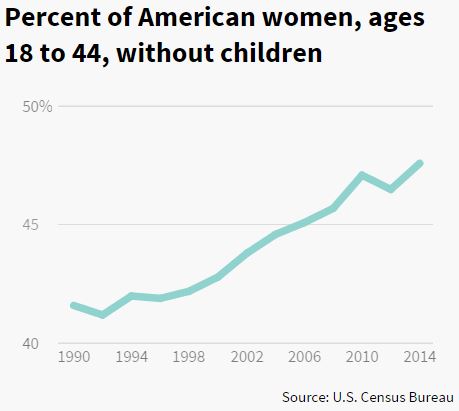
Childless by choice, not because of men
Childless by choice, not because of men failing to “man up”

These quotations are very troubling to me. I’ve been serious about obtaining STEM degrees, saving money by not traveling, and making a plan to have a marriage and family that will serve God. I haven’t used my freedom to buy alcohol or to play the field sexually. I don’t see women being serious about choosing men who are serious about marriage – especially men who are financially prepared to pay for things like houses and children. A lot of women are even interested in men who are younger than they are, despite the fact that these men have not proven themselves in their careers and finances.

How can young, unmarried women be sincere about wanting marriage and children “some day” if they waste their 20s and 30s on men who aren’t prepared for the financial responsibility? And that’s not even to mention the fidelity responsibility – men who have self-control before marriage are more able to be faithful after marriage. It seems as if a faithful man who can provide for a family is that last thing that women want. Even if a man does find one who wants to get married, the financial situation between a marriage-minded man and a woman who has spent all her time traveling is going to be a huge mismatch.

Young, unmarried women seem to oppose marriage because they know it will impose responsibilities, expectations and obligations on them. And their parents, relatives, friends and co-workers are doing nothing to detect and counter this attitude. As Lindsay argued on this blog before, the marriage / children plan is an excellent way for Christians to make a difference. But it does take work – work that some young, unmarried women are deliberately avoiding.


Who suffers the most from the trend of extended adolescence?

Marriage and family
Marriage and family

My friend Tracy sent me this interesting post. As I read it, I thought I was going to disagree with him about who is to blame for the mess he describes, but as we’ll see in a bit, I don’t.

Here’s his intro, which pretty much everyone agrees on:

The Five Traditional Milestones of Adulthood

Something magically happens between adolescence and young adulthood.  There are five traditional milestones of that mark entrance into adulthood that sociologists, psychologists, and the general population have used as a proxy to determine when someone has reached that tipping point of maturity.  It is at this time adolescence is shed and emotional maturity comes to full fruition.

These are:

  • Leaving Home
  • Becoming Financially Independent
  • Completing School
  • Marrying
  • Starting a Family

He has some examples to illustrate who is and isn’t mature:

Examples of Adults:

  • A 25-year old teacher with a college degree, who works full time, is married, has a child, owns her own home, and pays for her own living expenses
  • A 65-year old janitor with a high school diploma, who works full time, is married or widowed, has children, owns his own home, and pays for his own living expenses

Examples of Extended Adolescence: 

  • A 30-year old who has part of their rent and bills covered by parents, endlessly enrolls in colleges or universities seeking additional degrees or credentials, single, without children.
  • A 45-year old high-school dropout living on social welfare programs who spends his days getting drunk in bars

OK, then he talks about who suffers the most from “extended adolescence”:

What is particularly interesting is the interaction between biology and the paradigm shift that has occurred with so much of the younger generation suffering from extended adolescence. Women have a specific, limited window of time in which they can genetically reproduce and to which they are attractive to potential mates.  This so-called “biological clock”, written into the code at the very deepest core of our DNA, puts a limit on childbearing for females.

  • Fertility: Female fertility peaks at 20 to 30 years old.  After 30 years old, fertility drops by 20%.  After 35, it drops 50%.  After 40, it drops 95%.  As for in vitro fertilization, the American Society for Reproductive Medicine states that women in their early 40’s have, on average, only a 3% to 5% chance of having a baby through this method.
  • Down Syndrome: At 25, a woman has about 1 chance in 1,250 of having a baby with Down Syndrome; at age 30, a 1-in-1,000 chance; at age 35, a 1-in-400 chance; at age 40, a 1-in-100 chance; and at 45, a 1-in-30- chance.
  • Miscarriage: Only 9 percent of recognized pregnancies for women aged 20 to 24 end in miscarriage; 15 percent of women aged 25-30 miscarry; 40 percent of women over 40 do and more than 50 percent miscarry at 42 years of age.

These limitations do not apply to men (an 80 year old man can still reproduce).  Men have virtually no opportunity cost to waiting to find a mate.  If they want to spend their twenties working their way up their field, putting money in the bank, playing video games, and hanging out with friends, they can always wake up one morning and decide they are ready to settle down, get married, and have kids.  As such, the biological cost of extended adolescence is significantly and substantially higher for women than it is for men.  Females suffer from a Mother Nature-induced “use it or lose it” policy.

So, should men be expected to ride to the rescue of women who are the end of the their fertility period? Should men make things “work out” for women who refused to marry when they were in their 20s, when they were fertile and attractive?

Nope:

This fear was encapsulated by Kay Hymowitz in a book called Manning Up: How the Rise of Women Has Turned Men Into Boys.

[…]As one reviewer somewhat critically noted of the book, “Hymowitz wants the child-men [those suffering from extended adolescence] to man up so that women don’t have to become spinsters or “choice mothers” at the expense of their careers. Might women alter their own behavior? “[T]he economic and cultural changes are too embedded, and, for women especially, too beneficial to reverse.” So the answer is no. Although it is women who are becoming disenchanted with the way things are, and although it is women who have created this situation, it is [in her opinion] men who ought to change.  And they are to change precisely when women are ready.”

The reviewer is correct because men are acting rationally within the confines the new paradigm.  In today’s world, men are presented no social, financial, emotional, or reproductive advantage by adjusting their own life to the ticking of a potential mate’s biological clock.  It is for the woman, to borrow a phrase, “too damn bad”.  It may not be fair, but in a finite world, there is an opportunity cost to every decision we make.  That has always been one of the central themes of this blog.  Incentive systems drive nearly everything in civilization from the type of people we attract into certain industries to the kind of behavior we reward.  The incentive system for men has changed and society now reflects this reality.

I actually blame the pastors and parents for allowing women to delay marriage, and then blaming men for not marrying women who pass their fertility date. Pastors and parents don’t challenge young women’s feelings with the truth about what she ought to be doing in order to grow up early and attract a man during the time when she is younger and fertile. They want to let women decide what to do at every point in their lives, based on their feelings “in the moment”. The refusal to make judgments leads to women having delusions like “I can have children when I’m 35” and “I can change a bad man into a good man after I marry him” and “a degree in English is as worthwhile as a degree in computer science”.

Feminism has a lot to do with it. Women used to be taught by pastors and parents that they should choose chaste men with good jobs, work histories and savings. But feminism says that men don’t have any special provider role, and now the main things that women look for in a man is that he is attractive, fun, and lets her do whatever she feels like doing – no matter how crazy and irrational it is.

One woman recently told me that a female friend of ours, who is dating a penniless 28-year-old student, who has never worked a day in his life need not worry about him. She said “if they marry, he’ll drop out of school and start to work and provide for her”. She is 33, and she thinks that marrying a full-time student is a good idea, because he enthusiastically supports her crazy plans to pursue fun, thrills and travel into her mid-30s. She tells him that God is telling her (through her feelings) to pursue fun and thrills through travel – a position she held when she still an atheist in college, mind you. And she intends to keep up the traveling for as long as she can, even if she isn’t out of debt until she turns 40. And he, in response, is both unwilling to, and incapable of, questioning her plan from a practical point of view. She likes that he lets her fly the plane, even it it means she’ll crash it and kill them both. There is something mentally wrong with a man who stays in school until he is 30, and thinks that he is fine to be in a relationship with a woman. Only men who show aptitude for the provider role should be taken seriously by women.

Pastors and parents don’t dare hurt the self-esteem of sensitive little girls by telling them to study hard things, get full-time jobs, move out of the house and focus on marrying a man who can provide during their 20s. And what happens when the “fun-thrills-travel until you’re 35” plan explodes and no one wants to marry her? Well, then, all pastors and parents who applauded when she delayed marriage blame men for not wanting to marry her. But men don’t marry 35-year-old women. At age 35, the value proposition of marriage to men has been greatly diminished by age and infertility. (Or worse: by promiscuity, cohabitation, divorce, and children from other men) There is a window of opportunity for a woman to invest in a man with her youth, beauty, support and encouragement. Once that window is closed, a man who has a good education, a good resume and good amount of savings has no obligation to marry. All the battles have already been fought as well as they are going to be, and without a woman there to help him. He doesn’t have any emotional connection to a woman that would cause him to either get married or stay married, because of the help he received when it really mattered. Believe me when I tell you that single women today are very intentional about passing up good men so that they can be “free” to travel and have fun. They know exactly what they are doing, but hope to somehow escape the responsibility for their choices later.

Young women: one of the best things you can do is marry and raise children

Does government provide incentives for people to get married?
Should women postpone marriage and raising children for other things?

Super-mom Lindsay sent me this article about by a former feminist who was once opposed to children, then had 4 of them in 5 years.

Introduction:

Up until my mid-20’s I was firm in my belief that I never wanted to have kids. A combination of events made me reconsider the issue, and by the time we got married I was open to the idea of having some pre-set, small number of kids and had begun thinking about the precise timetables on which I would have them.

[…]It would have been inconceivable to me to imagine that constantly having my plans derailed by pregnancies and not even having any idea when I’d be done changing diapers would be an improvement over my fully controlled, well-ordered life, but it has been.

[…]Lately I’ve been imagining what I would say to 2003 Jen if I could go back in time and give her a crystal ball to show her what her future would be like. I’ve been trying to imagine how I would talk her down from the balcony ledge after the crystal ball got to the “four kids in five years — and doing NFP!” part, how I could possibly convince her that this life is not only not a recipe for misery, but the true fulfillment of everything she thought she wanted.

I would love to tell you that I’d simply be able to explain that each child is such a joy and a blessing, but that would not have resonated with Old Jen; I might have agreed, but ultimately I would have said that those joys and blessing are just too much hard work. “I just don’t see how that kind of life could be anything but miserable for someone like me,” I would have said.

So how do you convince a woman that “hard work”, i.e. – self-denial, self-control, self-discipline, self-sacrifice – while caring for children could actually lead to a fulfilling life? And most importantly, that it should not be postponed in pursuit of something that appears more fun, more thrilling or more important (according to a feminist measure of fun, thrills and importance).

She makes 5 points in her post.

Here’s one:

3. “It’s not what you do, it’s whom you serve.”

A product of secular society, I’d fallen into the common notion that the way to find true happiness is to focus on yourself more and other people less. It makes perfect sense, after all: doing pleasurable things for me is fun, sacrifice and hard work are not fun; ergo, the secret to happiness must be to live for myself as much as possible. Right?

How shocked I was to discover that I was wrong — dead wrong. Part of fully understanding the concept of vocation was understanding that a vocation is not to be thought of as “what you do” as much as it is “whom you serve.” It was nothing short of revolutionary to hear the concept that God has called every one of us to serve others, that living for yourself is not a valid option; that the key to deep fulfillment, to finding your very purpose in life, is as simple as finding out the specific way in which you’re called to serve. Do that, and you will find peace.

It sounded not only too simple to be true, but too difficult. As a spoiled only child the idea of living to serve sounded terrible. But once I actually took a leap of faith and tried it, I had no doubt that this was truth.

Next,I want to talk about one of the young Christians I mentor, and then about the woman I supported for President in the 2012 election.

I spent Friday night playing with one of the young women I mentor. This is the one who did the BS in computer science, and is now doing the MS in computer science. After playing a few rounds of “Keep Talking and Nobody Explodes”, she mentioned the salary from her internship this summer. She asked me “what am I going to do with so much money? I think I had better stop thinking so much about myself and find some people out there to help”. And I was so pleased. Because this woman, more than any of the other young people I mentor, is my replacement.

J. Warner Wallace likes to talk about training your replacement, and I have several replacements, but none better than her. I remember when she was younger, she was a bit more selfish than now. She still organized events, like bringing Frank Turek, Tim McGrew, etc. to speak on her campus. But she never showed much interest in one-on-one care for others. It was my hope that just like me, she would react to computer science salary with a sense of obligation to others, and so she has. And that’s how I think women ought to be. They should be educated, they should be successful – but they should be open to the needs of others.

Michele Bachmann

The woman I admire the most in the world is former GOP Congresswoman Michele Bachmann, who was my first choice for President in 2012. I had been following her for many years before that, when she was just a state senator. I liked her because of her interest in apologetics, as well as her focus on her family.

Marcus and Michele Bachmann and family

The  radically leftist New York Times did a profile of her.

It says:

Nearly two decades ago, a stay-at-home mother and onetime federal tax lawyer named Michele Bachmann felt a spiritual calling to open her clapboard home here to troubled teenage girls.

“We had our five biological children that God gave to us, and then he called us to take foster children into our home,” Mrs. Bachmann told a Christian audience in 2006. “We thought we were going to take unwed mothers in,” she continued, adding, “We took 23 foster children into our home, and raised them, and launched them off into the world.”

Today Mrs. Bachmann is Representative Bachmann, a Minnesota Republican, first elected to the House in 2006, and now a candidate for her party’s nomination for president. In Washington, she has grabbed the spotlight as a staunch fiscal conservative and brash Tea Party leader. But a look at her life here shows that it was her role as a mother, both to her biological children and to her adolescent foster daughters, that spurred her to seek public office.

[…]Mrs. Bachmann’s political awakening began with her deep disenchantment with the public school system.

[…]By the late 1990s, with her own children enrolled in private Christian schools, Mrs. Bachman was upset by the education her foster children were getting in public school. Teachers gave them “little special attention,” and many were “placed in lower-level classes, as if they were not expected to succeed,” she told a House subcommittee in 2007.

One brought home “an 11th-grade math assignment that involved coloring a poster,” she testified. Another “spent an entire week watching movies.” A third “remarked to me once that she was in ‘stupid people math.’ ”

So Mrs. Bachmann immersed herself in the minutiae of Minnesota’s graduation requirements. She worked with a conservative researcher and began giving talks in church basements.

[…]The Rev. Marcus Birkholz, the pastor at Salem Lutheran Church, which Mrs. Bachmann attended for years, calls her “a lady with energy and a heart” whose uncompromising “support for the unborn” extends beyond fighting abortion. “She sees the whole picture,” Pastor Birkholz said. “It’s not just bringing a child into the world; that child has to be nurtured and educated.”

[…]Mrs. Bachmann, whose biological children now range in age from 17 to 29, worked until her fourth child was born. (Her youngest, Sophia, is headed to college this fall, while the eldest, Lucas, is a medical resident at the University of Connecticut, pursuing a specialty in psychiatry.) Friends remember her planning neighborhood picnics and organizing bicycle parades.

“I had all these balls in the air that I was juggling,” she said in an interview with Minnesota Monthly last year. In choosing to leave work, she said, “I finally realized my dream, which was to be mom of a big, happy family.”

What does it mean? It means that women ought not be horrified by husband needs or children needs. They should not be opposed to responsibilities, expectations and obligations in relationships. Sometimes, the path to greatness means taking a few years off from work to homeschool your kids. After all, isn’t it better for God to have FIVE Christian kids who will surpass you in influence?  Michele didn’t get involved in politics by thinking of herself. She got involved in politics by thinking of her children, and her 23 foster children.

Here’s my advice to young women: 1) Study something hard that pays. 2) Work a few years and get debt free. 3) Marry a good provider in your mid-to-late 20s. 4) Have as many children as your husband can support. 5) Be actively involved in the education of your kids (with apologetics, too). 6) Open your home to kids who don’t have a mom or a dad. 7) Teach your kids the importance of caring for others. 8) Run for President (as a Republican).