
Tag Archives: Trade War

Who has the better economy? Canada or the USA?

Hans Bader at the Competitive Enterprise Institute reports:

1.2 million Americans have lost their jobs since the $800 billion stimulus package was signed into law.

The stimulus package has directly destroyed tens of thousands of jobs. A provision in the stimulus package that blocked 97 Mexican truckers from U.S. roads “caused Mexico to retaliate with tariffs on 90 goods affecting $2.4 billion in U.S. trade,” destroying 40,000 American jobs.

It also ignited a trade war with Canada. In response to vague “buy American” provisions in the stimulus package, “A number of Ontario towns, with a collective population of nearly 500,000, retaliated with measures effectively barring U.S. companies from their municipal contracts — the first shot in a larger campaign that could shut U.S. companies out of billions of dollars worth of Canadian projects.”

Yet, Obama had the audacity to claim that only passing the stimulus package would save us from “irreversible decline” and economic ““disaster”.

Obama’s policies echo those of Herbert Hoover, who helped spawn the Great Depression through his protectionism and tax increases.

Remember how Democrats used to complain about Bush and his “tax cuts for the rich”? Yeah, it’s strange how only people who pay taxes (59% of the public) can actually get tax cuts, isn’t it. But Obama has an even better idea: “tax hikes for the poor”.

The Washington Post reports on Obama’s new car tax: (H/T Heritage Foundation, Michelle Malkin, Stop the ACLU, Gateway Pundit)

A senior administration official said the new standards would raise the cost of an average car by $1,300, $600 of which could be attributed to the rules being announced today.

This is not to mention the electricity tax (cap and trade), the cigarette tax, taxing employee health care plans, and the rising cost of living caused by protectionism.

On the other hand, let’s take a look at Canada in relation to the United States, courtesy of the Cato Institute. (H/T Heritage Foundation)

The Cato Institute writes:

Spending: Spending by all levels of the Canadian government peaked at 53 percent of the country’s GDP in the early 1990s, then plunged to 40 percent in 2008. U.S. government spending has risen, reaching 39 percent of GDP in 2008. And with the stimulus package, that number is likely to jump even higher.
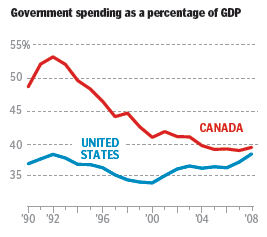
Government spending as % of GDP

Debt: The Canadian government cut its debt from 71 percent of GDP in 1995 to 32 percent in 2008. Under President Obama’s budget plan, U.S. federal public debt will jump from 41 percent of GDP in 2008 to more than 60 percent next year.
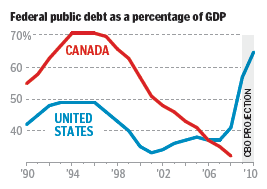
Federal debt as % of GDP

Deficits: Canada has balanced its budget every year since 1998 — not by raising taxes, but by cutting spending. The United States balanced its budget for four years in the late 1990s, but now deficits are so large that it’s difficult to imagine that ever happening again.
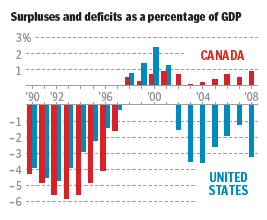
Surplus / Deficit as % of GDP

Corporate Taxes: Canada has cut the corporate tax rate from 28 percent to just 15 percent, and most provinces have trimmed corporate taxes as well. The U.S. federalstate rate stands at about 40 percent, and the Obama administration is planning to increase corporate taxes.
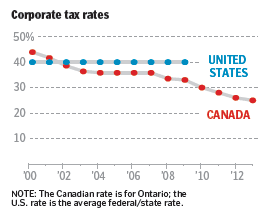
Corporate tax rates
Corporate tax rates

It’s important to note that the Liberal party in Canada is socially progressive, but moderate on fiscal issues. Of course, now that the Conservatives have been running things, it’s gotten even better. It would be great if they could win a majority. The biggest problem in Canada right now is the fascist Human Rights Commissions, but there are candidates from the Conservative Party who intend to abolish the HRCs in BC and Ontario.

Is Obama saving or creating jobs?

KSDK reports that Obama’s cuts in defense spending will cost St. Louis 30,000 jobs. (H/T Gateway Pundit)

Excerpt:

Thousands of jobs could be in jeopardy at St. Louis’ second largest employer: Boeing.

The aerospace company announced the government’s planned defense budget cutbacks will slow production of two locally-built planes and eliminate the jobs of the employees who make them. Michael Moran has helped build hundreds, if not thousands, of C-17 cargo planes.

…The bottom line is Boeing needs to get through to President Obama, Congress and Secretary Gates. If not, they stand to lose more than 5,000 jobs at Boeing in St. Louis, and 30,000 total local jobs, including suppliers.

Boeing executives are reaching out to anyone who will listen. They’re trying to get Congress to put the planes back in the budget.

The video is here.

And remember the protectionist regulations Obama included in his Porkulus bill? Recently, we talked about how the “Buy American” provisions of the stimulus bill caused American companies to stop buying anything from Canada for their projects. Well guess what? The Canadians were not amused.

Here’s the story from the left-wing Washington Post. (H/T Ace of Spades)

This week, the Canadians fired back. A number of Ontario towns, with a collective population of nearly 500,000, retaliated with measures effectively barring U.S. companies from their municipal contracts — the first shot in a larger campaign that could shut U.S. companies out of billions of dollars worth of Canadian projects.

And it’s going to cost American jobs:

The new buy American provisions, the company said, are being so broadly interpreted that Duferco Farrell is on the verge of shutting down. Part of an increasingly global supply chain that seeks efficiencies by spreading production among multiple nations, it manufactures coils at its Pennsylvania plant using imported steel slabs that are generally not sold commercially in the United States. The partially foreign production process means the company’s coils do not fit the current definition of made in the USA — a designation that the stimulus law requires for thousands of public works projects across the nation.

In recent weeks, its largest client — a steel pipemaker located one mile down the road — notified Duferco Farrell that it would be canceling orders. Instead, the client is buying from companies with 100 percent U.S. production to meet the new stimulus regulations. Duferco has had to furlough 80 percent of its workforce.

“You need to tell me how inhibiting business between two companies located one mile apart is going to save American jobs,” said Bob Miller, Duferco Farrell’s executive vice president. “I’ve got 600 United Steel Workers out there who are going to lose their jobs because of this. And you tell me this is good for America?”

Losing your job sucks, and there’s going to be a lot more of it until people shut off their televisions and pick up some books on economics, like the Federalist Papers or The Road to Serfdom. Learn a little about what made our country not like North Korea. Our prosperity wasn’t an accident, it was the result of a set of decisions made by men who believed in God, human rights and free enterprise.

UPDATE: The Competitive Enterprise Institute has more on the trade war with Canada.

The Democrats are considering carbon tariffs on imported goods

Robert P. Murphy’s linked to this post he wrote at the Institute for Energy Research. Murphy is concerned that Obama is going down the same path as that interventionist Herbert Hoover did. Hoover passed the Smoot-Hawley Tariff Act, which led the United States into the Great Depression. Murphy thinks that carbon tariffs could be on the way!

Here is an an excerpt from Murphy’s post:

…the Obama administration—under the guise of fighting climate change—is testing the waters with new restrictions on imports. Specifically, lawmakers on the House Energy and Commerce Committee are considering imposing “carbon tariffs” to prevent foreign nations from gaining a competitive advantage vis-à-vis U.S. producers who are burdened with a forthcoming cap-and-trade regime. The idea is that the U.S. government would slap a huge “compensatory” tax on imports that were produced in foreign nations that do not impose carbon legislation on their manufacturers.

Murphy explains why free trade increases the prosperity of all nations, by promoting efficient production:

Even without retaliation, a unilateral tariff increase makes Americans poorer. The gains to the workers in the “protected” domestic industry are more than offset by the loss to consumers who have to pay higher prices. A tariff is a tax on American consumers; the government says to its own citizens, “If you want to buy a product from a foreign producer, you have to make a side payment to the U.S. Treasury.” You don’t make a country richer by jacking up taxes on its own consumers.

International trade allows countries to specialize in their “comparative advantage,” or their areas of relative expertise. It would be catastrophic if everyone had to grow his own food, sew his own clothes, and drill his own cavities. We all benefit tremendously from the ability to specialize in occupations at which we are better than our peers, and then trade with each other.

The same principle applies to entire countries, which are simply aggregates of the individuals living in them. Because of differences in resource endowments, industrial infrastructure, weather, and the skills of the workforce, it is much more efficient for certain regions of the world to concentrate on a few key items and export them to other regions. When the government raises tax barriers, it interferes with this process and makes everyone poorer on average.

Not only do tariffs hurt consumers, but they also destroy businesses that export products. First, those businesses will have to pay more for raw materials. Second, the goods they export to other countries will face import tariffs. This will cost more American jobs than are “saved” by imposing tariffs. And the government gets the money from tariffs, not the productive private sector.

Murphy explains how global warming is really just a euphemism for economically-ignorant socialism:

Even if the threat from man-made climate change is as serious as some scientists claim, this fact would not overturn the centuries of work done by economic scientists. We know from both theory and history that raising trade barriers in the middle of a severe worldwide recession is a terrible policy. We also know from theory and history that government central planning does not work. When the technocrats reorder the economy, deciding which firms will survive and which prices are too high or too low, the results are disastrous. It doesn’t matter whether the justification is “fighting the Depression” (as in the 1930s) or “fighting climate change” (as in today’s discussions). Either way, central planning will wreck the economy, and it won’t even achieve its ostensible goals.

I recommend you go there and read the whole article. Think of the future of your children, and of your neighbor’s children.

Related story over at Stop the ACLU: “EPA may soon deem CO2 a threat to human health“. I blogged before about cap and trade, tax hikes on oil, the world’s anger at tariffs, and the myth of global warming.