Is it intolerant to think that one religion is true?
Is it more important to be loving and accepting of people regardless of worldview?
How should Christians approach the question of religious pluralism?
How does a person choose a religion anyway?
Who is Wonmug, and would you like to be like Wonmug?
Is it enough that a belief “works for you”, or do you want to believe the truth?
Can all the religions in the world be true?
Is it wise to pick and choose what you like from all the different religions?
Is it possible to investigate which religion is true? How?
Which religions are testable for being true or false?
How you can test Christianity historically (very brief)
I’m posting this, because I’ve noticed that there’s an awful lot of cultural Christianity in red states. Basically, if you ask someone if they are a Christian, and they say yes, they don’t usually mean that they think it’s true and that they’ve investigated whether it’s true. They usually just mean that they like it, or it makes them feel good, or that’s how they were raised, etc. My worry about this is that if Christianity isn’t adopted because it’s true, then no one is going to do any work or self-sacrifice for it. And I think that Christianity won’t survive the challenges of the secular culture if parents and pastors don’t understand that Christianity will require work, if it’s going to be presented to people as TRUE in a persuasive way.
Why is truth important? People are willing to invest in projects self-sacrificially if they think that they are involved in something true. So, you might enroll in a chemistry program in college because you expect to come out with true beliefs about chemistry. You’ll do the work and solve the problems because you think that chemistry is real. But if you think that chemistry is just made up nonsense with no use at all, you’re probably not going to work at it and sacrifice for it. You’ll probably just find something else to do with your life that’s easier and more fun. That’s why the truth question is really important.
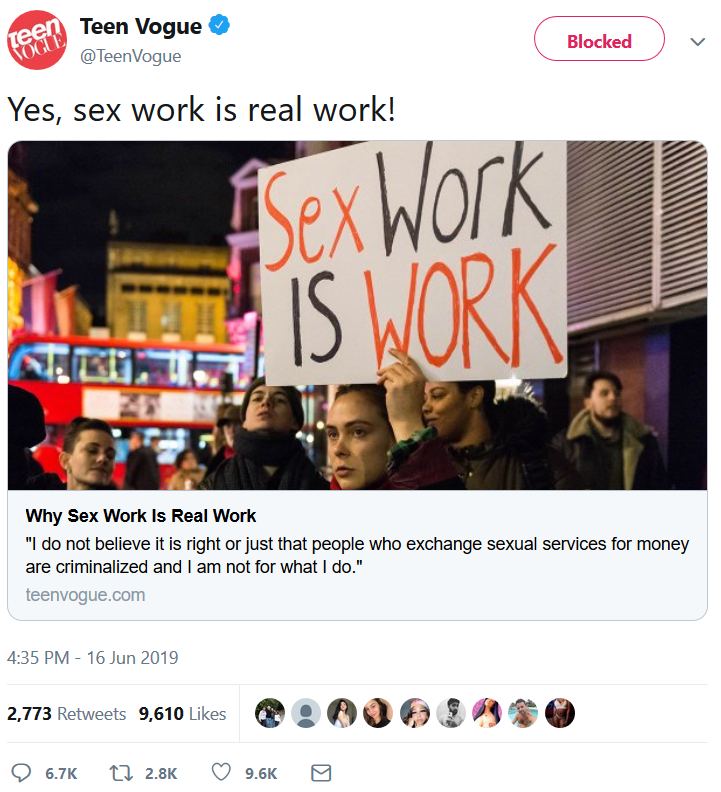
Ten Vogue urges young women to legalize sex trafficking of women
Third wave feminism promotes the conditions that allow women to bypass the traditional path to marriage (chastity, courtship, marriage, children, stay at home wife and mother) and “have sex like a man” without any shame or repercussions. They want sex outside of marriage is seen as normal. sex outside of marriage is seen as normal.
Here’s the latest article “Why Sex Work is Real Work” from Teen Vogue, a feminist magazine that is read by millions of teenage girls.
They write:
[C]ontinued criminalization of sex work and sex workers is a form of violence by governments and contributes to the high level of stigma and discrimination.
[…]But governments often fail to accept the evidence for the economic and social bases for sex work; the ILO estimates that “sex workers support between five and eight other people with their earnings. Sex workers also contribute to the economy.” Governments ignore the nuanced histories and contexts in different countries and thus continue to wrongfully offer blanket solutions and “rescue” models that advocate for partial decriminalization or continued criminalization. They also ignore the wishes of sex workers, who want full decriminalization, as supported by the Global Commission on HIV and the Law, and the Lancet, as well as human rights organizations like Amnesty International.
Now, since the author is a radical feminist, you can imagine what she would say to my suggestions that instead of incentivizing women to avoid sex work, we should instead provide incentives for women to be chaste, stay debt-free, choose marriage-minded men, marry before having sex. She would say that this life plan would stigmatize women who have sex before marriage with men who won’t commit. She would say that this life plan would stigmatize women who choose to raise girls without a father (who are far more likely to engage in sex work). She would say that the most important thing government can do is to promote a “good” lifestyle for women that would make the women who want sex with hot bad boys outside of marriage feel “bad” about their own choices. What we need, she thinks, is laws and social spending that allow women who make poor choices and raise fatherless daughters to escape shame, stigma and discrimination.
But what comes next, after countries have decriminalized “sex work” as Teen Vogue urges?
Until his dramatic fall from grace, Jürgen Rudloff was the self-proclaimed “brothel king” of Germany. Owner of a chain of clubs he boasted was the “the largest marketplace for sex in Europe”, he was every inch the well-dressed entrepreneur, a regular face on reality TV and chat shows.
Rudloff is now serving a five-year sentence for aiding and abetting trafficking. His trial laid bare the misery and abuse of women working as prostitutes at his club who, according to court documents, were treated like animals and beaten if they didn’t make enough money. His imprisonment has dismantled the idea of Germany’s “clean prostitution” industry and raised troubling questions about what lies behind the legalised, booming sex trade.
Prostitution – legalised in Germany in 2002 – is worth an annual €15bn (£13.4bn), and more than a million men visit prostitutes every day. The change in the law led to a rise in “super brothels”, attracting tourists from countries where such establishments are illegal.
[…]Rudloff’s high-volume, low-cost model only works if the supply of women is enough to satisfy demand and bring enough customers through the doors.
According to court documents, this became a problem for Paradise almost immediately. There weren’t enough women to fill the clubs. So Rudloff’s friends in the industry offered to help him out.
[…]In a trial lasting almost a year, testimony from the jailed pimps revealed that trafficking was crucial to the success of Rudloff’s business.
Legalizing prostitution inevitably leads to sex-trafficking, and the radical feminists who promote legalized prostitution to young women know that. They know that if they remove moral and legal barriers to legalized prostitution, then they will cause more young women to find it attractive, leading to easier targets for sex-trafficking. Sex-trafficking is the end goal of the radical feminists.
Don’t believe me? I’ll prove it.
Women’s March says that banning sex-trafficking of women is wrong
I remember when the Women’s March came out in favor of sex-trafficking, because they didn’t want women to feel shame, stigma and discrimination for having sex outside of marriage.
Last Friday, the FBI seized Backpage.com, a website well known for facilitating the sale of trafficked minors, mostly girls, for sex all over the United States. On Monday, seven top Backpage officials were arrested after being indicted on 93 counts, including money laundering and facilitating prostitution, 17 cases of which involve trafficking victims as young as 14. The Washington Post says Backpage earned an estimated $500 million in prostitution-related revenue since its launch in 2004.
The National Center on Missing and Exploited Children reports that 73 percent of all child sex trafficking cases it has handled involved Backpage.com. According to the National Center on Sexual Exploitation, Backpage reached 97 countries and was the world’s largest single facilitator of sex trafficking. NCOSE also reports that from January 2013 to March 2015, 99 percent of Backpage’s global revenue was attributable to prostitution advertising. During that time, it made nearly $51 million from prostitution ads in California alone.
The rest of the The Federalist article makes clear that nothing in that web site’s operations made sex-trafficking “safer” for women. In fact, the whole “sex work” business is dangerous for women:
We do know, thanks to the research of Melissa Farley at Prostitution Research and Education, that 70 percent of those in the sex industry link their entry to prior sexual abuse.
Most say they entered as minors, which in the United States qualifies as trafficking. Many enter feeling they have no other options, reducing the sense of free choice in the matter. Once they’re in, 89 percent of “sex workers” say they want to get out of the industry but feel they have limited options. You don’t call an industry safe when women are coerced into it and have difficulty getting out.
According to Farley’s comprehensive studies, as many as 99 percent of those in the sex industry have said they experienced violence within it.
And of course, in the feminized UK, radical feminists voted in regime after regime of secular leftists, who imported thousands of unskilled workers from Muslim countries, who proceeded to immediately set up sex-trafficking rings where young girls were taken from their single mothers and passed around at parties like a cigarette. Taking women out of married homes where they will be influenced by their biological fathers and taught Judeo-Christian values like chastity, sobriety, and self-control is the primary aim of the radical feminists. And if a few teenage girls need to be sex-trafficked, then too bad for them. The important thing is that young women grow up without fathers, have sex outside of marriage, and depend on the government to help them with “health care”: contraceptives, abortions and treatment for STDs. Women must never choose men to be husbands and fathers in a married home: that’s sexist.
Keep in mind that the VAST MAJORITY of the young women who enter sex work do so because their mothers freely chose to have sex outside of marriage to men who they were attracted to on a superficial level: tall, piercings, tattoos, bad boy, criminal record, etc. As a society, we’re more concerned with preventing these women from being shamed (and supporting their recklessness with taxpayer dollars) then we are with encouraging them towards the marriage life plan: chastity, sobriety, courting, marriage, being a stay-at-home wife and mother. We attacked the “shaming” of reckless single mothers that created sex-trafficking instead, thinking that eliminating the moral boundaries that protected daughters from their mother’s hypergamy was the real target.
Whenever you see a girl in difficult circumstances, always remember that this is the result of a chain of reckless decisions by her mother, and her mother’s mother, and so on, to flout the moral law by choosing irresponsible, immoral men that she found more attractive than “boring” men who were chaste, sober, Christians looking for marriage before sex. And always remember that these women were encouraged in their choices about who to have sex with and when to have sex by radical feminists, who were MORE ANXIOUS to have these women avoid moral judgment (“shame, stigma and discrimination”), probably because they felt that their own moral failures would look better if they could trick more younger women into repeating (and surpassing) their own moral failures. Third-wave feminism is ultimately a movement by adult sluts to escape the shame of their slutting by manipulating younger women away from chastity, sobriety, marriage and wed motherhood with lies.
The war on Christianity and moral judgment by radical feminists in the end results in subsequent generations of women living in conditions that Christian stay at home wives and mothers of generations could not possibly have imagined. But this is what happened when we decided that out public policy and laws should be based on feelings and compassion, rather than on moral laws grounded in the Christian worldview. When non-judgmental intuitions are elevated about moral boundaries to sin, the end result is far worse than the “shaming” that the tolerance crowd sought to eliminate in the first place.
I used to think that if you were really good at your job, then it wouldn’t matter if you were serious about your Christian beliefs, because no one would fire you. But I guess that’s not true when it comes to the conflict between gay rights and the Bible. On Friday, an Australian rugby player had his contract canceled because he shared some Bible verses on social media.
Israel Folau says he ‘deeply saddened’ by Rugby Australia’s decision to tear up his $4million rugby contract, but his religious beliefs should not stop him from playing the sport.
The decision, which was announced on Friday afternoon, makes the devout Christian the first Australian athlete dismissed for expressing religious beliefs after sharing a homophobic Instagram post.
[…]’The Christian faith has always been a part of my life and I believe it is my duty as a Christian to share God’s word.
‘Upholding my religious beliefs should not prevent my ability to work or play for my club and country.’
The words he cited are from 1 Corinthians 6:9-14 which are about sin and repentance and who will be admitted to the Kingdom of God.
Just to be clear, the Christian position on sexuality is that you cannot have sex outside of marriage. And the Christian position on marriage is that it is one man and one woman for life. Authentic Bible-believing Christians may fail to live out that standard, but they can never take any other stance than that in public. If you are a Christian, you cannot say that sex outside of marriage is fine with God. If you are a Christian you cannot say that redefinitions of natural marriage are OK with God. There’s only one kind of authentic Christian, and that’s the kind that takes the Bible as authoritative, including on moral issues. Telling someone they can’t quote the Bible in public is essentially telling them that they can’t be a Christian in public.
Whenever things like this happen to Christians who are serious about their beliefs, I always try to find out what the people who take away their livelihood have to say about it. These people usually think of themselves as very tolerant and open-minded, so it’s interesting to hear how they keep their self-image after firing someone for their religious beliefs.
The article says:
In a press conference this afternoon, Rugby Australia CEO Raelene Castle said Folau was a ‘great player’ but that everyone has the right to be respected regardless of sexuality, race, gender or religion.
[…]’Our clear message today is that we need to stand by our values and the qualities of inclusion, passion, integrity, discipline, respect and teamwork.’
Ms Castle said she had told all rugby players in Australia that RA supports their rights to their own beliefs.
‘But when we are talking about inclusiveness in our game, we are talking about respecting differences as well,’ she said.
‘When we say rugby is a game for all, we mean it. People need to feel safe and welcoming in the game, regardless of their race, background or sexuality.
[…]’I’m confident because those players understand that everybody has a right to their own views or religious beliefs, and as long as they continue to express them in a respectful way we will continue to support them,’ she said.
[…]Ms Castle said she was ‘disappointed’ that Folau had not apologised.
So, did the rugby player have a right to be respected regardless of his religion? No, he needed to be fired. Did she respect his differences? No, she fired him. She says that authentic Christian quoting the Bible on social media is not being a Christian “in a respectful way”. So there’s a non-Christian telling a Christian how to behave like a Christian. And after she fires you, she’s disappointed that you didn’t apologize to her for not being Christian in a respectful way.
My thoughts
I have two thoughts about this. First, if you want to be public about your Christianity and keep your job, then you need to have an alias. Because of this intimidation from secular left fascists, Christians are refusing to speak out on moral issues on a daily basis. To help you to be more comfortable speaking out, you should have an alias. I have blogged about sexual issues and marriage many, many times on this blog, often citing peer-reviewed research in order to support the Christian position on these issues. And so far, no one has been able to get me fired. My goal is to have an influence. I want to do as much as I can without letting the fascists on the other side stop me.
Second, I’ve noticed that it’s increasingly common for Christians to side with the gay activists against other Christians. And that’s because Christianity has become so much about feelings and self-esteem that many people who claim to be Christians think that Christianity should always make them feel good and be popular. If all you have is feelings, it’s pretty easy to put your need to feel good above the need to defend what the Bible teaches.
For those who would like to be bolder but don’t know how, the Bible actually has an answer to that in 1 Pet 3:15. In order to be bold, you need to be prepared. By reading books outside of the Bible, you’ll equip yourself with evidence so that you can debate non-Christians who don’t accept the Bible. They may not accept the Bible, but they have to accept evidence, or they’ll look stupid and irrational.




 WINTERY KNIGHT