
Tag Archives: Thomas Sowell

Tom Sowell on gun control and judicial activism

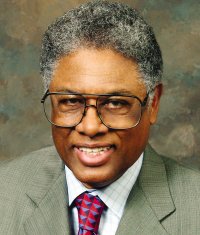
Thomas Sowell

His latest column is here.

Excerpt:

Now that the Supreme Court of the United States has decided that the Second Amendment to the Constitution means that individual Americans have a right to bear arms, what can we expect?

Those who have no confidence in ordinary Americans may expect a bloodbath, as the benighted masses start shooting each other, now that they can no longer be denied guns by their betters. People who think we shouldn’t be allowed to make our own medical decisions, or decisions about which schools our children attend, certainly are not likely to be happy with the idea that we can make our own decisions about how to defend ourselves.

When you stop and think about it, there is no obvious reason why issues like gun control should be ideological issues in the first place. It is ultimately an empirical question whether allowing ordinary citizens to have firearms will increase or decrease the amount of violence.

[…]If the end of gun control leads to a bloodbath of runaway shootings, then the Second Amendment can be repealed, just as other Constitutional Amendments have been repealed. Laws exist for people, not people for laws.

There is no point arguing, as many people do, that it is difficult to amend the Constitution. The fact that it doesn’t happen very often doesn’t mean that it is difficult. The people may not want it to happen, even if the intelligentsia are itching to change it.

When the people wanted it to happen, the Constitution was amended 4 times in 8 years, from 1913 through 1920.

The whole point of strict gun control or lax gun control is to reduce violent crime rates. All we have to do is look and see whether stricter gun control, like the UK handgun ban of 1997, raises or lowers violent crime rates. It’s not for judges to make that assessment – it’s for the people, and their legislators, to decide. I used to be a judicial activist supporter when I was younger. But not after I read Tom Sowell’s “Conflict of Visions” book.

This point about judges interpreting the law also applies to businesses and capitalism. If judges can change the rules that businesses operate under arbitrarily, then fewer people will start businesses. It’s bad enough that they have to put up with so many taxes and regulations. If one loopy judge can take away everything you own by legislating from the bench, then what is the point of even trying to start a business?

If you want jobs, you need small business. If you want small business, you need strict constructionist judges. If you want strict constructionist judges, you vote Republican. (And you get pro-life and pro-marriage for FREE!)

Thomas Sowell is my #1 favorite economist.

UPDATE: Hot Air wonders how the liberal SCOTUS guys can oppose the clear meaning of the Constitution so openly.

Are liberal lawyers and law professors in favor of open debate?

Here’s a great post over at Stuart Schneiderman’s blog.

The topic of the post is a high-profile meeting  of lawyers and law professors at NYU Law School to discuss the recent Supreme Court decision that allow businesses to make political donations to candidates in the same way that trial lawyer organizations and teacher unions and abortion providers do. The meeting was supposed to be an open and honest debate on the issues. Was it?

Excerpt:

The most disturbing aspect of the meeting was that everyone took for granted that the the decision had been wrongly decided. There was no free trade in ideas about the correctness or incorrectness of the decision; only a discussion about how to overturn the decision.

In their modus operandi the assembled lawyers were ignoring the marketplace of ideas in favor of their own dogmatic beliefs. These defenders of the marketplace of ideas were constitutionally incapable of finding any merit whatever in an opposing viewpoint.

If you refuse to allow an idea (whether a policy or a belief) to be tested against reality, then the question becomes who has the strongest faith. True believers are willing to fight and die to prove that their strength is strongest, thus, most true.

[…]Why were the assembled liberal lawyers so lathered up about the Citizens United decision. Simply, because they believed, dogmatically and unthinkingly, that corporate money was fundamentally corrupt and corrupting. Corporations were sinners; they had acquired their money by less than idealist means; they had no right to try to influence the democratic political process.

Again, dogmatic belief leads to a fighting faith. Why? Perhaps they wanted to maintain their own monopoly control of correct opinion. The greatest enemy of free trade in ideas today is the monopoly on dogmatic belief that is maintained by the educational and media establishments.

Surely, opposing views are aired, through conservative talk radio and through Fox News. But these engines of the free market in ideas are often subject to attack. Those who prefer a more mercantilist, monopoly control over the marketplace in ideas, want to invoke the fairness doctrine to shut down much of conservative talk radio. They often try to discredit Fox News for trafficking in hate speech.

As several of the commenters on the Times site pointed out, none of these great legal minds seem to have the least problem with the influence that labor unions exert on elections through their political advertising. At a time when the political power of labor unions has brought states, cities, and counties to the brink of bankruptcy… lawyers are about to go to war to stop corporations from spending money on political advertising.

This post highlights a change in my own views. I once wanted to be a lawyer, you see. And my judicial philosophy was one of idealism and judicial activism. But after reading Thomas Sowell’s “A Conflict of Visions” three times, I am now a strict constructionist, while respecting rights guaranteed by the Constitution. Legislating from the bench now seems to me to be the wrong point of view. Injustices need to be fixed by legislators elected by the people, not by an appointed oligarchy of out-of-touch judges. So don’t ever say that I don’t change my mind when confronted with the evidence! It happens all the time. Well, sometimes.

Five videos on Thomas Sowell’s most difficult book

“A Conflict of Visions” is the most difficult Thomas Sowell book I ever read. So I hope these five videos from the Hoover Institute at Stanford University will give you all of the benefits without so much of the hard work.

Here’s a little written summary to get you started.

Excerpt:

In “A Conflict of Visions”, Thomas Sowell proposed that the fundamental difference between the policies of the left and the right derive from their respective views of human nature.

The left sees man in general as perfectly malleable. It sees every individual’s problems as being caused by society as a whole. Criminal behavior under this theory is merely a response to injustice; poverty is a condition brought on by greed; depression, drunkenness and illness are all seen as a fault of the medical system or our general “awareness”. Since individual problems are the fault of the whole of society, the solution must be to fix society by massive government intervention.

People on the right take an inverse view of the situation. Conservatives believe in individual responsibility. This means, if someone commits murder, he is bad. If someone is poor he has declined to take advantage of opportunities manifest within a free market system. If someone is uneducated, he has not worked hard enough to secure education for himself. This attitude among conservatives means that the perceived solution is not to change society in a general way but to get government out of the business of regulating the people in mass and making them take responsibility for their actions in particular. Social man then is not malleable, but the individual can be guided by market forces.

And here are the videos.

Part 1:

Part 2:

Part 3:

Part 4:

Part 5:

If you’re interested in learning how the world really works, you can’t do much better than Tom Sowell.