Tag Archives: Theism

New study: galactic habitable zone depends on fine-tuning of cosmological constant

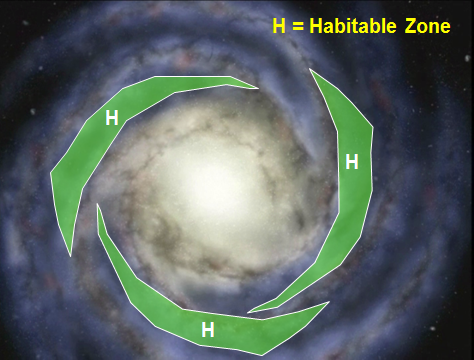
The galactic habitable zone (GHZ) is shown in green against a spiral galaxy
The galactic habitable zone (GHZ) is shown in green superimposed on a spiral galaxy

This is going to be old news to readers of this blog who are familiar with the Michael Strauss, Walter Bradley and Guillermo Gonzalez lectures on habitability and fine-tuning. But, it’s nice to see these ideas show up in one of the most presitigious peer-reviewed science journals in the world (if not the most presitigious).

Here’s the article from Science. (H/T Gunter)

It says:

Scientists have known for several years now that stars, galaxies, and almost everything in the universe is moving away from us (and from everything else) at a faster and faster pace. Now, it turns out that the unknown forces behind the rate of this accelerating expansion—a mathematical value called the cosmological constant—may play a previously unexplored role in creating the right conditions for life.

That’s the conclusion of a group of physicists who studied the effects of massive cosmic explosions, called gamma ray bursts, on planets. They found that when it comes to growing life, it’s better to be far away from your neighbors—and the cosmological constant helps thin out the neighborhood.

“In dense environments, you have many explosions, and you’re too close to them,” says cosmologist and theoretical physicist Raul Jimenez of the University of Barcelona in Spain and an author on the new study. “It’s best to be in the outskirts, or in regions that have not been highly populated by small galaxies—and that’s exactly where the Milky Way is.”

Jimenez and his team had previously shown that gamma ray bursts could cause mass extinctions or make planets inhospitable to life by zapping them with radiation and destroying their ozone layer. The bursts channel the radiation into tight beams so powerful that one of them sweeping through a star system could wipe out planets in another galaxy. For their latest work, published this month in Physical Review Letters, they wanted to apply those findings on a broader scale and determine what type of universe would be most likely to support life.

The research is the latest investigation to touch on the so-called anthropic principle: the idea that in some sense the universe is tuned for the emergence of intelligent life. If the forces of nature were much stronger or weaker than physicists observe, proponents note, crucial building blocks of life—such fundamental particles, atoms, or the long-chain molecules needed for the chemistry of life—might not have formed, resulting in a sterile or even completely chaotic universe.

Basically, the best place for a galaxy that permits complex, embodied life to exist is one where you can pick up enough heavy elements from dying stars nearby, but not be in an area that is so crowded by stars that you will be murdered by intense gamma radiation when they die.

The cosmological constant has to be set just right that we spread out enough to make space between spiral arms for life-permitting solar systems, but no so spread out that we cannot pick up the heavy elements we need for a metal-rich star, a moon, and the bodies of the intelligent agents themselves.

More:

As it turns out, our universe seems to get it just about right. The existing cosmological constant means the rate of expansion is large enough that it minimizes planets’ exposure to gamma ray bursts, but small enough to form lots of hydrogen-burning stars around which life can exist. (A faster expansion rate would make it hard for gas clouds to collapse into stars.)

Jimenez says the expansion of the universe played a bigger role in creating habitable worlds than he expected. “It was surprising to me that you do need the cosmological constant to clear out the region and make it more suburbanlike,” he says.

Remember, this is only one of many characteristics that must obtain in order for a have a location in the universe that can support complex, embodied life of any conceivable kind.

Let’s review the big picture

Time for me to list out some of the things that are required for a galaxy, solar system and planet to support complex embodied life. Not just life as we know it, but life of any conceivable kind given these laws of physics.

  • a solar system with a single massive Sun than can serve as a long-lived, stable source of energy
  • a terrestrial planet (non-gaseous)
  • the planet must be the right distance from the sun in order to preserve liquid water at the surface – if it’s too close, the water is burnt off in a runaway greenhouse effect, if it’s too far, the water is permanently frozen in a runaway glaciation
  • the solar system must be placed at the right place in the galaxy – not too near dangerous radiation, but close enough to other stars to be able to absorb heavy elements after neighboring stars die
  • a moon of sufficient mass to stabilize the tilt of the planet’s rotation
  • plate tectonics
  • an oxygen-rich atmosphere
  • a sweeper planet to deflect comets, etc.
  • planetary neighbors must have non-eccentric orbits

It’s not easy to make a planet that supports life. For those who are interested in reaching out to God, he has left us an abundance of evidence for his existence – and his attention to detail.

And remember, these requirements for a habitable planet are downstream from the cosmic fine-tuning of constants and quantities that occurs at the Big Bang. No point in talking about the need for plate tectonics if you only have hydrogen in your universe. The habitability requirements are a further problem that comes after the fine-tuning problem.

Resources

The best book to read on this topic is “The Privileged Planet“, by Guillermo Gonzalez and Jay W. Richards. The latter is one of my absolute favorite Christian scholars, a real renaissance man. If the book is too much, there is a DVD by the same name that covers everything you need to know at a high level. Just FYI, Gonzalez made the cover of Scientific American in 2001, for his research on habitable zones. This is real evidence you can discuss with anyone, anywhere.

You can also watch the DVD for FREE on YouTube. Not sure how long that will be there. If you like it, buy the DVD, so you can show your friends.

Related posts

New study: belief in free will linked to ability to behave morally and to help others

J. Warner Wallace: God's Crime Scene
J. Warner Wallace: God’s Crime Scene

A while back I finished reading “God’s Crime Scene”, the new book by J. Warner Wallace. I wanted to post something about some studies he mentioned in Chapter 6, on free will. This is one of the places where he found evidence in a surprising area.

Wallace says that free will makes more sense if theism is true, because we have non-material souls that interact with our bodies, but are not causally determined by them. On atheism, only matter exists, and you can’t get free will (or consciousness) from matter. So atheists like Sam Harris and Alex Rosenberg, for example, deny free will, because they are materialists and atheists.

Anyway, here’s what he writes on p. 256:

In 2008, researchers from the University of Minnesota and the University of British Columbia conducted experiments highlighting the relationship between a belief in determinism and immoral behavior. They found students who were exposed to deterministic literature prior to taking a test were more likely to cheat on the test than students who were not exposed to literature advocating determinism. The researchers concluded those who deny free will are more inclined to believe their efforts to act morally are futile and are, therefore, less likely to do so.

In addition, a study conducted by researchers from Florida State University and the University of Kentucky found participants who were exposed to deterministic literature were more likely to act aggressively and less likely to be helpful toward others.” Even determinist Michael Gazzaniga conceded: “It seems that not only do we believe we control our actions, but it is good for everyone to believe it.”” The existence of free will is a common characteristic of our experience, and when we deny we have this sort of free agency, there are detrimental consequences.

I decided to look up these studies.

Here’s the abstract for first study: (2008)

Does moral behavior draw on a belief in free will? Two experiments examined whether inducing participants to believe that human behavior is predetermined would encourage cheating. In Experiment 1, participants read either text that encouraged a belief in determinism (i.e., that portrayed behavior as the consequence of environmental and genetic factors) or neutral text. Exposure to the deterministic message increased cheating on a task in which participants could passively allow a flawed computer program to reveal answers to mathematical problems that they had been instructed to solve themselves. Moreover, increased cheating behavior was mediated by decreased belief in free will. In Experiment 2, participants who read deterministic statements cheated by overpaying themselves for performance on a cognitive task; participants who read statements endorsing free will did not. These findings suggest that the debate over free will has societal, as well as scientific and theoretical, implications.

And the abstract for the second study: (2009)

Laypersons’ belief in free will may foster a sense of thoughtful reflection and willingness to exert energy, thereby promoting helpfulness and reducing aggression, and so disbelief in free will may make behavior more reliant on selfish, automatic impulses and therefore less socially desirable. Three studies tested the hypothesis that disbelief in free will would be linked with decreased helping and increased aggression. In Experiment 1, induced disbelief in free will reduced willingness to help others. Experiment 2 showed that chronic disbelief in free will was associated with reduced helping behavior. In Experiment 3, participants induced disbelief in free will caused participants to act more aggressively than others. Although the findings do not speak to the existence of free will, the current results suggest that disbelief in free will reduces helping and increases aggression.

So what to make of this?

If you’re an atheist, then your worldview is telling you that what you are doing now is the result of genetic programming and sensory inputs. You’re not conscious. You can’t reason. You make no free choices, including moral choices. Naturally, someone who believes this is going to struggle with prescriptive morality, including self-sacrificial care and concern for others. Their worldview undermines the rationality of the moral point of view. You might find atheists acting morally for their own purposes, but their worldview doesn’t rationally ground it. This is a big problem for people who can see objective morality woven into the universe – and themselves – because they have the awareness of objective right and wrong.

I think what atheists like to say is “I can be moral, too”. That’s not interesting. What is interesting is whether it is rational for you to be moral when things start to get a bit uncomfortable. When I look at the adultery of Dawkins, the polyamory of Carrier, the divorces of Shermer and Atkins, etc. I am not seeing anything that really wows me. They all deny free will of course, and think that trying to resist temptation is a waste of time. What difference would it make if they did, anyway – there’s no afterlife on atheism.

Wallace explains how the awareness of free will and moral choices caused him to turn away from atheism, in this blog post.

He writes:

As an atheist, I chose to cling to naturalism, in spite of the fact that I lived each day as though I was capable of using my mind to make moral choices based on more than my own opinion. In addition, I sought meaning and purpose beyond my own hedonistic preferences, as though meaning was to be discovered, rather than created. I called myself a naturalist while embracing three characteristics of reality that simply cannot be explained by naturalism. As a Christian, I’m now able to acknowledge the “grounding” for these features of reality. My philosophical worldview is consistent with my practical experience of the world.

I think atheists who want to be honest about their own experience of first-person consciousness, free will, moral realism, etc. will do well to just accept that theism rationally grounds all of these things, and so you should accept theism. Theism is real. If you like morality, and want to be a virtuous person, then you should accept theism.

Cosmologist Luke Barnes answers 11 objections to the fine-tuning argument

Apologetics and the progress of science

This is from the blog Common Sense Atheism. (H/T Allen Hainline)

Atheist Luke Muehlhauser interviews well-respect cosmologist Luke Barnes about the fine-tuning argument, and the naturalistic response to it.

Luke M. did a good job explaining what was in the podcast. (I wish more people who put out podcasts would do that).

Details:

In one of my funniest and most useful episodes yet, I interview astronomer Luke Barnes about the plausibility of 11 responses to the fine-tuning of the universe. Frankly, once you listen to this episode you will be better equipped to discuss fine-tuning than 90% of the people who discuss it on the internet. This episode will help clarify the thinking of anyone – including and perhaps especially professional philosophers – about the fine-tuning of the universe.

The 11 responses to fine-tuning we discuss are:

  1. “It’s just a coincidence.”
  2. “We’ve only observed one universe, and it’s got life. So as far as we know, the probability that a universe will support life is one out of one!”
  3. “However the universe was configured, evolution would have eventually found a way.”
  4. “There could be other forms of life.”
  5. “It’s impossible for life to observe a universe not fine-tuned for life.”
  6. “Maybe there are deeper laws; the universe must be this way, even though it looks like it could be other ways.”
  7. “Maybe there are bajillions of universes, and we happen to be in one of the few that supports life.”
  8. “Maybe a physics student in another universe created our universe in an attempt to design a universe that would evolve intelligent life.”
  9. “This universe with intelligent life is just as unlikely as any other universe, so what’s the big deal?”
  10. “The universe doesn’t look like it was designed for life, but rather for empty space or maybe black holes.”
  11. “Fine-tuning shows there must be an intelligent designer beyond physical reality that tuned the universe so it would produce intelligent life.”

Download CPBD episode 040 with Luke Barnes. Total time is 1:16:31.

There is a very good explanation of some of the cases of fine-tuning that I talk about most on this blog – the force of gravity, the strong force, etc. as well as many other examples. Dr. Barnes is an expert, but he is also very very easy to listen to even when talking about difficult issues. Luke M. is very likeable as the interviewer.