Tag Archives: The Fed

QE3: Obama ushers in hyperinflation with more “quantitative easing”

Investors Business Daily explains Obama’s latest desperate ploy to cover up his economic failures.

Excerpt:

The Federal Reserve announced a third round of quantitative easing Thursday afternoon, and it is big: A net $40 billion a month in additional purchases of mortgage-backed securities. And policymakers said additional accommodation will continue “for a considerable time after the economic recovery strengthens.”

[…]Ordinary Americans can expect to see higher gasoline prices. Quantitative easing also pushes up commodity prices — both by boosting demand for financial assets and by weakening the dollar.

Crude oil prices have been trending higher, and were up $1 to nearly $98 a barrel in mid-afternoon trade.

That will quickly filter down to gasoline prices at the pump. Gas prices moved back to $3.847 a gallon last week, the highest since April. They’ve risen for 10 straight weeks in part on anticipation that QE3 was coming. Gas prices could once again threaten the $4 level — it’s already well over that mark in California. And that’s with no major supply issues or feared disruptions around the world.

Higher oil and gas prices also could push food prices higher, by encouraging more corn burning to produce ethanol, as IBD’s Jed Graham recently noted. Corn prices are near record highs due to this summer’s historic drought.

The producer price index shot up 1.7% in August — the biggest jump in three years — on higher food and energy costs. Gasoline prices at the wholesale level exploded 13.6%. Food costs rose 0.9%, the most in nine months.

With job growth and wage gains so weak, higher food and gas prices will cut into consumers’ buying power on everything else. That will offset much of the modest QE3 benefits.

First and second round of quantitative easing:

Third round of quantitative easing:

It means they are going to print the money. There really is no difference between Barack Obama and Robert Mugabe when it comes to economic policy. The only thing stopping him is the Republican House and the conservative alternative media.
Republican platform adds resolution to audit the Federal Reserve

From San Francisco Chronicle.

Excerpt:

 The Republican Party platform promises to replace what it criticizes as President Barack Obama’s debt-swollen entitlement society with “a roaring job market to match a roaring economy.”

The platform reflects the influence of presidential candidate Mitt Romney, offering as the remedy for the nation’s economic ills a familiar recipe of low taxes, light regulation, expanded oil drilling and free enterprise. It vows to reduce personal and corporate taxes, repeal Obama’s health-care law, promote small businesses and avoid taxpayer bailouts of troubled financial institutions.

The 62-page roadmap, approved by a voice vote of the delegates yesterday at the party’s national convention in Tampa, Florida, promotes expanded trade and accuses the Obama administration of “a virtual surrender” to commercial rival China. The Asian country is stealing American trade secrets, manipulating its currency to make its exports cheaper, and hampering U.S. firms trying to sell to Chinese customers, the Republicans say.

Republicans call for banks to be “well-capitalized” and pledge to repeal the 2010 Dodd-Frank financial-regulation law.

Along with major economic policy shifts, the Republicans vow to transform the size and scope of government. Trillion- dollar annual budget deficits and mounting debt are harming job growth, they say. “The massive federal government is structurally and financially broken,” the platform says.

[…]Echoing a longtime demand of libertarian Representative Ron Paul of Texas, the platform calls for an annual audit of the Federal Reserve. And it proposes a commission to investigate “possible ways to set a fixed value for the dollar,” a reference to a potential revival of the gold standard.

The campaign document labels Fannie Mae and Freddie Mac, government-sponsored mortgage financiers, as “a primary cause of the housing crisis because their implicit government guarantee allowed them to avoid market discipline and make risky investments.”

That view, though widely held among conservatives, has been rejected by the Federal Reserve and three of the four Republicans on the government commission that investigated the 2008 financial meltdown.

Note that both Mitt Romney and Paul Ryan support auditing the Federal Reserve.

Presumptive Republican nominee Mitt Romney called for increased transparency at the Federal Reserve Monday, voicing his strongest support yet for an audit of the country’s central banking system.

“The answer is yes to that, very plain and simple,” Romney responded, when asked by a supporter at a New Hampshire town hall whether it was time to audit the Fed. “The Federal Reserve should be accountable. We should see what they’re doing.”

The mark aligns Romney with a growing cadre of conservatives championing an audit of the Federal Reserve, a group led by Romney’s primary opponent Ron Paul and his acolytes. Earlier this month,Paul’s “Audit The Fed” bill passed the House of Representatives with overwhelming bipartisan support.

After taking a more measured stance on the issue during the Republican primaries, Romney has slowly moved to embrace a Federal Reserve audit as support for the issue grows with voters across the political spectrum. Romney’s new running mate, Wisconsin Congressman Paul Ryan, has been a vocal critic of the central banking system, and is listed as one of 268 co-sponsors of Paul’s bill. 

Romney has also said that he will not reappoint Ben Bernanke if he is elected. I think that Ron Paul supporters should be able to decide who to support in the general election based on this information.

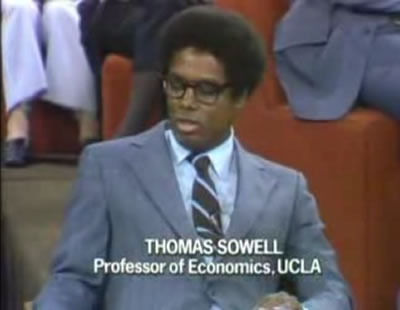
Thomas Sowell opposes government intervention in the economy

Young Thomas Sowell

From Investors Business Daily.

Excerpt:

The policies of this administration make it risky to lend money, with Washington politicians coming up with one reason after another why borrowers shouldn’t have to pay it back when it is due, or perhaps not pay it all back at all. That’s called “loan modification” or various other fancy names for welshing on debts. Is it surprising that lenders have become reluctant to lend?

Private businesses have amassed record amounts of cash, which they could use to hire more people — if this administration were not generating vast amounts of uncertainty about what the costs are going to be for ObamaCare, among other unpredictable employer costs, from a government heedless or hostile toward business.

As a result, it is often cheaper or less risky for employers to work the existing employees overtime, or to hire temporary workers who are not eligible for employee benefits. But lack of money is not the problem.

Those who are true believers in the old-time Keynesian economic religion will always say that the only reason creating more money hasn’t worked is because there has not yet been enough money created. To them, if QE2 hasn’t worked, then we need QE3. And if that doesn’t work, then we will need QE4, etc.

Like most of the mistakes being made in Washington today, this dogmatic faith in government spending is something that has been tried before — and failed before.

[…]It is not politically possible for either the Federal Reserve or the Obama administration to leave the economy alone and let it recover on its own.

Both are under pressure to “do something.” If one thing doesn’t work, then they have to try something else. And if that doesn’t work, they have to come up with yet another gimmick.

All this constant experimentation by the government makes it more risky for investors to invest or employers to employ, when neither of them knows when the government’s rules of the game are going to change again. Whatever the merits or demerits of particular government policies, the uncertainty that such ever-changing policies generate can paralyze an economy today, just as it did back in the days of FDR.

Words of wisdom.