Tag Archives: Terrorism

Eric Holder testifies on Fast and Furious gun smuggling to Mexican drug cartels

From Human Events.

Excerpt:

In a hearing before the Senate Judiciary Committee, Republicans questioned Attorney General Eric Holder about the smuggling of weapons to Mexican gun cartels through Operation Fast and Furious, when he knew about its existence and what he did about it when he learned of it.

Republicans pushed Holder on why it took him nine months to respond to memos sent to the Department of Justice.

“I am eager to hear whether the Attorney General thinks that is acceptable and what he intends to do about it,” said Ranking Member Chuck Grassley (R.-Iowa).

While the Fast and Furious gun smuggling scandal was at the top of everyone’s mind, and what conservatives specifically wanted to hear about, only a few Republican senators grilled him on it. Democrats on the committee tried to talk about nearly everything else, including treatment of Muslims by the Department of Justice, bath salt regulations, and anti-bullying measures.

The Republicans that did come out swinging on Fast and Furious got Holder to give stammering and often inconsistent testimony.

[…]Cornyn also had the most intense exchanges with Holder during the entire hearing, asking about the murder of Border Patrol Agent Brian Terry and whether or not Holder would like to apologize to the family.

“It pains me whenever there is the death of a law enforcement official, especially under the circumstances. It is not fair, however, to assume that the mistakes that happened in Fast and Furious directly led to the death of Agent Terry,” Holder said.

Cornyn also asked whether or not anyone in the Department of Justice has been made accountable for the errors that have been made.

“Can you name me one person who’s been held accountable for this Fast and Furious Operation? Just one in the Department of Justice?” Cornyn said.

Holder responded: “Well we have made a number of changes with regard to personnel both in the Phoenix U.S. Attorney’s Office, also at the ATF Headquarters here. I will certainly await the report that comes out of the Inspector General. And I will assure you and the American people that people will be held accountable for any mistakes that were made in connection with Fast and Furious.”

Wow… I think the Republicans might be a bit angry about how that Border Patrol agent got murdered because of this gun-smuggling operation, which was administered by the Department of Justice. I think Eric Holder knows more than he is admitting to, based on his evasive, politicized answers.

Related posts

FARC terrorist leader Alfonso Cano killed by Colombian armed forces

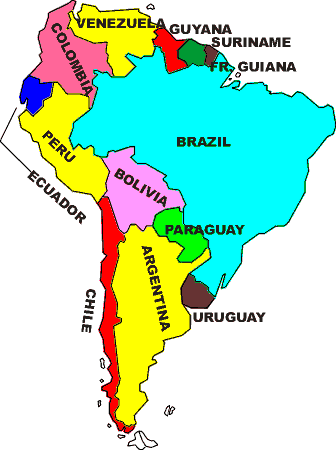
Map of South America

From the Heritage Foundation.

Excerpt:

The armed forces of Colombia have scored a major battlefield victory. They finally hunted down, confronted, and killed the leader of the narco-terrorist Revolutionary Armed Forces of Colombia (FARC), Guillermo Leon Saenz, widely known by his alias Alfonso Cano.

A guerrilla for decades, Cano assumed the top leadership of the FARC following the natural death of founder Manuel Marulanda (2008) and the elimination of senior figures Raul Reyes (2008) and Jorge Briceno (aka Mono Jojoy, 2010).

Seen by some as a modern-day version of the “good revolutionary,” Cano—a life-long advocate of armed violence and terrorism—fell in combat with the Colombian armed forces as they rappelled their way into his secret jungle hideout. Cano was also indicted in a U.S. court for drug trafficking along with dozens of other FARC leaders and had a $5 million price on his head.

FARC is a Marxist terrorist group.

The Economist reports that the Colombian economy is also doing well.

Excerpt:

WHEN the figures are finally tallied, Colombia may prove to have weathered the world recession better than any other of the larger Latin American countries. After a slight contraction at the end of 2008, the economy has been growing modestly this year. This resilience stems from continued foreign investment, an increase in government spending on public works and easier money: since December the central bank has cut interest rates by six percentage points, to 4%, a steeper drop than anywhere in the region outside Chile.

[…]President Álvaro Uribe’s security policies have helped to restore confidence. Investment soared, from 15% of GDP in 2002 to 26% last year, says Mr Zuluaga. Private business has retooled. After many delays, the government has issued licences to expand several ports; this month it hopes to award a contract for the first of four big road schemes, costing a total of $7.5 billion over four years. It hopes for investment of up to $50 billion in mining and oil over the next decade.

And liberal MSNBC has more on the booming Colombian economy.

Excerpt:

…Colombia’s revival is benefiting U.S. economic and political rivals as much as or more than the U.S. itself.

The long delay in signing the treaty allowed Latin America’s fourth-largest economy to strengthen ties with China. It also damaged U.S. credibility in the region, says Eric Farnsworth, vice-president of the Council of the Americas in Washington. “The delay in passing this called into question the United States’ reliability as a partner,” Farnsworth says. “There’s a strategic component to this. It’s not just about economics and trade.”

[…]As talks between the U.S. and Colombia dragged on, Colombia and China forged plans for a rail link between the Pacific and Caribbean that could draw freight away from the Panama Canal. Colombian President Juan Manuel Santos aims for a trade deal with South Korea. To tighten his connections to high-growth Asia, he’s also seeking membership in the Asia-Pacific Economic Cooperation group. “While Washington was debating whether the accord with Colombia was opportune, we advanced in our foreign policy strategy,” says Trade Minister Sergio Diaz-Granados.

Santos has cooperated more with his South American neighbors, organizing a meeting of finance ministers to discuss ways to protect their currencies and economies from the debt crisis in the U.S. and Europe. He supports a stock trading platform with Colombia, Chile, and Peru and wants to bring Mexico and Panama on board. Exports to Brazil have surged tenfold. While the U.S. remains Colombia’s biggest export market, with $16.8 billion in 2010 sales, up 30 percent from a year earlier, sales to China more than doubled last year, to $1.2 billion. Sales to the European Union are also rising, to $5.4 billion this year through August, more than in all of 2010. An EU trade accord could come next year.

The government has reduced cocaine cultivation 37 percent and halved the number of insurgents to about 8,000. Improved security has spurred enough growth to win an investment-grade credit rating from Standard & Poor’s as well as investment from billionaires. Colombia’s victories over the guerrillas opened up swathes of countryside to exploration for oil, gold, and coal. Mexican billionaire Carlos Slim’s push into crude has helped fuel foreign investment that the government says may reach a record $12 billion this year. The economy grew 5.2 percent in the second quarter.

The U.S. faces more competition from Colombia’s neighbors and Canada. In 2010, U.S. agricultural exports to Colombia fell more than 50 percent from 2008, to $827 million, as Argentina’s more than doubled, to $1 billion, according to a report by Senator Richard Lugar’s staff. Diaz-Granados attributes the U.S. setback to the delay in the free-trade agreement.

An August accord reduces or ends Colombian tariffs on Canadian wheat, paper, and machinery. Bank of Nova Scotia, Canada’s third-largest lender, agreed in October to buy 51 percent of Banco Colpatria Red Multibanca Colpatria for about $1 billion—Scotiabank’s largest international takeover. “This is not the Colombia of old,” says Brian J. Porter, group head of international banking for Scotiabank. “The more we looked at Colombia, the more excited we got about the economic potential.”

We really should have signed that trade deal 3 years ago – it would have helped out economy a lot.  But unions got Obama elected, and the unions decided that the trade deal needed to be held up for 3 years. And that’s one of the reasons why we’ve had over 9% unemployment. Our economic policy is being set by unions, not by economists. But in Colombia, economic policy is set by economists, not unions.

IAEA report expected to show that Iran now has the ability to build a nuclear bomb

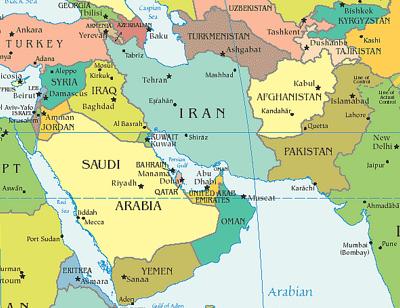
Map of the Middle East

From Fox News.

 Pakistan, North Korea and a former weapons scientist from the Soviet Union reportedly all helped Iran with its nuclear weapons quest, according to an impending U.N. nuclear watchdog report expected to show the Islamic regime has mastered the science of building a bomb.

The International Atomic Energy Agency’s report due out this week will lay out findings collected over years of intelligence gathering. It is expected to reinforce concerns that Iran didn’t actually abandon its weapons-related research in 2003, as indicated by a 2007 National Intelligence Estimate given to then-President George W. Bush.

U.S. intelligence agencies reported in 2007 that they believed Tehran halted its experiments in response to international and domestic pressures. But an ongoing investigation by the Fox News Specials Unit concludes that more than 600 entities were working inside Iran to support its program, and at least 40 sites where the work is taking place are suspected to exist across the country.

For British, French and American investigators, one of the most concerning sites is the Qom uranium enrichment construction site, hidden deep in the mountains. The latest intelligence shows that security walls have doubled around the site. Its scale cannot be explained by any known civilian nuclear energy use.

David Albright, a former IAEA official and president of the Washington-based Institute for Science and International Security who reviewed the intelligence files, told The Washington Post that Iran’s nuclear weapons program “never really stopped” and also concluded that Iran “has sufficient information to design and produce a workable implosion nuclear device.”

Western diplomats and nuclear experts briefed on the findings in the IAEA report also told the Post that foreign scientists offered assistance in overcoming key technical hurdles.

The documents reportedly show that a former Soviet weapons scientist named Vyacheslav Danilenko allegedly tutored Iranians for several years on building high-precision detonators needed to trigger a nuclear chain reaction. The Post reported that Pakistani and North Korean officials also gave to Iran mathematical formulas and codes as well as a so-called neutron initiator, which shoots a stream of atomic particles into the weapon’s fissile core at the start of the chain reaction.

There are two things to point out about this story. The first thing is that it was a strategic disaster for us to back out of Iraq, because that’s where we need to be to be able to gather intelligence, mount covert ops, run interdiction on attempts to transfer WMDs to Syria, etc. We really need to be in theater in order to deal with Iran, Syria and groups like Hezbollah, Iran’s Quds force and Muqtada Al Sadr’s Mahdi Army.

Unfortunately, I think that David Axelrod is running our national security now, which is why Obama pulled out forces out of Iraq.

Excerpt:

Three years, two abject failures. The first was the administration’s inability, at the height of American post-surge power, to broker a centrist nationalist coalition governed by the major blocs — one predominantly Shiite (Maliki’s), one predominantly Sunni (Ayad Allawi’s), one Kurdish — that among them won a large majority (69 percent) of seats in the 2010 election.

Vice President Biden was given the job. He failed utterly. The government ended up effectively being run by a narrow sectarian coalition where the balance of power is held by the relatively small (12 percent) Iranian-client Sadr faction.

The second failure was the SOFA [Status of Forces Agreement] itself. U.S. commanders recommended nearly 20,000 troops, considerably fewer than our 28,500 in Korea, 40,000 in Japan and 54,000 in Germany. The president rejected those proposals, choosing instead a level of 3,000 to 5,000 troops.

A deployment so risibly small would have to expend all its energies simply protecting itself — the fate of our tragic, missionless 1982 Lebanon deployment — with no real capability to train the Iraqis, build their U.S.-equipped air force, mediate ethnic disputes (as we have successfully done, for example, between local Arabs and Kurds), operate surveillance and special-ops bases, and establish the kind of close military-to-military relations that undergird our strongest alliances.

The Obama proposal was an unmistakable signal of unseriousness. It became clear that he simply wanted out, leaving any Iraqi foolish enough to maintain a pro-American orientation exposed to Iranian influence, now unopposed and potentially lethal. Message received. Just this past week, Massoud Barzani, leader of the Kurds — for two decades the staunchest of U.S. allies — visited Tehran to bend a knee to both President Mahmoud Ahmadinejad and Ayatollah Ali Khamenei.

The second thing to point out is the question of what we should be doing to restrain Iran’s nuclear ambitions. Click here for a run-down of some of our options. There are a lot of things we could do short of all-out war, but that would require that we had a statesman in the White House – someone who takes foreign policy seriously and treats it as more than a political issue.

A previous post I wrote showed how arms that China sells to Iran make their way to Hezbollah to be used against Israeli assets. That’s what we can expect will happen with nuclear weapons that Iran develops. Are we willing to accept that? There is also the matter of the Mexican drug cartels, the Quds force, Hugo Chavez in Venezuela and our porous border with Mexico. Are we willing to risk that?

We need to take the gloves off our national security agencies, especially the CIA, and do what has to be done.