
Tag Archives: Ted Cruz

Cruz wins primaries that are “closed” for Republican voters only

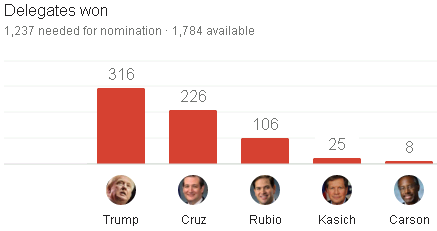
GOP primary delegate count after Super Tuesday

I have some great news. I found out why Cruz unexpectedly lost South Carolina. It turns out that in states that have “open” primaries, that anyone can vote – including Democrats! Cruz is losing some states because Democrats are declining to vote in their own primary, and instead voting in the Republican primary. They are voting for the Republican who is the easiest to beat in head-to-head polls: Donald Trump.

Here’s what the Boston Herald reported:

Nearly 20,000 Bay State Democrats have fled the party this winter, with thousands doing so to join the Republican ranks, according to the state’s top elections official.

Secretary of State William Galvin said more than 16,300 Democrats have shed their party affiliation and become independent voters since Jan. 1, while nearly 3,500 more shifted to the MassGOP ahead of tomorrow’s “Super Tuesday” presidential primary.

So that explains why Cruz is not winning everything. Cruz wins primaries that are closed, so that only people who register as Republicans can vote – not registered Democrats.

But some states allow Democrats to vote in Republican primaries without any change in registration.

Look at how it’s explained in the leftist Washington Post:

Following the South Carolina primary, an interesting article by Michael Harrington went around Facebook that speculated that Donald Trump’s victory in the South Carolina primary was attributable to Democrats voting in the Republican (open) primary. One of the good things about Harrington’s article is that he put out a testable hypothesis — that turnout in the Democratic primary a few days later would be less than 390,000. In fact, it was 367,000. Harrington concludes that had South Carolina had a closed primary, Ted Cruz would have won the primary there. I don’t know him and the author seems to be anti-Trump based on other things he has written — but the fact that his prediction was borne out adds some independent verification to his thesis. So that got me to thinking.

[…][S]o far the primary calendar has been heavily tilted toward open primaries. But there have been four closed elections: the Iowa caucus, the Nevada caucus, and Super Tuesday’s Oklahoma primary and Alaska caucus. Ted Cruz won three of those four closed elections.

[…][T]here are four Republican primaries/caucuses: Kansas, Kentucky, Louisiana and Maine. All are closed.

Then, once the winner-takes-all states begin, a large number of those are closed primaries and caucuses as well (including Florida, for what it’s worth).

[…]First, the fact that South Carolina and most of the SEC primaries were open primaries may very well explain why those states did not turn out to be Ted Cruz’s firewall or launch states as he had predicted. Oklahoma did perform as expected, being a fairly comfortable win for Cruz.

This is something that the Republican National Committee really needs to fix, along with requiring photo identification and proof of residency in order to vote. We can’t allow a bunch of Democrats to come in and pick a raving con man as our candidate, in order to make it easier on their candidate in November. No wonder we haven’t been winning elections!

Anyway, there is more good news. Shane Vander Hart has it up on his Caffeinated Thoughts blog.

He writes:

The next few contests on March 5 are ones where Cruz could do well Kansas and Kentucky which are both caucus states that rely upon organization. Cruz could also do well in Louisiana which is a closed primary. On March 8th you have Idaho Primary which is a closed primary that doesn’t favor Trump. Mississippi has an open primary, but I suspect Cruz will be competitive. Michigan on March 8th is an open primary which favors Trump.

So not only are there more upcoming closed primaries, but some of the states are caucus states, where having a good ground game makes a difference. We should be optimistic about Cruz’s chances in the next week.

Which candidate is best at working with Democrats to get things done?

The Jesus Seminar and their pre-suppositions
Republican voters need to go beyond the surface level in assessing candidates

I have a few friends who I know are supporting either Donald Trump or Marco Rubio in the election. I have asked them specifically what policies, accomplishments and past battles they like best about their candidate.

Donald Trump supporters say this:

  • he’s leading in the polls (vs Republicans)
  • he tells it like it is
  • he’s going to build a fence  and make Mexico pay for it
  • he’s a businessman

Marco Rubio supporters say this:

  • he’s leading in the polls (vs Democrats)
  • he’s handsome
  • I like the way he talks
  • his wife was a Miami Dolphins cheerleader, so she is prettier and funner than nerdy workaholic Harvard MBA Heidi Cruz

My candidate is Ted Cruz, and the Trump supporters tend to have no problem with him. But the Rubio supporters don’t like Cruz. So I made a list of their objections to Cruz.

The Rubio supporters say this:

  • (quoting Donald Trump) not one of his colleagues in the Senate has endorsed him
  • he won’t be able to convince other people to get things done
  • I don’t like the way he talks
  • he has a pickle nose
  • he said he wanted to make Marco Rubio’s amnesty bill “better” but  his amendment actually killed the amnesty bill – that means he’s a liar because his amendment didn’t make the bill better

Regarding the point about Ted Cruz not being able to get along with his colleagues in the Senate, that’s actually false. First, Cruz and Rubio came into the Senate at the same time, and Cruz has passed more legislation than Rubio. That might be because Rubio has the worst attendance record in the Senate.

When Rubio works together with people, he authors an amnesty bill, he supports the failed Libya invasion, he gives in-state tuition to illegal immigrants, he weakens border security, he authors a bill to remove the due process rights of men falsely accused of rape on campus, he skips votes to defund Planned Parenthood, he is liberal on the issue of gay marriage, his deputy campaign manager is a gay activist, and so on. In short, he works with liberals on liberal priorities – that’s why he is likable to them.

Ted Cruz gets into trouble with his colleagues, because he tries to stop the spending, stop amnesty, stop the military interventions in Syria, Libya and Egypt, etc. That’s why he is not likable to them.

What about the point that Cruz would not be persuasive to Democrats, and so would not be able to get anything done? Well, we already saw that Cruz has passed more legislation than Rubio, despite having a pickle nose. But he’s also shown the ability to pull Democrats towards his point of view.

Here’s an article from PJ Media to explain:

Now that Cruz regularly polls toward the top of an ever-shrinking field, his early tenure bears closer scrutiny. Cruz has gained fame as a social conservative and an unwavering opponent of Obamacare. In his first major leadership role, however, he developed economic policy as the director of the Federal Trade Commission’s Office of Policy Planning.

At the FTC, Cruz’s agenda could have been written by Milton Friedman.

Cruz promoted economic liberty and fought government efforts to rig the marketplace in favor of special interests. Most notably, Cruz launched an initiative to study the government’s role in conspiring with established businesses to suppress e-commerce. This initiative ultimately led the U.S. Supreme Court to open up an entire industry to small e-tailers. Based on his early support of disruptive online companies, Cruz has some grounds to call himself the “Uber of American politics.”

Moreover, and perhaps surprising to some, Cruz sought and secured a broad, bipartisan consensus for his agenda. Almost all of Cruz’s initiatives received unanimous support among both Republicans and Democrats.

Ted Cruz a consensus-builder? He was, at the FTC.

[…]Beyond the e-commerce initiative, Cruz also reoriented the FTC’s use of antitrust laws.

[…]Cruz also sent dozens of letters to states to fight new efforts to enshrine crony capitalism.

[…]Perhaps surprisingly, Cruz secured a high degree of consensus in pursuing his agenda.

As an independent agency, the FTC has five commissioners, and during Cruz’s tenure, two of them had served in President Clinton’s administration. All five commissioners voted to support almost all of Cruz’s proposals.

Cruz achieved this consensus by listening to policy experts and political opponents. He listened to the FTC’s economic experts and marshaled empirical economic analysis to support his policy objectives. He solicited input from prominent Democrats, including the late Senator Howard Metzenbaum, who spoke at the e-commerce conference. In addition, Cruz worked to develop personal relationships across the aisle. He regularly met with Democratic commissioners and incorporated their ideas into his policy proposals.

The article explains Cruz’s conservative agenda in detail; increasing competition, protecting consumers, and so on. But he wasn’t likable in the way that Marco Rubio was likable – by pushing a Democrat agenda. He was likable by convincing Democrats to push a conservative agenda. He did it by gathering evidence and making his case. And that’s what you expect from a lawyer who wins cases for conservatives at the Supreme  Court.

Ted Cruz’s plan to lower taxes and simplify the process for filing tax returns

How to get kissed: Heidi Cruz helping her husband

Ted Cruz is very upset with the IRS for discriminating against conservative groups and Christian groups in order to get Barack Obama re-elected in 2012. So, he’s come up with a plan to drastically reduce their influence – and their cost to taxpayers.

Here he is talking about the plan with Megyn Kelly on Fox News.

And he has posted something about the plan on his web site:

Under the Simple Flat Tax, the current seven rates of personal income tax will collapse into a single low rate of 10 percent. For a family of four, the first $36,000 will be tax-free. The Child Tax Credit will remain in place, and the Simple Flat Tax Plan expands and modernizes the Earned Income Tax Credit with greater anti-fraud and pro-marriage reforms.

[…]The IRS will cease to exist as we know it, there will be zero targeting of individuals based on their faith or political beliefs, and there will be no way for thousands of agents to manipulate the system.

For businesses, the corporate income tax will be eliminated. It will be replaced by a simple Business Flat Tax at a single 16 percent rate. The current payroll tax system will be abolished, while maintaining full funding for Social Security and Medicare.

The convoluted tax code will be replaced with new rules of the game – so simple, in fact, that individuals and families could file their taxes on a postcard or phone app. The Death Tax will be eliminated. The Alternative Minimum Tax will be eliminated. The tax on profits earned abroad will be eliminated. And of course, the Obamacare taxes will be eliminated. Also gone will be the unending loopholes in the current code, the stacks of depreciation schedules for businesses, and the multi-tiered rates on income and investments. Under the Simple Flat Tax, the Internet remains free from taxes.

Simple.

The Tax Foundation, which is the leading non-partisan think tank that deals with the issue of taxation, scored Cruz’s plan.

They say:

  • Senator Cruz’s plan would cut taxes by $3.6 trillion over the next decade on a static basis. However, the plan would end up reducing tax revenues by $768 billion over the next decade when accounting for economic growth from increases in the supply of labor and capital and the much broader tax base due to the new value-added tax.

  • According to the Tax Foundation’s Taxes and Growth Model, the plan would significantly reduce marginal tax rates and the cost of capital, which would lead to a 13.9 percent higher GDP over the long term, provided that the tax cut could be appropriately financed.

  • The plan would also lead to a 43.9 percent larger capital stock, 12.2 percent higher wages, and 4.8 million more full-time equivalent jobs.

  • On a static basis, the plan would cut taxes by 9.2 percent, on average, for all taxpayers.

  • Accounting for economic growth, all taxpayers would see an increase in after-tax income of at least 14 percent at the end of the decade.

They conclude:

Senator Cruz’s tax plan would significantly alter the federal tax code. It would completely repeal the corporate income tax and all payroll taxes and enact a 10 percent income tax and a 16 percent “business transfer tax” or value-added tax. These changes to the tax code would increase the incentives to work and invest and would greatly increase the U.S. economy’s size in the long run, leading to higher incomes for taxpayers at all income levels. The plan would also be a large tax cut, which would increase the federal government’s deficit by over $3.6 trillion on a static basis. Accounting for the growth caused by the plan, federal revenues would decline by $768 billion over the next decade.

The non-partisan The Hill says that another major think thank for fiscal conservatism also likes Cruz’s plan:

Ted Cruz’s tax plan would cost less and stimulate the economy more than Donald Trump‘s, a recent analysis found.

“Of the two proposals that we have examined so far, those by Trump and Cruz, we find the Cruz proposal to be the better of the two,” said David Tuerck, executive director of the Beacon Hill Institute and senior fellow at the National Center for Policy Analysis. The free-market groups released a report comparing the economic effects of the tax plans from the two Republican presidential candidates.

[…]Cruz’s plan would also increase business investment and personal income more than Trump’s plan would, the report found.

I want a higher personal income, and I want more money invested into the business that employs me – so I can keep my job, or maybe find a better one. It’s very important to my life plan that I be able to earn money, and keep what I earn. I have a use for that money, whether I marry or not. And that use is not to give it to the government so they can buy people condoms and abortions in exchange for their votes. I have a better plan for the money I earn than what a secular government wants to do with it.

Now, Ted Cruz will have to come up with $768 billion in revenue to balance his plan, but that’s why he has promised to abolish or significantly reduce FIVE government departments. Don’t worry, they aren’t the useful ones. We have too much government, and we can get rid of some, and return the money to the people.

Related posts