Tag Archives: Taxes

New paper on income inequality: Does taxing the rich hurt the middle class?

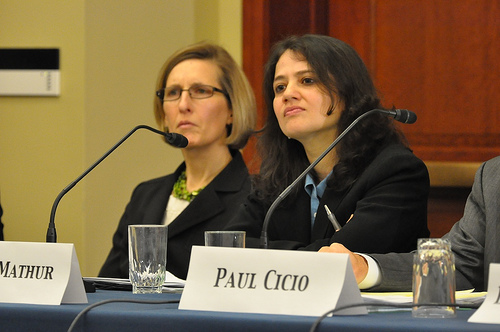
Aparna Mathur (right)

Here’s an article by Indian economist Aparna Mathur.

She writes (in part):

In a recent paper that I co-authored with Kevin Hassett, we explored the effect of high corporate taxes on worker wages. The motivation for the paper came from the international tax literature (summarized by Roger Gordon and Jim Hines in a 2002 paper1) that suggested that mobile capital flows from high tax to low tax jurisdictions. In other words, in any set of competing countries, investment flows are determined by relative rates of taxation. The current U.S. headline rate of corporate tax is 35 percent. The combined federal and state statutory rate of 39 percent is second only to Japan in the OECD. With Japan set to lower its statutory rate later this year, the U.S. rate will soon be the highest in the OECD and one of the highest in the world. What effect do these high rates have on worker wages?

When capital flows out of a high tax country, such as the United States, it leads to lower domestic investment, as firms decide against adding a new machine or building a factory. The lower levels of investment affect the productivity of the American worker, because they may not have the best machines or enough machines to work with. This leads to lower wages, as there is a tight link between workers’ productivity and their pay. It could also lead to less demand for workers, since the firms have decided to carry out investment activities elsewhere.

Our paper was one of the first to explore the adverse effect of corporate taxes on worker wages. Using data on more than 100 countries, we found that higher corporate taxes lead to lower wages. In fact, workers shoulder a much larger share of the corporate tax burden (more than 100 percent) than had previously been assumed. The reason the incidence can be higher than 100 percent is neatly explained in a 2006 paper by the famous economist Arnold Harberger.2 Simply put, when taxes are imposed on a corporation, wages are lowered not only for the workers in that firm, but for all workers in the economy since otherwise competition would drive workers away from the low-wage firms. As a result, a $1 corporate income tax on a firm could lead to a $1 loss in wages for workers in that firm, but could also lead to more than a $1 loss overall when we look at the lower wages across all workers.

Following our paper, several academic economists substantiated our results, using different data sets and applying varied econometric modeling and techniques. Some examples of these studies include a 2007 paper by Mihir A. Desai and C. Fritz Foley of Harvard Business School and James Hines Jr. of Michigan University Law School, a 2007 paper by R. Alison Felix of the Federal Reserve Bank of Kansas City, a 2009 paper by Robert Carroll of The Tax Foundation, and a 2010 paper by Wiji Arulampalam of the University of Warwick and Michael Devereux and Giorgia Maffini of Oxford.3 A recent Tax Notes article that I co-authored summarizes these various studies and also the lessons from the theoretical literature on the topic. The general consensus from theory and empirical work is that while we may argue academically about the size of the effect, there is no disagreement among economists that a sizeable burden of the corporate income tax is disproportionately felt by working Americans. On average, a $1 increase in corporate tax revenues could lead to a dollar or more decline in the wage bill.

Conservatives and liberals have the same goal. We both want to help the poor. Liberals think that taking money from the rich and giving it to the poor helps, but all it does it cause the rich to move their capital and jobs elsewhere, leaving the poor poorer. Conservatives let the rich keep their money and encourage them to risk it trying to make more money by engaging in enterprises that create wealth – creating products and services from less valuable raw materials. In a socialist system, the rich get poorer, but so do the poor. In a capitalist system, the rich get very rich, but the poor also gain more wealth. That’s what happens when corporations like Apple make IPads out of junky raw materials. That’s how wealth is created – by letting people who want to make things keep more of what they earn. We all benefit from encouraging people to make new things and provide value for their neighbors.

Related articles

Caterpillar decides to not build its new manufacturing plant in Illinois

Central United States

From the Peoria Journal Star.

Excerpt:

Caterpillar Inc. will not be building its new North American plant anywhere in the state of Illinois, officials with the company told local leaders Tuesday, with part of the reason being continued concerns about the business climate in the state.

The company will instead focus on a location closer to its division headquarters in Cary, N.C., Peoria County officials were told in an email sent to them shortly after the close of business and later obtained by the Journal Star. The plant stood to bring with it from Japan roughly 1,000 jobs manufacturing track-type tractors and mini hydraulic excavators.

Peoria County had submitted a regional proposal for the facility at the end of last year, and the Galesburg area also had a proposal on the table for the manufacturer. Peoria’s proposal reportedly included economic incentives as well as a promise of a legislative effort to establish a tax increment financing district to benefit the company.

At its core, Caterpillar’s decision reflects some concerns its officials had previously expressed about the economic condition of the Land of Lincoln.

“Please understand that even if your community had the right logistics for this project, Caterpillar’s previously documented concerns about the business climate and overall fiscal health of the state of Illinois still would have made it unpractical for us to select your community for this project,” the letter reads in part. “Caterpillar intends to continue calling for long-term changes in Illinois and to offer help to the state as it works toward real and fundamental reforms that will position communities like yours to compete for future projects.”

And:

Still, the rejection didn’t come as much of a surprise to state Rep. David Leitch, R-Peoria.

“I think Caterpillar has been very frustrated by the state’s inability to improve the business climate,” he said. “I still think that workers’ comp is a very serious issue for Caterpillar and others. I think there’s great concern about the financial situation within the state itself. The precarious nature of the state’s finances and having the worst bond rating in the country and huge liabilities … have not been addressed.”

The decision to locate elsewhere — and the reasons for it — should serve as a wake-up call to the region and the state as a whole, Rand said.

“I think the lessons learned here shouldn’t read like recriminations but instead resonate like a call to action,” he said. “Perhaps someone in Springfield will take notice. It’s our job to make certain they do.

“You can’t move a mountain while wearing a pair of roller skates. The disadvantages Cat identifies in Illinois are all man-made. We have to make ourselves competitive. It won’t happen because of a wish.”

Illinois is one of the bluest states in the union – totally dominated by Democrats. It’s very important for working Americans to understand that a Democrat can stand up and complain about outsourcing and greed and corporations and income inequality until they are blue in the face. It doesn’t mean a thing. Democrats are for higher taxes and more regulations on businesses, and that’s what causes outsourcing. Democrats cause unemployment. It doesn’t matter what they say. What matters is how job creators respond to the incentives created by Democrat policies.

Electric car company that got $500 million in stimulus announces layoffs

From the left-wing Politico.

Excerpt:

In another setback for President Obama’s clean energy loan programs, the recipient of more than a half-billion dollars in federal loans is laying off workers at their Delaware and California operations.

Delaware’s News Journal reports that Fisker Automotive, a California-based electric car start-up company, is laying off an undisclosed number of staff to try to reserve enough capital in order to qualify for more federal help from the Department of Energy, according to a Delaware state development official.

“They’re trying to preserve the cash that they have,” said Alan Levin told the News Journal. “And unfortunately, until they meet the milestone that DOE continues to set … they’re not able to access the additional capital that they need.”

The company also came under fire last year for taking federal loans while producing cars in Finland. Company officials told ABC News at the time that “there was no contract manufacturer in the U.S. that could actually produce our vehicle.” The company was working on reopening a shuttered General Motors plant in Wilmington to produce vehicles — an effort that top Obama administration officials lauded.

[…]“This is proof positive that our efforts to create new jobs, invest in a clean energy economy and reduce carbon pollution are working,” said Energy Secretary Steven Chu. “We are putting Americans back to work and reigniting a new Industrial Revolution that is paramount for the economic success of this country.”

The company received $529 million in loans to produce two lines of plug-in hybrid cars.

The Wall Street Journal explains who stands to gain from the loans that were given to Fisker.

Excerpt:

A tiny car company backed by former Vice President Al Gore has just gotten a $529 million U.S. government loan to help build a hybrid sports car in Finland that will sell for about $89,000.

The award this week to California startup Fisker Automotive Inc. follows a $465 million government loan to Tesla Motors Inc., purveyors of a $109,000 British-built electric Roadster. Tesla is a California startup focusing on all-electric vehicles, with a number of celebrity endorsements that is backed by investors that have contributed to Democratic campaigns.

[…]Kalee Kreider, a spokeswoman for Mr. Gore, confirmed that the former vice president backs Fisker and purchased a Karma. “He believes that a global shift of the automobile fleet toward electric vehicles, accompanying a shift toward renewable-energy generation, represents an important part of a sensible strategy for solving the climate crisis,” she said in a statement.

Fisker’s top investors include Kleiner Perkins Caufield & Byers, a veteran Silicon Valley venture-capital firm of which Gore is a partner. Employees of KPCB have donated more than $2.2 million to political campaigns, mostly for Democrats, including President Barack Obama and Hillary Clinton, according to the Center for Responsive Politics, a nonpartisan group that tracks campaign contributions.

Officials at Kleiner Perkins didn’t return requests for comment.

So let’s recap. A company connected to Democrats gets a $500 million pay-off, then lays off employees to qualify for more payoffs. And all of this money is coming f

Related posts