Tag Archives: Tax

New House GOP bill de-funds Planned Parenthood

Rep. Denny Rehnberg
Rep. Denny Rehnberg

Story from Life News.

Excerpt:

The battle over yanking federal taxpayer funding of the Planned Parenthood abortion business is back in Congress as House Republicans have unveiled new legislation attempting to remove its Title X funding.

Republicans tried earlier this year to de-fund Planned Parenthood but Obama refused overtures from pro-life Speaker John Boehner to do so when Republicans and Democrats were working on ironing out legislation to fund the federal government. Obama eventually agreed to a compromise that allowed both the House and Senate to vote on a stand-alone bill de-funding Planned Parenthood and, while House Republicans approved their measure, Senate Democrats defeated it in the upper chamber.

[…]Now, Rep. Denny Rehberg of Montana, the chairman of the House Labor, Health, and Human Services Appropriations Subcommittee has introduced new legislation to fund the federal government that prohibits any funds going to Planned Parenthood unless the organization stops doing abortions.

“This bill is the result of the cumulative effort of members of the Subcommittee, and Americans I heard from at 81 listening sessions and in countless meetings in Washington and in Montana.  Now, it’s posted online for the only test that matters, and that’s the approval of the American people,” Rehberg said.

Naturally, the head abortionist is outraged – someone is taking away her dollars!

Planned Parenthood president Cecile Richards issued a statement last week condemning the legislation.

“Eliminating funding for the Title X family planning program and prohibiting Planned Parenthood from providing preventive health care through federal programs will result in millions of women across the country losing access to basic primary and preventive health care,” Richards said.

The new bill also came under attack from both pro-abortion organizations and pro-abortion lawmakers.

“Another health-related provision prohibits any funding under the bill from going to any Planned Parenthood affiliate unless the organization promises not to perform abortions with non-federal funds,” Congresswoman Rosa DeLauro, a pro-abortion Connecticut Democrat and a member of the subcommittee, groused. “The main effect would probably be to prohibit Medicaid patients from choosing to receive services such as contraception and cancer screenings from Planned Parenthood clinics.”

I listed Planned Parenthood AND the Democrats as being interested in the dollars. It’s a vicious circle. Planned Parenthood gets the dollars to kill the babies, and then they make campaign contributions to the Democrats who give them the taxpayer money. It’s all about the money. They kill babies for money. It’s a big business, and we subsidize it with our taxes.

Hon. Maurice Vellacott

And even in Canada, some Canadian conservatives are trying to push to de-fund Planned Parenthood.

Excerpt:

Two more Tory MPs are taking swipes at the International Planned Parenthood Foundation.

One claims the group conned the government when it applied for and got a federal grant of $6 million over three years.

Another is linking it to the sinister and long-discredited science of eugenics.

Saskatchewan MP Maurice Vellacott says the federation was deceitful in claiming that the money would only go to countries where abortion is illegal.

Alberta MP Leon Benoit wants to condemn the foundation over an award named for Margaret Sanger.

Sanger was a pioneer in planned parenthood who embraced a type of eugenics.

Saskatoon MP Brad Trost started the ball rolling earlier this week with a web post condemning the decision to fund the international family-planning group.

While the Prime Minister’s Office is adamant that abortion is not an issue for the Conservative government, it still seems to be a touchy subject for backbenchers.

The Planned Parenthood grant is a case in point.

Trost said in his web post that the government’s claim that the money would be used in countries that bar abortion is “hair-splitting.”

Vellacott said the federation is “trying to dupe” the government over abortion.

“Even in those countries where abortion is technically illegal, it’s naive to think that Canadian tax dollars are not being used to promote abortion,” he said in a news release.

Maurice Vellacott is my favorite Canadian MP. He is the Canadian-equivalent to Iain Duncan-Smith in the UK. And don’t think these guys aren’t good on fiscal issues – they are. They just are also good at social issues, which should go together anyway.

Related posts on Planned Parenthood

New survey finds that Canadian health care system quality is declining

Map of Canada
Map of Canada

A story about a recent survey on Canada’s universal health care system, from the National Post.

Excerpt:

A new survey on attitudes about the health-care system reveals some interesting responses, confirming that Canadians have widespread misgivings about the system, even while not fully understanding how it works. They also favour using tax incentives to encourage healthier living and eating.

The survey of 2,300 Canadians carried out in April by the consulting firm Deloitte was part of a larger poll covering 12 countries. It is considered accurate to within two percentage points, 95% of the time.

Some of the highlights include:

– Just 5% of respondents gave the system an A grade; 45% giving it a B, 36% a C, 10% a D, and 4% a failing F.

– 33% of Canadians said they understood how the system works, down from 39% in 2009 when Deloitte did a similar survey.

– 69% feel that the system has not improved in the last two years, while there were slightly more who thought it had deteriorated, as opposed to improved, in that period.

– 36% believe that half the money spent on health care is wasted; interestingly, half of those skeptics blame the waste on people failing to take responsibility for their own health.

– 13% reported that they are caring for another person, up from 10% in 2009, a possible sign of the increasing personal burden posed by the aging population. In a third of those cases, the individual is caring for a spouse.

– 55% rated their health as excellent or very good … even though 52% report having been diagnosed with one or more chronic diseases.

– 63% favour some kind of tax-based incentive to encourage more healthy diets and lifestyles.

– About 80% favour expanding medical-school enrollments to increase the supply of doctors.

You can find some more videos describing horror stories in the Canadian system in this previous post.

Everyone agrees that the American health care system is too expensive, but do we at least get better quality outcomes? Let’s see.

How good is the American health care system?

Consider this article from the Hoover Institute at Stanford University.

Medical care in the United States is derided as miserable compared to health care systems in the rest of the developed world. Economists, government officials, insurers, and academics beat the drum for a far larger government role in health care. Much of the public assumes that their arguments are sound because the calls for change are so ubiquitous and the topic so complex. Before we turn to government as the solution, however, we should consider some unheralded facts about America’s health care system.

1. Americans have better survival rates than Europeans for common cancers. Breast cancer mortality is 52 percent higher in Germany than in the United States and 88 percent higher in the United Kingdom. Prostate cancer mortality is 604 percent higher in the United Kingdom and 457 percent higher in Norway. The mortality rate for colorectal cancer among British men and women is about 40 percent higher.

2. Americans have lower cancer mortality rates than Canadians. Breast cancer mortality in Canada is 9 percent higher than in the United States, prostate cancer is 184 percent higher, and colon cancer among men is about 10 percent higher.

3. Americans have better access to treatment for chronic diseases than patients in other developed countries. Some 56 percent of Americans who could benefit from statin drugs, which reduce cholesterol and protect against heart disease, are taking them. By comparison, of those patients who could benefit from these drugs, only 36 percent of the Dutch, 29 percent of the Swiss, 26 percent of Germans, 23 percent of Britons, and 17 percent of Italians receive them.

4. Americans have better access to preventive cancer screening than Canadians. Take the proportion of the appropriate-age population groups who have received recommended tests for breast, cervical, prostate, and colon cancer:

  • Nine out of ten middle-aged American women (89 percent) have had a mammogram, compared to fewer than three-fourths of Canadians (72 percent).
  • Nearly all American women (96 percent) have had a Pap smear, compared to fewer than 90 percent of Canadians.
  • More than half of American men (54 percent) have had a prostatespecific antigen (PSA) test, compared to fewer than one in six Canadians (16 percent).
  • Nearly one-third of Americans (30 percent) have had a colonoscopy, compared with fewer than one in twenty Canadians (5 percent).

5. Lower-income Americans are in better health than comparable Canadians. Twice as many American seniors with below-median incomes self-report “excellent” health (11.7 percent) compared to Canadian seniors (5.8 percent). Conversely, white, young Canadian adults with below-median incomes are 20 percent more likely than lower-income Americans to describe their health as “fair or poor.”

6. Americans spend less time waiting for care than patients in Canada and the United Kingdom. Canadian and British patients wait about twice as long—sometimes more than a year—to see a specialist, have elective surgery such as hip replacements, or get radiation treatment for cancer. All told, 827,429 people are waiting for some type of procedure in Canada. In Britain, nearly 1.8 million people are waiting for a hospital admission or outpatient treatment.

7. People in countries with more government control of health care are highly dissatisfied and believe reform is needed. More than 70 percent of German, Canadian, Australian, New Zealand, and British adults say their health system needs either “fundamental change” or “complete rebuilding.”

8. Americans are more satisfied with the care they receive than Canadians. When asked about their own health care instead of the “health care system,” more than half of Americans (51.3 percent) are very satisfied with their health care services, compared with only 41.5 percent of Canadians; a lower proportion of Americans are dissatisfied (6.8 percent) than Canadians (8.5 percent).

9. Americans have better access to important new technologies such as medical imaging than do patients in Canada or Britain. An overwhelming majority of leading American physicians identify computerized tomography (CT) and magnetic resonance imaging (MRI) as the most important medical innovations for improving patient care during the previous decade—even as economists and policy makers unfamiliar with actual medical practice decry these techniques as wasteful. The United States has thirty-four CT scanners per million Americans, compared to twelve in Canada and eight in Britain. The United States has almost twenty-seven MRI machines per million people compared to about six per million in Canada and Britain.

10. Americans are responsible for the vast majority of all health care innovations. The top five U.S. hospitals conduct more clinical trials than all the hospitals in any other developed country. Since the mid- 1970s, the Nobel Prize in medicine or physiology has gone to U.S. residents more often than recipients from all other countries combined. In only five of the past thirty-four years did a scientist living in the United States not win or share in the prize. Most important recent medical innovations were developed in the United States.

Despite serious challenges, such as escalating costs and care for the uninsured, the U.S. health care system compares favorably to those in other developed countries.

The author of that article is a senior fellow at the Hoover Institution and a professor of radiology and chief of neuroradiology at Stanford University Medical School.

So, we saw that the quality of the U.S. health care system is good, but how can we lower the costs? Is government controlled rationing (like Canada) the answer, or is there another way?

Choice and competition in health care

The Center for Freedom and prosperity seems to have found another way: choice and competition.

Excerpt:

In many ways, America’s health care system is the best in the world. It has state-of-the-art technology and highly-skilled medical professionals. America is also home to most of the cutting-edge medical research in the world. However, there are also important problems, such as the “third-party payer” model where consumers rarely pay the full cost of their own health care. This creates an incentive for both excessive and expensive use of health care, a problem that would be exacerbated by current proposals for greater government control of the health care system.

But the third-party payer problem is not the only reason that health care costs are high. State governments impose health insurance coverage mandates, often for “gold-plated” coverage, that drive up the cost of insurance. These regulations, which are unique to each state, are imposed at the behest of interest groups seeking to increase demand for their services. Combined with protectionist barriers that prevent consumers from buying policies from providers in other states, these mandates have severe unintended consequences:

  • They limit competition in the health insurance market by preventing insurance buyers from shopping across state lines, creating monopolistic and oligopolistic situations in many states;
  • They impose coverage mandates that force health insurance buyers to purchase coverage that they either do not want or cannot afford;
  • They force insurers to use community rating instead of experience rating, which means healthy people are forced to subsidize unhealthy people – to the effect that insurance premiums rise for many buyers and healthy people are driven out of the market.

The symptoms of a dysfunctional health insurance market – foremost the significant number of uninsured, but also rising costs – are recognized by many legislators. But the problem cannot be solved, as some suggest, by means of increased government regulation. Indeed, government regulation is the cause of most problems in the health insurance market, not the solution.

Restoring a free market health care system would be a daunting task, one that would involve, 1) sweeping reforms to the 45 percent of health care directly financed by government programs, and 2) a complete rewrite of the tax code to remove the distortions that exist in employer-provided health insurance. This paper focuses on the so-called third leg of the stool – policies to remove government barriers and restore competition to the market for individual health insurance.

Reforming the government-financed programs is definitely necessary because there is so much fraud and waste, as there always is with government, when compared to the private sector. Private sector businesses have to turn a profit, so they actually try to prevent fraud and waste.

Here’s a documentary featuring John Stossel that explains the health insurance problem. (And featuring Regina Hertzlinger, too)

Part 1 of 5:

Part 2 of 5:

Part 3 of 5:

Part 4 of 5:

Part 5 of 5:

Choice and competition govern the way we buy things that we want normally, especially when we buy things online. I am pretty happy buying things from online retailers, because I have so many stores to choose from, with lots of product reviews and retailer ratings. I usually like what I buy, because I know that I am buying a good product from a good seller. And if I don’t get a good outcome, I can leave a review of the product, service or seller as a warning for the next person. That helps to encourage producers to make quality products and services Seller rating helps to make sellers care for customers, and to accept returns on items that don’t perform. Maybe we should do that with health care, and just leave health insurance for catastrophic care – like car insurance is for accidents, but not for oil changes.

Guttmacher Institute: states enact record number of abortion restrictions

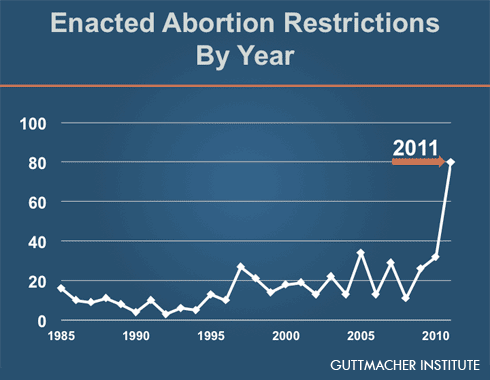
Enacted Abortion Restrictions By Year

Great news from the Guttmacher Institute, a pro-abortion think tank. (H/T John from Truth in Religion & Politics)

Excerpt:

In the first six months of 2011, states enacted 162 new provisions related to reproductive health and rights. Fully 49% of these new laws seek to restrict access to abortion services, a sharp increase from 2010, when 26% of new laws restricted abortion. The 80 abortion restrictions enacted this year are more than double the previous record of 34 abortion restrictions enacted in 2005—and more than triple the 23 enacted in 2010. All of these new provisions were enacted in just 19 states.

The post breaks down the pro-life measures by category:

  • Counseling and waiting periods
  • Gestational bans
  • “Heartbeat” bill
  • Banning abortion coverage in new insurance exchanges
  • Medication abortion
  • Cuts to abortion subsidies

All of these bills were supported by Republicans, and opposed by Democrats.

Elections have consequences. We elected a massive number of Republicans in 2010, and now we are seeing the results of that effort. I could not be more proud of the Republicans who voted in these measures to protect the unborn.

Related posts