1. The foolish apologist speaks before listening. Proverbs 18:13 says, “He who answers before listening – that is his folly and his shame.” Not only does he communicate to others that he could care less about what they have to say, but he also becomes unable to give a well informed answer. The wise apologist is patient, seeks to understand, and avoids monologue.
7. The foolish apologist neglects spiritual disciplines. He finds reading philosophy more interesting than reading the Bible, so he neglects the Bible. Prayer is seldom and rushed. In fact, prayer, meditation, Bible study, worship and fellowship take the back seat to study. The foolish apologist deceives himself that he is being spiritual, all the while drifting away. The wise apologist sits at the feet of Jesus.
9. The foolish apologist isolates himself from others. He doesn’t need their input. He doesn’t appreciate correction. He has his own plans, his own agenda, and own personal ministry. He refuses to let iron sharpen iron. When he falls, he has no one to help him up. He’s accountable to himself only. The wise apologist surrounds himself with godly counsel and fellow laborers.
I know that some people will think that I am guilty of number 8, but sometimes you have to break the rules in order to get the conversation started, and then walk it back later. That’s how you get the other person to engage.
Do any of these pitfalls that Christian apologists fall into sound familiar to you?
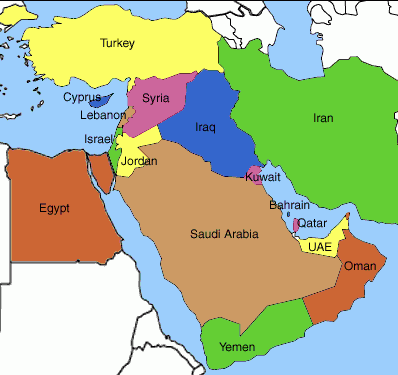
Unofficial initial results from the first two days of Egypt’s parliamentary elections pointed to a dominant showing for Islamist candidates, fulfilling most analysts’ expectations that conservative religious politicians could have the upper hand in next year’s drafting of a new Egyptian constitution.
Initial tallies put the powerful Muslim Brotherhood’s political arm, the Freedom and Justice Party, or FJP, in a leading position, followed by the Nour Party, which represents the ultraconservative Salafi school of Islam, FJP said.
An FJP official said the party’s vote-counting observers expect the group to win as much as 50% of the vote. A Nour Party spokesman said the early returns point to a Salafi capture of about 10% to 15% of seats in the incoming Parliament.
The Egyptian Bloc, a list of liberal parties dominated by the left-leaning Social Democrat Party and the pro-market Free Egyptians Party, appeared to be in third place. Official early results are expected to be announced on Thursday, the High Elections Commission said.
The results are far from final—a second and third round of elections covering two-thirds of Egypt’s 27 governorates are scheduled to take place in December and January. Individual candidate races that didn’t secure at least 51% will face runoffs beginning next week.
But the early results indicate that Egypt—the largest Arab country and under former President Hosni Mubarak one of the region’s staunchest defenders of secular governance—is set to pivot toward political Islam. The next voting rounds include mostly smaller Egyptian cities and villages, where Islamist rule is popular.
Such an outcome would surprise few Egyptians or political observers. Egypt’s deeply religious population grated under the ousted regime’s secular policies, and Tunisia and Morocco have recently awarded pluralities to moderate Islamist parties.
[…]Both Salafi and Brotherhood representatives said it was too early to say whether the two groups would form a coalition in Parliament—an alliance that would give Islamists a powerful majority.
This is what Obama bought us by taking his eye off the ball in Iraq, Afghanistan, Syria, Pakistan and Iran. We had no business firing a shot in Libya and Egypt. There was no strategic reason for us to be there.
House Speaker John Boehner (R-OH) today released a list of 132 American economists who believe the job creation strategy used in the House GOP Plan for America’s Job Creators will do more to boost private-sector job growth in America in both the near-term and long-term than the “stimulus” spending approach favored by President Obama.
“This list underscores the need for immediate action on the now-22 bipartisan jobs bills passed by the Republican-led House that are awaiting a vote in the Democratic-controlled Senate,” Boehner said. “All 22 of these bills passed the House with bipartisan support, but to date have not been brought to a vote by Senate Democrats. To help support job creation in both the short-term and long-term, we need bipartisan action to halt unnecessary government regulations and fix the tax code to help private-sector job creators. Our plan does that. The Senate needs to pass these 22 bills and send them to the president’s desk.”
Last month, Boehner asked a group of economists across the nation: which do you believe is more likely to provide a boost for private-sector job growth in America in both the near- and long-term: a plan focused on billions of dollars in additional “stimulus” spending by government – or a plan focused on halting excessive government regulations and fixing the tax code to help private-sector job creators? A total of 132 economists indicated they clearly favor the latter strategy. The list of 132 economists includes experts from Stanford University’s Hoover Institution, Carnegie Mellon University, and Harvard University; economists from the American Enterprise Institute (AEI), the Manhattan Institute, and the American Action Forum; and many others.
On Friday, in response to the U.S. Department of Labor’s announcement that October 2011 marked the 33rd consecutive month in which the national unemployment rate exceeded eight percent, Boehner asked President Obama to prod the Democratic-controlled Senate for action on the stalled jobs bills. Boehner and other Republicans have called for President Obama to be more engaged in the legislative process this fall and less focused on his re-election campaign.
“I urge the president to call on Senate Democrats to bring these common-sense jobs bills to a vote,” Boehner said. “As long as these bipartisan jobs bills are stalled in the Senate, it is unacceptable for the White House to be anything less than 100 percent engaged in the legislative process.”
Here’s the plan:
Empower Small Business Owners and Reduce Regulatory Burdens:
Require congressional review and approval of any government regulations that have a significant impact on the economy or burden small businesses.
Audit existing and pending regulations to identify and address those that hinder economic growth.
Fix the Tax Code to Help Job Creators:
Increase American competitiveness to spur investment and create more American jobs by streamlining the tax code and lowering the tax rate for businesses and individuals including small business owners to no more than 25%.
Reform the tax code to allow American businesses to bring back their overseas profits without having to pay a tax penalty so they can invest in our economy and create American jobs.
Increase Competitiveness for American Manufacturers:
Pass the three pending free trade agreements with Colombia, Panama, and South Korea to create up to 250,000 jobs.
Continue to open new markets to American made products. Encourage Entrepreneurship and Growth:
Modernize our patent system to protect our nation’s innovators, discourage frivolous lawsuits, and expedite patent reviews.
Re-Authorize and improve federal programs and approval processes to streamline development of new products.
Remove barriers to building a first class workforce so that the United States can compete in the global marketplace and lead the way in technological development and growth.
Maximize Domestic Energy Production to Ensure an Energy Policy for the 21st Century:
Promote lower energy prices through increased domestic production.
Encourage all forms of energy production.
Pay Down America’s Unsustainable Debt Burden and Start Living Within our Means:
Build upon the House Republicans’ Budget by enacting significant spending cuts.
And they already passed about 20 bills through the House with bipartisan support.

 WINTERY KNIGHT