Tag Archives: Stewardship

Wayne Grudem explains what the Bible says about spending, saving and charity

Theology that hits the spot

A practical lecture on money – spending, saving, charitable giving – from famous pastor Wayne Grudem.

If you’re like me and you struggle with Bible study and church sermons unless you get something practical out of it, then these Bible studies are for you. You’ll like the way that Grudem navigates the Bible finding the passages that tell you who God is, so that you can make better decisions by analyzing alternatives and choosing the one that gives your Boss a maximum return on investment.

The MP3 file is here.

The PDF outline is here.

Spending:

  • Christianity does not teach asceticism (= don’t enjoy anything in this world), Paul condemns it in 1 Timothy 4:1-5
  • When you buy nice things, even if it is a little more expensive, it’s an opportunity to be thankful for nice things that God has provided
  • Even being rich is OK, but don’t let it make you haughty and arrogant, and don’t set your hopes on your money (see 1 Tim 6:17)
  • It is important for you to earn money, and you are supposed to use it to support yourself and be independent
  • It is possible to overspend and live recklessly (Luke 15:13) and it’s also possible to overspend and live too luxuriously
  • Increasing your income through career progression is wise, because it allows you to give away more and save more
  • God gives us freedom to decide how much we spend, how much we give away, and how much we save
  • every choice a Christian makes with money will give him or her more or less reward in his or her afterlife
  • Do not spend more than you have – you should make every effort to get out of debt as quickly as possible

Saving:

  • Saving money is wise so you can help yourself and others, and have money in your old age when you will not be working
  • If you do not save your own money, you end up being dependent on others (e.g. – family or taxpayers)
  • Not saving money for the future is a way of “putting God to the test” (Matt 4:7)
  • You are to “be dependent on no one”, to the extent that you can (1 Thes 4:12)
  • We don’t know the future, that’s why we should prepare for an emergency, and buy insurance to guard (James 4:13-17)
  • It’s right for us to learn how to save to be able to buy bigger assets, like a car or a college education
  • Saving and investing in stocks and bonds lets people in business start and grow companies, creating jobs and new products
  • Don’t over-save, trusting too much in money more than you trust in God (Ps 62.10; Matt 6:19,24; Luke 12:15-21)

Giving:

  • it is required for the people of God to give something out of what they earn, but no percentage is specified (Deut 26:12-13)
  • you do not give money to become right with God, you can’t earn your salvation
  • a Christian gives to show God that you trust him to take care of you, and to experience trusting him through your giving
  • the quality of your resurrection life with God is affected by giving you do for the Kingdom (Phil 4, Matt 6:19-21; 1 Tim 6:18-19)
  • when you get involved in the lives of others and give to them, you have the joy of experiencing caring for others (Acts 20:35)
  • it’s possible to give too little, but it’s also possible to give too much – be careful about pride creeping in as well

The first part of this lecture made me think of my treat for the week, which is to go to an Indian buffet on Wednesdays, if I can. It costs $10, which is more than my usual $3.50 for a frozen meal for lunch and another $3.50 for a frozen meal for dinner. Spending a little more on a yummy plate of my favorite food makes it easy for me to remember to say grace, which is what Grudem said about spending making you thankful.

Theology that hits the spot
My weekly treat causes me to be VERY thankful

I was so happy listening to this talk because he was condemning bad stewardship, which I see in a lot of young people these days. I was happy until he got to the part about trusting in your savings for your security, and then I thought – that’s what I do wrong! I save a lot but it’s not just for emergencies and to share with others, like he was saying – I want a sense of security. This was more of a temptation in my 20s than it is now in my 30s, though.

Ironically, I woke up Wednesday morning and was singing this song in the shower:

It’s a song about being wanting to be righteous, and yet being unable to attain it on your own. I must think that being justified by faith in Jesus is more important than money, because I never wake up singing about the security I get from my savings. Still, I consider myself warned.

I can remember being in my first full-time job as a newly hired junior programmer when the 2001 recession struck. I would cry while signing checks to support William Lane Craig’s Reasonable Faith ministry, because I was so scared. I had no family or friends where I lived to help me if anything went wrong, and that’s been the story of my working life. If anything goes wrong, there is no backup. But it’s that experience of crying when I gave that allows me to say today “that’s when I became the man I am, that’s what a man does when he is a follower of Jesus”. If you are not doing the actions of charity, then you will not having the experience of trusting God and letting him lead you. There is more to the Christian life than just saying the right things – you have to do the right things.

If you’re scared about giving when you are young, then do what I did in my 20s: work 70-hour weeks, get promoted often, and save everything you earn. I volunteered every Saturday for 9 months in order to get my first white-collar part-time job when I was still in high-school. The faster you increase your savings, the easier it’s going to be to take a genuine interest in caring for the people around you. Read Phil 1 (fellowship), Phil 2 (concern for others), and Phil 4 (charity). Turn off your emotions and desires, and put Philippians into practice. Note that your freedom to give is very much tied to the quality of your decisions of what to study, where to work, how much you spend on entertainment, and so on. That’s why you need to turn off your feelings and desires and do what works, even it it’s not fun, and even if it involves responsibilities and obligations.
Move over housing bubble and student loan bubble: here’s pension bubble!

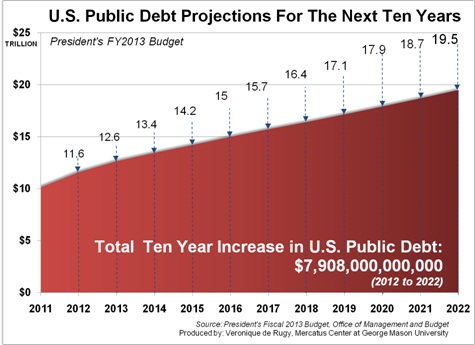
Obama 2013 Budget Debt Projection

Recently, I was talking to Dina about which state I would like to live in. I looked at a whole bunch of factors like tax rates, housing prices, religious liberty laws, voting patterns… but I also looked at state obligations to pay pensions.

Let’s take a look at the story from the Washington Examiner to see why this is important.

It says:

Years of gimmicks and politically motivated benefit increases for government workers have left America’s states and municipalities with pension funds that are short at least $1.5 trillion — and possibly as much as $4 trillion if the investment returns of these funds don’t live up to expectations in coming years.

[…]Since 2007, states and localities have been forced to increase annual contributions into pensions by $43 billion, or 65 percent, and in various places these rising payments are crowding out other government services or driving taxes higher or both. Retirement debt has even played a crucial role in high-profile government bankruptcies — including in Detroit; Stockton, California; and Central Falls, Rhode Island. Fixing the problem is proving expensive, and it won’t happen quickly in places with the worst debt.

[…][O]fficials in Stockton spent years enhancing benefits to workers without understanding the debts they were accruing. The city agreed back in the 1990s, for instance, to pay not only its own share of contributions into the pension system, but those of staff, too. It also guaranteed healthcare for life for retirees.

[…]Facing $400 million in pension debt and $450 million in promises for future healthcare, the city declared bankruptcy in 2012. Employees lost some of their perks, like healthcare in retirement, but citizens suffered, too. Trying to save money, the city cut essential services, including the police department, and crime soared.

[…]Places that cannot reform pensions, or where legislators were slow to act, are inevitably seeing tax increases to finance these steep obligations. In Pennsylvania, 164 school districts applied in 2014 to increase property taxes above the state’s 2.1 percent tax cap. Every one of them listed pension costs as a reason for the higher increases. In West Virginia, the state has given cities the right to impose their own sales tax to pay for increased pension costs.

Several cities, including Charleston, have already gone ahead with the new tax. Chicago Mayor Rahm Emanuel tried to impose a $250 million property tax increase last year to start wiping out pension debt in the Windy City, where pensions are only 35 percent funded. When the City Council balked, Chicago instead passed $62 million in other taxes, including a levy on cell phone use, as a stopgap measure. But the city faces a pension bill that is scheduled to rise by half a billion dollars annually in 2016.

I was able to find a helpful table that shows the solvency of all the public sector pension plans in each state. There are sensible states where I could live. It’s also important to look at the trend to see what direction the state is moving in, and thankfully the table had that information.

Anyway, here is the point I want to make about this.

When I look at these numbers, I feel sad, because it means that I have to be careful about my spending, and not spend too much on things that are fun in the short-term. I also cannot stop working to take a year off to go backpacking in Europe, because that would wreck my resume, and lose me a whole bunch of earned income. Sometimes, reality causes us to feel bad like that, so we run away from it. We find people who will agree with our feelings, and we shut out people who see things clearly. But we as Christians should not make decisions based on intuitions and feelings. And it doesn’t even work if you wrap up a bad decision in spiritual language, i.e. – “God told me…”, either. As much as I might feel like spending my money on frivolous things, I know in my mind that I cannot do that. I don’t like having constraints on my freedom, but to ignore data like this in my decision-making would not end well for me.

Sue Bohlin of Probe Ministries recently wrote a wonderful post about short-term pain versus long-term pleasure.

She writes:

Decision-making often involves choosing between short-term pleasure or short-term pain. (Usually it’s more like short-term inconvenience.)

Short-term pleasure often leads to long-term pain, and short-term pain often leads to long-term pleasure. What doesn’t work, and is a horribly unrealistic expectation for life, is short-term pleasure leading to long-term pleasure! (Wouldn’t THAT be nice?!)

Maturity and wisdom is displayed by the choices we make, especially when we exercise patience and self-control, not insisting on the instant-gratification jolt of “I want it NOW!!!” Many of our choices for pleasure in the right-now end up costing us down the road, causing pain later. You know, like that fourth brownie that tastes soooooo good in the moment, but then you can’t zip up your jeans a few days later. Or indulging your child’s demands and whims today because you want to be the “cool parent” and you want them to like you, but then you start to notice the ugliness of that child’s sense of self-absorbed entitlement. Short-term pleasure, even when that pleasure is simply trying to avoid pain, results in long-term unpleasant consequences.

But when we recognize the value of self-control and self-denial in the present, so that we can reap the harvest of pleasure in the future, that’s wisdom. Mark Twain advised, “Do one thing every day you don’t want to do.” That’s good advice, but of course God thought of that much earlier! Using self-control and self-denial is how we fulfill the biblical idea of not indulging the flesh (Galatians 5:16).

[…]Jesus said, “If anyone wants to become My follower, he must deny himself, take up his cross daily, and follow Me.” (Luke 9:23) Denying ourselves, taking up our cross, and following Jesus are all about short-term pain with major long-term pleasures!

Sue is wise. And her newest post is all about how to deal with feelings.

She says:

What is the biblical perspective on how to handle overwhelming feelings?

There are healthy and unhealthy ways to do that.

The healthy way to deal with strong feelings starts with thinking wisely about feelings in general. Our pastor often says that feelings are real (we do feel them, often intensely), but they’re not reliable (they make terrible indicators of what is true). So we should acknowledge them, but not be led by them.

Especially powerful, overwhelming feelings.

Allowing yourself to be controlled by your feelings is unwise and immature. The flip side of that is our example of Jesus in the Garden of Gethsemane. No one ever experienced the strength of horrific feelings like He did, to the point of sweating blood. He allowed Himself to feel His feelings, but then He turned in trust to His Father, submitting to His will. He set the bar for how to handle overwhelming feelings: feel the feelings, and trust the Lord.

Often, though, especially in the young, people deal with their strong feelings in unhealthy ways.

Feel the feelings, but don’t let them into your decision-making.

New study: most Americans have not saved enough for their retirement

Building a castle isn't easy - it takes work
Building a castle isn’t easy – it takes work

This story is from CNBC, and I hope it causes you young people to count the cost of your plans.

It says:

A new GAO analysis finds that among households with members aged 55 or older, nearly 29 percent have neither retirement savings nor a traditional pension plan.

“There hasn’t been a significant increase in wages, people have student loans and other debt, and many are continuing to struggle financially,” said Charles Jeszeck, the GAO’s director of education, workforce and income security, which analyzed the Federal Reserve’s 2013 Survey of Consumer Finances to come up with its estimates. “We aren’t surprised that people have not saved a lot for retirement.”

Even among those who do have retirement savings, their nest eggs are small. The agency found the median amount of those savings is about $104,000 for households with members between 55 and 64 years old and $148,000 for households with members 65 to 74 years old. That’s equivalent to an inflation-protected annuity of $310 and $649 per month, respectively, according to the GAO.

Americans underestimate how much money is needed in order to retire:

Estimates about the size and scope of the retirement savings problem vary widely, the GAO found. In addition to examining the Survey of Consumer Finances, it reviewed nine studies conducted between 2006 and 2015 by a variety of organizations, including academics, benefits consultant Aon Hewitt, the Employee Benefit Research Institute (EBRI) and the Investment Company Institute. Based on these reports, it concluded that one-third to two-thirds of workers are at risk of falling short of their retirement savings targets, in part because of the range of assumptions about how much income is required in retirement.

Given that we have been inflating the currency and running low interest rates for the last few years, any savings you have will buy less than they buy today.

Here’s another really key point:

The research that the GAO examined consistently showed that people aged 55 to 64 are less confident about their retirement and plan to work longer to afford retirement. However, a 2012 study by the EBRI found that about half of retirees said they retired earlier than planned because of health problems, changes at their workplace or having to care for a spouse or another family member. This suggests “that many workers may be overestimating their future retirement income and savings,” wrote GAO researchers.

Got that? When young people make plans about the future, they underestimate the risks and overestimate their own abilities.

Don't rely on Social Security, young snowflakes
Don’t rely on Social Security, precious little snowflakes

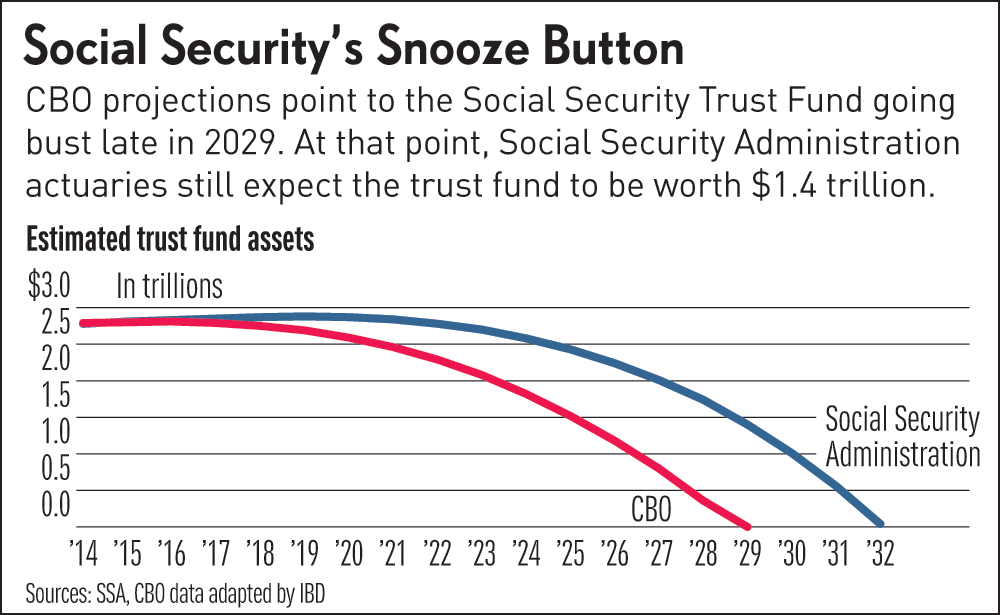
Investors Business Daily has been posting a lot about Social Security, and they are saying that payouts are going to be dropping sooner than you think.

Look:

Every year, the Social Security Administration releases its Trustees Report, which projects the program’s solvency — how much it will take in, how much it will pay out and how long the “trust fund” can cover revenue gaps — over the next 75 years.

The latest report says that Social Security can meet its financial obligations for about 18 more years. After that, the trust fund will be exhausted, and payroll taxes won’t cover nearly all the benefit costs.

That’s bad enough. But a new study by researchers at Harvard and Dartmouth shows that this day of reckoning will almost certainly come far sooner than that.

The authors compare previous Trustees Report forecasts about life expectancy, fertility rates and other variables to actual results. They found that these forecasts have grown increasingly unreliable.

Worse, since 2000 “the direction of the biases are all in the same direction, making the Social Security trust funds look healthier than they turned out to be.”

For example, Social Security has been consistency underestimating life expectancy, which means that people are living and collecting benefits for longer than predicted. Underestimating life expectancy by just 1.3 years leads to 150,000 more people collecting benefits than predicted, the researchers note.

The Trustees Report has also overestimated the nation’s fertility rate. In 2010, for example, 315,000 fewer children were born than predicted. This error makes the population look younger, which in turn makes Social Security’s financial outlook seem healthier.

Likewise, the report has consistently overestimated the Trust Fund’s assets and solvency.

Many of these forecasts are so bad that the actual results are often worse than the report’s “worst case” scenario, which currently has the program becoming insolvent in just 14 years.

Don’t be depending on Social Security if you are under 50 – it’s not going to be there for you, even though you’re going to be paying into it.

When young people imagine what the future will be like, they almost always underestimate the things that can go wrong. They are so optimistic and inexperienced, that they simply can’t conceive of the possible setbacks, and calculate the probabilities of these occurring. The best way to get around this is to talk to someone who is good at doing what you are trying to do. When I was training as a software engineer, I actually had to take classes in software design to learn how to identify unexpected scenarios. This is because engineers start off the same as everyone else – optimistic. We have to train ourselves to identify dependencies and risks. This is how you design software – by thinking not just of common usage scenarios, but also unexpected disaster scenarios, like power failures and data transmission interruptions and database failures. When it comes to earning and saving money, don’t talk to your inexperienced young friends. Talk to someone a little older who has already been through it, and who is doing a good job at it.