Tag Archives: Stephen Harper

Conservative government reforms public sector pensions in Canada

Canadian Prime Minister Stephen Harper
Canadian Prime Minister Stephen Harper (evil!)

From the National Post.

Excerpt:

Finance Minister Jim Flaherty says planned changes to the pension plan for members of Parliament won’t take effect until after the next election, noting it would not be fair to change the rules during the current term.

[…]The object, the finance minister says, is for members of parliament and public servants to contribute 50% of the cost of their pensions.

Treasury Board President Tony Clement says changes to the MP pension plan will see them paying almost four times more in contributions.

He says MP contributions will jump to about $39,000 from the present level of about $11,000 and the bill would delay retirement age for a full pension to 65 from the present 55.

The changes, for a while at least, will create a two-tier system — with some existing MPs still being able to collect pension benefits at age 55. After the next election, all new MPs who qualify for the plan will have to wait until they are 65 before getting full pension benefits.

It was also expected that the bill would include cost-saving measures to change the federal employee pension plan so that new workers who join the public service starting in 2013 will see the normal age of their retirement raised to 65 from 60.

Clement says the changes will move public service and MP pension contributions to a 50-50 split, similar to private sector plans.

He says the changes will save taxpayers $2.6-billion over five years.

The bill passed the House of Commons today, and is on its way to the Conservative-controlled Senate. Harper will sign it, and then drink a chalice brim-full with the tears of his pathetic socialist enemies, as is his custom since gaining the majority in 2011.

Also, Conservative Party MP Pierre Poilievre (Nepean-Carleton = evil!) has been pushing the right of workers not to have to join a union, nor to have to pay union dues against their will:

While chieftains at the government’s largest union celebrated a separatist victory in Quebec on Wednesday, a Conservative MP said he will push for legislation to allow workers to opt out of paying dues.

Ottawa MP Pierre Poilievre says by supporting the Parti Quebecois and Quebec Solidaire and other activities, the NDP-friendly Public Service Alliance of Canada (PSAC) is not acting in the interests of the majority of its 172,000 members.

Poilievre’s riding is home to thousands of government workers – some of whom have expressed their disbelief to him over the use of dues to fund political and militant activity, including supporting student protesters in Montreal.

He says he will advocate for passage of a private member’s bill in Parliament that would force unions to open their books to learn how dues are spent.

And while he is a parliamentary secretary and can’t introduce private bills, he will encourage and help others draft legislation that would allow union members the choice of paying dues.

“It stands to reason that the law should not force workers against their will to pay union dues to radical causes of PSAC union bosses,” he said.

“Workers should have the right to know how their union dues are spent and if they don’t like what they see, the freedom to opt out of paying them.”

Previously, the evil Harper banned per-vote subsidies for political parties:

The Conservatives’ budget bill tabled Tuesday will end taxpayer-funded subsidies for federal political parties, a proposal that helped spark the 2008 coalition crisis but was promised again by the Tories in the spring election campaign.

[…]The 2011 Tory election platform cited $27.4 million as the cost to the taxpayer last year of the current $2 per vote subsidy.

[…]The other parties generally, but the Bloc Québécois in particular, do not match the Conservatives’ ability to fundraise from grassroots party members. An end to the party subsidies puts parties that are not effective at grassroots fundraising at a major financial disadvantage.

Returns filed with Elections Canada for 2010 show the Conservative party raising $17.4 million from some 95,000 donors. Other parties were far behind: the Liberals raised approximately $6.4 million from over 32,000 donors, while the NDP raised $4.3 million from just under 23,000 donors. The Bloc Québécois, then the third-largest party in the House of Commons, raised only $640,000 on its own from fewer than 6,000 donors.

And the evil Harper planned to banning loans to political parties from unions:

The Harper government’s plan to ban corporate and union loans to political parties will further tighten a revenue-raising vise on the opposition parties. The Liberal Party will be especially squeezed, as it prepares for a leadership race in 2013.

The goal of the legislation, which was introduced into the House Wednesday by Democratic Reform Minister Tim Uppal, is “to reduce the potential for undue influence of wealthy interests in the political process,” according a government release.

But the effect could be to further widen the gap between the Tories’ revenue-raising efforts and those of other parties, who badly trail in total campaign contributions from individual donors.

[…]Individuals will still be allowed to lend money, but their combined loans and donations will not be allowed to exceed the $1,100 annual contribution limit.

Banks and other accredited financial institutions will be able to lend money to parties and candidates, and political parties can lend money to constituency associations or candidates. But the terms must be publicly disclosed, including the amount, interest rate and the names of the lenders and guarantors, allowing other parties and the media to know who is in hock to whom and for how much.

Political contributions from unions are already banned.

We don’t see that level of aggression down here, do we? Canada even requires photo ID for voting, so there is no voter fraud. And they are reforming their immigration and welfare programs to eliminate fraud there, too. Unreal. It’s like they actually think that being conservative means… being conservative. Instead of kow-towing to the leftist media at cocktail parties.

It seems like Canada is embracing the free enterprise system at a time when we are turning our backs on it. And they’ve been reaping the benefits: smaller deficits, less spending and lower unemployment. We will get our chance in November to try and catch up to their financial success if we can kick our socialist President out.

Canadian government to limit environmentalist obstruction of energy development

From Fox Business: the Canadians embrace federalism.

Excerpt:

The Canadian government released details Tuesday of its plan to dramatically streamline reviews for big energy and mining projects, capping the timeline for federal reviews and ceding more regulatory oversight to the country’s provinces.

The Conservative government of Prime Minister Stephen Harper has said for months it would move to speed up the regulatory review of big energy, mining and infrastructure projects. It has expressed frustration at the sometimes-lengthy review timelines for big projects.

Mr. Harper’s government said in its annual budget announcement last month that it would cap federal reviews. Resources Minister Joe Oliver released details Tuesday, saying that federally-led hearings would be applied only to major initiatives that risk some environmental harm.

Further, the government said it was prepared to hand over more responsibility for the review to Canadian provinces, so long as their regulations meet or exceed federal standards. Canadian provinces already enjoy considerable regulatory oversight.

“It is counterproductive to have the federal and provincial governments completing separate reviews of the same project,” Oliver said in a speech in Toronto.

[…]The government had previewed in its budget last month that reviews for major projects would be limited to 24 months. Meanwhile, regular inter-provincial pipeline reviews, as conducted by the National Energy Board, would be limited to 18 months.

Oliver said Tuesday that Enbridge Inc.’s (ENB) proposed Northern Gateway pipeline – which envisions shipping oil from Alberta to Canada’s West Coast — would benefit from the quicker review. The line has been mired in stiff opposition from native groups in British Columbia, and the government has accused foreign-funded environmental groups of tying up the project in regulatory hearings. Government officials said the new rules would also limit who could participate as intervenors in the review process.

[…]In Toronto, Oliver said the current process is unworkable, with over 40 federal departments involved in reviews. He said he would pare that back to only three federal agencies: the Canadian Environmental Assessment Agency; the National Energy Board; and the Canadian Nuclear Safety Commission.

The Canadian process, as it stands, forces investors to go “through hoops and hurdles as far as the eye can see,” Oliver said. “We simply have to turn that around.”

Canadians don’t want to scare businesses away from Canada – they want the jobs to come to Canada. That’s the exact opposite of what Obama’s socialist “Environmental Protection Agency” does – they regulate energy development, in order to block it or slow it down.

And Canada lowered corporate taxes to 15% compared to our 35% – and their revenues held steady.

Canada: Corporate tax cuts, not stimulus spending

They cut their corporate tax rate, but then businesses saw the lower rate and just kept on expanding in order to make more money. As businesses grow, they pay more in taxes. So government revenues from taxes haven’t dropped at all, even with the lower corporate tax rates! More businesses moved in to Canada to capitalize on the lower tax rates, generating revenue for the government. More workers moved off of unemployment and welfare as demand for labor grew, and they started paying income taxes and sales taxes, generating even more revenue for the government. Do you know what makes consumers more confident, so that they spend more? Having a job.  Not being dependent on government.

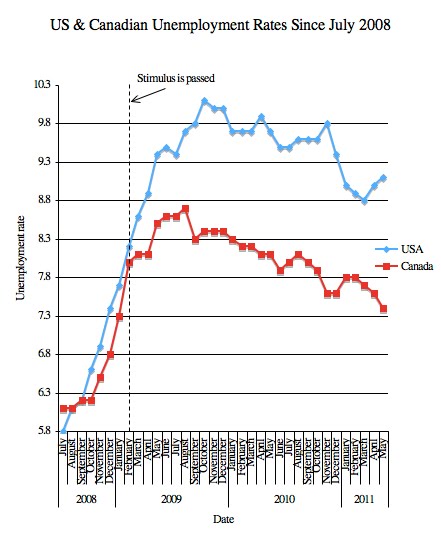
Look at their unemployment rate:

Canada and US unemployment rates

When we embraced “stimulus” spending, they went for the corporate tax cuts. Our unemployment rate used to be LOWER than theirs, before Pelosi and Reid took over Congress in January 2007. Now we are HIGHER than they are. That’s not rhetoric – that’s data. Even though Canada’s economy is linked to ours, and has suffered as a result of that, they have been signing free trade deals left, right and center. They did this in order to decouple themselves from our collapsing economy, massive debt and devalued currency. Barack Obama, of course, opposes free trade. He has to – he’s in the back pocket of the socialist labor unions.

Free trade empire: (click for larger image)

Canada: Free Trade Empire

What a contrast Canada’s energy policy makes with Obama’s politicized “Cash for Cronies” energy policy. But then again, Canada hired a conservative right-wing capitalist economist to run their country. We could have just done the same and put in economists like Thomas Sowell or Walter Williams to run our economy, but we put in an unqualified community organizer instead.

Conservative MP’s bill to repeal Section 13 moves to committee

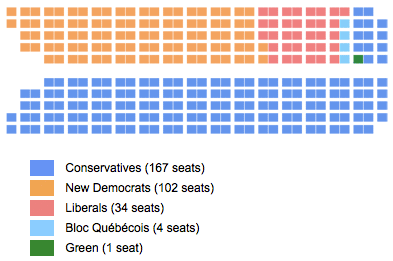
Canada 2011 Federal Election Seats
Canada 2011 Federal Election Results

Andrew sent me this article from the Chronicle Herald.

Excerpt:

To protect freedom of expression in Canada, sometimes you need a majority government in Ottawa.

That’s the moral of the story of a Conservative backbencher’s private member’s bill — which has now cleared second reading in the House of Commons and gone to committee — seeking to repeal Section 13 of the Canadian Human Rights Act.

Let’s recall the exact wording of that infamous clause. Hate messages, according to Section 13 (1), are communications “likely to expose a person or persons to hatred or contempt by reason of the fact that that person or those persons are identifiable on the basis of a prohibited ground of discrimination.”

In other words, if I were to write something critical about Islam, for example, and someone reading my column felt it “likely” that my words could provoke “contempt” towards Muslims, they could lodge a complaint against me with one of Canada’s government-created human rights commissions.

Truth would not be a defence. Neither would my intent. And the person complaining wouldn’t even have to be a Muslim.

That’s because, on top of the appallingly loose wording of this section of federal human rights law — a clause echoed in its provincial counterparts — any complaints are adjudicated by government-appointed tribunals, where the standard protections afforded any accused in a court of law don’t necessarily apply.

When complainants’ cases go forward, taxpayers pick up the tab. Meanwhile, those accused must pay to defend themselves out of their own pockets.

It’s a system ripe for abuse. And that’s exactly what has happened. We’ve seen comics fined for insulting hecklers (B.C. human rights tribunal), former publishers spend $100,000 in legal fees over three years to defend themselves for printing “offensive” cartoons (Alberta human rights commission), and Maclean’s magazine investigated by three human rights bodies (federal, Ontario and B.C.) for running an article on Muslim demographics in Europe.

The Conservatives have long opposed Section 13, but didn’t feel they had the support they needed from the other parties, as a minority government, to push the issue legislatively.

They also were concerned, with good reason, that some opponents might twist the issue for political advantage, slamming the Tories for being soft on hate.

Yes, Bill C-304, which aims to repeal Sections 13 and 54 (dealing with penalties under S.13), was put forward by Alberta MP Brian Storseth (Westlock-St. Paul) and is a private member’s bill, but the legislation has the justice minister’s endorsement. So there’s a good chance the bill will be back in the Commons this spring for final reading, then on to the Senate and, hopefully, passage and royal assent.

The bill, if made law, would take effect a year after receiving royal assent.

Canada does not protect free speech right now. Repealing Section 13 would be good, but Canada is not a good place for families to raise children. Even if they get Section 13 repealed, there is still the recent unanimous Supreme Court decision affirming that the provincial governments have a right to decide what children will believe – not parents. The Supreme Court was mostly selected by the previous Liberal governments.