
Tag Archives: Spending

CBO finds that Obama understated budget deficits by 2.3 TRILLION

From the Hill. (H/T Michelle Malkin)

Excerpt:

The Congressional Budget Office on Friday released its analysis of President Obama’s 2012 budget proposal and found it does less to rein in deficits and the debt than the administration had estimated.

CBO estimates Obama’s plan would produce 10 years of deficits totaling $9.5 trillion. By 2021, it would increase the debt held by the public to 87 percent of gross domestic product.

The administration, using different methods, estimated budget deficits would total $7.2 trillion over the next 10 years under the 2012 budget. It forecast that total debt in 2021 would be 77 percent of GDP.

The White House also said total deficits over the next decade would be $1.1 trillion more without the recommendations included in Obama’s budget.

Marc Goldwein, policy director for the Committee for a Responsible Federal Budget, said that CBO has found the effects to be almost nil.

He explained that the difference between the CBO’s $9.5 trillion estimate and OMB’s $7.2 trillion estimate comes from two sources: rosy economic growth assumptions by OMB and offsets for the Medicare doc fix as well as transportation spending OMB did not specify in the budget and which CBO will not factor in.

The most important aspect of CBO’s analysis is that, while OMB claimed the president’s budget “stabilized” the debt at 77 percent of GDP over the 10-year window, CBO estimates the debt will grow throughout the period and end up at 87 percent, he said.

Here’s Michelle Bachmann explaining that since the Democrats took control of the budget in 2007, over 5 trillion dollars has been added to the debt.

The chart Michele is talking about:
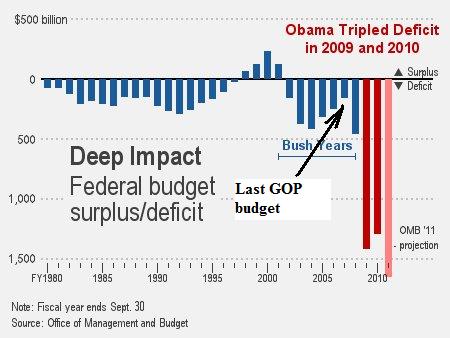
Barack Obama Budget Deficit

The last Republican budget was in 2006. The recession started in 2007, along with the spending.

Meanwhile, the Obama will attend his fourth party event of the month. It’s party time! Just like in college!

How is Obama responding to a recession and global instability?

From Investors Business Daily.

Excerpt:

When Democrats held Congress, the Obama agenda was audacious. Today, faced with global unrest and an economic reckoning, the president is filling out basketball brackets and scolding school bullies.

‘There is only one president,” Senate Budget Committee Chairman Kent Conrad, D-N.D., told Politico this week, when asked if President Obama should be exercising leadership toward reforming America’s out-of-control entitlement spending programs, such as Medicare and Social Security.

The soothsayer famously told Julius Caesar to “beware the ides of March.” One of the priority items for Obama on Tuesday, March 15, was taping his picks for the NCAA basketball tournament.

Last week, the president and the first lady were holding a “White House Conference on Bullying Prevention,” at which he recalled being taunted because of “big ears and the name that I have.” He lamented recent youthful suicides, such as those of Ty Field and Carl Walker-Hoover.

We can’t just accept that “kids will be kids,” Obama insisted, citing data showing that many American students have been “pushed, shoved, tripped, even spit on.”

Then, of course, there is the partying. Late last month, the president and first lady treated themselves to an East Room concert by Smokey Robinson, Sheryl Crow, comedian Jamie Foxx and others. At previous soirees, the Obama White House has hosted Stevie Wonder, Paul Simon, Tony Bennett, Bob Dylan, Joan Baez, and even a cavalcade of stars from Broadway shows.

And let’s not forget former Beatle Paul McCartney being flown in from England to sing “Michelle” to the first lady and attack President George W. Bush from the East Room stage.

He has no idea what the average American family is facing right now.


Should government do more to help people achieve prosperity?

From Arthur Brooks at the American Enterprise Institute. (H/T Mary)

Excerpt:

In January, the right-leaning organization Resurgent Republic asked Americans which of the following statements comes closer to their view: (a) “Government should do more to solve problems and help meet the needs of people”; or (b) “Government is trying to do more things than it can do well, things that should be left to the private sector and individuals.” Forty-nine percent of respondents chose (a); 46% chose (b). (The other 5% said they didn’t know.)

[…]The “doing good” philosophy cannot accommodate difficult but necessary budget decisions. It will always devolve into a drunken spending binge largely directed toward rewarding political friends like public-sector unions (witness the current mayhem in Wisconsin), engaging in social engineering (see the new health-care mandates), socializing losses (emergency loans and grants to failing businesses), and doling out pork (look almost anywhere in the stimulus).

[…]So citizens say they want government to help them, politicians oblige, but citizens loathe the result. How do we cut this Gordian Knot? The solution is a real philosophy that outlines what the government should do–and, just as importantly, not do. Our elected officials must then show courage and leadership by governing according to this philosophy.

What is that governing philosophy? Here is an answer from the great economist and Nobel laureate Friedrich Hayek: As regards the economy, the government should provide a minimum basic standard of living for citizens, and address market failures in cases where government action can do so cost effectively. That’s all.

We should acknowledge that markets are not perfect. Market failures can occur when we have monopolies (which eliminate competition), externalities (like pollution), public goods (the military, for example), and information problems (such as when people cheat others in the marketplace). Nearly all economists agree these kinds of failures can justify some degree of state intervention.

Obviously, there is plenty of room for debate in this philosophy. What is a minimum basic standard of living? And are certain services–for example, the Smithsonian Institution–public goods? How much waste can we find in the defense budget? These are the arguments we should be having.

But there are many others we shouldn’t be having, because the answers are clear. Should we bail out car companies? (No: GM would fail precisely because markets are working, not because they are failing.) Should we leave the retirement age at 65 even though people are living much longer than ever before and taking more than they ever paid into the Social Security system? (No: This is middle-class welfare, not a minimum basic standard of living.) Should we continue to prohibit people from buying health insurance from companies across state lines? (No: This induces market failure.) Do we need high-speed trains to take us to St. Louis? (No: This is not a public good.) And so on.

It’s not the government’s job to equalize life outcomes regardless of our own choices. Their job is to referee the game, not to pick winners and losers.