Tag Archives: Spending

Ted Cruz’s plan to lower taxes and simplify the process for filing tax returns

How to get kissed: Heidi Cruz helping her husband

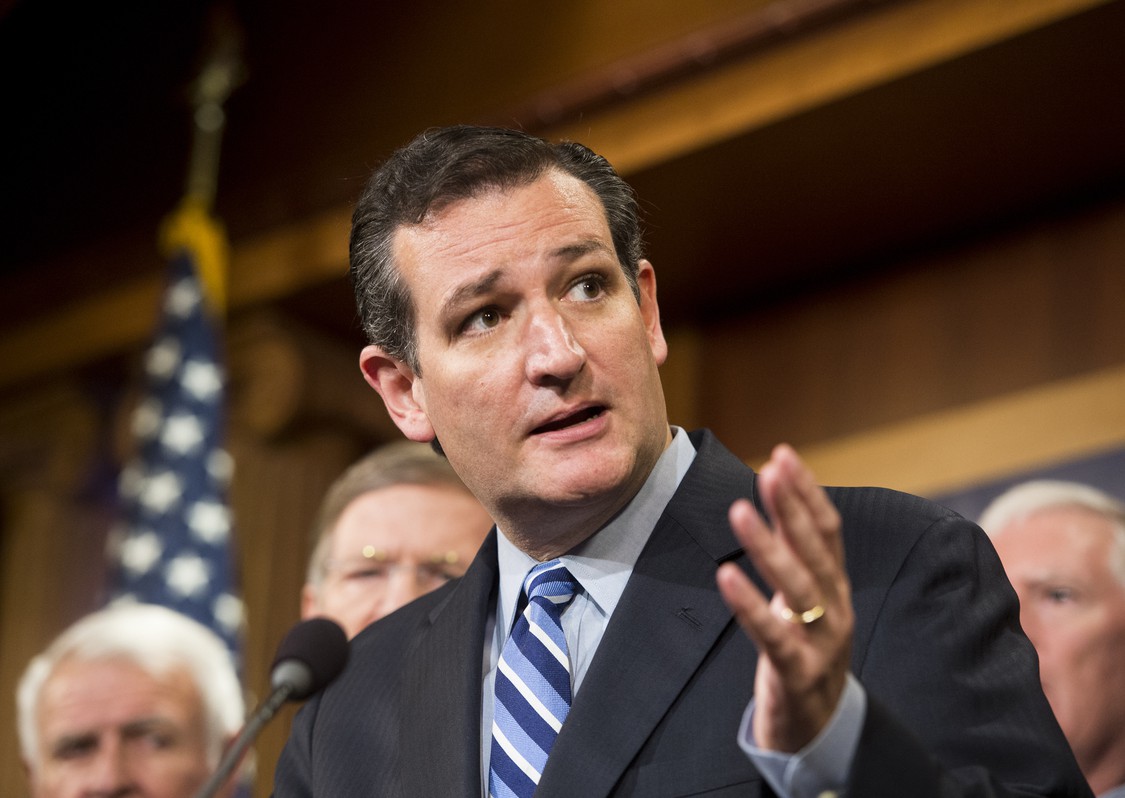
Ted Cruz is very upset with the IRS for discriminating against conservative groups and Christian groups in order to get Barack Obama re-elected in 2012. So, he’s come up with a plan to drastically reduce their influence – and their cost to taxpayers.

Here he is talking about the plan with Megyn Kelly on Fox News.

And he has posted something about the plan on his web site:

Under the Simple Flat Tax, the current seven rates of personal income tax will collapse into a single low rate of 10 percent. For a family of four, the first $36,000 will be tax-free. The Child Tax Credit will remain in place, and the Simple Flat Tax Plan expands and modernizes the Earned Income Tax Credit with greater anti-fraud and pro-marriage reforms.

[…]The IRS will cease to exist as we know it, there will be zero targeting of individuals based on their faith or political beliefs, and there will be no way for thousands of agents to manipulate the system.

For businesses, the corporate income tax will be eliminated. It will be replaced by a simple Business Flat Tax at a single 16 percent rate. The current payroll tax system will be abolished, while maintaining full funding for Social Security and Medicare.

The convoluted tax code will be replaced with new rules of the game – so simple, in fact, that individuals and families could file their taxes on a postcard or phone app. The Death Tax will be eliminated. The Alternative Minimum Tax will be eliminated. The tax on profits earned abroad will be eliminated. And of course, the Obamacare taxes will be eliminated. Also gone will be the unending loopholes in the current code, the stacks of depreciation schedules for businesses, and the multi-tiered rates on income and investments. Under the Simple Flat Tax, the Internet remains free from taxes.

Simple.

The Tax Foundation, which is the leading non-partisan think tank that deals with the issue of taxation, scored Cruz’s plan.

They say:

  • Senator Cruz’s plan would cut taxes by $3.6 trillion over the next decade on a static basis. However, the plan would end up reducing tax revenues by $768 billion over the next decade when accounting for economic growth from increases in the supply of labor and capital and the much broader tax base due to the new value-added tax.

  • According to the Tax Foundation’s Taxes and Growth Model, the plan would significantly reduce marginal tax rates and the cost of capital, which would lead to a 13.9 percent higher GDP over the long term, provided that the tax cut could be appropriately financed.

  • The plan would also lead to a 43.9 percent larger capital stock, 12.2 percent higher wages, and 4.8 million more full-time equivalent jobs.

  • On a static basis, the plan would cut taxes by 9.2 percent, on average, for all taxpayers.

  • Accounting for economic growth, all taxpayers would see an increase in after-tax income of at least 14 percent at the end of the decade.

They conclude:

Senator Cruz’s tax plan would significantly alter the federal tax code. It would completely repeal the corporate income tax and all payroll taxes and enact a 10 percent income tax and a 16 percent “business transfer tax” or value-added tax. These changes to the tax code would increase the incentives to work and invest and would greatly increase the U.S. economy’s size in the long run, leading to higher incomes for taxpayers at all income levels. The plan would also be a large tax cut, which would increase the federal government’s deficit by over $3.6 trillion on a static basis. Accounting for the growth caused by the plan, federal revenues would decline by $768 billion over the next decade.

The non-partisan The Hill says that another major think thank for fiscal conservatism also likes Cruz’s plan:

Ted Cruz’s tax plan would cost less and stimulate the economy more than Donald Trump‘s, a recent analysis found.

“Of the two proposals that we have examined so far, those by Trump and Cruz, we find the Cruz proposal to be the better of the two,” said David Tuerck, executive director of the Beacon Hill Institute and senior fellow at the National Center for Policy Analysis. The free-market groups released a report comparing the economic effects of the tax plans from the two Republican presidential candidates.

[…]Cruz’s plan would also increase business investment and personal income more than Trump’s plan would, the report found.

I want a higher personal income, and I want more money invested into the business that employs me – so I can keep my job, or maybe find a better one. It’s very important to my life plan that I be able to earn money, and keep what I earn. I have a use for that money, whether I marry or not. And that use is not to give it to the government so they can buy people condoms and abortions in exchange for their votes. I have a better plan for the money I earn than what a secular government wants to do with it.

Now, Ted Cruz will have to come up with $768 billion in revenue to balance his plan, but that’s why he has promised to abolish or significantly reduce FIVE government departments. Don’t worry, they aren’t the useful ones. We have too much government, and we can get rid of some, and return the money to the people.

Related posts

CBO: national debt will rise to $30 trillion in the next decade

Democrats took control of government spending in 2007

The Washington Times has a warning for all the young voters who are freaking out over the spending promises of Hillary Clinton and Bernie Sanders.

Here it is:

The federal government will be flirting with $30 trillion in debt within a decade, the Congressional Budget Office reported Monday, blaming an aging population, new spending and tax cuts approved on Capitol Hill, and the growing burden from Obamacare for erasing the progress Washington had made over the past few years.

Analysts said Obamacare will chase more workers out of the labor force over the next five years, adding pressure to an economy still struggling to spring to life more than seven years into the Obama recovery.

The Affordable Care Act itself is still struggling to attract a customer base, the CBO said, lowering its estimate for the number of people who will sign up for the exchanges from 21 million to 13 million — a drop of nearly 40 percent in projections. Customers collecting taxpayer subsidies this year will be 11 million, down from the 15 million the CBO projected a year ago.

[…]Deficits will continue to rise over the next 10 years, topping $1 trillion again in 2022 and reaching $1.4 trillion in 2026, the analysts said.

Basically, we’ve dug ourselves into a whole with all this spending – taking money out of the productive private sector and giving it to the wasteful public sector.

How wasteful?

This wasteful:

The National Aeronautics and Space Administration is spending $80,000 to see what effects space flight has on oral herpes.

The federal space agency has awarded multiple grants and contracts to a researcher at the University of Florida to determine the “Effect of Spaceflight on Herpes virus Genome Stability and Diversity,” beginning last summer. The project recently received an additional $15,000 in December.

“The goal of this study will be to determine the changes in the genomic and mutational diversity that is present in the Herpes virus virome present in astronaut saliva and urine samples collected before, during, and after space flight,” according to NASA’s description of the research. “Ground subjects will serve as the control group providing saliva and urine samples preflight and postflight during the same schedule as the astronauts.”

That $80,000 was taken from private sector businesses and individual families. They could have spent it on jobs, innovation or consumer spending. But instead the government took it and wasted it on garbage.

Texas Senator Ted Cruz

There is someone who has a plan to deal with these deficits. And his plan is to shut down or scale back many government departments.

Ted Cruz:

For the individual income tax under his tax reform, Cruz’s plan provides for one flat rate of 10% on everything – wages, capital gains, dividends, personal business income, rent, interest, and all other forms of individual income. The corporate income tax would be abolished, and replaced with a 16% Business Flat Tax, which applies to sales of goods and services, minus all purchases and expenses for inputs for production. It automatically provides for immediate “expensing,” or an immediate deduction for all purchases of plant and equipment, and all other capital investment, which inherently involves purchases of inputs from other businesses. It is essentially a consumption tax for business.

That net business tax, which also automatically abolishes all special-interest, corporate-welfare loopholes, raises an enormous amount of revenue, $25.4 trillion over the first 10 years alone. This enables the plan to include abolishing the Social Security and Medicare payroll tax, which is the highest tax most working people pay, with Social Security and Medicare financed in full. It also enables the plan to include abolishing the death tax, the Alternative Minimum Tax, and all Obamacare taxes, as well as the corporate income tax. With a standard deduction of $10,000 per adult, and a $4,000 personal exemption, the first $36,000 of income for a family of four would be exempt from all significant federal taxes.

Because such tax reform would be enormously pro-growth, the Tax Foundation scores it on a dynamic basis as a net tax cut of $768 billion over the first 10 years. The Tax Foundation, which has developed a formal, sophisticated, and thorough economic model of the economy, estimates Cruz’s tax reform would create nearly 5 million new jobs, increase wages by 12%, and increase real economic growth over the next decade by nearly 14% more than under current tax policies. The after tax income of all workers would increase by 21.3% on average, with those in the bottom 20% of the income ladder seeing income increases of 15.3%.

Cruz intends to pay for these tax cuts by reducing the size and scope of government – pushing many federal responsibilities down to the state level, where there is more accountability to the people.

The four agencies are the standard four that most conservatives want to abolish or streamline:

  • Department of Energy (raises energy prices for individuals and businesses)
  • Department of Commerce (hands our taxpayer money to businesses favored by big government)
  • Department of Education (indoctrinates children in big government dogma, e.g. – global warming)
  • Department of Housing and Urban Development (caused the housing bubble recession by forcing banks to loan money to unqualified individuals, then bailed them out with taxpayer money)

Many other smaller government departments would be streamlined or eliminated. There would be a hiring freeze in the federal government, and pay increases would be based on merit, not tenure. Cruz would also save a trillion dollars over 10 years by repealing Obamacare, and replacing it with a consumer-driven alternative.

Although young people are in love with the idea that government will give them things by taxing others, that’s not sustainable. They ought to be voting for someone who wants to cut spending and cut government.

Liberal Party has made Ontario’s economy a disastrous failure

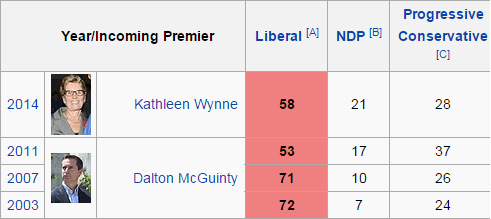
Liberal Party has dominated Ontario since 2003

I like to follow the economic situations in the most liberal Canadian provinces to see how bad things can get when liberals are in charge. This article is by Joe Oliver, who I have mentioned before on this blog.

Here’s the article from the Financial Post:

The numbers tell the story. Ontario is the largest sub-national debtor in the entire world, just one alarming distinction. Its debt is more than twice that of California, a state with three times the population and one that has its own severe fiscal problems. Its debt is $294 billion, or over $21,000 per capita. Net debt to GDP is up 48 per cent in the past 10 years to almost 40 per cent, second only to Quebec. Last year’s interest obligations totalled $11.4 billion, about the same as the cost of community and social services. I doubt many Ontarians realize how much they are paying just in interest on the provincial debt. It averages $840 per person every year and rising. Not surprisingly, Standard and Poor’s downgraded Ontario’s bond credit from AA- to A+, citing a very high debt burden and very weak budgetary performance

The energy sector is nationalized in Ontario – there is no free market competition, it’s all government-run. Consumers have one choice when they want to purchase electricity – the provincial government. How well has nationalizing the energy sector (“Ontario Hydro”) worked out?

Some of its biggest problems are self-inflicted. Recently, we received a stunning revelation from Bonnie Lysyk, the province’s Auditor-General. In the past eight years, electricity cost $37 billion above market price. Even more staggering, it will pay a further $132 billion above market by 2032. The by-now infamous Green Energy Act guaranteed the price for wind and solar, so that they cost double and 3.5 times the U.S. market price respectively. As a result, energy costs have skyrocketed by 70 per cent, a regressive tax that hurts lower income earners disproportionately and depresses personal consumption. Higher energy costs also render businesses less competitive, which discourages job-creating capital investment.

Surprise! Green energy doesn’t lower electricity bills. But that hasn’t stopped the Liberal government from jumping into it with both feet.

There is no respect for the taxpayer in Ontario… every dollar earned there is seen by the ruling elite as more fuel for her vote-buying schemes. They want to spend their way to prosperity, as if spending money in the right way will cause economic growth. Well, here’s the truth: the government can never cause the people who start businesses and create value to produce more by taking more from them. The more the government takes from job creators, the more job creators scale back their productivity.

We should learn from the failure of socialism in other countries so that we don’t repeat their mistakes here.

Related posts