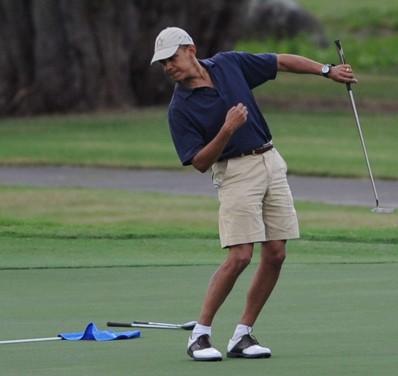
The U.S. Secret Service has arrived, street barricades are in place, and the U.S. Coast Guard has stationed itself in the waters surrounding Kailua, Oahu.
That is a sure sign President Barack Obama’s security team is preparing for the first family to arrive in the small beachside community as early as Friday night for what is expected to be a 17-day vacation.
The President and his family are traveling separately to Hawaii because he wants resolve the payroll tax cut issue before leaving Washington – and his wife does not want to wait.
But the advanced trip and the cost that comes with it – as much as $100,000 (flight and security) – adds to an already expensive vacation for the taxpayers.
Hawaii Reporter research shows the total cost for the President’s visit for taxpayers far exceeded $1.5 million in 2010 – but is even more costly this year because he extended his vacation by three days and the cost for Air Force One travel has jumped since last assessed in 2000. In addition, Hawaii Reporter was able to obtain more specifics about the executive expenditures.
The total cost (based on what is known) for the 17-day vacation roundtrip vacation to Hawaii for the President, his family and staff has climbed to more than $4 million. Here’s why.
TRAVEL: $3,629,622
The biggest expense is President Barack Obama’s round trip flight to Hawaii via Air Force One, a cost the GAO office estimated at $1 million in the year 2000. Contacted today, the GAO confirmed there is no report the independent office affiliated with Congress has prepared since 2000 to operate Air Force One and Air Force Two.
The cost for USAF C-17 cargo aircraft that transports the Presidential limos, helicopters and other support equipment to Hawaii was not made available. However, the flight time between Andrews Air Force Base and Hawaii is at about 21.5 hours roundtrip, with estimated operating cost of $12,000 per hour. (Source: GAO report, updated by C-17 crew member). The United States Marine Corps provides a presidential helicopter, along with pilots and support crews for the test flights, which travel on another C-17 flight. That is $258,000, not including costs for the 4 to 6 member crew’s per diem and hotel.
Mrs. Obama’s early flight to Hawaii costs about $63,000 (White House Dossier), but add security and personnel for a total of about $100,000.
The rest of that article calculates the remaining components of the FOUR MILLION DOLLAR bill.
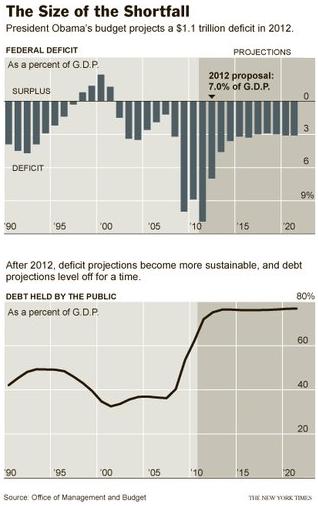
On another topic, here is a re-cap on our budget situation in 2012:
Barack Obama, Budget Deficit and Debt to GDP
Remember, the Democrats took control of the House and Senate in January 2007, and that’s when the overspending started.
Why should we expect someone who can spend FOUR MILLION dollars on a vacation to have the discipline and frugality to balance the nation’s books?
Pity the poor Democrats. Here they were counting on scaring seniors about GOP plans to “destroy” Medicare when Rep. Paul Ryan teams up with a prominent Senate Democrat to offer a compromise reform.
From the White House on down, Democrats were wringing their hands this week about the bi-partisan Medicare reform plan offered up by Ryan and Sen. Ron Wyden, D-Ore.
Their plan would shift Medicare from an open-ended health benefit to one in which the government provides a set amount of money for insurance. Seniors could choose from a variety of private, approved plans, as well as the traditional government-run Medicare.
The subsidy would be based on the second cheapest plan in an area, and if seniors wanted more expansive coverage, they’d have to pay the difference out of their own pockets. The reform would also cap the growth in Medicare.
[…]As one Democratic congressional aide told the New York Times, “this plan gives bipartisan political cover to Ryan and other Republicans against whom we have been waging a very successful political offensive.”
[…]While we prefer Ryan’s original proposal to his current one, it’s to his credit that he realized the political need to produce a bi-partisan compromise. Wyden, too, deserves credit for his willingness to buck his party and sacrifice short-term political gain for much needed long-term reforms.
I took a look at Wyden’s ACU ratings, and he has a 9.23 out 100. I have no idea how Ryan got this guy on board. It’s magic.
Typically, I try to tie the beginning of Wonkbook to the news. But today, the most important sentence isn’t a report on something that just happened, but a fresh look at something that’s been happening for the last three years. In particular, it’s this sentence by the Financial Times’ Ed Luce, who writes, “According to government statistics, if the same number of people were seeking work today as in 2007, the jobless rate would be 11 percent.”
Remember that the unemployment rate is not “how many people don’t have jobs?”, but “how many people don’t have jobs and are actively looking for them?” Let’s say you’ve been looking fruitlessly for five months and realize you’ve exhausted every job listing in your area. Discouraged, you stop looking, at least for the moment. According to the government, you’re no longer unemployed. Congratulations?
Since 2007, the percent of the population that either has a job or is actively looking for one has fallen from 62.7 percent to 58.5 percent. That’s millions of workers leaving the workforce, and it’s not because they’ve become sick or old or infirm. It’s because they can’t find a job, and so they’ve stopped trying. That’s where Luce’s calculation comes from. If 62.7 percent of the country was still counted as in the workforce, unemployment would be 11 percent. In that sense, the real unemployment rate — the apples-to-apples unemployment rate — is probably 11 percent. And the real un- and underemployed rate — the so-called “U6” — is near 20 percent.
There were some celebrations when the unemployment rate dropped last month. But much of that drop was people leaving the labor force. The surprising truth is that when the labor market really recovers, the unemployment rate will actually rise, albeit only temporarily, as discouraged workers start searching for jobs again.
Yeah, because taking money away from private sector job creators costs jobs. That is straight out of Henry Hazlitt’s “Economics in One Lesson”: Public Works Means Taxes.
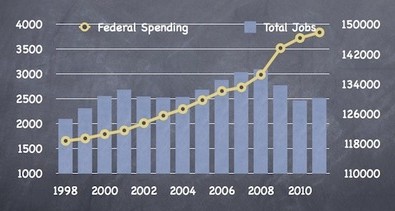
When the Obama administration releases a report on the Friday before a long weekend, it’s clearly not trying to draw attention to the report’s contents. Sure enough, the “Seventh Quarterly Report” on the economic impact of the “stimulus,” released on Friday, July 1, provides further evidence that President Obama’s economic “stimulus” did very little, if anything, to stimulate the economy, and a whole lot to stimulate the debt.
The report was written by the White House’s Council of Economic Advisors, a group of three economists who were all handpicked by Obama, and it chronicles the alleged success of the “stimulus” in adding or saving jobs. The council reports that, using “mainstream estimates of economic multipliers for the effects of fiscal stimulus” (which it describes as a “natural way to estimate the effects of” the legislation), the “stimulus” has added or saved just under 2.4 million jobs — whether private or public — at a cost (to date) of $666 billion. That’s a cost to taxpayers of $278,000 per job.
In other words, the government could simply have cut a $100,000 check to everyone whose employment was allegedly made possible by the “stimulus,” and taxpayers would have come out $427 billion ahead.
When the government takes a dollar from a job creator, they take half of it for themselves, and then they often give the other half to some favored group, like a “green energy” company or Planned parenthood or a labor union. Then they who turns around and give half of that handout right back to Obama as a campaign donation. The only way to stop them from doing more of this stimulus is to stop giving them money.
Consider this article by the Cato Institute, which discusses how the Reagan tax cuts affected the unemployment rate.
Excerpt:
In 1980, President Carter and his supporters in the Congress and news media asked, “how can we afford” presidential candidate Ronald Reagan’s proposed tax cuts?
Mr. Reagan’s critics claimed the tax cuts would lead to more inflation and higher interest rates, while Mr. Reagan said tax cuts would lead to more economic growth and higher living standards. What happened? Inflation fell from 12.5 percent in 1980 to 3.9 percent in 1984, interest rates fell, and economic growth went from minus 0.2 percent in 1980 to plus 7.3 percent in 1984, and Mr. Reagan was re-elected in a landslide.
[…]Despite the fact that federal revenues have varied little (as a percentage of GDP) over the last 40 years, there has been an enormous variation in top tax rates. When Ronald Reagan took office, the top individual tax rate was 70 percent and by 1986 it was down to only 28 percent. All Americans received at least a 30 percent tax rate cut; yet federal tax revenues as a percent of GDP were almost unchanged during the Reagan presidency (from 18.9 percent in 1980 to 18.1 percent in 1988).
What did change, however, was the rate of economic growth, which was more than 50 percent higher for the seven years after the Reagan tax cuts compared with the previous seven years. This increase in economic growth, plus some reductions in tax credits and deductions, almost entirely offset the effect of the rate reductions. Rapid economic growth, unlike government spending programs, proved to be the most effective way to reduce unemployment and poverty, and create opportunity for the disadvantaged.
President Bush signed the first wave of tax cuts in 2001, cutting rates and providing tax relief for families by, for example, doubling of the child tax credit to $1,000.
At Congress’ insistence, the tax relief was initially phased in over many years, so the economy continued to lose jobs. In 2003, realizing its error, Congress made the earlier tax relief effective immediately. Congress also lowered tax rates on capital gains and dividends to encourage business investment, which had been lagging.
It was the then that the economy turned around. Within months of enactment, job growth shot up, eventually creating 8.1 million jobs through 2007. Tax revenues also increased after the Bush tax cuts, due to economic growth.
In 2003, capital gains tax rates were reduced. Rather than expand by 36% as the Congressional Budget Office projected before the tax cut, capital gains revenues more than doubled to $103 billion.
The CBO incorrectly calculated that the post-March 2003 tax cuts would lower 2006 revenues by $75 billion. Revenues for 2006 came in $47 billion above the pre-tax cut baseline.
Here’s what else happened after the 2003 tax cuts lowered the rates on income, capital gains and dividend taxes:
GDP grew at an annual rate of just 1.7% in the six quarters before the 2003 tax cuts. In the six quarters following the tax cuts, the growth rate was 4.1%.
The S&P 500 dropped 18% in the six quarters before the 2003 tax cuts but increased by 32% over the next six quarters.
The economy lost 267,000 jobs in the six quarters before the 2003 tax cuts. In the next six quarters, it added 307,000 jobs, followed by 5 million jobs in the next seven quarters.
The timing of the lower tax rates coincides almost exactly with the stark acceleration in the economy. Nor was this experience unique. The famous Clinton economic boom began when Congress passed legislation cutting spending and cutting the capital gains tax rate.
It worked for Reagan and it worked for Bush – they made unemployment go down, while Obama’s public works spending has made unemployment go up. Those are the facts. And we have to live in the world as it is. We may not like it, it may not be intuitive to us, it may not line up with our feelings, but that is the way the world is. When you let people with capital keep more of the money they earn, they hire more people and they try to make more money. When the rich risk their capital, they take the rest of us up with them – either by giving us jobs, or by offering us things that we are free to buy or not. Things like iPods, laptops and kitchen appliances. And the more competition there is among sellers in a free market, the lower the prices go, and the higher the quality gets.