
Tag Archives: Socialism

Middle Eastern men who ran Oxford child sex-trafficking ring found guilty

Muslim populations in Europe

Note: this story is NOT about the Telford sex-trafficking ring that I reported on recently. This is about the Oxford sex-trafficking ring that I reported on in 2015.

Although this article from the far-left BBC refuses to find the common denominator in the seven men who were convicted of sex-trafficking children, but you might be able to discern it for yourself.

Excerpt:

Seven men have been found guilty of grooming and sexually abusing teenage girls “on a massive scale” in Oxford.

The gang was convicted of more than 20 offences including rape and indecent assault between 1998 and 2005.

Prosecutor Oliver Saxby QC said they carried out the “routine, cynical and predatory sexual exploitation” of vulnerable girls who were groomed with alcohol and drugs.

The five victims were aged between 13 and 15 when the offences started.

Opening the case at Oxford Crown Court, Mr Saxby said the gang preyed on girls who had a background of problems at home.

He said they offered their victims “company, attention, acceptance into the group” as well as “food, parties, alcohol, and sometimes drugs”.

Mr Saxby said this was all part of “the grooming process” the gang used in order to carry out “sexual exploitation on a massive scale”.

He said the girls would be made to have sex at parties, in cars or parks, with other men around, and sometimes after being subjected to threats and violence.

One girl was taken to a B&B in Iffley Road and told to have sex with older men, who one of the defendants described as “uncles”, he said.

Mr Saxby added: “She says she has lost count of the number of ‘uncles’ she had sex with… After sex she would sit in the shower and scrub herself.”

And here are the names and ages of the men:

  • Assad Hussain, 37, of Iffley Road, Oxford, guilty of five counts of rape and two counts of indecent assault, not guilty of one count of indecent assault.

  • Kameer Iqbal, 39, of Dashwood Road, Oxford, guilty of three counts of rape.

  • Khalid Hussain, 38, of Ashhurst Way, Oxford, guilty of rape and indecent assault, not guilty of one count of rape.

  • Kamran Khan, 36, of Northfield Road, Bolton, guilty of indecent assault and false imprisonment, not guilty of rape.

  • Moinul Islam, 41, of Wykeham Crescent, Oxford, guilty of rape, two counts of indecent assault and supplying cannabis, not guilty of false imprisonment.

  • Raheem Ahmed, 40 of Starwort Path, Oxford, guilty of two counts of indecent assault and false imprisonment, not guilty of rape.

  • Alladitta Yousaf, 48, of Bodley Road, Oxford, guilty of indecent assault.

In my previous article about the Telford gang, I reported on how the secular, leftist, politically correct UK police refused to take the complaints of the girls and their mothers seriously, for fear of offending the Middle Eastern men who were being accused. The police did nothing to protect the children, because the Labour Party had carefully instructed them in politically correct leftist dogma. If they had done anything to prosecute the predators, they would have lost their jobs for insensitivity and intolerance.

This is not the first time that we have had sex-trafficking gangs run by men of Middle-Eastern origin.

Rotterham

How about the Rotterham sex-trafficking gang?

Here are the facts from Powerline Blog:

Full text:

You are probably familiar with the Rotherham scandal. Rotherham is a city in England where over a period of years, more than 1,400 girls, many of them pre-teens, were raped and trafficked by a loose consortium of men. The men were all Muslim immigrants or sons of immigrants, the girls were all, or nearly all, white. When the scandal finally came to light in 2014, city officials said that they had been reluctant to do anything about the problem for fear of being accused of racism.

Several criminal trials have resulted from the scandal. The third such trial has just been completed. Six defendants were convicted and sentenced to 10 to 20 years for rape and other crimes. The Sun identified them:

Brothers Basharat Dad, 32, and Nasar Dad, 36, of both of Rotherham, and Tayab Dad, 34, of Sheffield, were jailed on Tuesday for sex offences along with Matloob Hussain, 41, of Rotherham, Mohammed Sadiq, 40, of Rotherham, and Amjad Ali, of Worksop, Nottinghamshire.

This is the most curious aspect of the news report:

There were emotional and chaotic scenes at Sheffield Crown Court after two of the defendants shouted “Allahu Akbar” as they were led from the dock.

But wait, there are more examples.

Rochdale

Another case reported in the UK Telegraph:

Taxi driver Shabir Ahmed, 59, was already serving a 19 year sentence from May for conspiracy, two rapes, aiding and abetting rape, sexual assault and sex trafficking. His domineering temper earned him the nickname “Daddy” by the white teenage victims.

The ringleader, who called the judge a ‘racist b——‘, was one of nine men jailed at Liverpool Crown Court for a total of 77 years for passing round the youngsters and plying them with drugs and drink.

[…]His victim, who cannot be named, revealed Ahmed once made her kneel on the floor in a pose called the ‘chicken’, with her arms threaded through her legs and touching her ears, before striking her on the back with a cricket bat.

The girl, now an adult, claims she was repeatedly raped over many years. He left her never wanting to have sex again or get married.

The girl said when she was first raped she was so young she needed to stand on a chair to reach a sink.

[…]Ahmed told the court he was a standard-bearer for “targeted and weakened British Muslims”, and claimed the police were anti-Muslim

He said of the Rochdale grooming trial: “We were all innocent. My only crime was to be Muslim. Not of the majority race.”

In May, Ahmed and his eight co-defendants were jailed for their role in a child-sex ring.

In other cases, the police ignored the complaints of the victims.

This happens often because the UK deliberately chose a “compassionate” open-borders immigration policy. We should not imitate their example. Merit-based immigration is best.

I find it very interesting that so many Christian leaders like Russell Moore take progressive positions on refugees and illegal immigrants. Are they not aware of what is going on in countries that embraced open borders? Or do they just not care about the fatherless little girls who suffer from their “generosity”?

Jay Richards: eight common myths about wealth, poverty and the free market

I have a key that will unlock a puzzling mystery

Have you read Jay Richards’ book “Money, Greed and God?” Because if you haven’t, he’s written a series of articles that summarize the main points of the book.

The index post is here.

Here are the posts in the series:

  • Part 1: The Eight Most Common Myths about Wealth, Poverty, and Free Enterprise
  • Part 2: Can’t We Build A Just Society?
  • Part 3: The Piety Myth
  • Part 4: The Myth of the Zero Sum Game
  • Part 5: Is Wealth Created or Transferred?
  • Part 6: Is Free Enterprise Based on Greed?
  • Part 7: Hasn’t Christianity Always Opposed Free Enterprise?
  • Part 8: Does Free Enterprise Lead to An Ugly Consumerist Culture?
  • Part 9: Will We Use Up All Our Resources?
  • Part 10: Are Markets An Example of Providence?

Parts 4 and 5 are my favorites. It’s so hard to choose one to excerpt, but I must. I will choose… Part 4.

Here’s the problem:

Myth #3: The Zero Sum Game Myth – believing that trade requires a winner and a loser. 

One reason people believe this myth is because they misunderstand how economic value is determined. Economic thinkers with views as diverse as Adam Smith and Karl Marx believed economic value was determined by the labor theory of value. This theory stipulates that the cost to produce an object determines its economic value.

According to this theory, if you build a house that costs you $500,000 to build, that house is worth $500,000. But what if no one can or wants to buy the house? Then what is it worth?

Medieval church scholars put forth a very different theory, one derived from human nature: economic value is in the eye of the beholder. The economic value of an object is determined by how much someone is willing to give up to get that object. This is the subjective theory of value.

And here’s an example of how to avoid the problem:

How you determine economic value affects whether you view free enterprise as a zero-sum game, or a win-win game in which both participants benefit.

Let’s return to the example of the $500,000 house. As the developer of the house, you hire workers to build the house. You then sell it for more than $500,000. According to the labor theory of value, you have taken more than the good is actually worth. You’ve exploited the buyer and your workers by taking this surplus value. You win, they lose.

Yet this situation looks different according to the subjective theory of value. Here, everybody wins. You market and sell the house for more than it cost to produce, but not more than customers will freely pay. The buyer is not forced to pay a cost he doesn’t agree to. You are rewarded for your entrepreneurial effort. Your workers benefit, because you paid them the wages they agreed to when you hired them.

This illustration brings up a couple important points about free enterprise that are often overlooked:

1. Free exchange is a win-win game.

In win-win games, some players may end up better off than others, but everyone ends up better off than they were at the beginning. As the developer, you might make more than your workers. Yet the workers determined they would be better off by freely exchanging their labor for wages, than if they didn’t have the job at all.

A free market doesn’t guarantee that everyone wins in every competition. Rather, it allows many more win-win encounters than any other alternative.

2. The game is win-win because of rules set-up beforehand. 

A free market is not a free-for-all in which everybody can do what they want. Any exchange must be free on both sides. Rule of law, contracts, and property rights are needed to ensure exchanges are conducted rightly. As the developer of the house, you’d be held accountable if you broke your contract and failed to pay workers what you promised.

An exchange that is free on both sides, in which no one is forced or tricked into participating, is a win-win game.

On this view, what you really need to fear as a consumer is government intervention that restricts your choices in the marketplace, or makes some choices more expensive than they need to be (tariffs).

If you care about poverty, it’s often tempting to think that it can only be solved one way – by transferring wealth from the rich to the poor. But that is a very mistaken view, as any economist will tell you. The right way to create prosperity is by creating laws and policies that unleash individual creativity. Letting individuals create innovative products and services, letting them keep what they earn, making sure that the law doesn’t punish entrepreneurs – that incentivizes wealth creation. Fixing poverty does not mean transferring wealth, it means giving people more freedom to create wealth on their own. Free trade between nations is an important way that we encourage people to create better products and services that what they have available in their own countries.

Economists agree on the benefits of free trade

Who could possibly disagree with free trade? Well, many people on the left do. But economists across the spectrum of ideology (university and private sector and public sector) agree on the benefits of free trade.

Harvard economist Greg Mankiw explains what most professional economists agree on.

Excerpt:

Here is the list, together with the percentage of economists who agree:

  1. A ceiling on rents reduces the quantity and quality of housing available. (93%)
  2. Tariffs and import quotas usually reduce general economic welfare. (93%)
  3. Flexible and floating exchange rates offer an effective international monetary arrangement. (90%)
  4. Fiscal policy (e.g., tax cut and/or government expenditure increase) has a significant stimulative impact on a less than fully employed economy. (90%)
  5. The United States should not restrict employers from outsourcing work to foreign countries. (90%)
  6. The United States should eliminate agricultural subsidies. (85%)
  7. Local and state governments should eliminate subsidies to professional sports franchises. (85%)
  8. If the federal budget is to be balanced, it should be done over the business cycle rather than yearly. (85%)
  9. The gap between Social Security funds and expenditures will become unsustainably large within the next fifty years if current policies remain unchanged. (85%)
  10. Cash payments increase the welfare of recipients to a greater degree than do transfers-in-kind of equal cash value. (84%)
  11. A large federal budget deficit has an adverse effect on the economy. (83%)
  12. A minimum wage increases unemployment among young and unskilled workers. (79%)
  13. The government should restructure the welfare system along the lines of a “negative income tax.” (79%)
  14. Effluent taxes and marketable pollution permits represent a better approach to pollution control than imposition of pollution ceilings. (78%)

Socialist economic policies don’t work because they are making policies that are based on economic myths. We know that these myths are myths because of economics is a mathematical science, and because we have tried good and bad policies in different times and places. We have calculations and we have experience to know what works and what doesn’t work. If you want to help the poor, you have to respect what economists know about how wealth is created. The solution is not to “spread the wealth around”, it’s to encourage people to create more wealth by inventing things that people freely choose to buy.

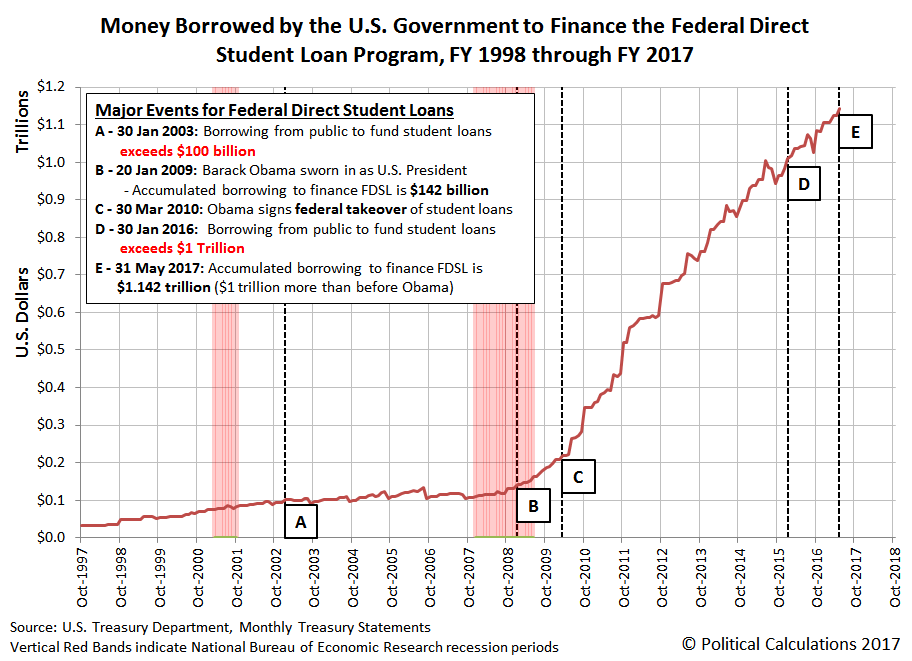
How did Obama’s plan to let government run student loans work out?

Obama nationalized student loan administration in 2010

I’m a free-market capitalist, so I believe that economic decision-making is best done by the people it concerns, not the people in government. If it is a decision that affects the family, let the family decide. If it’s a decision that affects the business, let the business owner decide. Obama has a different view – he thinks that government should make all of the decisions, even though government earns none of the money.

Here is an article in Investor’s Business Daily about his policy of letting the government take over student loan decision-making.

Excerpt:

A report from the Department of Education notes that the net cost of the federal government’s direct loan program is quickly heading into the red. This program, mind you, was supposed to be a moneymaker for the government, as students paid back federal loans with interest.

But as it turns out, borrowers have been flocking toward various loan forgiveness programs, by which the government will lose money, erasing gains from other loans. The report shows that the direct loan program went from a $25 billion surplus in 2012 to less than $5 billion by 2015.

A separate report says that this program ran a $36 billion deficit last year, up from $8.4 billion in 2016.

This is not how this federal loan program was supposed to work when President Obama launched it eight years ago.

In 2010, President Obama effectively nationalized student lending by cutting banks — which had been offering government-backed loans to students — out of the equation and having the government make the loans itself.

“By cutting out the middleman, we’ll save the American taxpayers $68 billion in the coming years,” Obama said when he signed this change into law. “That’s real money.”

As a result, federal student loan debt shot up from $154.9 billion in 2009 to $1.1 trillion by the end of 2017.

As everyone knows, under Obama’s big government leadership, the national debt skyrocketed from $10 trillion to $20 trillion in only 8 years. Obama ran up as much debt in his 8 years as ALL the other presidents, combined. Why? It’s simple. Because government isn’t as careful with other people’s money as people are careful with their own money. People make better decisions than government because they care about the money more – they earned it. The right people to solve an economic problem are the people in the families, and the people at the local bank branches nearby. When government takes over economic decision-making, they use other people’s money to buy the votes of people who make poor decisions.

We shouldn’t be allowing students to take 4-year vacations at taxpayer expense, so that they can learn English or Women’s Studies and then stick taxpayers with the bill. Some of those taxpayers had to study hard things like engineering and pay their own way. Some of those taxpayers had to get jobs in the trades as electricians and plumbers to pay for the bad decisions of these spoiled brats. Student loan administration should not be something for big government to control. When government decides who gets loans, students feel no pressure to study subjects and get credentials that will allow them to pay back what they borrowed. I want the banks to make the lending decisions and loan out their own money, so that they can deny people who are studying nonsense that won’t get a return.

That’s why we should never have elected a big-government liberal to be president. They make a lot of promises about how great they are with money, but it never works out. Big government is never the answer to problems that are outside of what the Constitution describes as the boundaries of government.

(Image Source)