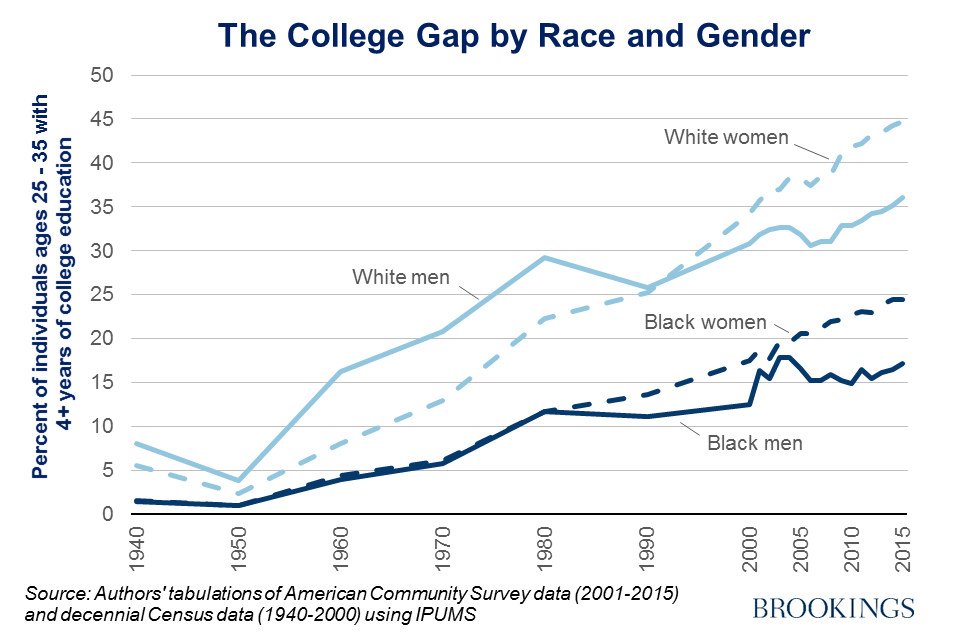
College graduation rates for men and women (Source: Brookings Institute)
Britain is a country that is absolutely dominated by radical feminists. And it affects everything from their collectivist views on economic policy, to their pro-criminal views in the justice system, to their open-borders views on immigration, their preference for government-run healthcare, their hatred of self-defense, and so on. So, I wouldn’t expect to see an article about the plight of boys in a feminist society published in a British newspaper.
Nevertheless, here is an article from the UK Telegraph that explains how the public schools are handling the problem of underperforming boys.
It says:
Britain’s education system is failing to tackle the “astonishing” underperformance of boys as feminists have made the topic “taboo”, the former head of the university admissions service has warned.
Mary Curnock Cook, who was chief executive of Ucas until last year, said the fact that boys are falling behind in education is a national scandal – yet it is such an “unfashionable” topic to discuss that it has become “normalised”.
Girls outperform boys in all aspects of education, from primary school to GCSEs and A-level results. Last year, 57 per cent of women went to university compared to 43 per cent of men, a gap that has widened significantly over the last decade.
[…]Ms Curnock Cook said that the debate about gender equality tends to be dominated by issues such as the gender pay gap and the glass ceiling.
“But those are work issues, not education issues,” she said. “Quite often initiatives to support men do meet derision from feminists.”
When attempts are made to address men’s issues, they are ridiculed and are met with the “wrath” of feminist and gender equality groups, she said.
Last month the only university in the UK with a men’s officer scrapped the role after the candidate withdrew due to “harassment”.
But, it’s happening in America as well.
An article from 2013 appeared in the far-left The Atlantic. It explains how the school system punishes boys and favors girls – from kindergarten to the workplace, where women receive affirmative action preferences.
Excerpt:
Boys in all ethnic groups and social classes are far less likely than their sisters to feel connected to school, to earn good grades, or to have high academic aspirations. A recent working paper from the National Bureau of Economic Research documents a remarkable trend among high-achieving students: In the 1980s, nearly the same number of top male and female high school students said they planned to pursue a postgraduate degree (13 percent of boys and 15 percent of girls). By the 2000s, 27 percent of girls expressed that ambition, compared with 16 percent of boys. During the same period, the gap between girls and boys earning mostly A’s nearly doubled—from three to five percentage points.
This gap in education engagement has dire economic consequences for boys. A 2011 Brookings Institution report quantifies the economic decline of the median male: For men ages 25 to 64 with no high school diploma, median annual earnings have declined 66 percent since 1969; for men with only a high school diploma, wages declined by 47 percent. Millions of male workers, say the Brookings authors, have been “unhitched from the engine of growth.” The College Board delivered this disturbing message in a 2011 report about Hispanic and African-American boys and young adults: “Nearly half of young men of color age 15 to 24 who graduate from high school will end up unemployed, incarcerated or dead.” Working-class white boys are faring only slightly better. When economist Andrew Sum and his colleagues at the Center for Labor Market Studies at Northeastern University examined gender disparities in the Boston Public Schools, they found that for the class of 2007, among blacks and Hispanics, there were 186 females for every 100 males attending a four-year college or university. For white students: 153 females to every 100 males.
Just like in the UK, American feminists oppose doing anything to help boys:
In the U.S., a powerful network of women’s groups works ceaselessly to protect and promote what it sees as female interest. But there is no counterpart working for boys—they are on their own.
It’s important for parents to understand that the problem of boys underperforming in school and work is not caused by boys. It’s not with video games, it’s not with sports, or anything else that anti-male people might blame. The problem with boys not learning and boys not working is caused by an education system dominated by anti-male feminists who systematically discriminate against boys, making it harder for them to learn the skills they need to find work.
The problem isn’t going to be fixed by airhead feminist pastors and other male “leaders” telling boys to “man up”. The problem is going to be fixed when parents realize that radical feminism is hostile to boys, and that institutions that are dominated by radical feminism are damaging to boys. I have a Jewish friend named Ari who homeschools all his children. He spends a lot of time and effort on this. He told me that sending boys to public schools is child abuse. I used to laugh at him when he said that. What a funny exaggeration, I thought. Now I’m not so sure he was joking.
In this post, I have the video of a debate on the topic of what Christians should think about economics and economic policies. In addition to the video, I summarized the two opening speeches and the two rebuttals, for those who prefer to read rather than watch. We’ll start with a short biography about each of the debaters.
The video recording:
The debaters
Jay Richards:
Jay Richards, Ph.D., is a Senior Fellow of the Discovery Institute where he directs the Center on Wealth, Poverty and Morality, and is a Visiting Scholar at the Institute for Faith, Work & Economics. Most recently he is the co-author with James Robison of the best-selling Indivisible: Restoring Faith, Family, and Freedom Before It’s Too Late”.
In addition to writing many academic articles, books, and popular essays on a wide variety of subjects, he recently edited the new award winning anthology, God & Evolution: Protestants, Catholics and Jews Explore Darwin’s Challenge to Faith . His previous book was Money, Greed, and God: Why Capitalism Is the Solution and Not the Problem (HarperOne, May 2009), for which he received a Templeton Enterprise Award in 2010.
[…]In recent years, he has been a Contributing Editor of The American at the American Enterprise Institute, a Visiting Fellow at the Heritage Foundation, and a Research Fellow and Director of Acton Media at the Acton Institute. Richards has a B.A. with majors in Political Science and Religion, an M.Div. (Master of Divinity) and a Th.M. (Master of Theology), and a Ph.D. (with honors) in philosophy and theology from Princeton Theological Seminary.
Jim Wallis:
Jim Wallis (born June 4, 1948) is a Christian writer and political activist. He is best known as the founder and editor of Sojourners magazine and as the founder of the Washington, D.C.-based Christian community of the same name. Wallis is well known for his advocacy on issues of peace and social justice. […]He works as a spiritual advisor to President Barack Obama.
[…]In 2010, Wallis admitted to accepting money for Sojourners from philanthropist George Soros after initially denying having done so. […]In 2011, Wallis acknowledged that Sojourners had received another $150,000.00 from Soros’ Open Society Foundation.
Wallis just came out this month in favor of gay marriage. He is also a strong supporter of Barack Obama, who is radically pro-abortion. Some pro-lifers have argued that Barack Obama has the same views on abortion as Kermit Gosnell, because Obama voted twice to allow abortions on babies who were already born alive.
The format of the debate
20 minute opening speeches
10 minute rebuttals
10 minutes of discussion
Q&A for the remainder
SUMMARY
I use italics below to denote my own observations.
Jim Wallis’ opening speech:
My goal is to spark a national conversation on the “common good”.
A story about my son who plays baseball.
The central goal of Christianity is to promote the “common good”.
Quotes “Catholic social teaching” which values “human flourishing”.
The “common good” is “human flourishing”.
Is the purpose of Christianity is to make sure that everyone has enough material stuff or to preach the gospel?
When Christians go on mission trips, it’s good that they focus on things like human trafficking.
Democrat John Lewis is the “conscience of the U.S. Congress”.
John Lewis gets a 0% rating from the American Conservative Union in 2012.
John Lewis gets a 8% rating from the American Conservative Union in 2011.
John Lewis gets a 2.29% lifetime rating from the American Conservative Union.
Nothing is going well in Washington right now except comprehensive immigration reform.
Does he think that Christianity means giving 20-30 million illegal immigrants a path to citizenship, while skilled engineers cannot even get green cards, even though there is a shortage of them? Does he think that the other people in society who earn more than they receive from the government ought to be taxed more in order to provide more services and benefits to those who earn less than they take from the government?
Jay Richards’ opening speech:
Two topics: 1) what is the common good? 2) what should Christians do to promote the common good?
Catholicism defines the “common good” as “Indeed, the common good embraces the sum of those conditions of the social life whereby men, families and associations more adequately and readily may attain their own perfection.”
We have natural ends that we are supposed to be achieving and some places, like South Korea, are better for allowing that to happen.
The common good is broader and prior to any sort of political specification.
It’s not the political good or what the state is supposed to do.
It’s not about the communal good, as in Soviet Russia, where the communal good was above individual and familial good.
The common good is the social conditions that promote the things that we humans have in common as individuals and members of family.
The common good takes account of who we are as individuals and in associations with other individuals, e.g. – families.
Christians don’t have to be doing the same things to promote the common good, e.g. – pastors, entrepreneurs, etc.
The church, as the church, has as its primary goal making disciples of all nations.
But even in that capacity, the church should be interested in more than just conversions and saving souls.
We also have to care about God’s created reality including things like physics, education, etc.
How should Christians promote the common good in politics?
Question: when is coercion warranted?
In Romans 13, Paul says that the state does have power to coerce to achieve certain ends, like justice.
Most Christians think that there are some things where the state can use coercion, for example, to prevent/punish murder.
It is OK for the police to use coercive force to maintain public order and the rule of law.
But we need to ask whether other things are legitimate areas for the state to use coercive force.
We should only give the state power to coerce when there is no other way to achieve a goal.
We need to leverage the science of economics in order to know how to achieve the common good.
Jay Richards’ main point in the debate
Henry Hazlitt: “The art of economics consists in looking not merely at the immediate but at the longer effects of any act or policy; it consists in tracing the consequences of that policy not merely for one group but for all groups.”
For example, what happens if we raise the federal minimum wage to $50. What happens next for all groups? That’s what we need to ask in order to know which policies achieve the common good.
When it comes to economics a lot of things have been tried in other places and times.
We can know what works and doesn’t work by studying what was tried before and in other places.
Many things are counter-intuitive – things that sound good don’t work, things that sound bad do work.
Principle: “We are our brother’s keeper”. Christians have an obligation to care for their neighbors.
We all agree on the goal. But how do we do things that will achieve that goal?
We have to distinguish aspirations from principles and prudential judgment.
Principle: We should provide for the material needs of the poor.
Prudence: Seeing the world as it is, and acting accordingly.
Example policies: which minimum wage is best? None? $10? $20?
We decide based on seeing how different economic policies achieve the goal of helping the poor.
Jim Wallis’ first rebuttal:
Jesus commanded us to “care for the poor and help to end poverty”.
Actually, Jesus thought that acknowledging him and giving him sacrificial worship was more important than giving money to the poor, see Matthew 26:6-13:
6 While Jesus was in Bethany in the home of Simon the Leper,
7 a woman came to him with an alabaster jar of very expensive perfume, which she poured on his head as he was reclining at the table.
8 When the disciples saw this, they were indignant. “Why this waste?” they asked.
9 “This perfume could have been sold at a high price and the money given to the poor.”
10 Aware of this, Jesus said to them, “Why are you bothering this woman? She has done a beautiful thing to me.
11 The poor you will always have with you, but you will not always have me.
12 When she poured this perfume on my body, she did it to prepare me for burial.
13 Truly I tell you, wherever this gospel is preached throughout the world, what she has done will also be told, in memory of her.”
It’s not clear to me whether Jim Wallis thinks that preaching is more important than redistributing wealth to address material inequality.
I like what Jesus said in a TV series, even though it’s not in the Bible when an actor playing Jesus said to “change the world”.
Jesus never said to “change the world” in the Bible. Should we be concerned that he is quoting a TV actor playing Jesus instead of Jesus.
Here is a terrific story about Bill Bright.
I love Catholic social teaching.
Quote: “All are responsible for all”.
I go to the World Economic Forum at Davos, Switzerland every year. I spoke once at 7 AM on the 4th floor.
It’s a funny place for a Christian to be if they care about the poor – rubbing shoulders with leftist elites. He must have named a dozen high-profile people that he spoke with during the debate, as if he could win the debate by some sort of argument from name-dropping. He mentioned the Davos thing several times!
The greatest beneficiary of government actions to deal with the economic crisis was Wall Street banks.
I’m going to tell you a story about what a Washington lawyer says to Jesus.
I’ve had conversations with business leaders where I tell them to integrate moral truths.
I talk about the Good Samaritan parable.
Quote: “Do you love your undocumented neighbor?”
Quote: “Do you love your Muslim neighbor?”
Jay Richards’ first rebuttal:
Who is responsible for your own children? Who knows the most about them?
Parents should have more discretion over their children because they have more knowledge about their child and what’s best for them.
The Good Samaritan doesn’t show that government should confiscate wealth through taxation and redistribute it.
The Good Samaritan emphasizes voluntarily charity to help people who are not necessarily your immediate neighbor.
Some of the things we do should be for the good of other people in other countries.
But then we are back to leveraging economics to know what policies are good for those other people in other countries.
The principle of subsidiarity: if a problem can be addressed by a lower level of society (family) then we shouldn’t make higher levels (government) address it.
The best place to take care of children is within the family.
Only if the family fails should wider and wider spheres get involved.
Although we want to think of the common good in a global sense, we don’t want to lose sight of the fact
The financial crisis: we need to integrate moral truths, but also economic truths.
We don’t want to assume policies based on intuitions, we want to check our intuitions using economic principles.
Why did we have a financial crisis in mortgages, but not in commodities futures or technology, etc.?
Greed is a contributing factor in all areas of business.
Something more was going on in the mortgage markets than just greed.
There were specific policies that caused the mortgage lending crisis.
The root cause of the problem were “affordable housing policies” that lowered lending restrictions on low income people.
The policy ended up degrading the underwriting standards on loans.
Government intruded into the market and undermined the normal ways of
People were getting massive loans with no income, no jobs, no assets and no down payment.
The federal government created a market for risk loans by guaranteeing
There was a government imposed quota on mortgage lenders such that 50% of their loans had to be given to high-risk borrowers.
That is what led to the financial crisis. Not the free market, but intrusions into the free market.
These policies were well-meaning and implemented by people from both parties. But they had bad effects.
I noticed that the Democrats are trying to focus on health care in the 2018 mid-terms, so I thought I would re-post a debate on health care between Ted Cruz and Bernie Sanders. I think debates are always a good idea, because you have to listen to both sides. If you can’t watch the full debate, there’s a good article summarizing the main points further down.
Here is the full video:
It’s 90 minutes long. No commercials. This was basically a debate of similar substance to the William Lane Craig debates, where actual economic evidence was continuously produced in order to show who was telling the truth, and who was just trying to be popular by saying what people who are uneducated at economics want to hear. In short: there was a clear winner and loser in this debate, and it was clear all the way through, and was reinforced over and over every time evidence was produced. The person producing the evidence would turn his back on the camera, and return to his podium to get the evidence. That person won the debate by being grounded in reality.
Also, the questions were excellent, especially from the small business owners who were impacted by Obamacare. The moderators were biased towards Sanders, but not excessively.
For those who cannot watch, there is an article at the Daily Signal.
Full text:
In a prime-time debate on CNN this week, Sens. Bernie Sanders, I-Vt., and Ted Cruz, R-Texas, discussed “The Future of Obamacare” in America. Cruz, a leading critic of the law, used the moment to outline the law’s failures.
Here are four things Cruz said about Obamacare:
1) “Now, nobody thinks we’re done once Obamacare is repealed. Once Obamacare is repealed, we need commonsense reform that increases competition, that empowers patients, that gives you more choices, that puts you in charge of your health care, rather than empowering government bureaucrats to get in the way. And these have been commonsense ideas.”
2) “Indeed, I don’t know if the cameras can see this, but in 70 percent of the counties in America, on Obamacare exchanges, you have a choice of one or two health insurance plans, that’s it … It’s interesting. You look at this map, this also very much looks like the electoral map that elected Donald Trump. It’s really quite striking that the communities that have been hammered by this disaster of a law said enough already.”
During one of the more powerful moments in the debate, Cruz held up aHeritage Foundation chart showing viewers how many counties in the U.S. have access to only one or two insurers under Obamacare. Additionally, only 11 percent of counties have access to four or more insurance providers.
3) “Whenever you put government in charge of health care, what it means is they ration. They decide you get care and you don’t. I don’t think the government has any business telling you you’re not entitled to receive health care.”
The U.S. should not envy other health care systems, especially Canada and the United Kingdom, Cruz said. He referred to a governor from Canada who came to the U.S. specifically to have heart surgery.
4) “That’s why I think the answer is not more of Obamacare, more government control, more of what got us in this mess. Rather, the answer is empower you. Give you choices. Lower prices. Lower premiums. Lower deductibles. Empower you and put you back in charge of your health care.”
Obamacare is burdening Americans. The average deductible for a family on a bronze plan is $12,393, according to a HealthPocket analysis. According to aneHealth report, the average nationwide premium increase for individuals is 99 percent and 140 percent for families from 2013-2017.
I really recommend you watch this debate, because it these things were done on a weekly or monthly basis, then people would be able to think critically about what they are presented with from the mainstream media, Hollywood elites and liberal academics.


 WINTERY KNIGHT