
Tag Archives: Socialism

Jay Richards: eight common myths about wealth, poverty and the free market

Have you read Jay Richards’ book “Money, Greed and God?” Because if you haven’t, he’s written a series of articles that summarize the main points of the book.

The index post is here.

Here are the posts in the series:

  • Part 1: The Eight Most Common Myths about Wealth, Poverty, and Free Enterprise
  • Part 2: Can’t We Build A Just Society?
  • Part 3: The Piety Myth
  • Part 4: The Myth of the Zero Sum Game
  • Part 5: Is Wealth Created or Transferred?
  • Part 6: Is Free Enterprise Based on Greed?
  • Part 7: Hasn’t Christianity Always Opposed Free Enterprise?
  • Part 8: Does Free Enterprise Lead to An Ugly Consumerist Culture?
  • Part 9: Will We Use Up All Our Resources?
  • Part 10: Are Markets An Example of Providence?

Parts 4 and 5 are my favorites. It’s so hard to choose one to excerpt, but I must. I will choose… Part 4.

Here’s the problem:

Myth #3: The Zero Sum Game Myth – believing that trade requires a winner and a loser. 

One reason people believe this myth is because they misunderstand how economic value is determined. Economic thinkers with views as diverse as Adam Smith and Karl Marx believed economic value was determined by the labor theory of value. This theory stipulates that the cost to produce an object determines its economic value.

According to this theory, if you build a house that costs you $500,000 to build, that house is worth $500,000. But what if no one can or wants to buy the house? Then what is it worth?

Medieval church scholars put forth a very different theory, one derived from human nature: economic value is in the eye of the beholder. The economic value of an object is determined by how much someone is willing to give up to get that object. This is the subjective theory of value.

And here’s an example of how to avoid the problem:

How you determine economic value affects whether you view free enterprise as a zero-sum game, or a win-win game in which both participants benefit.

Let’s return to the example of the $500,000 house. As the developer of the house, you hire workers to build the house. You then sell it for more than $500,000. According to the labor theory of value, you have taken more than the good is actually worth. You’ve exploited the buyer and your workers by taking this surplus value. You win, they lose.

Yet this situation looks different according to the subjective theory of value. Here, everybody wins. You market and sell the house for more than it cost to produce, but not more than customers will freely pay. The buyer is not forced to pay a cost he doesn’t agree to. You are rewarded for your entrepreneurial effort. Your workers benefit, because you paid them the wages they agreed to when you hired them.

This illustration brings up a couple important points about free enterprise that are often overlooked:

1. Free exchange is a win-win game.

In win-win games, some players may end up better off than others, but everyone ends up better off than they were at the beginning. As the developer, you might make more than your workers. Yet the workers determined they would be better off by freely exchanging their labor for wages, than if they didn’t have the job at all.

A free market doesn’t guarantee that everyone wins in every competition. Rather, it allows many more win-win encounters than any other alternative.

2. The game is win-win because of rules set-up beforehand. 

A free market is not a free-for-all in which everybody can do what they want. Any exchange must be free on both sides. Rule of law, contracts, and property rights are needed to ensure exchanges are conducted rightly. As the developer of the house, you’d be held accountable if you broke your contract and failed to pay workers what you promised.

An exchange that is free on both sides, in which no one is forced or tricked into participating, is a win-win game.

On this view, what you really need to fear as a consumer is government intervention that restricts your choices in the marketplace, or makes some choices more expensive than they need to be (tariffs).

If you care about poverty, it’s often tempting to think that it can only be solved one way – by transferring wealth from the rich to the poor. But that is a very mistaken view, as any economist will tell you. The right way to create prosperity is by creating laws and policies that unleash individual creativity. Letting individuals create innovative products and services, letting them keep what they earn, making sure that the law doesn’t punish entrepreneurs – that incentivizes wealth creation. Fixing poverty does not mean transferring wealth, it means giving people more freedom to create wealth on their own. Free trade between nations is an important way that we encourage people to create better products and services that what they have available in their own countries.

Economists agree on the benefits of free trade

Who could possibly disagree with free trade? Well, many people on the left do. But economists across the spectrum of ideology (university and private sector and public sector) agree on the benefits of free trade.

Harvard economist Greg Mankiw explains what most professional economists agree on.

Excerpt:

Here is the list, together with the percentage of economists who agree:

  1. A ceiling on rents reduces the quantity and quality of housing available. (93%)
  2. Tariffs and import quotas usually reduce general economic welfare. (93%)
  3. Flexible and floating exchange rates offer an effective international monetary arrangement. (90%)
  4. Fiscal policy (e.g., tax cut and/or government expenditure increase) has a significant stimulative impact on a less than fully employed economy. (90%)
  5. The United States should not restrict employers from outsourcing work to foreign countries. (90%)
  6. The United States should eliminate agricultural subsidies. (85%)
  7. Local and state governments should eliminate subsidies to professional sports franchises. (85%)
  8. If the federal budget is to be balanced, it should be done over the business cycle rather than yearly. (85%)
  9. The gap between Social Security funds and expenditures will become unsustainably large within the next fifty years if current policies remain unchanged. (85%)
  10. Cash payments increase the welfare of recipients to a greater degree than do transfers-in-kind of equal cash value. (84%)
  11. A large federal budget deficit has an adverse effect on the economy. (83%)
  12. A minimum wage increases unemployment among young and unskilled workers. (79%)
  13. The government should restructure the welfare system along the lines of a “negative income tax.” (79%)
  14. Effluent taxes and marketable pollution permits represent a better approach to pollution control than imposition of pollution ceilings. (78%)

Socialist economic policies don’t work because they are making policies that are based on economic myths. We know that these myths are myths because of economics is a mathematical science, and because we have tried good and bad policies in different times and places. We have calculations and we have experience to know what works and what doesn’t work. If you want to help the poor, you have to respect what economists know about how wealth is created. The solution is not to “spread the wealth around”, it’s to encourage people to create more wealth by inventing things that people freely choose to buy.
Two reasons why Christians and conservatives should not donate to United Way

Well, it’s that time of year again, when corporations bully their employees into donating to the United Way. I thought it might be a good idea to urge all Bible-believing Christians to avoid donating to the United Way.  Please share this post if you agree with it!

Let’s start with abortion. The United Way gives TONS of money to fund abortion providers.

In 2008, United Way affiliates send $1.9 million to Planned Parenthood:

The national United Way does fund Planned Parenthood; their website states:

United Way funded programs through Planned Parenthood include community health maintenance, e.g. communicable disease prevention; medical care service; family planning; health education; public awareness services; and family preservation and strengthening services, e.g. counseling and family life education.

Nationally in 2008, local United Ways distributed an estimated $1.9 million to Planned Parenthood agencies.

Any finances being donated to Planned Parenthood (even if not specifically for abortion services) will free up more of their money to be used toward abortion services.

In 2015, United Way sent $3 million to Planned Parenthood:

Last year, on the heels of shocking videos showing the Planned Parenthood abortion business selling the body parts of aborted babies, a new expose’ from a group that monitors corporations that finance the abortion giant reveals the United Way is a major donor. That expose found United Way agencies giving $2 million to the abortion giant.

A new expose’ released this week shows that figure has increased to $3 million.

In 2016, United Way sent $3 million to Planned Parenthood:

Analysis of the most recent IRS Form 990 filings and other documentation found 62 United Way affiliates sent $2,756,799 to Planned Parenthood abortion organizations in tax year 2016. 2ndVote’s latest findings indicate an increase of $168,806 from the $2,590,994 United Way funneled to Planned Parenthood in 2015.

We’re living in a time when abortion rights involves such issues as sex-selection abortions, race-selection abortions, covering up statutory rapists, Democrat support for infanticide, attacking Supreme Court nominee Brett Kavanaugh, selling the body parts of unborn babies, etc. I don’t think we can count on United Way to come down on the right side of these issues. We’re already being forced to fund abortions with our tax dollars, thanks to Democrats. I don’t think we should give any more money to abortion providers and their secular leftist allies.

That’s abortion. What about gay rights? We’ve seen a lot of pressure on traditional values coming from the secular left lately. They redefined marriage AGAIN to deprive children of their biological mothers or fathers. They’re pushing for the Equality Act, which would have huge religious liberty repercussions for Christians.

Texas attorney Maria Martinez explains on the American Thinker:

The Equality Act is more draconian that any state or city conversion therapy ban to date because it takes away the traditional constitutional exemption for religious freedom.  The act specifically states that the Religious Freedom Restoration Act (RFRA) may not be invoked as a defense, marking the first time in history that Congress has limited the reach of RFRA.  This means that it could become illegal for Christian pastors, churches, schools, and ministries to communicate a message that sexual orientation or gender identity can change.  The Equality Act is unprecedented in its overreach, impacting even adults who are willingly seeking counseling.

By contrast, therapy of any kind that pushes a person toward same-sex attraction or gender transition is not impacted by the law at all.

Banning counseling isn’t the only thing the Equality Act will do:

  • Parents could lose custody of their children if they decline to assist in their gender transition.  Parents in Ohio recently lost custody of their female child because they would not give her testosterone supplements to help her “transition” to look like a male.

  • Doctors and hospitals could be subject to lawsuits for refusing to perform so-called “sex change” surgeries.  In California and New Jersey, Catholic hospitals are already being sued for discrimination for refusing to perform these surgeries.

  • Battered women’s shelters could be required to admit members of the opposite sex.  In Anchorage, Alaska, a male who was refused access to a shelter for abused and trafficked women sued the shelter for “gender identity discrimination.”

  • Faith-based adoption and foster care agencies that believe that children do best with both a mother and a father could be forced to shut down.  This has already occurred in at least six states in this country.

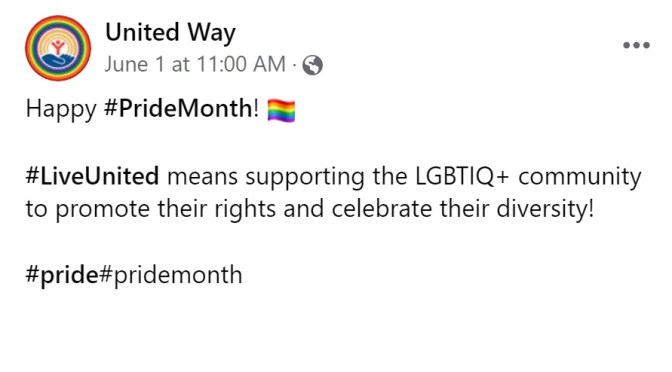
I wonder what United Way thinks about attacks on Bible-believing Christians by LGBT activists? I posted what they shared on Facebook at the top of this post, and this is what I found on their Twitter:

United Way Twitter Gay Rights Pride Month LGBT

I don’t find that very encouraging, do you?

As a Bible-believing Christian, maybe I would be better off giving money to an organization that protects religious liberty, like Alliance Defending Freedom. I understand that many people who call themselves Christians think that the United Way’s positions are compatible with the Bible. But not everyone who calls herself a Christian actually takes the Bible seriously. Especially when it interferes with their career advancement and peer approval. This is especially true of people who work in Human Resources.

Please, don’t give money to the United Way

You don’t HAVE to give money to the United Way, just because the godless progressives in your office try to bully you into it. Instead, why not send the money to the Life Training Institute, or Ratio Christi, or Alliance Defending Freedom? These are groups do operate on Bible-based principles. I do think that Christians need to be careful about who they donate their money to. It doesn’t make sense for Christians to get up and go to work and earn money, and then give it away to anti-Christian groups who want Christianity to disappear from American life. Paul talks about how God rewards those who give gifts to partner for the gospel in Philippians. Make sure that you are not wasting your money on anything less.

What can we learn about communist leaders from the record of history?

Now that we have atheistic communists in the majority of the House, Senate and White House, it might be a good idea to take a look at what atheistic communist leaders have done in history. First, let’s see how the atheistic worldview of communist leaders affected religious people.

Here is what Josef Stalin did during his rule of Russia in the 1920s and 1930s.

The Library of Congress offers this in their “Soviet Archives exhibit”:

The Soviet Union was the first state to have as an ideological objective the elimination of religion. Toward that end, the Communist regime confiscated church property, ridiculed religion, harassed believers, and propagated atheism in the schools. Actions toward particular religions, however, were determined by State interests, and most organized religions were never outlawed.

The main target of the anti-religious campaign in the 1920s and 1930s was the Russian Orthodox Church, which had the largest number of faithful. Nearly all of its clergy, and many of its believers, were shot or sent to labor camps. Theological schools were closed, and church publications were prohibited. By 1939 only about 500 of over 50,000 churches remained open.

What’s the attitude of Democrat candidates to Bible-believing Christians? My read is that they think that Christian values need to be suppressed by the government lest they offend Democrat voters, who seem to be very easily offended these days. You can already see their animus towards Christians in their Equality Act, which eradicates conscience rights in order to protect (some) LGBT people from feeling offended.

The Ukraine Famine

Take a look at this UK Daily Mail article about Josef Stalin.

Excerpt:

Now, 75 years after one of the great forgotten crimes of modern times, Stalin’s man-made famine of 1932/3, the former Soviet republic of Ukraine is asking the world to classify it as a genocide.

The Ukrainians call it the Holodomor – the Hunger.

Millions starved as Soviet troops and secret policemen raided their villages, stole the harvest and all the food in villagers’ homes.

They dropped dead in the streets, lay dying and rotting in their houses, and some women became so desperate for food that they ate their own children.

If they managed to fend off starvation, they were deported and shot in their hundreds of thousands.

So terrible was the famine that Igor Yukhnovsky, director of the Institute of National Memory, the Ukrainian institution researching the Holodomor, believes as many as nine million may have died.

[…]Between four and five million died in Ukraine, a million died in Kazakhstan and another million in the north Caucasus and the Volga.

By 1933, 5.7 million households – somewhere between ten million and 15 million people – had vanished. They had been deported, shot or died of starvation.

The Holodomor is just one of the atrocities committed by Soviet Union communists. You may also have heard that they operated a system of labor camps for dissidents that killed millions more. The total number of people killed by Stalin is estimated at 20 to 40 million.

Stalin actually wasn’t very good at mass murder compared to another communist, Mao Zedong.

Can you name the greatest mass murderer of the 20th century? No, it wasn’t Hitler or Stalin. It was Mao Zedong.

According to the authoritative “Black Book of Communism,” an estimated 65 million Chinese died as a result of Mao’s repeated, merciless attempts to create a new “socialist” China. Anyone who got in his way was done away with — by execution, imprisonment or forced famine.

For Mao, the No. 1 enemy was the intellectual. The so-called Great Helmsman reveled in his blood-letting, boasting, “What’s so unusual about Emperor Shih Huang of the China Dynasty? He had buried alive 460 scholars only, but we have buried alive 46,000 scholars.” Mao was referring to a major “accomplishment” of the Great Cultural Revolution, which from 1966-1976 transformed China into a great House of Fear.

The most inhumane example of Mao’s contempt for human life came when he ordered the collectivization of China’s agriculture under the ironic slogan, the “Great Leap Forward.” A deadly combination of lies about grain production, disastrous farming methods (profitable tea plantations, for example, were turned into rice fields), and misdistribution of food produced the worse famine in human history.

Deaths from hunger reached more than 50 percent in some Chinese villages. The total number of dead from 1959 to 1961 was between 30 million and 40 million — the population of California.

[…]Mao kept expanding the laogai, a system of 1,000 forced labor camps throughout China. Harry Wu, who spent 19 years in labor camps, has estimated that from the 1950s through the 1980s, 50 million Chinese passed through the Chinese version of the Soviet gulag. Twenty million died as a result of the primitive living conditions and 14-hour work days.

Whenever I bring up the historical record of communism to Democrats, they always tell me that their leaders have good intentions. But the communist leaders of the past aren’t any different from the communist leaders of today. Communist leaders all start out with noble ambitions of wanting to help the poor. The problem is that they don’t know anything about economics, so whatever they try doesn’t work. Communist policies like nationalizing private industries, printing money, purging wealthy people, imposing tariffs, and imposing price controls cause enormous poverty. And then they need someone to blame for their failure to produce the results they promise.

If we were serious about helping the poor, then we would elect leaders who had experience lifting the poor out of poverty. A business leader or a governor of a state. It’s not a popularity contest. We need to choose someone who has already had success at helping the poor. And the best way to help the poor is by helping them to find work so they can earn their own success and chart their own course. After all it’s not words that affect our lives. Or the feelings we have about words we like. What affects our lives is policies that produce results. Intentions and rhetoric don’t matter, ultimately.