I just received my copy of the “Signature in the Cell” book from the Discovery Institute in the mail today. My former co-worker Robb got his last week. It’s a ~600 page hardcover, so perhaps Robb and I should have a contest to see who can finish it first! It has huge print and lots of space, and beautiful illustrations on practically every page. I’m so excited – I can tell that I am going to learn a lot by reading this book.
This episode of ID the Future tells the story of how philosopher of science Stephen C. Meyer first began his quest for the origin of life. How did one of the architects of the intelligent design movement move from the oilfields of Texas to the study halls of Cambridge to pursue the mystery of where biological information originated? Listen in and find out. (MP3 file)
On this episode of ID the Future philosopher of science Stephen C. Meyer continues the story of how he became involved in intelligent design, sharing some of what he studied while at Cambridge University. What methods do scientists use to study biological origins? Is there a distinctive method of historical scientific inquiry? Meyer set off to investigate not only the history of scientific ideas about the origin of life, but also questions about the definition of science and about how scientists study and reason about ancient events in the past. Listen in and learn, and check out Dr. Meyer’s new book, Signature in the Cell, which tells more of the story, the culmination of over 20 years of study and research on the origins of life. (MP3 file)
On this episode of ID the Future CSC Director Stephen C. Meyer explains the problem that information presents to origin of life researchers within a naturalistic paradigm. Information within the cell presents a daunting challenge to Darwin’s theory — and provides significant evidence for a signature of a designing intelligence, as Meyer explains in his new book. (MP3 file)
On this episode of ID the Future philosopher of science Stephen C. Meyer responds to critics of intelligent design, such as Richard Dawkins and his book, The God Delusion. (MP3 file)
I give these videos my highest recommendation. If you have not seen them, you must see them.
Stephen C. Meyer’s new book
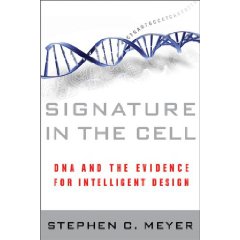
The new book by Stephen C. Meyer is called “Signature in the Cell: DNA and the Evidence for Intelligent Design”. It is being published by Harper-Collins.
Signature in the Cell
Here is the blurb:
Meyer tells the story of the successive attempts to solve this mystery of DNA and argues that fundamental objections now exist to the adequacy of all purely naturalistic or materialistic theories. The book then proposes a radical alternative based upon developments in molecular biology and the information sciences: it proposes the design hypothesis as the best explanation for the origin of the information necessary to produce the first life.
SIGNATURE IN THE CELL will not merely provide a critique of evolutionary theories. It also shows that, based on our uniform and repeated experience-the basis of all scientific reasoning about the past-there is a strong positive case for intelligent design. From our experience we know that intelligence alone produces large amounts of information. Thus, the book shows that the argument for intelligent design from DNA is not based on ignorance or a desire to “give up on science,” but instead upon just the opposite: our growing scientific knowledge of the inner workings of the cell and our experience-based knowledge of the cause-and-effect structure of the world. For just this reason the argument for design can be formulated as a rigorous and positive scientific argument-specifically one called “an inference to the best explanation.” The book shows, ironically, that the argument for intelligent design from DNA is based on the same method of scientific reasoning that Darwin himself used.
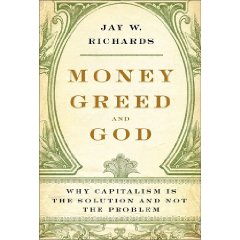
To understand what capitalism is, you can watch this lecture entitled “Money, Greed and God: Why Capitalism is the Solution and Not the Problem” by Jay W. Richards, delivered at the Heritage Foundation think tank, and televised by C-SPAN2. The book has the same title, and is published by Harper-Collins.
Money, Greed and God
Here is the blurb:
Does capitalism promote greed? Can a person follow Jesus’s call to love others and also support capitalism? Was our recent economic crisis caused by flaws inherent to our free market system? Jay Richards presents a new approach to capitalism, revealing how it’s fully consistent with Jesus’s teachings and the Christian tradition, while also showing why this system is our best bet for renewed economic vigor.
The church is bombarded with two competing messages about money and capitalism:
wealth is bad and causes much of the world’s suffering
wealth is good and God wants you to prosper and be rich
Richards exposes these myths, and other common misconceptions about capitalism, and reveals the surprising ways that capitalism is, in fact, the best system to respond to the biblical mandates of alleviating poverty and protecting the environment. Money, Greed, and God equips readers to take practical steps in their own lives to conduct business, worship God, and serve others without falling into the “prosperity gospel” trap.

 WINTERY KNIGHT