
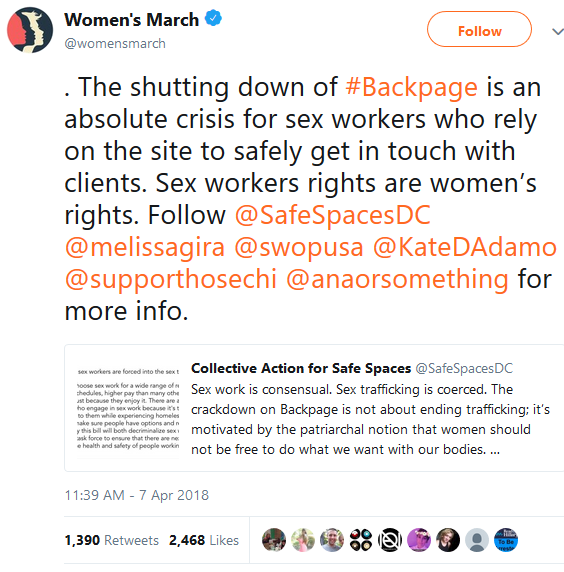
Wow! Read that tweet by the organizer’s of the Women’s March (which doesn’t even represent all women). A web site that facilitates “sex work” was shut down by the FBI, and the Women’s March is upset. What can it mean?
Well, here’s an article from The Federalist to explain. (H/T Sean M.)
Excerpt:
Last Friday, the FBI seized Backpage.com, a website well known for facilitating the sale of trafficked minors, mostly girls, for sex all over the United States. On Monday, seven top Backpage officials were arrested after being indicted on 93 counts, including money laundering and facilitating prostitution, 17 cases of which involve trafficking victims as young as 14. The Washington Post says Backpage earned an estimated $500 million in prostitution-related revenue since its launch in 2004.
The National Center on Missing and Exploited Children reports that 73 percent of all child sex trafficking cases it has handled involved Backpage.com. According to the National Center on Sexual Exploitation, Backpage reached 97 countries and was the world’s largest single facilitator of sex trafficking. NCOSE also reports that from January 2013 to March 2015, 99 percent of Backpage’s global revenue was attributable to prostitution advertising. During that time, it made nearly $51 million from prostitution ads in California alone.
The rest of the The Federalist article makes clear that nothing in that web site’s operations made sex-trafficking “safer” for women. In fact, the whole “sex work” business is dangerous for women:
While it’s impossible to say all women in prostitution are trafficked into it, numerous young women and girls tell us they were sold into sex against their will into the industry that traffickers, sex buyers, and their supporters try to legitimize with terms like “sex work.” We do know, thanks to the research of Melissa Farley at Prostitution Research and Education, that 70 percent of those in the sex industry link their entry to prior sexual abuse.
Most say they entered as minors, which in the United States qualifies as trafficking. Many enter feeling they have no other options, reducing the sense of free choice in the matter. Once they’re in, 89 percent of “sex workers” say they want to get out of the industry but feel they have limited options. You don’t call an industry safe when women are coerced into it and have difficulty getting out.
According to Farley’s comprehensive studies, as many as 99 percent of those in the sex industry have said they experienced violence within it. Thanks to ladies like Marian Hatcher, who leads the human trafficking division at the Cook County Sheriff’s Office, we know that 37 children and adults between 2007 and 2016 were killed as a result of online sex ads like those at Backpage.com. You don’t call an industry safe when women face threats to their lives and agency within it.
Sometimes, it’s a good idea to look back and see how we got to this point. Just a few decades ago, women generally did not have sex before marriage. Instead, they avoided sex with hot bad boys, found a man who could do husband roles early on, and got married. We had a lot of 40, 50 and 60 year marriages. Lots of children and grandchildren. Photo albums full of pictures. Family, relationships and community. In those days, women were more comfortable with the obligations of relationships, and they were happy to give up some freedom in order to have a strong family and home.
Today, things are different. Feminism won. Women don’t look for men who would make good husbands and fathers. Women don’t marry early because they see marriage as boring and sexist. Unfortunately, having a lot of fun with bad boys in your 20s isn’t a plan for the next 60 years of your life.
Instead of backtracking on their mistakes, the radical feminists are now telling us we have to go forward. How far forward? We have to normalize prostitution and sex-trafficking, too. Once upon a time we had rules around sex, and men played by those rules. Now, the old rules that protected women are gone, and the radical feminists are the ones driving it. Their ideology means more to them than women’s happiness and safety.
And it’s not just harmful sex work that the radical feminists support. Radical feminists also championed sex-selection abortions, which allows mothers to terminate their children for being the wrong sex. Radical feminists also support race-selection abortions, which allow mothers to terminate their children for being the wrong race. And no-fault divorce law were championed by radical feminists and their trial lawyer allies, resulting in an epidemic of fatherless children. Fatherlessness is really bad for little girls, and little boys, too.
Well, maybe I’m wrong, but I don’t see how radical feminism has made the lives of women, born and unborn, better. Just because a few women made poor choices with men, and got angry at all men, that isn’t a reason to let them burn down the institution of marriage. Maybe we should just encourage young women to make better choices about when to marry and who to marry than the bitter feminists did? That’s what we used to do, and it seemed to me that women were a lot safer and happier with that.

 WINTERY KNIGHT