Tag Archives: Sexual Revolution

New study: As Christianity declines, so do stable relationships and marriage

Man and woman working on a computer upgrade
Man and woman working on a computer upgrade together

Mark Regnerus is a sociologist at the University of Texas, Austin. He publishes a lot of his books with Oxford University Press. So, his research methods are generally seen as reliable. I noticed that he had done a survey of views on religion, sexuality and marriage in 2018, and he published a popular level article about it earlier this week. I think it’s worth taking a look at his findings.

He writes:

Let me offer a word about the survey. I call it the American Political and Social Behavior survey, which interviewed 5,285 Americans in November 2018, just days after the midterm election. The data collection was conducted by Ipsos… a research firm with a very strong record of generating high-quality data for academic projects.

Here are his findings:
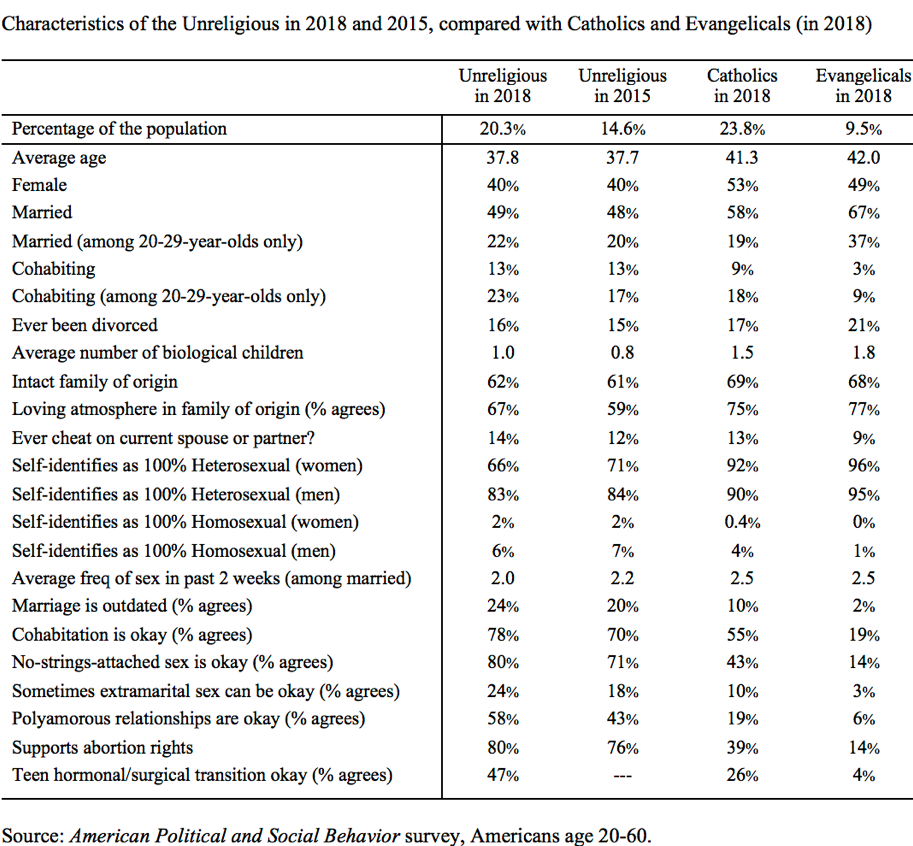
Views of unreligious, Catholic and evangelical Americans
Views of unreligious, Catholic and evangelical Americans (click to expand)

This is interesting:

Even when I limit the group to respondents below age thirty—which is just north of the median age at marriage in the United States—it is notable that 22 percent of the unreligious are married and 23 percent are currently cohabiting, not radically different from the 19 and 18 percent of Catholics that are married and cohabiting, respectively. For comparison, 37 and 9 percent of younger evangelicals are married and cohabiting, respectively. The cohabiting habits of the unreligious, however, have shifted—note the uptick in cohabitation—six percentage points in just under four years. That amounts to a 35 percent increase. Since it’s unlikely that the unreligious have recently changed their minds about the morality or pragmatics of living together, my bet is in the other direction: cohabiting leads many to no longer identify as religious at all.

Got that part in bold? Their attitudes are changing because of their sexual behaviors. So, if you want to reverse the decline of Christianity, we’re going to need to come up with some arguments and evidence to counter the sexual revolution. And on this blog, we’ve done that many times, looking at studies showing the future instability of marriages that occur after cohabitation. I’ve never heard a church preach on that, though. And it’s not something that even many Christian apologists focus on. Most Christian apologists, particularly the women, tend to focus on soft arguments,. They stay away from arguments about morality, because it’s divisive and abrasive to their desired audience. However, if the goal is persuading people that Christianity is a viable worldview, then we need to focus more on sexuality.

More Regnerus:

[O]n each of seven attitude measures I examined, the unreligious are notably more permissive than even the spiritual-but-not-religious (not shown). Nearly 80 percent of unreligious Americans agree (or strongly agree) that cohabitation is okay, no-strings-attached sex is okay, and abortion should be a legal right. This is all unsurprising. But even some of the more radically “progressive” attitudes demonstrate strong support among the unreligious: 24 percent agree that it is “sometimes permissible for a married person to have sex with someone other than his/her spouse.” (I thought perhaps women would differ from men here, but they didn’t—or at least not by much.) Although few Americans are actually in polyamorous living arrangements, the unreligious would support them should someone choose such an arrangement; 58 percent of them agreed that “it is okay for three or more consenting adults to live together in a sexual/romantic relationship,” a percentage that is far more supportive than Catholics or evangelicals. Among the latter, only 6 percent thinks polyamory could be okay.

A more interesting theme, however, is the surge in support for such alternatives. On each statement, note the rise in agreement that has occurred in just under four years. Polyamory tops the list—a 35-percent leap in the share of unreligious who now endorse polyamorous arrangements (from 43 to 58 percent). Even support for extramarital affairs grew by one-third (from 18 to 24 percent). The unreligious aren’t alone here. Catholics, too, have witnessed liberalization in attitudes. Evangelical numbers display a more modest uptick, and from lower starting points.

The non-religious people in my office who were raised Christian like to tell me that the existence of the Christian God isn’t important to them, because they can achieve marriage via cohabitation, and behave like good people without the need for any sort of framework to rationally ground it. They think that you can just pull out God, and the marriage will stay the same. They expect the people they start relationships with to act on Christian morality, even if the worldview was rejected as superstitious nonsense. But as you can see from the data, removing God has an enormous effect on the person’s ability to be stable and faithful.  The truth is that when you take out the vertical relationships with God, then the blueprint for the relationship becomes completely different. Relationships used to be seen as an enterprise where each person’s primary commitment was to lead and protect their spouse before delivering them to God with faith intact. Now, relationships are contingent on continuous happiness.

More Regnerus:

Only 66 percent of unreligious women say they are “100% Despite the permissive reputation of the unreligious, their actual marital sexual frequency is lower than that of Catholic and evangelical couples—at two instances in the past two weeks. As has been documented extensively in the past few years, the frequency of sex among American couples—whether cohabiting or married—has been declining at statistically significant rates. This pattern has not spared the godless.

I think this is interesting. I believe that men are facing an epidemic of sex-withholding from their wives, and I have an idea why that is. Today, women most commonly use sex to “jump start” a relationship with men who they perceive as “high value”, but who refuse to commit to them. This behavior is not focused on men who have commitment abilities, e.g. – provider, moral leader, spiritual leader, accurate worldview rooted in logic and evidence. Instead, most women use sex to get men who have the appearance of high value, e.g. – tall, tattoos, piercings, violent tendencies, exciting, fun, etc. Having established that pattern over and over with no-commitment bad boys, they marry someone who they see as beneath them, and then withhold sex. Commitment isn’t worthy of sex. It’s the man’s appearance and entertainment value that makes him worthy of sex. The comparison of this low-quality man to previous partners makes women more likely to initiate divorce for “unhappiness” later on.

Even alpha male bad boys are disappointed by the Sexual Revolution

Marriage stability vs sexual partners,(Teachman et al. JAMF, August 2010)

Thanks to radical feminism’s dominance in the culture, young unmarried women are very disinterested in marriage. Many of them see marriage as boring, and children as restrictive of their freedom. Instead, young women want to make sure to use their young and fertile years to pack in as much fun and thrills as they can. So what sort of men do they choose to pursue for that?

This article from the UK Daily Mail has the answer:

Women are often said to be the less shallow sex when it comes to what they find attractive.

But a study of an online gallery of ‘hot male commuters’ has found that the fairer sex are just as superficial as men – as they find muscles and money the sexiest male attributes.

The study based its findings on a website called Tube Crush, where women and gay men secretly take pictures of the capital’s attractive men on the London Underground.

[…]While the authors acknowledge that gay men also use the site, they say that female responses to the ‘hot commuters’ suggest females have not moved on in what they find attractive beyond ‘money and strength’ – despite their advancement in society.

Signs that the man is wealthy – such as a flashy watch or an expensive suit – were considered highly attractive by site users, as were powerful arm and chest muscles.

But the classic image of the ‘new man’ – a man holding a baby – or skinnier or nerdier types of man were far less represented.

Now, in my experience, men who are getting a lot of attention because of their looks are probably the least likely to be faithful, much less commit. If the man is putting in a lot of effort into his appearance (as opposed to his education, his career, his spiritual life, etc.), he’s probably doing it in order to get sexual access to a lot of women. He’s not looking to commit, in short. He’s looking to play the field. But it turns out that even the men who are successful at this are not happy with their success.

Consider this article from the UK Sun: (H/T Sarah)

It sounds like every young man’s idea of heaven: endless sex with a constant stream of gorgeous, up-for-it women who don’t even expect a pizza date before, or a conversation afterwards – and all via a tap on your smartphone.

Yet incredibly, a new generation of handsome, successful – and sexually prolific – Tinder-weary lads are claiming sex with hundreds of one-night stands is leaving them burned out, bored – and lonely.

Despite bedding a bevvie of beauties, they claim they’re desperate for lasting romance – and broody for children with a new wave of sexually-liberated young women who just don’t want to commit.

I got to know a group of these seemingly lucky men after I co-wrote the UK’s biggest ever academic study into more than 2,000 British men, released this week.

Called the Harry’s Masculinity Report, the survey was conducted by University College London and Harry’s, a new men’s grooming company that’s just launched in the UK.

Harry’s wanted to shatter the myths around masculinity, and discover what truly made modern men tick in 2017.

Here are some details:

One of these was Simone Ippolito, 25, from Bournemouth, a self-confessed Tinder “player” for two years.

The salesman and part-time model claimed: “When I first got Tinder two years ago, it was heaven. In three months I got 300 matches. They were coming so fast I couldn’t keep up.

“People on Tinder are only there for sex. I’ve been on 200 dates, and I get a result 99 per cent of the time.

“Getting sex is too easy. You get bored of it. Tinder takes all the pleasure out of flirting. It’s not fun anymore. Tinder is literally two glasses of wine then back home for sex. There is no emotion.

“It is boring, empty and lonely. You can’t have a nice conversation after mechanical sex. It’s just sex and go. Now I just want to stop it and settle down”.

Talking to other single men, it rapidly became clear that while dating apps like Tinder means it’s never been easier to get sex, it’s never been harder to fall in love.

This sentiment was echoed by Gary Barnett, 34, social media manager from Brighton, who’s been single for three months.

“For the first time ever in human history, sex is on tap,” he says.

“Nine times out of ten you don’t even have to go out on a date. If a girl likes your photos, they just come round.

“If you’re half attractive you’re bombarded with offers. You can go on Tinder dates every single night of the week.

“The social interaction is totally lacking. You can have sex and never talk again.

“They always ask the same three questions. ‘Hi how are you?’ ‘how’s your week been?’ or ‘I love your beard/tattoos’. That’s literally code for ‘do you want to f***?’

“That was really good for the first year. I filled my boots. After 50 Tinder dates, including 20 in the last two months with no sign of any ‘keepers,’ I’m over it. You get to the point where you can’t be bothered to do it anymore”.

Ah yes, the beard and tattoos. These are apparently very important for attracting women today. But it doesn’t work to attract a serious marriage-minded women to settle down with. Men are designed to want relationships with women. But not every woman is capable of having a relationship with a man. Especially after so many women have been taught by feminism not to prefer commitment-minded men who can perform the traditional male roles: protecting, providing and leading on moral and spiritual issues. Beards, muscles, shiny watches and tattoos might attract women, but it doesn’t make those women marriage-ready. In fact, the sort of women who are impressed with appearances are probably looking for fun. They are definitely NOT going to be comfortable with relationship obligations to a husband or children. To build a capacity for self-sacrificial commitment, you don’t practice having fun and thrills. You practice self-sacrificial commitment. You work on developing a worldview that makes self-sacrificial commitment rational, even when it goes against your self-interest. A worldview like Christianity, for example.

We already knew that women are unhappy with the dating scene today. And now we know that even the men who are “succeeding” are unhappy with it too, in the long term. The Sexual Revolution has messed up love and commitment for everyone.

Feminist explains how she chose to drink alcohol before recreational sex

College students puking in toilet

Guess where I’m linking today? To a radical feminist web site named Jezebel, to an article written by a radical feminist who writes for the radically leftist Slate.

No, I’m not crazy. Just read it:

Much of the conversation around alcohol and sex has focused on assault—the line at which intoxication becomes incapacitation, for instance—but what we fail to mention is how haunted people can be by the sex they actually, technically consented to.

[…]I wonder what my sex life would even look like if alcohol hadn’t been there. Alcohol gave me comfort in my own body, and it allowed me to turn my erotic curiosity and hunger for experience into an action plan. I was tired of being the stuttering girl sucking in her stomach after the lights went out. I wanted to be the woman who roamed wild and free.

Alcohol also helped me cut the girlish strings on my heart, an action my college years demanded. Three months into my freshman year, I split a six pack with a dashing sophomore, and we wound up partially clothed on his bed, my bare legs wrapped around his waist, my hands around his neck. I pulled back slightly and asked him the question, the naive question of a girl who does not yet understand her fate: “What does this mean?”

He looked past me, into his studio apartment, and then back into my eyes. “It means that I’m a 19-year-old boy, and we’re having fun.”

What is interesting is that she didn’t see this man’s using her for fun after getting her drunk as any disqualification for a serious relationship. On the contrary, she believes that a serious relationship built on self-sacrificial love and commitment that lasts through difficulties can be found in a man who uses her for fun sex:

I’m not saying I didn’t enjoy that night with the dashing sophomore. I’m saying the fun part for me might have been turning our physical intimacy into a sustained attachment.

Amazing. She wasn’t looking for men with good educations, good jobs, lots of savings, who were sober and chaste – they would have made her unhappy with their bossy leading, and strict plans about courting and marriage. She thought that she could get to live-long married love by choosing what was free, easy and fun in the moment.

She is 35 now, and still single. I’m sure if you ask her, she would like to be married “some day”, but who would say that her past decisions were good preparation for the challenges of marriage? Marriage is about self-sacrificial love, and endurance. To prepare for marriage, you practice self-denial and self-control. You learn how to accept expectations, obligations and responsibilities. You grow up.

Anyway, back to the article. She choose the alcohol herself, and she did it for a very specific reason:

I wanted to have fun, too. And alcohol evened the score. I cared less about everything when I was drinking: What you thought of me, what I looked like in this dress, whether that taco was warm or cold when I stuffed it in my mouth. I don’t want to make it sound like I drank in order to have sex. I drank for a million reasons.

[…]Booze downshifted my intense body consciousness, and it revved up my bravado. Sex was scary—but alcohol made me feel safe.

She drank in order to have sex. Got it? She chose to get drunk in order to feel safe about having sex. Many young women think that recreational sex with hot guys is a pathway to marriage. They drink in order to make progress towards the marriage they want – the marriage to the man who is fun. Not the man who is serious. They don’t want the serious man who makes plans for marriage, and expects the woman to sober up, behave responsibly and honor obligations.

Why are millenials acting like children into adulthood?

This reminds me of the Institute for American Values study. Despite their name, it is not a conservative organization

Look at this citation from p. 15:

A number of students noted that being drunk could later serve as your excuse for the hook up.

A Yale University student said, “Some people like hook up because they’re drunk or use being drunk as an excuse to hook up.”

A New York University student observed, “[Alcohol is] just part of an excuse, so that you can say, oh, well, I was drinking.”

A Rutgers University student commented, “If you’re drinking a lot it’s easier to hook up with someone… [and] drugs, it’s kind of like a bonding thing… and then if you hook up with them and you don’t want to speak to them again, you can always blame it on the drinking or the drugs.”

[…]A University of Chicago junior observed, “One of my best friends… sometimes that’s her goal when we go out. Like she wants to get drunk so I guess she doesn’t have to feel guilty about [hooking up].”

I hope that many of the men out there who refuse to hold women accountable for their own desires start to understand that not everything a woman wants is good, and not every plan a woman makes will work. Sometimes, you need to calmly and constructively challenge them about their priorities, plans and actions. It’s for their own good.