Tag Archives: Risk

Richard Epstein explains why economic inequality is required in order to promote innovation

My friend Matt, who blogs at The Conscience of  a Young Conservative, posted this on Facebook.

Epstein explains how the profit motive creates economic value that raises the standard of living of all people, who are able to exchange their money for valuable products and services that they did not create. He explains how wealth redistribution is wasteful and harmful to economic growth.

(Found here)

Now let’s look at some myths that Christians believe about economics.

We need to understand basic economics

Christian philosopher Jay Richards explains basic economics.

Excerpt:

THE ZERO-SUM GAME MYTH.

There are three kinds of games: win-lose, lose-lose, and win-win. Win-lose games, like basketball, are sometimes called “zero-sum games.” When the Celtics and the Bulls compete, if the Celtics are up, then the Bulls are down, and vice versa. The scales balance. It’s a zero-sum.

Besides lose-lose games, which most of us avoid, there are positive-sum, or win-win, games. In these games, some players may end up better off than others, but everyone ends up at least the same if not better off than they were at the beginning.

Millions of people think that the free trade in capitalism is a dog-eat-dog competition, where winners always create losers. This is the zero-sum game myth, which leads many to think that the government should somehow redistribute wealth. While some competition is a part of any economy, of course, an exchange that is free on both sides, in which no one is forced or tricked into participating, is a win-win game. When I pay my barber $18 for a haircut, I value the haircut more than the $18. My barber values the $18 more than the time and effort it took her to cut my hair. We’re both better off. Win-win.

THE MATERIALIST MYTH.

A similar myth leads people to think of the economy as some fixed amount of material stuff—money in safes or gold bars in a vault. Since two firms competing for one customer can’t both get the customer’s money, we might think the whole economy looks that way: wealth itself isn’t created, it’s merely transferred from one party to another.

A common image of this “Materialist Myth” is a pie. If one person gets too big a slice, someone else will get just a sliver. To serve it fairly, you have to slice equal pieces.

This isn’t how a free economy works, however. Over the long run, the total amount of wealth in free economies grows. We can create wealth that wasn’t there before. The “pie” doesn’t stay the same size. Under capitalism, someone can get wealthy not merely by having someone else’s wealth transferred to his account, but by creating new wealth, not only for himself, but for others as well.

THE GREED MYTH.

Friends and foes of capitalism often claim that it is based on greed. Writer Ayn Rand even claimed that selfishness is a virtue (see the accompanying feature article). But greed is one of the seven deadly sins. If capitalism is based on it, then Christians can’t be capitalists.

In truth, Adam Smith and other capitalist thinkers did not believe this “Greed Myth.” Rather, Smith argued that capitalism, unlike static economies, channels even greedy motives into socially beneficial outcomes. “In spite of their natural selfishness and rapacity,” Smith wrote, business people “are led by an invisible hand…and thus without intending it, without knowing it, advance the interest of the society.”3

Rather than inspire miserliness, capitalism encourages enterprise. Entrepreneurs, including greedy ones, succeed by delaying their own gratification, by investing their wealth in creative but risky ventures that may or may not pan out. Before they ever profit, they must first create.

In a fallen world, we should want an economic system that not only channels greed into productive purposes, but unleashes human ingenuity, creativity, and willingness to risk as well.

I think Christians who don’t understand economics really need to make the effort to understand the basics. I recommend Robert Murphy’s “The Politically Incorrect Guide to Capitalism” and Thomas Sowell’s “Basic Economics“. If you want to see how economics works together with Christianity, then you also want Jay Richards “Money, Greed and God” and Wayne Grudem’s “Politics According to the Bible“.
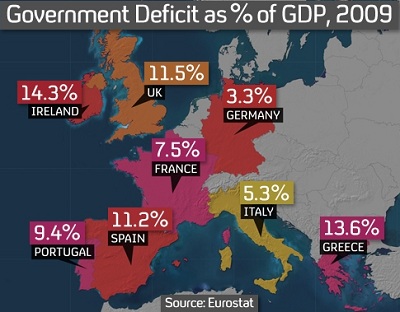
Bank run in socialist Europe begins

Europe: Annual Budget Deficit as % of GDP

From CNBC.

Excerpt:

Money-market funds in the United States have quite dramatically slammed shut their lending windows to European banks. According to the Economist, Fitch estimates U.S. money market funds have withdrawn 42 percent of their money from European banks in general.

And for France that number is even higher — 69 percent. European money-market funds are also getting in on the act.

Bond issuance by banks has seized up because buyers have gone on strike.

From the Economist’s Free Exchange Blog:

In the third quarter bonds issues by European banks only reached 15 percent of the amount they raised over the same period in the past two years, reckon analysts at Citi Group. It is unlikely that European banks have sold many more bonds since.

Corporate depositors are also pulling their cash.

Free Exchange:

“We are starting to witness signs that corporates are withdrawing deposits from banks in Spain, Italy, France and Belgium,” an analyst at Citi Group wrote in a recent report. “This is a worrying development.”

And there are troubling signs that banks are even running out of collateral to back their borrowings from the European Central Bank .

So far the liquidity of the European Central Bank (ECB) has kept the system alive. Only one large European bank, Dexia, has collapsed because of a funding shortage. Yet what happens if banks run out of collateral to borrow against?

And from the leftist New York Times.

Excerpt:

The flight from European sovereign debt and banks has spanned the globe. European institutions like the Royal Bank of Scotland and pension funds in the Netherlands have been heavy sellers in recent days. And earlier this month, Kokusai Asset Management in Japan unloaded nearly $1 billion in Italian debt.

At the same time, American institutions are pulling back on loans to even the sturdiest banks in Europe. When a $300 million certificate of deposit held by Vanguard’s $114 billion Prime Money Market Fund from Rabobank in the Netherlands came due on Nov. 9, Vanguard decided to let the loan expire and move the money out of Europe. Rabobank enjoys a AAA-credit rating and is considered one of the strongest banks in the world.

American money market funds, long a key supplier of dollars to European banks through short-term loans, have also become nervous. Fund managers have cut their holdings of notes issued by euro zone banks by $261 billion from around its peak in May, a 54 percent drop, according to JPMorgan Chase research.

This is really disturbing. I wonder if any of my economics-minded commenters can explain to me what happens when there is a run on banks. I am guessing that there will be some rioting over benefits as austerity measures are imposed, and interest rates will go up.

Has Obama’s buddy Jon Corzine misplaced $1.2 billion of customer funds?

From the Washington Times.

Excerpt:

The facts are that on Oct. 25, Jon Corzine, a former New Jersey governor, stated he was confident that MF Global would successfully manage its $6.3 billion exposure to European debt (Spain, Portugal, Belgium and Italy). Yet a week after a failed attempt to sell the company, MF Global filed for Chapter 11 bankruptcy on Oct. 31.

Now let’s discuss the failure of management at MF Global. Mr. Corzine who is considered by many one of the smartest fixed-income minds in the business took immeasurable risk with the capital of his firm. It was revealed that the company was leveraged 40-1. In summary, the company only had 2.5 percent equity invested against risk positions. Note: Even in the height of the subprime crisis a 40-1 leverage would have been considered extremely risky, where small movements in underlying positions could represent deleterious outcomes for investors.

Did the great Jon Corzine not learn from the greatest financial meltdown seen in the U.S. economy? The answer is simple, here is another example to the entrusted “gambling with other people’s money.” The irony of this is that in the August 2011 bond deal there is a key clause that states if Mr. Corzine departs as MF Global’s full-time chief executive officer prior to July 1, 2013, because of an appointment to a federal position by the president and confirmation of that appointment by the U.S. Senate, investors would get an additional 1 percent coupon on their existing 6.250 percent bonds. I beg to differ in that the “clause” should have said if Mr. Corzine decides to increase the risk-taking at MF Global similar to previous risk positions at Goldman Sachs, investors should be redeemed their money at 100 cents on the dollar. We will find out more but another concern, there is approximately $600 million of unaccounted for customer funds.

UPDATE: The figure is now $1.2 billion.

Excerpt:

The court-appointed trustee overseeing MF Global’s bankruptcy says up to $1.2 billion is missing from customer accounts, double what the firm had reported to regulators last month.

Obama is the Solyndra president. He’s been raiding the public coffers to reward his billionaire campaign fundraisers from day 1 with from his “stimulus” funding – running 1.3 trillion deficits to pay off all the people who got him elected. The young people who will have to pay off this debt still keep voting for him like lemmings – they have no idea about his connections to rich Wall Street bankers. They buy the rhetoric. And the Obama-media has no interest of informing anyone about his connections to dodgy people and organizations.

Look for Corzine to get a presidential pardon in 2012, when Obama leaves office.