Tag Archives: Right to Work

Twinkies company liquidates due to demands of greedy labor union

The Wall Street Journal explains.

Excerpt:

Hostess Brands is going to liquidate, a blow to lovers of Twinkies, Wonder Bread and Drake’s Coffee Cakes all around the globe.

But CEO Gregory Rayburn told CNBC today that as the company winds down its operations after failing to reach an agreement with a union, it will try to sell its various brands. There are 30 separate brands under the companies sugary umbrella.

[…]Rayburn, a restructuring veteran brought in for the bankruptcy, did not shy away from blaming the striking bakers’ union for the liquidation after the company put out an ultimatum earlier this week for them to return to work or face this consequence. He told the television network the union hasn’t “returned our calls in a couple of months.”

There is a silver lining to this story, though:

The reason: insurmountable (and unfundable) difference in the firm’s collective bargaining agreements and pension obligations, which resulted in a crippling strike that basically shut down the company… [the company] was unable to survive empowered labor unions who thought they had all the negotiating leverage…  until they led their bankrupt employer right off liquidation cliff.

[…]Hostess’ numerous brands will be bought in a stalking horse auction by willing private buyers, however completely free and clear of all legacy labor and pension agreements which ultimately led to the company’s liquidation.

Now that’s progress. But what causes union bosses to be so uninformed and ignorant of basic economics? How is it that they do not understand how businesses work?

Consider this quote from Richard Trumka about the looming fiscal crisis:

AFL-CIO President Richard Trumka has declared there’s no fiscal cliff and any address of runaway government spending is just “a manufactured crisis.”

[…]”‘Take what the media are calling ‘the fiscal cliff.’ There is no fiscal cliff!” Trumka thundered at a National Mediation Board Conference Thursday, sounding like an alcoholic pleading for one last swig well before he hits rock bottom.

[…]”What we’re facing,” he said Thursday, “is an obstacle course within a manufactured crisis that was hastily thrown together in response to inflated rhetoric about our federal deficit.

“But all the deficit chatter has distracted us from our real crisis — the immediate crisis of 23 million unemployed or underemployed workers. It’s time to protect Social Security benefits. It’s time to protect Medicare and Medicaid benefits. And it’s time to raise taxes for the richest 2%,” he went on.

In short, Trumka is arguing that there’s no such thing as too much government spending, that deficits don’t matter and that entitlements cannot be cut. Such denialist thinking is beyond irresponsible in the face of a $16 trillion debt, highest on global record and a sign of an irrational agenda often followed by would-be tyrants.

Trumka is trying to intimidate congressional Democrats into intransigence on a debt deal with Republicans to restore the solvency of the U.S. Instead, he wants them to stand fast on the idea that the debt, deficit and entitlements can be addressed simply by taxing higher-income earners who already account for more than half of federal income-tax revenue.

This is the kind of irresponsible thinking that has triggered riots in Greece and Spain — a belief that the money is there and only the meanness of austerity is keeping the common man from his share.

In reality, the money is not there — the pot is empty. Medicare and Social Security are now on “unsustainable paths,” paying out more in benefits than they take in, with their trust funds projected to run dry by 2024 and 2033, according to their own trustees.

Socialism is meeting its natural end — which, in the words of former U.K. Prime Minister Margaret Thatcher, is when it “runs out of other people’s money.”

Unions don’t make anything on their own, only businesses do. And they just don’t understand that. They don’t understand that at some point it is possible to suck too much blood from the host so that the host dies.

I feel bad for the conservatives who are forced to join these labor unions and pay dues to greedy union bosses who don’t understand capitalism or economics. My recommendation is that individual states pass right-to-work laws. Right-to-work states have created FOUR TIMES as many jobs as forced unionization states, since 2009. That’s what happens when you embrace freedom and capitalism.

Indiana passes right-to-work law and is now open for business – and jobs

Central United States

From GOP USA.

Excerpt:

Indiana is poised to become the first right-to-work state in more than a decade after the Republican-controlled House passed legislation on Wednesday banning unions from collecting mandatory fees from workers.

It is yet another blow to organized labor in the heavily unionized Midwest, which is home to many of the country’s manufacturing jobs. Wisconsin last year stripped unions of collective bargaining rights.

The vote came after weeks of protest by minority Democrats who tried various tactics to stop the bill. They refused to show up to debate despite the threat of fines that totaled $1,000 per day and introduced dozens of amendments aimed at delaying a vote. But conceding their tactics could not last forever because they were outnumbered, they finally agreed to allow the vote to take place.

The House voted 54-44 Wednesday to make Indiana the nation’s 23rd right-to-work state. The measure is expected to face little opposition in Indiana’s Republican-controlled Senate and could reach Republican Gov. Mitch Daniels’ desk shortly before the Feb. 5 Super Bowl in Indianapolis.

“This announces especially in the Rust Belt, that we are open for business here,” Republican House Speaker Brian Bosma said of the right-to-work proposal that would ban unions from collecting mandatory representation fees from workers.

Republicans recently attempted similar anti-union measures in other Rust-Belt states like Wisconsin and Ohio where they have faced massive backlash. Ohio voters overturned Gov. John Kasich’s labor measures last November and union activists delivered roughly 1 million petitions last week in an effort to recall Wisconsin Gov. Scott Walker.

Indiana would mark the first win in 10 years for national right-to-work advocates who have pushed unsuccessfully for the measure in other states following a Republican sweep of statehouses in 2010. But few right-work states boast Indiana’s union clout, borne of a long manufacturing legacy.

Every time one state enacts a right-to-work law, it puts competitive pressure on other states. The reason why is because businesses are attracted to right-to-work states, and they will prefer to expand there, rather than in union-friendly states. In fact, some companies will just up and move to right-to-work states, leaving the union-friendly states with no employers at all.

Do right-to-work or forced union states create more high-paying jobs?

Neil Simpson writes about a CNBC report entitled “America’s Top States for Business 2011“. At the top of the list: right-to-work states where workers are not forced to join unions that collect union dues to support Democrat policies like amnesty for illegal immigrants, taxpayer-funded abortion and legalizing same-sex marriage.

Here are the criteria used to rank states in the CNBC survey:

  • Cost of Doing Business
  • Workforce
  • Quality of Life
  • Economy
  • Transportation & Infrastructure
  • Technology & Innovation
  • Education
  • Business Friendliness
  • Access to Capital
  • Cost of Living

Red State writes:

When it comes to America’s Top States for Business 2011, when it comes to a quality workforce, 18 out of the top 20 states are Right-to-Work states. Moreover, all 22 Right-to-Work states are in the top 25 states for having the best workforces.

CNBC defines its criteria as this:

Many states point with great pride to the quality and availability of their workers, as well as government-sponsored programs to train them. We rated states based on the education level of their workforce, as well as the numbers of available workers. We also considered union membership. While organized labor contends that a union workforce is a quality workforce, that argument, more often than not, doesn’t resonate with business. We also looked at the relative success of each state’s worker training programs in placing their participants in jobs.

Since nine out of 10 of the states cited for having the best education are not right to work states, it appears that those who receive their educations in forced-union states get smart, pack up and leave, leaving the not-so-smart union extremists to invent myths about their own superiority while they pay their forced union dues.

And here’s a map of right to work states:

Right to Work State Map

Notice that they are mostly Republican states, because are the states that are run by economists and people with business experience – people who know how to create jobs, as opposed to giving speeches that demonize and threaten the people who create jobs.

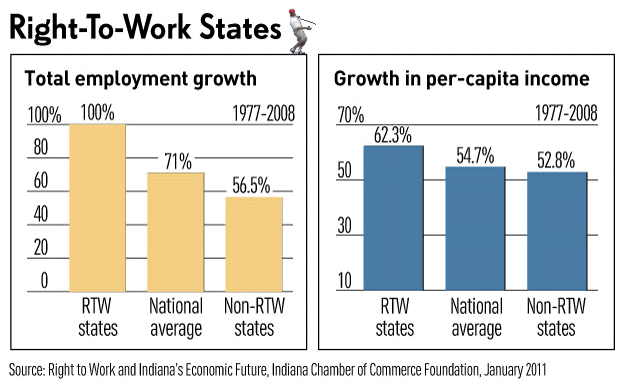
Doug Ross posted these charts a while back that show that employees also do better in right to work states. There are more jobs being created, and the income growth is higher than the forced union states.

Employment growth:

Right To Work States: Employment Growth

Income growth:

Right To Work States: Income Growth

The only losers are the unions. In right to work states, businesses and workers WIN.