

Tag Archives: RFRA

Before the rise of secularism, Americans believed in conscience

Dissent, disagreement, conscience and religious liberty
The importance of respecting the conscience of others

In the last 50 years, America exchanged religious liberty for hedonism. We used to believe that conscience was a good thing, and we respected individual differences rooted in religious convictions. But today, secular leftist politicians, lawyers and judges attack Christians using the courts. Pro-lifers, pro-marriage business owners, and people expressing Christian convictions in public have all felt what it is like to have conscience attacked by the secular leftist state.

Let’s take a look at what things were like in a different time when moral convictions had not been destroyed by secular leftism.

Consider this article in The Federalist about a new movie called “Hacksaw Ridge”.

Excerpt:

Over last weekend, I saw the new Mel Gibson flick “Hacksaw Ridge.” Gruesome and at times overshadowed by lead actor Andrew Garfield’s awkwardness, “Hacksaw Ridge” was an ode to the age-old American custom of protecting dissent by protecting the conscience.

In an age when attacks upon conscience and religious liberty grow more and more fiery, the true tale of World War II hero Desmond Doss’ conscientious objection to killing is a reminder of the difficult stakes involved in ensuring that individual liberty is the presumption that government takes toward individuals, even during war.

“Hacksaw Ridge” is the story of Doss, a Seventh Day Adventist whose religion prohibited taking the life of a fellow human being. Doss, obviously a patriot, felt obligated to serve in World War II as a medic. Where war is the business of taking life, Doss saw his role as helping save lives. That he does, as his heroism is on full display in his military record and receiving the Medal of Honor from President Truman.

The article has 6 sections.

The first one makes the point about how things have changed:

1. The Conscience Is Sacred

Doss arrived at his pacifism through religious conviction. It was an ethical precept he arrived at by religious devotion and piety, which means his pacifism was not something arbitrarily considered. Throughout the movie, the tattered Bible he carried with him everywhere he went symbolized the solemnity of his beliefs. Standing before a court martial, he was willing to go to jail for his convictions.

This is important today because so much hostility is based in rejecting religious motivation around contentious issues such as sexuality. Liberals are inclined to believe that any and all opposition to the ever-expanding lexicon of the sexual revolution is based in animus. That’s hogwash. Today’s dissenters from the sexual revolution have no use for animus. Rather, they believe the purposes of sexuality and human embodiment are different than what secular progressivism teaches.

Doss’ sincerity is a reminder that the convictions people arrive at by religious motivation are not designed to be capricious, but are ordered toward certain ends that people will naturally disagree about.

Part 3 was also good, because it explains efforts by Republicans to pass laws like the Religious Freedom Restoration Act – laws that are opposed by atheists in the Democrat party:

3. It’s Good to Accommodate People’s Consciences

When almost court-martialed for insubordination, Doss insists that his desire all along was to be a medic. This request was eventually approved. In the movie, we see the U.S. government preserve a man’s conscience by assigning him a duty that did not violate it. The U.S. government was right to accommodate Doss where accommodations can be made. In this move, it recommitted itself to an important principle at the heart of our constitutional system: The presumption of liberty.

This means it is government’s burden to prove infringing upon a person’s liberty is absolutely necessary. In Doss’ case, it was deemed unessential for him to carry a weapon, so he served in a different capacity. This is at the heart of legislation like the Religious Freedom Restoration Act, which puts the burden on the government to prove its case and make every last accommodation where possible.

The problem with people on the secular left today is that they have no empathy. For them, other people have no right to disagree because it makes them feel bad – but they don’t see how jail time and fines amounting to hundreds of thousands of dollars makes the victim of their legal attacks feel bad:

5. Protecting Conscience Means Developing Empathy for Others’ Convictions

As the movie’s plot develops, Doss’ fellow soldiers come to understand that his motives aren’t sinister. They realize that, when freed to live faithfully, Doss is there to help save their lives. Throughout this, and when they learn of his sincerity, his enemies-turned-friends gained a greater understanding of Doss’ convictions. They came to understand the force of his resolve, which dampens their mockery.

In one visceral scene in particular, Doss and the most intense warrior in his battalion are in a foxhole together. There, in seeing Doss’ devotion to sacrifice and conscience, his enemy-turned-friend makes lighthearted gestures recognizing that Doss’ motives are pure. In the crucible of conflict, progress occurs.

As in the case of Doss, protecting conscience doesn’t mean you will agree with the conscience you’re protecting. In fact, disagreement underscores the very need for protection. If conscience and religious liberty are simply ideas our society supports when popular, such protections are easily undone.

One of my favorite passages in the Bible talks about conscience.

1 Corinthians 4:2:

1 This is how one should regard us, as servants of Christ and stewards of the mysteries of God.

2 Moreover, it is required of stewards that they be found faithful.

3 But with me it is a very small thing that I should be judged by you or by any human court. In fact, I do not even judge myself.

4 For I am not aware of anything against myself, but I am not thereby acquitted. It is the Lord who judges me.

You can clearly see in today’s gay rights movement the problem with the government choosing to favor sinful behavior over religious liberty. People who are involved in sinful lifestyles don’t have the ability to do the right thing when it comes to respecting others. Engaging in a sinful lifestyle corrupts the ability to be respectful of the human rights of others. The desire to feel good and be approved of is seen as more important than respecting the right of others to disagree.

Who knows how far the secular left would go to punish dissenters from gay marriage? Although the media doesn’t cover it, there have been countless episodes of violence and vandalism, workplace persecution and job terminations, not to mention an armed attack by a domestic terrorist at the Family Research Council building. Because people in a sinful lifestyle don’t respect conscience rights of those who disagree. Conversely, when a person stands alone for a moral virtue (e.g. – chastity), there is no desire to compel others.

Disney, Marvel, NFL and Apple threaten to boycott Georgia over religious freedom bill

Gay activist vandalizes pro-marriage sign

This story is from the Washington Times.

Excerpt:

Walt Disney Co. and its subsidiary Marvel are threatening not to shoot films in Georgia if the governor signs a religious liberty bill that the opponents say is discriminatory against gays and the transgendered.

“Disney and Marvel are inclusive companies, and although we have had great experiences filming in Georgia, we will plan to take our business elsewhere should any legislation allowing discriminatory practices be signed into state law,” a Disney spokesman said in a statement.

The boycott threat comes after Human Rights Campaign President Chad Griffin issued a clarion call for Hollywood to stop doing business in Georgia after the legislature passed the Free Exercise Protection Act.

Republican Gov. Nathan Deal has not indicated whether he will sign the bill.

The bill would originally have protected religious liberty and conscience over the demand of gay activists that anyone who disagrees with them be punished:

[…]The bill initially would have allowed Georgians to decline service for same-sex weddings if doing so violated their religious beliefs. But, sensing the coming storm, Mr. Deal urged lawmakers to make substantial changes to the legislation before passing it.

But then protections for religious liberty and conscience were removed:

“I know there are a lot of Georgians who feel like this is a necessary step for us to take,” Mr. Deal said during deliberations over the bill. “I would hope that in the process of these last few days, we can keep in mind the concerns of the faith-based community, which I believe can be protected without setting up the situation where we could be accused of allowing or encouraging discrimination.”

The new version of the bill says the protections do not apply in cases of “invidious discrimination,” which could mean religious wedding vendors would not be protected from declining to service same-sex marriage ceremonies.

The Atlanta Convention and Visitors Bureau said this week that it has heard from at least 15 companies that are considering pulling convention business out of Atlanta if the legislation becomes law. ACVB President and CEO William Pate said the loss of that business could cost the city up to $6 billion, the Atlanta Business Chronicle reported.

Conservatives accused Georgia of gutting the bill’s primary purpose.

“It is unfortunate that the Georgia legislature caved to pressure from big business and special interests to water down their weakened bill even further,” wrote the Heritage Foundation’s Roger Severino and Ryan Anderson at the Daily Signal. “Other states must stand vigilant against such cultural cronyism.”

And for me, this story just reinforces why I don’t have a television, why I don’t go to movies in the theater, and why I don’t buy comic books or other products from entertainment companies.

I also don’t follow American football because the NFL has been anti-Christian and anti-family for some time.

The Daily Signal explains:

A CBS News/Associated Press story Sunday, headlined “NFL warns state of Georgia over ‘religious freedom’ bill,” reported that “the NFL acknowledged that the religious exemptions bill … could have an impact on the selection process for the championship game in 2019 and 2020.” Atlanta is one of four cities up for the next two Super Bowls.

[…]“NFL policies emphasize tolerance and inclusiveness, and prohibit discrimination based on age, gender, race, religion, sexual orientation, or any other improper standard,” spokesman Brian McCarthy said in a statement, adding that the NFL may evaluate “whether the laws and regulations of a state and local community are consistent with these policies” when looking at Super Bowl contenders.

Yes, because tolerance and inclusiveness require making sure people of faith who don’t support same-sex marriage have no freedom to live in accordance with their beliefs.

ESPN is also on record as being anti-Christian and anti-family, which is why I never tune them in. Why would I choose to be influenced by people who disagree with free speech, religious liberty and conscience protections?

I’ve blogged before about Apple’s opposition to religious liberty and conscience rights. And they are involved in the Georgia legislation as well:

“We urge Gov. Deal to veto the discriminatory legislation headed to his desk and send a clear message that Georgia’s future is one of inclusion, diversity, and continued prosperity,” said Apple in a statement. Hundreds of companies are part of Georgia Prospers, a coalition that told The New York Times that the bill “could harm our ability to create and keep jobs that Georgia families depend upon.”

I don’t use Apple products, not even if they are given to me for free.

Atlanta fire chief Kelvin Cochran

This might be a good time to recall what happened to the Atlanta fire chief Kelvin Cochran with this story is from the Daily Signal.

Excerpt:

Cochran’s book, published in 2013 and called “Who Told You That You Were Naked?,” expresses a biblical view on marriage and addresses homosexuality from his Christian perspective.

[…]Fast-forward a few months, and Cochran received a 30-day suspension without pay, after an LGBT activist group started to protest the book.

“LGBT citizens deserve the right to express their beliefs regarding sexual orientation, and deserve to be respected for their positions without hate and discrimination,” Cochran said, according to a January article from The Atlanta-Journal Constitution. “But Christians also have the right to express their beliefs regarding sexual orientation and be respected for their position without hate and without discrimination.”

After 34 years as a firefighter, Cochran’s fairy-tale career came to a halt in January due to his personal views on gay marriage.

Just to refresh your memory, this is what religious freedom laws are supposed to defend against:

Everyone knows that big government and big labor unions are opposed to conservative values. Big business, contrary to popular myth, is also not conservative. Small businesses are conservative, but big businesses are not conservative. It’s very important for Christians to understand who is opposed to religious liberty so that we can vote accordingly. The right to behave as a Christian in public should be our number one concern.

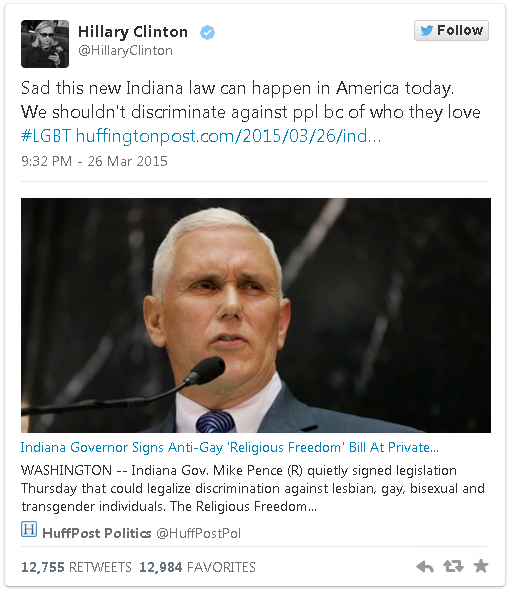
Hillary Clinton attacks Indiana’s religious liberty law

First, let’s take a look at what Jesus says about same-sex marriage.

Matthew 19:1-6:

1 Now when Jesus had finished these sayings, he went away from Galilee and entered the region of Judea beyond the Jordan.

2 And large crowds followed him, and he healed them there.

3 And Pharisees came up to him and tested him by asking, “Is it lawful to divorce one’s wife for any cause?”

4 He answered, “Have you not read that he who created them from the beginning made them male and female,

5 and said, ‘Therefore a man shall leave his father and his mother and hold fast to his wife, and the two shall become one flesh’?

6 So they are no longer two but one flesh. What therefore God has joined together, let not man separate.”

Now, let’s see some reactions to the Indiana law, which I explained in a previous blog post, from people on the secular left.

Hillary Clinton thinks that any arrangement of people who love each other is as good as any other:

Hillary Clinton opposes religious liberty

Her tweet implies support for incestuous relationships being “marriage” as well as polygamy. That is a direct logical implication of calling an arrangement of people who love each other “marriage”.

But she’s not the only one.

Marriage defender Ryan T. Anderson responds to Apple CEO Tim Cook in the Daily Signal.

He writes:

Apple CEO Tim Cook has taken to The Washington Post to tell the nation that, in the words of the headline, “Pro-discrimination ‘religious freedom’ laws are dangerous.”

Notice the scare quotes around “religious freedom.” But the reality is that the only person in favor of discrimination in this debate is Tim Cook.

It is Tim Cook who favors laws that discriminate against people of faith who simply ask to be left alone by government to run their businesses and their schools and their charities in accordance with their reasonable belief that marriage is the union of a man and a woman. It is Tim Cook who would have the government discriminate against these citizens, have the government coerce them into helping to celebrate a same-sex wedding and penalize them if they try to lead their lives in accordance with their faith.

[…]As Sarah Torre and I explained last week, Indiana’s religious freedom law protects citizens from government coercion—it places the burden of proof on the government if it is going to violate liberty. For over 20 years, the federal government has lived by this standard—the Religious Freedom Restoration Act  passed unanimously in the House, with 97 votes in the Senate, and was signed into law by Bill Clinton. Twenty states have passed this law. And 11 additional states have religious liberty protections that state courts have interpreted to provide a similar level of protection.

So, in total, the federal court system and 31 state court systems enforce this level of protection. Why is Tim Cook suddenly opposed to it?

The answer is simple: This isn’t a debate about Religious Freedom Restoration Acts. This is a debate about whether Americans should remain free to live in accordance with the truth about marriage in their public lives. This is a debate about whether or not the government should be able to coerce people into violating their belief that marriage is the union of a man and a woman.

This is what the Indiana law is suppose to defend against:

Again, it’s not a slam dunk – all it says is that when a secular big government sues a person of any religion to force them to deny their faith, then religious liberty can be brought in as part of their defense during their day in court. By the way, always vote for smaller government, then these things don’t even happen because marriage, family and private businesses are less regulated.

How is the law applied?

This article from The Federalist lists 10 examples of how religious freedom laws have been applied.

Here’s one:

7) Muslim prisoner fights to wear short beard: Abdul Muhammad
Abdul Muhammad is a Muslim incarcerated in Arkansas. He was not allowed to grow the 1/2 inch beard his religion commands even though Arkansas permits beards for other reasons. And the same beard would have been allowed in 44 state and federal prison systems in the country. In 2011, he filed suit. He won the suit using the “RFRA for prisoners” — the Religious Land Use and Institutionalized Persons Act. That bill was also signed by Bill Clinton.Earlier this year, Muhammad won his case unanimously at the United States Supreme Court. They held that he’d shown the restriction was a substantial burden on his religious exercise.

And:

9) Florida denies prisoners kosher meals: Bruce Rich

Bruce Rich is an Orthodox Jewish prisoner in Florida, one of the last remaining states in the country that doesn’t provide kosher food for Jewish prisoners. He argued this violates the Religious Land Use and Institutionalized Persons Act of 2000, RFRA for prisoners.

Florida claimed it limited food options to control costs and maintain security. The Becket Fund for Religious Liberty, which took Rich’s case, noted that 35 states and the federal government provided kosher meals without it posing a problem.

[…]Rich withdrew his case once Florida began providing the necessary meals.

Does this law sound like a free pass to discriminate against gays to you? It goes to trial, and religious liberty is part of the defense that the judge considers.

Look at this opinion from another Indiana law professor:

I should stress–and this point was totally lost in the Indiana debate–that RFRA does not provide immunity. It only allows a defendant to raise a defense, which a finder of fact must consider, like any other defense that can be raised under Title VII or the ADA. RFRA is *not* a blank check to discriminate.

Here’s another defense of the Indiana law by an Indiana University law professor who supports same-sex marriage.

You can read another analysis of the religious liberty law from Gabriel Malor, a gay conservative. Actually, I re-tweeted THREE gay conservatives who were in favor of the law yesterday (Gabriel Malor, Milo Yiannopoulos, and Gay Patriot).  This is not what you are hearing in the mainstream media, but is being used as a club to beat Christians into silence. And sadly, many younger evangelicals will respond to this and vote Democrat out of a lack of understanding of the issues.