Tag Archives: Republican

Social conservative hero James Dobson endorses Ted Cruz

Republican Senate candidate Ted Cruz

Remember how I was freaking out about Marco Rubio from the day he announced his candidacy for the Florida Senate seat? Well, I think that Ted Cruz is another Marco Rubio. He may even eclipse Marco Rubio.

And James Dobson likes him, too.

Excerpt:

Today, we are excited to announce that national pro-life, family values leader Dr. James Dobson is endorsing our Senate campaign.

In his endorsement announcement, Dr. Dobson said: “I’m pleased to endorse Ted Cruz for U.S. Senate because he’s exactly the kind of candidate we need to turn this country around. Religious freedom is under assault every day. We need leaders with the courage to stand strong for conservative values in this battle. Ted Cruz is such a leader—one who will not only vote his convictions in the Senate, but will also lead the fight to defend life, traditional marriage, and religious liberty.”

Dr. Dobson added: “Ted Cruz stands out among conservative leaders across the country today. He has a consistent record of standing up for faith, family, and freedom, and winning values battles on a national level….I urge all Texans who love life, family, faith, and freedom to not only vote for Ted Cruz, but to work hard for his campaign.”

Here’s an interview with Ted Cruz from non other than Robert Stacy McCain!

About Ted Cruz

George Will thinks that Republican candidate Ted Cruz is the man to replace Kay Bailey Hutchison in Texas.

Excerpt:

For a conservative Texan seeking national office, it could hardly get better than this: In a recent 48-hour span, Ted Cruz, a candidate for next year’s Republican Senate nomination for the seat being vacated by Republican Kay Bailey Hutchison, was endorsed by the Club for Growth PAC, FreedomWorks PAC, talk-radio host Mark Levin and Erick Erickson of RedState.com.

For conservatives seeking reinforcements for Washington’s too-limited number of limited-government constitutionalists, it can hardly get better than this: Before he earned a Harvard law degree magna cum laude (and helped found the Harvard Latino Law Review) and clerked for Chief Justice William Rehnquist, Cruz’s senior thesis at Princeton — his thesis adviser was professor Robert George, one of contemporary conservatism’s intellectual pinups — was on the Constitution’s Ninth and 10th amendments. Then as now, Cruz argued that these amendments, properly construed, would buttress the principle that powers not enumerated are not possessed by the federal government.

Robbie George??? Robbie George??? Holy snouts! That guy is one of the top academic pro-lifers. Every Christian apologist knows about Robbie George. It’s the law! Well, it isn’t. But it should be!

I continue:

At age 14, Cruz’s father fought with rebels (including Fidel Castro) against Cuba’s dictator, Fulgencio Batista. Captured and tortured, at 18 he escaped to America with $100 sewn in his underwear. He graduated from the University of Texas and met his wife — like him, a mathematician — with whom he founded a small business processing seismic data for the oil industry.

By the time Ted Cruz was 13, he was winning speech contests sponsored by a Houston free-enterprise group that gave contestants assigned readings by Frederic Bastiat, Friedrich Hayek and Ludwig von Mises. In his early teens he traveled around Texas and out of state giving speeches. At Princeton, he finished first in the 1992 U.S. National Debate Championship and North American Debate Championship.

As Texas’s solicitor general from 2003 to 2008, Cruz submitted 70 briefs to the U.S. Supreme Court, and he has, so far, argued nine cases there. He favors school choice and personal investment accounts for a portion of individuals’ Social Security taxes. He supports the latter idea with a bow to the late Daniel Patrick Moynihan, who said such accounts enable the doorman to build wealth the way the people in the penthouse do.

Regarding immigration, Cruz, 40, demands secure borders and opposes amnesty for illegal immigrants but echoes Ronald Reagan’s praise of legal immigrants as “Americans by choice,” people who are “crazy enough” to risk everything in the fundamentally entrepreneurial act of immigrating.

Ted Cruz has Republican life experiences: legal immigrant, fought communism, studied something that required actual work, founded a small business, etc. This is the prototypical Republican!

You can find out more about him on his positions page. I was interested in his stance on social issues, in particular.

Excerpt:

Ted Cruz has fought to protect innocent human life. He played a leading role in several important cases, including defense of the partial-birth abortion ban, parental consent laws, and prohibiting state funds from going to abortion. These cases have all been part of the ongoing effort to ensure that every child in America  receives the protection and respect he or she deserves.

  • Authored an amicus brief for 13 states, successfully defending the federal Partial Birth Abortion Ban Act. The ban was upheld 5-4 before the U.S. Supreme Court;
  • Authored an amicus brief for 18 states, successfully defending the New Hampshire parental notification law. The law was upheld 9-0 before the U.S. Supreme Court [note: this brief was awarded the Best Brief Award from the National Association of Attorneys General for U.S. Supreme Court briefs written in 2005-06];
  • Successfully defended Texas’s Rider 8, which prohibits state funds for groups that provide abortions, winning unanimously before the Fifth Circuit court of appeals.

Ted Cruz has worked hard in defense of traditional marriage, including his intervention in a case protecting Texas marriage laws. In addition, he has fought on the federal level to defend marriage between one man and one woman as the fundamental building block of society.

  • When a Beaumont state court granted a divorce to two homosexual men who had gotten a civil union in Vermont, Cruz, under the leadership of Attorney General Greg Abbott, intervened in defense of the marriage laws of the State of Texas, which successfully led to the court judgment being vacated;
  • Worked with Attorney General Abbott to send a letter to Congress in support of the federal Defense of Marriage Act.

He has lots of nice actions related to lots of conservative policies on that page. What a resume! Energy production, voter fraud prevention, border security, legal firearm ownership – you name it, this guy has been fighting for conservative principles. Like Michele Bachmann, (and unlike RINO Mitt Romney), he has actually tried to do pro-life and pro-marriage things. We don’t just have to take his word for it, he has the actions to prove his words. Just look at the list of issues on his page!
132 economists prefer the Republican job creation strategy

From John Boehner’s web site.

Excerpt:

House Speaker John Boehner (R-OH) today released a list of 132 American economists who believe the job creation strategy used in the House GOP Plan for America’s Job Creators will do more to boost private-sector job growth in America in both the near-term and long-term than the “stimulus” spending approach favored by President Obama.

“This list underscores the need for immediate action on the now-22 bipartisan jobs bills passed by the Republican-led House that are awaiting a vote in the Democratic-controlled Senate,” Boehner said.  “All 22 of these bills passed the House with bipartisan support, but to date have not been brought to a vote by Senate Democrats.  To help support job creation in both the short-term and long-term, we need bipartisan action to halt unnecessary government regulations and fix the tax code to help private-sector job creators.  Our plan does that.  The Senate needs to pass these 22 bills and send them to the president’s desk.” 

Last month, Boehner asked a group of economists across the nation: which do you believe is more likely to provide a boost for private-sector job growth in America in both the near- and long-term: a plan focused on billions of dollars in additional “stimulus” spending by government – or a plan focused on halting excessive government regulations and fixing the tax code to help private-sector job creators?  A total of 132 economists indicated they clearly favor the latter strategy.  The list of 132 economists includes experts from Stanford University’s Hoover Institution, Carnegie Mellon University, and Harvard University; economists from the American Enterprise Institute (AEI), the Manhattan Institute, and the American Action Forum; and many others.

On Friday, in response to the U.S. Department of Labor’s announcement that October 2011 marked the 33rd consecutive month in which the national unemployment rate exceeded eight percent, Boehner asked President Obama to prod the Democratic-controlled Senate for action on the stalled jobs bills.  Boehner and other Republicans have called for President Obama to be more engaged in the legislative process this fall and less focused on his re-election campaign.

“I urge the president to call on Senate Democrats to bring these common-sense jobs bills to a vote,” Boehner said.  “As long as these bipartisan jobs bills are stalled in the Senate, it is unacceptable for the White House to be anything less than 100 percent engaged in the legislative process.”

Here’s the plan:

Empower Small Business Owners and Reduce Regulatory Burdens:

  • Require congressional review and approval of any government regulations that have a significant impact on the economy or burden small businesses.
  • Audit existing and pending regulations to identify and address those that hinder economic growth.

Fix the Tax Code to Help Job Creators:

  • Increase American competitiveness to spur investment and create more American jobs by streamlining the tax code and lowering the tax rate for businesses and individuals including small business owners to no more than 25%.
  • Reform the tax code to allow American businesses to bring back their overseas profits without having to pay a tax penalty so they can invest in our economy and create American jobs.

Increase Competitiveness for American Manufacturers:

  • Pass the three pending free trade agreements with Colombia, Panama, and South Korea to create up to 250,000 jobs.
  • Continue to open new markets to American made products. Encourage Entrepreneurship and Growth:
  • Modernize our patent system to protect our nation’s innovators, discourage frivolous lawsuits, and expedite patent reviews.
  • Re-Authorize and improve federal programs and approval processes to streamline development of new products.
  • Remove barriers to building a first class workforce so that the United States can compete in the global marketplace and lead the way in technological development and growth.

Maximize Domestic Energy Production to Ensure an Energy Policy for the 21st Century:

  • Promote lower energy prices through increased domestic production.
  • Encourage all forms of energy production.
  • Pay Down America’s Unsustainable Debt Burden and Start Living Within our Means:
  • Build upon the House Republicans’ Budget by enacting significant spending cuts.

And they already passed about 20 bills through the House with bipartisan support.

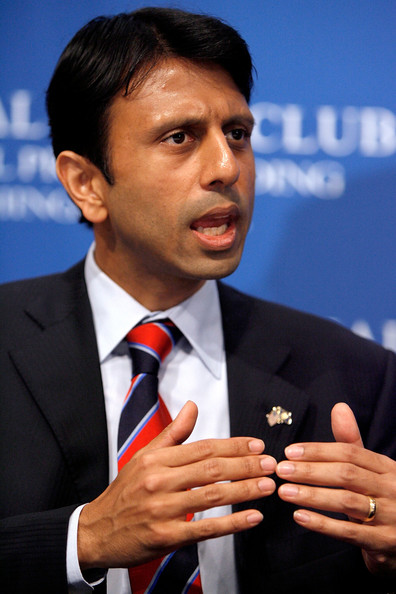
Bobby Jindal cuts Louisiana budget by 25%… and gets re-elected in landslide?

Gov. Bobby Jindal
Gov. Bobby Jindal

From the Philadelphia Inquirer.

Excerpt:

One gubernatorial election ended early this fall, when Louisiana Gov. Bobby Jindal won the state’s blanket primary Oct. 22. Under Louisiana’s system, all candidates of all parties are listed on the ballot, and if no one gets 50 percent, the top two finishers go to a runoff. Jindal blew past the threshold with 66 percent.

Jindal’s reelection was unusual in several respects. The only previous time the state has not had a runoff was his election in 2007. He is only the fourth Republican governor in the last 125 years in Louisiana, and one of those four switched over from the Democrats in office. Jindal’s best-known challenger this year was a schoolteacher, who raised less than 1 percent of the incumbent’s campaign treasury. The Democratic State Central Committee declined to endorse any candidate running on its party label.

But perhaps most unbelievable is that Jindal faced no serious competition after cutting state spending more than 25 percent. In January 2008, the state had a budget of $34.3 billion. This summer, Jindal signed into law a budget spending $25 billion. As governors from Harrisburg to Trenton to Columbus to Madison have learned, cutting a state’s budget is difficult enough; doing so without a significant backlash seems a politically impossible task.

A key part of Jindal’s story is recognizing that he took the helm of a state that had hit bottom: Decades of mismanagement and corruption had taken their toll even before Hurricane Katrina wreaked such devastation and exposed such colossal unresponsiveness in state government. The state, recognizing the bitter fruit of its traditions of colorful corruption, was ready to take a chance on a then-37-year-old Indian American congressman who speaks roughly 100 words per minute. The state was willing to try a new approach to governing; how much worse could it be?

Privatization played a big role in Jindal’s reinvention of state government, with private contractors taking over state-run operations for a lesser cost. The companies often hired the state workers who would often be the centerpiece of opponents’ criticism.

His administration privatized the state’s Office of Risk Management. Then the state’s Division of Administration privatized claims management and loss prevention in the self-insurance program, saving $20 million over five years. The Department of Health and Hospitals privatized six inpatient, residential-treatment programs around the state, saving $2.5 million. Separately, patients were moved from state-operated institutions that cost $600 or more per patient per day to community-based services and private group homes that average $191 per day, saving an additional $23.8 million.

Consolidation was another key element: The state’s Department of Revenue shrank from eight offices statewide to three. The Department of Children and Family Services consolidated its offices from 157 to 90, saving a total of $2.7 million.

But some of Jindal’s cuts are the old-fashioned kind. The state sold 1,300 vehicles from its fleet of automobiles. Louisiana’s Transportation Department shut down a ferry that was used by only 7,200 drivers per year, saving the state roughly three-quarters of a million dollars.

In fiscal 2011, Louisiana eliminated more than 3,500 full-time government positions. Add the 6,363 previous reductions during Jindal’s term, and that means a total of almost 9,900 full-time positions reduced since he took the oath, a savings of almost $600 million. Louisiana now has the lowest level of full-time state government employees in almost 20 years.

“You change people’s expectations and you make structural changes,” Jindal said, while racing around the state about three weeks before the election. “The most important is this cultural change, to say government is not the answer to everything. In a weird way, I want the office of governor to be less important than it is. What I mean by that is, there was an old joke that kids in Louisiana don’t grow up wanting to be president; they grow up wanting to be governor. You should want them to want to business leaders or doctors or teachers.”

Some cuts were more noticeable to the public, but Louisianans found shorter hours and workweeks at state facilities more palatable than complete shutdowns or higher taxes: Historic sites are now open five days a week instead of seven, pools at a half dozen state parks were closed on Mondays and Tuesdays this summer, and entrance stations at all state parks had shorter hours. Finally, 54,000 rank-and-file state workers are going without a raise for the second consecutive year.

Jindal’s first term was marked by several high-profile crises he successfully managed – Hurricane Gustav and the response to the BP oil spill, along with the Obama administration’s six-month moratorium on all drilling in the Gulf of Mexico – but the state’s economy has generally chugged along: Louisiana’s unemployment rate is 7.1 percent, two percentage points lower than the national average, and a comparably booming economy makes cuts in state spending much easier to take.

“If you have a good-paying job with benefits, you wouldn’t need the state to do so many things for you,” Jindal says. “You become less dependent, and that diminishes the role of the state and so you need fewer state employees, and it’s a virtuous cycle. You can lower taxes and lower government spending.”

Louisiana is a swing state. If Bobby Jindal can cut government spending in a swing state and get re-elected with 66% of the vote, then we do have hope that the American people will do the right thing. Maybe we just need to hit bottom with Obama so that we realize that competence does matter after all. We have a deep, deep bullpen for future elections. Governors like Scott Walker (Wisconsin), Rick Scott (Florida) and John Kasich (Ohio)would be excellent presidential candidates.  And of course we have Marco Rubio and soon-to-be senators Josh Mandel and Ted Cruz waiting in the wings.