Tag Archives: Religious Pluralism

Christian apologists sue City of Dearborn and Carleton University

First, the evil city of Dearborn, Michigan is being sued.

Excerpt:

If you’ve been following this blog for the past two years, you’ve seen Muslim security guards assault our sister Mary Jo Sharp at the Dearborn Arab Festival. You’ve seen Dearborn’s own Corporal Kapanowski assault our sister Negeen. You’ve seen falsified police reports, written by corrupt police officers trying to justify their unlawful arrests. You’ve seen police officers (who take an oath that they will support and defend the Constitution) take us into custody for attempting to hand out copies of the Gospel to Muslims outside the festival. You’ve seen lies from the Mayor, lies from police, and even lies from Christians trying to curry favor with the local Muslims.

For a complete summary of our experience in Dearborn, click here.

Enough is enough. Today, the Thomas More Law Center filed a massive 96-page Complaint against the City of Dearborn. Mayor John B. O’Reilly, Police Chief Ronald Haddad, seventeen Dearborn police officers, and two members of the Arab Chamber of Commerce are officially being sued. If the City of Dearborn refuses to honor the U.S. Constitution, we hope this lawsuit will help persuade them that, so long as Michigan is part of the United States, they have no choice in the matter.

Of course, the City of Dearborn is no stranger to civil rights lawsuits. A Christian wrestling coach sued the City after he was targeted for his faith by a Muslim principal. (The City settled out of court.) Two more Christian teachers at a majority Muslim high school are now suing after being targeted and persecuted for their faith.

And what about Carleton University in Ottawa, Canada?

Excerpt:

Members of an anti-abortion group at Carleton are suing the university for discrimination.

The $225,000 lawsuit filed in Ontario Superior Court Feb. 18 by Carleton students Ruth Lobo and John McLeod claims the university breached its own human rights policies and procedures by refusing to let a campus club called Carleton Lifeline set up a controversial display featuring large images of aborted fetuses and genocide atrocities in the Tory Quad, a high-traffic square at the centre of campus (university officials offered the group space at a different spot).

Claiming the university was trying to censor its message by suggesting the group set up its displays in an alternative location, Carleton Lifeline attempted to set up its display in Tory Quad last October and were arrested by Ottawa police and campus security.

“Carleton University’s decision to have Carleton Lifeline arrested, charged with trespassing and fined was excessive, unjustified and constituted an attempt to bully, intimidate and censor them,” the statement of claim says.

The lawsuit names the university, its president Roseann O’Reilly Runte and three other senior officials.

[…]Lobo, a human-rights major, and McLeod, who’s studying business, claim Carleton breached its fiduciary duty to provide them with a free and open campus environment to discuss and debate controversial ideas and, through its actions, stripped them of their freedom of expression and freedom from discrimination.

As a result, the students say their grades and reputations have suffered.

“Their university experience has been tarnished, their reputation, individually and as a group, has suffered and they have lost their trust in Carleton University’s professors and administrators,” the lawsuit claims.

The pair also claim being arrested and detained last fall infringed on their rights under the Canadian Charter of Rights and Freedoms.

They are seeking $100,000 in general damages for wrongful arrest and pain and suffering, $100,000 for punitive damages and $25,000 for the Charter violations.

I have an idea. Let’s make more children into Christian lawyers. And then let’s make them work for the Alliance Defense Fund, the Thomas More Law Center, the Homeschool Legal Defense Association, American Center for Law and Justice, The Becket Fund for Religious Liberty, Institute for Justice, etc. Yes, I know – the children won’t like it. They will prefer to play Nintendo and go to the movies with their annoying friends, (the same as what I wanted when I was a spoiled little brat!). But who cares what they think?
What happens to people who never hear about Jesus and the gospel?

One of the most difficult questions for Christians to answer, especially when posed by adherents of other religions, is the question of what happens to those who have never heard of Jesus? In this post, I will explain how progress in the field of philosophy of religion has given us a possible (and Biblical) solution to this thorny question.

First, Christianity teaches that humans are in a natural state of rebellion against God. We don’t want to know about him, and we don’t want him to have any say in what we are doing. We just want to appropriate all the gifts he’s given us, do whatever we want with them, and then have eternal bliss after we die. We want to do whatever we want and then be forgiven, later.

Along comes Jesus, who, through his sinless life and his death on the cross, heals that rift of rebellion between an all-good God and rebellious man. Now we have a real understanding of the fact that God is real, that he has power over death, and that he has very specific ideas on what we should be doing. If we accept Jesus’ atoning sacrifice and follow his teachings, we can avoid the penalty of our rebellion.

The only problem is that in order to appropriate that free gift of reconciliation, people need to actually know about Jesus. And there are some people in the world who have not even heard of him. Is it fair that these other people will be sent to eternal separation from God, just because they happened to be born in the wrong place at the wrong time?

Enter William Lane Craig to save the day. His solution is that God orders the world in such a way that anyone who would freely choose to acknowledge Jesus and appropriate his teachings in their decision-making will be given eternal life. God knows in advance who would respond, and chooses their time and place of birth, and he supplies them with the amount of evidence they need.

And this agrees with what the Bible teaches. The apostle Paul says this in his apologetic on Mars Hill in Acts 17:22-31:

22 So Paul stood in the midst of the Areopagus and said, “Men of Athens, I observe that you are very religious in all respects.
23 “For while I was passing through and examining the objects of your worship, I also found an altar with this inscription, ‘ N D ‘ Therefore what you worship in ignorance, this I proclaim to you.
24 “The God who made the world and all things in it, since He is Lord of heaven and earth, does not dwell in temples made with hands;
25 nor is He served by human hands, as though He needed anything, since He Himself gives to all people life and breath and all things;
26 and He made from one man every nation of mankind to live on all the face of the earth, having determined their appointed times and the boundaries of their habitation,
27 that they would seek God, if perhaps they might grope for Him and find Him, though He is not far from each one of us;

28 for in Him we live and move and exist, as even some of your own poets have said, ‘For we also are His children.’
29 “Being then the children of God, we ought not to think that the Divine Nature is like gold or silver or stone, an image formed by the art and thought of man.
30 “Therefore having overlooked the times of ignorance, God is now declaring to men that all people everywhere should repent,
31 because He has fixed a day in which He will judge the world in righteousness through a Man whom He has appointed, having furnished proof to all men by raising Him from the dead.”

In this research paper, Craig explains in detail how God foreknows how people will choose in every set of circumstances, and how God uses that knowledge to get everyone where they need to be without violating their free will. God wants the best for everybody, and has ordered to whole universe in order to give each of us our best opportunity for eternal life.

Here is a summary of the what is in his paper:

The conviction of the New Testament writers was that there is no salvation apart from Jesus. This orthodox doctrine is widely rejected today because God’s condemnation of persons in other world religions seems incompatible with various attributes of God.

Analysis reveals the real problem to involve certain counterfactuals of freedom, e.g., why did not God create a world in which all people would freely believe in Christ and be saved? Such questions presuppose that God possesses middle knowledge. But it can be shown that no inconsistency exists between God’s having middle knowledge and certain persons’ being damned; on the contrary, it can be positively shown that these two notions are compatible.

Go read this paper and equip yourself to answer this common question!

And now I want to close by making a general point. There are two kinds of people in the world. The first kind encounters problems, like the hiddenness of God, or the problem of evil, the problem of Cookie monster objections (thanks, Truthbomb!), or religious pluralism, and they respond by leveraging that problem in order to justify rejecting God and going their own way.

Even uninformed Christians read books like “The Da Vinci Code”, and avoid the arguments and evidence that would defeat the objections raised by that book. Why? They want to be lazy, or to fit in, or to pursue pleasure apart from God. This is because if we don’t know that God is real for certain then we won’t feel rationally compelled to be good. And that’s why many Christians go out of their way not to find out the truth about these thorny problems.

And doubts also relieve us of the burden of evangelizing. Uninformed Christians know that their doubts give them freedom to keep silent about God, so they can get along with non-Christians. They think that keeping the truth about God to themselves, and not being ready and available to answer questions, is loving. But it’s really just selfishness. It doesn’t help non-Christians to keep the truth from them.

So why do some Christians hide the truth from others? It’s because they really do not believe that God will exclude people based on their beliefs about Him, even though Jesus says so in many places. Deep down, we believe that God’s purpose for humans is to be happy. When Christians don’t try to find answers to difficult questions like religious pluralism, they end up softening the Bible’s exclusive claims based on their emotions.

This is not what ambassadors are supposed to do – we are not free to make up our own doctrines and then lie to people in order to be happy and popular.

The second group is willing to spend time and effort to assess whether science, history, philosophy, etc. support Christianity. This kind of person is willing to go where the evidence leads. They don’t jump on doubts and use them to justify disobedience. They are willing to be public (i.e. – “divisive”) about their faith and put God first, above worldly goals, like popularity.

The whole point of life is for God to draw people to himself in a two-way relationship. He reveals himself a little, and we respond and pursue him. How about you? Do you want to know for certain whether God is real? Are you willing to give up everything to follow him? Or would you rather that God just keep out of your busy life and your subjective purposes in the world?

UPDATE: A related post over at Tough Questions Answered on whether Jesus is required to be rightly related to God and to get eternal life.

India Supreme Court exonerates eleven Hindus who murdered three Christians

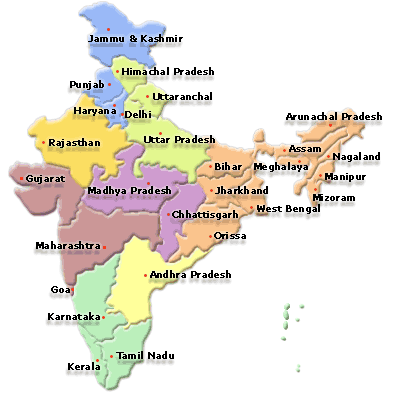
Map of India
Map of India

First, let’s hear about an anti-Christian crime that occurred in Orissa, the most anti-Christian area in India.

Excerpt:

The Central Bureau of investigation (CBI) wanted the death penalty for Singh, who was linked to extreme right-wing Hindu group Bajrang Dal. The GCIC has opposed the request for a death sentence. The wife of the slain pastor, Gladys Staines, had already forgiven Dara and his accomplices involved in the brutal murder of her husband and children. (20/01/2009 Widow of Graham Staines: “Do not give up hope, pray for India”).

Twelve years ago, Graham Staines was burnt alive with his children aged eight and ten years in the small village of Manoharpur, in the tribal area of Orissa. Graham Staines had worked for thirty years with leprosy patients in Orissa, and was sleeping with his children in a car, on his journey home on a cold December night. A group of attackers poured petrol on the car, and burned them alive.

The Staines tried to escape, but the assailants, fifty in all, prevented them. A witness said the attackers shouted slogans in praise of Dara Singh, the Hindu movement and the god Hanuman.

In 2003 a court in Khurda judged all 13 accused guilty. Life in prison for everyone else, a death sentence for Dara Singh. In 2005, the Orissa High Court commuted the death penalty to life imprisonment, judged Hembran guilty and exonerated the others.

Shalini sent me this story about how the Supreme Court upheld the High Court’s decision.

Excerpt:

Dara Singh killed Australian missionary Graham Staines and his two minor sons by setting fire to the vehicle in which they were sleeping, but the Supreme Court on Friday ruled that it was not a “rarest of rare” category crime to warrant death penalty for him.

In a judgment drawing curtains on court proceedings in the sensational incident of January 1999, a bench of Justices P Sathasivam and B S Chauhan upheld the Orissa High Court judgment imposing life sentence on Singh alias Rabindra Kumar Pal and Mahendra Hembram. The trial court had awarded death penalty to Singh.

The bench said the Orissa HC was justified in awarding life term to Singh and Hembran as the crime was committed in the passion to teach Staines a lesson for his alleged attempts to convert tribals.

“Though Graham Staines and his two minor sons were burnt to death while they were sleeping inside a station wagon at Manoharpur, the intention was to teach a lesson to Staines about his religious activities, namely, converting poor tribals to Christianity,” it said.

“All these aspects have been correctly appreciated by the high court and modified the sentence of death into life imprisonment with which we concur,” the bench said.

Justice Sathasivam, writing the judgment for the bench, also dismissed the CBI`s appeal challenging the HC`s decision to acquit 11 other accused. “We have highlighted the weakness and infirmities of the prosecution case insofar as acquitted accused, who are poor tribals,” he said. The CBI had taken over the probe from Orissa Police on May 3, 1999.

“In the absence of definite assertion from the prosecution side about their specific role and involvement, it is not safe to convict them. We entirely agree with the reasoning and conclusion of the high court,” it said.

While condemning killings in the name of religion, the bench also expressed its disapproval of conversion. “It is undisputed that there is no justification for interfering in someone`s belief by way of `use of force`, provocation, conversion, incitement or upon a flawed premise that one religion is better than the other,” said the bench.

This story is interesting because it shows how the pluralist view that “all religions are valid” can actually lead to violence. The pluralist view is itself a point of view that takes itself to be true. Pluralists think that religions like Christianity, which claim to be true, are actually FALSE. In short, pluralism DOES disagree with Christianity. If disagreement with other religions is bad, then pluralists are just as guilty of being bad as Christians.

Is what they say about Christians being “exclusive” true? Does being “exclusive” make Christians dangerous? Well, the reason why the practice of Christianity DOES NOT result in violence is because part of the “truth” that Christians believe is that they should love their enemies and pray for the people who persecute them. That’s why the victim’s wife forgave the murderers for their crimes.

I actually have Hindus and Muslims in my family. They treat religion as a cultural or national identity – not really something to investigate to see if it is true or false. Hindus are not usually Hindus because they did some big investigation and found Hinduism to be true. (Hinduism requires an eternally oscillating cosmology, which contradicts physics and the Big Bang theory). It’s more like that they do it for personal reasons or community reasons – it’s like part of their national/cultural identity.

Why do some Hindus oppose evangelism?

A while back I posted this debate featuring a Hindu who disagreed with Christian evangelism and wanted to make it illegal. He complained about Christians using “force” (being kind and giving gifts) to convince people to become Christians. In the next breath he was pushing the government to use force his anti-Christian views onto Christians. He did not want them to evangelize, so he wanted to pass that view into law and force his neighbors to accept HIS views by force. He thought his view of Christianity and evangelism was TRUE, and he thought the traditional, Biblical Christian view was false. He actually insisted that his interpretation of the Bible was correct and all the Christian theologians were misinterpreting the Bible. He expected Christians to act like Hindus! And he thought that Christianity WAS Hinduism – or that it should be redefined to be understood to be Hinduism. Then he complained about Christians who thought that their views were TRUE and that his were FALSE.

The difference between Christians and Hindus is that committed Christians think they are right and use ideas and words to persuade, while militant Hindus think they are right and are willing to use force to make people agree with them. I think the difference is that a Christian can appeal to facts like the Big Bang theory, and the Hindu cannot really do that, as this Hindu commenter to another post showed.

I really recommend that you listen to that debate, and there is a play-by-play summary that I wrote in case the bandwidth is too high. And read my exchange with the Hindu commenter, too.

Here is the major persecution story in Orissa that I blogged about before. And here’s another small story from Orissa that I found.