Tag Archives: Religious Liberty

In Ohio, faithful Jews and Christians can no longer serve as judges

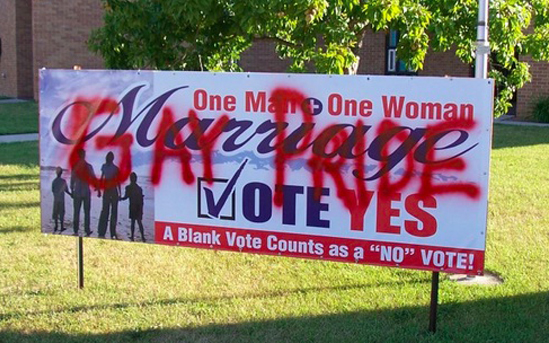
Gay activist vandalizes pro-marriage sign

For the past few decades, we have been able to see what happens when the Christian church decides that piety and feelings are more important than truth and evidence. Gradually, pastors decided to eliminate any discussion of apologetics as well as any integration between the Christian worldview and other areas of knowledge, e.g. – economics, politics, science. What were the consequences of this emotionalization of Christianity? Well, we basically handed the commanding heights of the culture to the secular left – including furnishing them with new soldiers from our own pious families.

Consider this article in The Stream about a recent decision by the Ohio Supreme Court.

It says:

The court’s Board of Professional Conduct was responding to a request submitted by several lawyers and judges, including C. Allen McConnell, a municipal court Judge whose predicament we addressedin “The ‘Soft’ Beginning of the Post-Obergefell Persecution.”

Judge McConnell said that as a Christian, he could not officiate at same-sex weddings. The Board of Professional Conduct of the Ohio Supreme Court said he must. In other words: Christians, check your faith at the bench or you may not serve as a judge in the state of Ohio.

It is helpful to go through the board’s opinion because it reveals how they will treat complaints filed against judges in the future. If a judge is the subject of a complaint filed by a lawyer, fellow judge or member of the public, the board reviews the complaint. They will apply the strained analysis of this opinion in determining whether to sanction, suspend or remove the judge from the bench.

In Ohio, judges are elected by the people, at every level, municipal, circuit court, appeals court or state Supreme Court. In many other states they are appointed. Where they are appointed there are growing efforts to weed out Christians. This advisory opinion presents a new way of removing Christians from the bench after the people have elected them to office.

In this seven-page opinion the Board claimed that there is a “self-evident principle that the personal, moral and religious beliefs of a judicial officer should never factor into the performance of any judicial duty.” In other words, Christians must check their faith at the bench if they serve as a judge in the state of Ohio.

So what we have now is a kind of “religious test” for judges. If you are a devout Christian or a devout Jew, then you can’t be a judge in Ohio. Only people reject the Judeo-Christian ethics that founded this country can be judges.

So, if we go back 50 years, what were the churches doing to stop this? Were they educating people in apologetics? Were they encouraging people to stay married? Were they educating people about feminism, the sexual revolution and no-fault divorce? Were they paying attention to cosmology and fine-tuning discoveries and making them known to the flock? Were they teaching people about how to think Christianly about economics, foreign policy, free enterprise, and so on? Were they steering young people towards areas that are related to apologetics? Were they steering young people towards careers that would place them in positions of influence? No. We had other priorities – making people feel good, and avoid controversy and conflict.

Brett Kunkle, who works for Stand to Reason, posted an interesting commentary that I tweeted earlier this week. He talks about grilling a bunch of Christian parents by pretending to be an atheist professor.

He writes this:

There was no surprise factor. The parents knew who I was and the Christian organization I represented. Indeed, I told the audience what I was about to do, turned my back on them for just a moment, and then turned round again in full atheist character. I jumped into my role and they jumped into theirs, attempting to defend the faith against atheist professor “Dr. Kunkle.” Sadly, they were ill-equipped to handle my challenges. I was glad to see their fighting spirit, but their responses were only vigorous in style, not substance. After half an hour, many parents were exasperated and I ended the role-play.

“How was that for you?” I asked. “Extremely frustrating,” was the immediate parental consensus.

“Why was it so frustrating?” I pressed. One mom blurted out, “Because I didn’t have any good answers.” As soon as the words left her mouth, tears began streaming down her cheeks. It was a painful recognition of her own inadequacy and she knew what was at stake. As I glanced around the room, other parents were nodding in agreement, eyes moist with their own tears.

Caught off guard, I began to tear up, too. I felt such compassion for these good-hearted yet unequipped parents. Quickly gathering my emotions, I looked that mom in the eyes and gently replied, “I know exactly how you feel. I felt that way, too, when Dr. David Lane was dismantling my Christianity in front of my peers, in my college philosophy class.” I told the parents my story and encouraged them to prepare themselves so, in turn, they can prepare their own kids.

Afterward, parent after parent thanked me. They expressed their deep appreciation for the wake-up call, despite the accompanying painful realizations. And the mom who burst into tears? She walked up and gave me a big hug. Then she shared how her 21-year-old son, a student at Duke University, had turned his back on Christ while at college. She was convicted to begin a dialogue with him, as well as with her second son, a junior at Village Academy. I encouraged her, shared some resources, and gave her my email address with an open invitation to contact me anytime.

Christian parents: we need to do what it takes so that OUR sons and daughters get on the Ohio Supreme Court. We need to be the ones making these decisions, not the people on the secular left. If you send your kid off to Duke University unprepared, you’re not doing a good job at parenting.
Colorado Court of Appeals rules that Christian must bake cakes for gay wedding

Gay activist vandalizes pro-marriage sign

This is from the Daily Signal.

Excerpt:

A custom cake baker in suburban Denver can’t cite his religious convictions in declining to make a wedding cake for two men, a Colorado appeals court ruled today.

“Cake artist” Jack Phillips said he gladly serves gays and lesbians in his family business. But, Phillips said, he could not in good conscience design a wedding cake for a same-sex couple when, as a Christian, he believes marriage is the union of a man and a woman.

A three-judge panel of the Colorado Court of Appeals ruled that not doing so amounts to illegal discrimination based on sexual orientation, Associated Press reported.

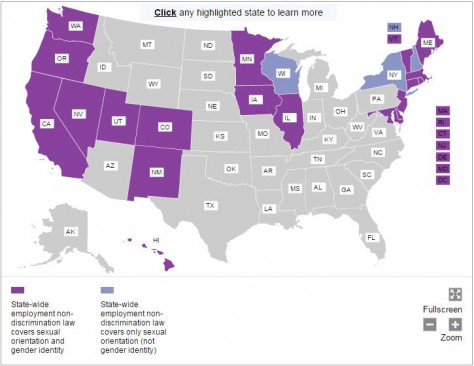
You’ll recall that Colorado is one of the states that does not recognize religious liberty as a human right:

States with non-discrimination laws

If you live in one of the non-gray states, you’re at risk.

What’s troubling to me about this is that Phillips was defended by Jeremy Tedesco of the Alliance Defending Freedom. He is a very capable religious liberty lawyer.

More:

The baker’s lawyer, Jeremy Tedesco, told The Daily Signal that the three judges “got it wrong on all counts” in a unanimous, 65-page opinion.

“He objects to the message, not to their protected status,” Tedesco said of the business owner’s attitude toward Charlie Craig and David Mullins, the two men who wanted him to design a wedding cake. “That’s not discrimination under the law.”

Tedesco, senior legal counsel with Alliance Defending Freedom, added:

Business owners have a right–especially when they’re engaged in expression, as our client is–to run their business in accordance with their beliefs. …When they’re engaged in expression, [they may] decline to create an expression that violates their convictions.

What’s interesting is that after being denied the cake, the gay couple easily went to another shop and got a cake. There was no harm done.

But that was not good enough for them, hence their decision to involve the state, and punish the Christian for choosing not to celebrate something he disagreed with.

Tedesco says that the baker should not be forced to say something that he violates his conscience:

As The Daily Signal reported, Tedesco argued that compelling Phillips to create a cake for the wedding of two men would violate his First Amendment rights not only to freedom of religion but also free speech or expression.

“The other side of the case thinks there are no First Amendment rights in the commercial context and once you open a business, you cede all First Amendment protections,” Tedesco told The Daily Signal after the hearing in Denver.

The ADF intends to appeal the case to the Colorado Supreme Court, and then to the Supreme Court of the United States. Unfortunately, since Obama won in 2008 and 2012, the Supreme Court is likely to rule against religious liberty. We’ll find out, I guess.

You can read more about Jeremy Tedesco here.

Kentucky bans pastor from prison ministry because he disagrees with homosexuality

Gay activist vandalizes pro-marriage sign

Yes, in Kentucky.

The Stream has the story.

Excerpt:

Like Christian ministers across the confessional spectrum, David Wells takes seriously the words of Jesus in the Gospel of Matthew: “I was in prison and you did not visit me.” Minister of evangelism of Pleasant View Baptist Church in McQuady, Kentucky, he has been visiting and mentoring juveniles in the Warren County Regional Juvenile Detention Center for 12 years.

Not any more. On July 7th, the Kentucky Department of Juvenile Justice (DJJ) revoked his volunteer credentials and permanently barred him from visiting, counseling or leading worship services for juveniles. He was found in violation of a newly revised departmental policy on “Sexual Orientation and Gender Identity” because he could not sign a state-mandated statement that he would not use the word “sinful” when talking about homosexuality. The policy states that volunteers:

shall not refer to juveniles by using derogatory language in a manner that conveys bias towards or hatred of the LGBTQI community. DJJ staff, volunteers, interns, and contractors shall not imply or tell LGBTQI juveniles that they are abnormal, deviant, sinful, or that they can or should change their sexual orientation or gender identity.

The acronym “LGBTQI” stands for “Lesbian, Gay, Bisexual, Transgender, Queer/Questioning, and Intersexed.”

I recommend reading the articles to get the details on the inmates, so that you see what they are in for, what their real problems are, and what it is that the pastor talks to them about.

But I want to skip to the end, which is about the conflict between the gay agenda (don’t offend me by saying that what I am doing is wrong, because it makes me feel bad) with the Constitutional right of religious liberty.

More:

The issue really isn’t the way Wells speaks to the juveniles he ministers to. The issue is what he says. In effect, the DJJ wants to remove the Bible from his hands. The policy equates the teaching of Biblical morality with derogatory and hateful speech.

Removing the Bible from a pastor’s hands is like taking a scalpel from the hands of a surgeon. The policy effectively deletes passages such as Romans 1:24-27, 1 Corinthians 6:9-10, and 1 Tim 1:10 from the New Testament. The words of Scripture are the gifts a pastor has to offer. He’s not there just to counsel the young people. He’s there to tell them the good news of Jesus Christ. That’s not hate speech, it’s love speech.

Wells is represented by Liberty Counsel. In a letter to the commissioner of the Kentucky Department of Juvenile Justice, Liberty Counsel explained that the new policy creates an unconstitutional religious test for access to the DJJ. The First Amendment prohibits the government from discriminating on the basis of viewpoint. This detention center may not prohibit the expression of biblical morality because DJJ policymakers object to the Bible.

That’s what the American Constitution says, but the authorities in other states and in federal and military prisons have begun imposing similar restrictions on religious speech. This may become one more aftershock of the Obergefell v Hodges decision. The homosexual equivalency movement wants to insert homosexual activity into the category of a protected class under State and Federal law in order to use the police power of the State against those who disagree with them. It’s one more example of a growing soft persecution underway in the United States.

I have been saying for some time that Christians have been really missing the boat by focusing on charity without theology. We are interested in being nice so we can be liked. We are not interested in telling the truth, so that we can be faithful. We spend all our money feeding hungry people and helping the poor and so on, and nothing is going to defend religious liberty – the freedom to actually treat what the Bible about God as real and serious – in public. Maybe instead of doing nice things, we can try to focus more on doing good things. We can start by not voting for secularists who charm us with their desire solve the world’s problems by redistributing wealth, and instead vote for people who promise to protect our religious liberty and our freedom of conscience. No more giving money to World Vision and the Boy Scouts of America and Susan G. Komen Race for the Cure. We have other things to think about now.