
Tag Archives: Relativism

Are all religions basically the same?

Lets take a closer look at a puzzle

So, everyone knows that there a huge number of different religions in the world. This is called religious pluralism. Some people infer from the large number of different religions that there must be no religion that is correct. After all, they say, there are people in many different religions who are sincere, so that must mean that they are not wrong. (Sincerity = not mistaken) Or, some say that because different religions disagree, then that must mean that no religion is correct. (Disagreement = no right answer) Or, some say that because different religions make different groups of people feel happy, then no religion is wrong. (Makes you happy = not mistaken) Or, one I see among Hindus a lot: “my family and my nation are Hindu, so it cannot be wrong or else my family and nation would be wrong”. (family pride and national pride = can’t be mistaken). There are probably other variants, but the common factor is this – religion is not like math or science or engineering or technology, where we do have right answers and wrong answers. Religion is something else – it’s more like clothing conventions, or culinary preferences, or taste in art or music. It’s more about a person’s likes and dislikes, not about claims being made about reality.

How should truth-seekers respond to religious pluralism?

The law of non-contradiction

To start with, we all need to be familiar with the law of non-contradiction. This is the stuff that software engineers all learned in undergraduate computer science courses. Computer science is a lot like analytical philosophy because both study symbolic logic. Analytical philosophy is as rigorous as mathematics.

The law says that for any proposition P, P cannot be true and not true at the same time, and in the same context. For example, let P be the statement “it is raining outside my window right now”. It is impossible that the reality of the world be that it is raining outside my window right now, and not raining outside my window right now.

The external world is shared by all of us, and it is objective (it is not affected by what we think about it). When we make propositional claims, it is the external, mind-independent world that makes claims true or false. And by “world” I mean all of reality, past, present and future.

Similarities between religions

On a superficial level, religions are similar because they all try to answer the same kinds of questions:

  • what is the nature of the ultimate reality in the universe?
  • what is the fundamental problem faced by human beings?
  • what should human beings do to solve this problem?

These questions are shared by all religions, but on a more fundamental level, religions are all completely different because they give mutually exclusive answers to these questions. Therefore, according to the law of non-contradiction, they cannot all be true at the same time and in the same context.

Differences between religions

In this post, blogger Neil explains how the Christian Bible claims that Jesus died on a cross, but the Koran claims he did not die on a cross. How do we understand these two contradictory claims? Are they propositional truth claims about the external world, or something else? There are two answers.

Postmodernism: Treating religious claims as subjective nonsense

We could say that all religious claims are just nonsense, and are not intended to apply to the external world, but are just personal preference claims about each believer – they are neither true nor false. The problem is that the postmodernist is then being condescending to the religious adherent by redefining their own words.

Rationality: Treating religions claims as genuine claims about reality

We could instead avoid insulting believers by being condescending about their claims. We could say that all religious claims are exactly what the believers claim they are: real claims about the external world. We could then resolve the conflicts using the same tools we use in our everyday lives: the laws of logic and empirical evidence.

How do postmodernists reinterpret religious claims as non-propositional?

Here are a few ways that postmodernists reinterpret the conflicting claims of different religions:

  1. relativism: you reinterpret truth claims of the different religions so that they are claims of personal preference, which express the deluded myths that each individual religious person finds “fetching”
  2. pragmatism: you reinterpret truth claims of the different religions so that they are claims of personal selfishness, so that each religious believer chooses the delusion that is personally satisfying to them
  3. syncretism: you re-interpret truth claims of the different religions so that claims that are absolutely central, such as “was Jesus God?” are reinterpreted as being peripheral issues, and then the religions can all agree on the core of religious belief, such as advocacy of socialism, global warming and abortion

Why would postmodernists want to treat religious claims as nonsense?

In addition to the desperate desire to keep God from having authority over our moral decision-making (i.e. – sin, rebellion, etc.), there are 3 reasons why people try to treat religious claims as non-propositional nonsense.

  1. Ignorance: people do not know the conflicting truth claims that different religions make
  2. Laziness: people do not want to have to spend time evaluating the competing truth claims
  3. Cowardice: people do not want to investigate and debate truth claims: it makes them unpopular

Postmodernists have decided that the purpose of life is to be hedonistic, and not to worry about the world really is. They think that trying to find out the truth about our origins, our purpose, and our ultimate fate is hard work, and talking about it makes them unpopular. So they don’t want to do it.

But that is not what they say when you ask them. Instead, they say that disagreements about religion has caused a lot of wars, and so it’s better if we just reduce the question of truth in religion to personal preference. That way, everyone can choose the delusion that makes them happy, (although religions are all actually false).

But postmodernists are arrogant to redefine the claims of all religions as nonsense. And it is self-refuting because they are substituting their own view of religion as objectively true, which is just what they deny everyone else. And if disagreeing about religion causes wars, then why are they disagreeing with us about religion?

So then how do we deal with the plurality of religions?

The answer is to treat religion the exact same way as any other area of knowledge. We can tolerate people’s right to disagree, disagree while still being polite, and resolving disputes using logic, and evidence supplied from disciplines such as analytical philosophy, scientific investigation, and historical analysis.

People who want to involve emotion and intuition in the process of testing the conflicting religious claims can just butt out of the conversation. The search for truth should proceed irrespective of what you think about the truth claims of religion. Yes, the doctrine of Hell offends people, but that doesn’t make it false.

Acknowledgement: I owe some of the thoughts in this post to the work of Douglas Groothuis, who is an expert on thinking about postmodernism and religious pluralism. You can hear his thoughts in a lecture posted at Apologetics 315.

Daughter of senior EU official raped and murdered by Afghan refugee

Maria Ladenburger, daughter of prominent EU official
Maria Ladenburger, daughter of prominent EU official, killed by Afghan refugee

The UK Daily Mail has the story about a tragic rape and murder that resulted directly from Angela Merkel’s open-borders immigration policy in Germany.

Excerpt:

A teenage Afghan asylum seeker has been arrested in Germany for the rape and murder of the 19-year-old daughter of a senior EU official.

Medical student Maria Ladenburger, who volunteered at a refugee home in her spare time, was found dead in the university city of Freiburg, near the border with Switzerland in mid October.

Her father is Dr. Clemens Ladenburger, a lawyer who works as the right hand man to the legal director of the European Commission.

It is unclear whether she ever met her murderer before he took her life.

The suspect has confessed to the murder, according to police. He was arrested on Friday and will go before the courts next year.

Maria was drowned after being raped, her body found in the River Dreisam on October 16.

[…]David Müller, head of the police’s Special Commission, said at a press conference: ‘Through interviews and a web-based survey, we were able to reconstruct Maria’s final hours.

‘The 19-year-old student had been at a party. By 2.37am, she left the party. Maria then cycled home, as usual.

‘The young woman had been the victim of a sexual offence and a violent crime.’

[…]Police are now trying to establish if he may also be responsible for the death of another girl in the area.

Carolin G., 27, was raped and murdered at the beginning of November while jogging in Endinge, just 18 miles away from Freiburg.

My parents would have killed me if I had been out at 2:37 AM in the morning, much less leaving a party. I’ve never even BEEN to a party filled with 19-year-olds. When I was 19, I was learning computer science and working two jobs.

Anyway, some people tell me that illegal immigrants and refugees from Muslim countries don’t commit crimes at a rate higher than other people. Is that true?

Breitbart News has the numbers from the U.S. Sentencing Commission.

Excerpt:

While illegal immigrants account for about 3.5 percent of the U.S population, they represented 36.7 percent of federal sentences in FY 2014 following criminal convictions, according to U.S. Sentencing Commission data obtained by Breitbart News.

According to FY 2014 USSC data, of 74,911 sentencing cases, citizens accounted for 43,479 (or 58.0 percent), illegal immigrants accounted for 27,505 (or 36.7 percent), legal immigrants made up 3,017 (or 4.0 percent), and the remainder (about 1 percent) were cases in which the offender was either extradited or had an unknown status.

Broken down by some of the primary offenses, illegal immigrants represented 16.8 percent of drug trafficking cases, 20.0 percent of kidnapping/hostage taking, 74.1 percent of drug possession, 12.3 percent of money laundering, and 12.0 percent of murder convictions.

Now a lot of those convictions will be related to immigration… what happens when we take those out?

The sentencing rate is still higher than normal:

Eliminating all immigration violations, illegal immigrants would account for 13.6 percent of all the offenders sentenced in FY14 following federal criminal convictions — still greater than the 3.5 percent of the population illegal immigrants are said to make up.

I don’t like it when supporters of open borders and taking in refugees make pious statements in public so they can feel good about themselves.  I think that they being generous with other people’s money, taking risks with other people’s lives. So often, politicians love to be generous with illegal immigrants and Muslim refugees. But they don’t pay the taxes for the education, health care, and increased law enforcement. Private sector employers and their workers pay those taxes.

I am very much in favor of expanding and streamlining immigration processes for skilled immigrants, especially for areas where there is more demand than supply. But I am not in favor of letting in refugees or other unskilled immigrants, especially if they will be eligible to collect benefits paid for by other working taxpayers.

The Daily Signal explains what the cost is:

On average, a nonelderly adult immigrant without a high school diploma entering the U.S. will create a net fiscal cost (benefits received will exceed taxes paid) in both the current generation and second generation. The average net present value of the fiscal cost of such an immigrant is estimated at $231,000, a cost that must be paid by U.S. taxpayers.

[…]Converting a net present value figure into future outlays requires information on the exact distribution of costs over time. That data is not provided by the National Academies.

However, a rough estimate of the future net outlays to be paid by taxpayers (in constant 2012 dollars) for immigrants without a high school diploma appears to be around $640,000 per immigrant over 75 years. The average fiscal loss is around $7,551 per year (in constant 2012 dollars).

Slightly more than 4 million adult immigrants without a high school diploma have entered the U.S. since 2000 and continue to reside here. According to the estimates in the National Academies report, the net present value of the future fiscal costs of those immigrants is $920 billion.

I think we need to draw a distinction between giving voluntarily to charity, and having money forcibly taken by a secular government to give to people whose votes they want to buy. Charity is Biblical. Taxing one group in order to buy the votes of others is socialism.

You can’t be “generous” by forcing a secular government to tax others to pay for your “generosity”. You can’t be “generous” by allowing innocent people to be raped and murdered for your “generosity”.

What percentage of Muslims approve of radical Islam and terrorism?

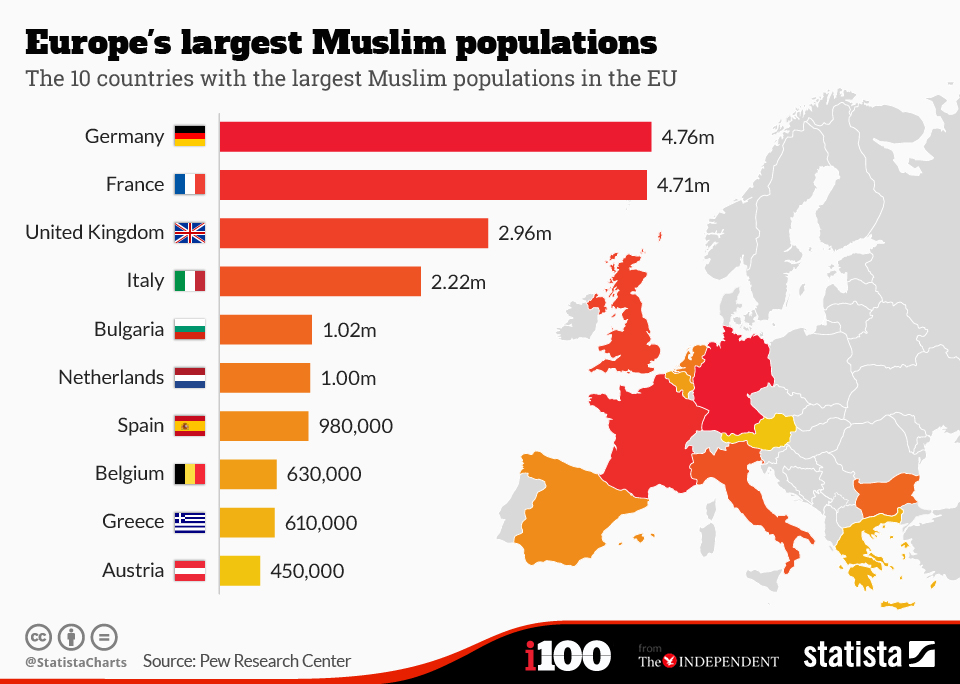
Muslim populations in Europe

Normally, when people ask me about this question, I go straight to the 2013 Pew Research survey which I blogged about before. But now I have something even better.

Here’s a post from Ben Shapiro at Breitbart News which looks at several polls from several different countries.

Shapiro writes: (links to polls removed)

So, here is the evidence that the enemy we face is not a “tiny minority” of Muslims, let alone a rootless philosophy unconnected to Islam entirely. It’s not just the thousands of westerners now attempting to join ISIS. It’s millions of Muslims who support their general goals, even if they don’t support the group itself.

France. A new, widely-covered poll shows that a full 16% of French people have positive attitudes toward ISIS. That includes 27% of French between the ages of 18-24. Anne-Elizabeth Moutet of Newsweek wrote, “This is the ideology of young French Muslims from immigrant backgrounds…these are the same people who torch synagogues.”

Britain. In 2006, a poll for the Sunday Telegraph found that 40% of British Muslims wanted shariah law in the United Kingdom, and that 20% backed the 7/7 bombers.Another poll from that year showed that 45% of British Muslims said that 9/11 was an American/Israeli conspiracy; that poll showed that one-quarter of British Muslims believed that the 7/7 bombings were justified.

Palestinian Areas. A poll in 2011 showed that 32% of Palestinians supported the brutal murder of five Israeli family members, including a three-month-old baby. In 2009, a poll showed that 78% of Palestinians had positive or mixed feelings about Osama Bin Laden. A 2013 poll showed 40% of Palestinians supporting suicide bombings and attacks against civilians. 89% favored sharia law. Currently, 89% of Palestinians support terror attacks on Israel.

Pakistan. After the killing of Osama Bin Laden, the Gilani Foundation did a poll of Pakistanis and found that 51% of them grieved for the terrorist mastermind, with 44% of them stating that he was a martyr. In 2009, 26% of Pakistanis approved of attacks on US troops in Iraq. That number was 29% for troops in Afghanistan. Overall, 76% of Pakistanis wanted strict shariah law in every Islamic country.

Morocco. A 2009 poll showed that 68% of Moroccans approved of terrorist attacks on US troops in Iraq; 61% backed attacks on American troops in Afghanistan as of 2006. 76% said they wanted strict sharia law in every Islamic country.

Jordan. 72% of Jordanians backed terror attacks against US troops in Iraq as of 2009. In 2010, the terrorist group Hezbollah had a 55% approval rating; Hamas had a 60% approval rating.

Indonesia: In 2009, a poll demonstrated that 26% of Indonesians approved of attacks on US troops in Iraq; 22% backed attacks on American troops in Afghanistan. 65% said they agreed with Al Qaeda on pushing US troops out of the Middle East. 49% said they supported strict sharia law in every Islamic country. 70% of Indonesians blamed 9/11 on the United States, Israel, someone else, or didn’t know. Just 30% said Al Qaeda was responsible.

Egypt. As of 2009, 87% of Egyptians said they agreed with the goals of Al Qaeda in forcing the US to withdraw forces from the Middle East. 65% said they wanted strict sharia law in every Islamic country. As of that same date, 69% of Egyptians said they had either positive or mixed feelings about Osama Bin Laden. In 2010, 95% of Egyptians said it was good that Islam is playing a major role in politics.

United States. A 2013 poll from Pew showed that 13% of American Muslims said that violence against civilians is often, sometimes or rarely justified to defend Islam. A 2011 poll from Pew showed that 21 percent of Muslims are concerned about extremism among Muslim Americans. 19 percent of American Muslims as of 2011 said they were either favorable toward Al Qaeda or didn’t know.

In short, tens of millions of Muslims all over the world sympathize with the goals or tactics of terrorist groups – or both. That support is stronger outside the West, but it is present even in the West. Islamist extremism is not a passing or fading phenomenon – it is shockingly consistent over time. And the West’s attempts to brush off the ideology of fanaticism has been an overwhelming failure.

A more recent poll says that 13% of Syrian refugees support Islamic State:

A first-of-its-kind survey of the hordes of Syrian refugees entering Europe found 13% support the Islamic State. The poll should raise alarms about the risks posed by the resettlement of 10,000 refugees in the U.S.

The poll of 900 Syrian refugees by the Arab Center for Research and Policy Studies also found that another 10% of the displaced Syrians have a lukewarm, but not entirely negative, view of the terror group. That means 23% — or almost 1 in 4 — could be susceptible to ISIS recruitment.

It also means as many 2,500 of the 10,000 Syrian refugees that the Obama administration is resettling inside American cities are potential terrorist threats.

Now contrast those facts with the views of Barack Obama and his allies in the mainstream media.

That video is from The Weekly Standard, here’s the text:

President Obama told CNN’s Fareed Zakaria that 99.9 percent of Muslims reject radical Islam. He made the comments in response to a question about the White House avoiding using the phrase “Islamic terrorists.”

“You know, I think that the way to understand this is there is an element growing out of Muslim communities in certain parts of the world that have perverted the religion, have embraced a nihilistic, violent, almost medieval interpretation of Islam, and they’re doing damage in a lot of countries around the world,” said Obama.

“But it is absolutely true that I reject a notion that somehow that creates a religious war because the overwhelming majority of Muslims reject that interpretation of Islam. They don’t even recognize it as being Islam, and I think that for us to be successful in fighting this scourge, it’s very important for us to align ourselves with the 99.9 percent of Muslims who are looking for the same thing we’re looking for–order, peace, prosperity.”

So Obama denies all of these surveys, and instead invents a view of the world that is consistent with his feelings. A true man of the secular left.

This gap between belief and reality explains why he is now bringing 200,000 Syrian Muslim refugees into America, keeping Syrian Christian refugees out of America, and generally underestimating Islamic State (ISIS / ISIL) because he cannot believe that radical Islam is anything for us to be concerned about.

Is the government capable of vetting Syrian refugees to find threats?

Not so much:

The administration argues that it’s conducting interviews with Syrians at camps in Turkey, Jordan and Lebanon. But without security forces on the ground in Syria who can verify details, there is no way to back-check a refugee’s story to see if he is telling the truth and is, in fact, not a security threat.

Even when we had people on the ground in Iraq to screen refugees, terrorists got through the safety net.

In 2011, for instance, two Kentucky immigrants who had been resettled as Iraqi refugees were busted for trying to buy stinger missiles for al-Qaida.

It turned out that their fingerprints matched those linked to roadside bombs in Iraq. It was a major red flag that should have barred their entry, but U.S. screeners failed to take note. And the terrorists slipped into the U.S.

The administration’s vetting process for the massive influx of Syrian refugees is completely unreliable, admits the FBI official in charge of such security background checks.

“It’s not even close to being under control,” warned assistant FBI director Michael Steinbach.

We should not be believing the man who promised us that we could keep our doctor, keep our health plans, and that our health insurance premiums would go down $2,500. He is either lying, or he likes to speak on matters where he is not competent to know the truth of the matter.

UPDATE: ECM sends me this video from Ben Shapiro:

Awesome!