
Tag Archives: Relationships

New study: open relationships in the gay community

Young people seem to like gay marriage more than they like individual liberties

Story from the San Francisco Chronicle.

Excerpt:

A new study released this week by the Center for Research on Gender & Sexuality at San Francisco State University put statistics around what gay men already know: Many Bay Area boyfriends negotiate open relationships that allow for sex with outsiders.

[…]”I think it’s quite natural for men to want to continue to have an active and varied sex life,” said 50-year-old technology consultant Dean Allemang from Oakland, who just ended a 13-year-open relationship and has begun another with a new boyfriend.

“I don’t own my lover, and I don’t own his body,” he said. “I think it’s weird to ask someone you love to give up that part of their life. I would never do it.”

Hoff, who just received a $3.5 million grant from the National Institute of Mental Health to continue the study for five more years, initially started her research based on findings that HIV infection is on the rise among male couples.

“So much of the HIV prevention effort is aimed at a different set – men in dance clubs or bathhouses having anonymous sex,” she said. “HIV prevention might want to expand its message to address relationships; we have to look at risk in a greater context.”

In her study of gay couples, 47 percent reported open relationships. Forty-five percent were monogamous, and the remaining 8 percent disagreed about what they were.

Another researcher quoted in the story explains how same-sex marriage is compatible with an “open relationship”, and that this interpretation of marriage would be a redefinition of traditional marriage.

Related to that, there is this radio interview with a gay activist.

Excerpt:

“It’s a no-brainer that (homosexual activists) should have the right to marry, but I also think equally that it’s a no-brainer that the institution of marriage should not exist. …(F)ighting for gay marriage generally involves lying about what we are going to do with marriage when we get there — because we lie that the institution of marriage is not going to change, and that is a lie.

The institution of marriage is going to change, and it should change. And again, I don’t think it should exist. And I don’t like taking part in creating fictions about my life. That’s sort of not what I had in mind when I came out thirty years ago.

I have three kids who have five parents, more or less, and I don’t see why they shouldn’t have five parents legally… I met my new partner, and she had just had a baby, and that baby’s biological father is my brother, and my daughter’s biological father is a man who lives in Russia, and my adopted son also considers him his father. So the five parents break down into two groups of three… And really, I would like to live in a legal system that is capable of reflecting that reality, and I don’t think that’s compatible with the institution of marriage.”

To me, making a relationship “open” puts an emphasis on each person feeling good, rather than each person committing to love the other self-sacrificially. I wonder if young people understand that. What would be interesting, I think, would be to ask all the young people – especially young women – how they would feel if their partner’s idea of marriage involved having an open relationship. How do they feel about non-exclusivity incorporated into the new definition of the word “marriage”.

It seems to me that it’s one thing to say that marriage is a man and a woman committing to love each other through to old age, regardless of changing feelings and unmet desires. A relationship based on the natural definition of marriage is focused on commitment, and not fulfillment of desires. And that works well for children, who need stability, even if the desires of adults are not met. If marriage is about people abandoning exclusivity and permanence in order to get what they need to be happy “in the moment”, then neither person will be able to depend on the other when they are old, ugly and sickly.

Here’s a video that explains the basics of why people like me support natural marriage:

The word marriage means, one man, one woman, for life. And both parents sacrifice to raise the children they create. And no frivolous divorce, either. And if you ask me, it should also mean no sex before marriage, formal courtship, approval of both sets of parents, and the wife stays home when the children under five.
William Lane Craig’s secret weapon is his amazing wife Jan

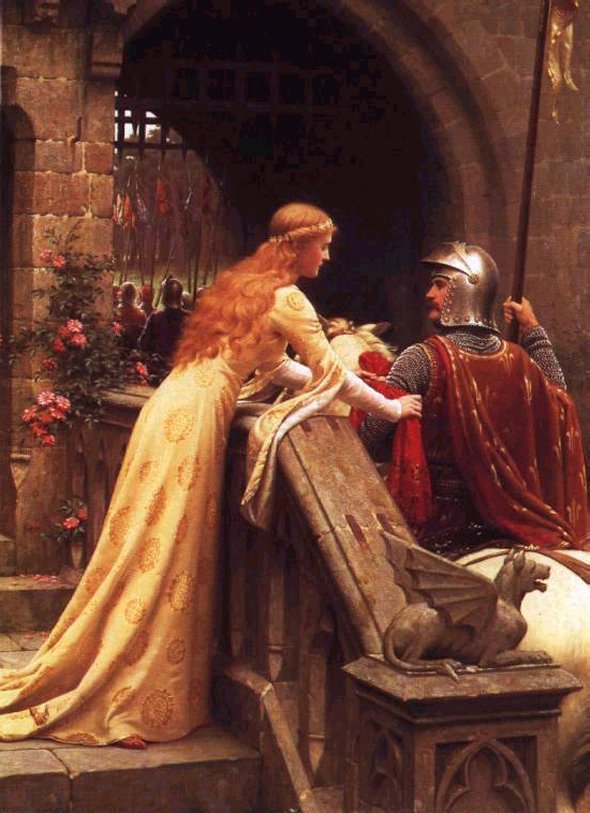
My favorite painting: "Godspeed" by Edmund Blair Leighton, 1900
My favorite painting: “Godspeed” by Edmund Blair Leighton, 1900

I want to draw your attention to a talk on “Vision in Life” given by Dr. William Lane Craig. Dr. Craig is the ablest defender of the Christian faith operating today. He has done formal academic debates with all of the best known atheists on major university campuses in front of thousands of university students.

It turns out that he owes a lot of his success to his amazing wife Jan.

The MP3 file is here. (32 minutes)

This talk was Dr. Craig’s chapel address to Biola University students.

About 11 minutes into the talk, Bill describes what happened after he finished his Bachelor’s degree at Wheaton:

And so I joined the staff of Campus Crusade for Christ for 2 years, and was assigned to Northern Illinois University. And that was where I met my wife Jan. She was a graduate of the University of North Dakota where she had come to faith in Christ. And she had a similar vision for her life of evangelism and discipleship.

And as we worked at NIU together, she with gals and I with the guys, leading students to Christ and discipling them to walk with the Lord, we fell in love. And we decided that we would be more effective if we joined forces and became a team.

So their reason for getting together was because they thought that they would be more effective in evangelism and discipleship if they worked as a team.

It is at this point in the talk where Bill begins to explain just how Jan molded him into the lean, mean debating machine that travels the world striking terror into the hearts of atheists.

Bill’s first story about Jan occurs early after their marriage while he is working on his first Masters degree at Trinity:

And it was also at that time that I began to see what an invaluable asset the Lord had given me in Jan. I remember I came home from classes one day, and found her at the kitchen table with all the catalogs and schedules and papers spread out in front of her and she said, “look! I’ve figured out how you can get two Masters degrees at the same time that it would normally take to get one! All you have to do is take overloads every semester, go to all full-time summer school and do all these other things, and you can do two MAs in the time it takes to do one!”

And I thought, whoa! Are you sure you really want to make the commitment it takes to do this kind of thing? And she said, “Yeah! Go for it!” And it was then I began to see that God had given me a very special woman who was my supporter – my cheerleader – and who really believed in me. And as long as she believed in me, that gave me the confidence to dream bigger dreams, and to take on challenges that I had never thought of before.

In an article on his web site, he talks about how Jan encouraged him to do his first Ph.D:

As graduation from Trinity neared, Jan and I were sitting one evening at the supper table in our little campus apartment, talking about what to do after graduation. Neither of us had any clear leading or inclination of what we should do next.

So Jan said to me, “Well, if money were no object, what would you really like to do next?”

I replied, “If money were no object, what I’d really like to do is go to England and do a doctorate under John Hick.”

“Who’s he?” she asked.

“Oh, he’s this famous British philosopher who’s written extensively on arguments for the existence of God,” I explained. “If I could study with him, I could develop a cosmological argument for God’s existence.”

But it hardly seemed a realistic idea.

The next evening at supper Jan handed me a slip of paper with John Hick’s address on it. “I went to the library today and found out that he’s at the University of Birmingham in England,” she said. “Why don’t you write him a letter and ask him if you can do a doctoral thesis under him on the cosmological argument?”

What a woman! So I did, and to our amazement and delight Professor Hick wrote back saying he’d be very pleased to supervise my doctoral work on that subject. So it was an open door!

And in the same article, he explains how Jan encouraged him to get his second Ph.D:

As Jan and I neared the completion of my doctoral studies in Birmingham, our future path was again unclear to us. I had sent out a number of applications for teaching positions in philosophy at American universities but had received no bites. We didn’t know what to do.

I remember it like yesterday. We were sitting at the supper table in our little house outside Birmingham, and Jan suddenly said to me, “Well, if money were no object, what would you really like to do next?”

I laughed because I remembered how the Lord had used her question to guide us in the past. I had no trouble answering the question. “If money were no object, what I’d really like to do is go to Germany and study under Wolfhart Pannenberg.”

“Who’s he?”

“Oh, he’s this famous German theologian who’s defended the resurrection of Christ historically,” I explained. “If I could study with him, I could develop a historical apologetic for the resurrection of Jesus.”

Our conversation drifted to other subjects, but Jan later told me that my remark had just lit a fire under her. The next day while I was at the university, she slipped away to the library and began to research grants-in-aid for study at German universities. Most of the leads proved to be defunct or otherwise inapplicable to our situation. But there were two grants she found that were possibilities. You can imagine how surprised I was when she sprung them on me!

Both of these Ph.D experiences are also described in the talk. And the talk concludes as follows:

I am so thankful to be married to a woman who is tremendously resourceful, tremendously talented and energetic, who could have pursued an independent career in any number of areas, but instead, she has chose to wed her aspirations to mine, and to make it her goal to make me the most effective person I can be, for Christ. And she has been like my right arm in ministry over these many years. And it is a tremendous privilege to be a team with a person like that.

And you young men, I would encourage you, if you marry, to find a gal who shares your vision, not some independent vision, but who is interested in aligning herself with you, and pursuing together a common vision and goal that will draw you [together], so that you will avoid the growing separateness that so often creeps into marriages.

And now you know the rest of Bill’s story. The person you marry will have an enormous influence on the impact you will have for Christ and his Kingdom. It is up to you to decide whether that influence is going to be positive or negative, by deciding if you will marry, and if you do marry, by deciding whom you will marry.

You may also be interested in this talk given by William Lane Craig, entitled “Healthy Relationships” (National Faculty Leadership Conf. 2008) (audio here) In that talk, he offers advice to Christians who want to have a marriage that is consistent with their Christian faith.

Why don’t men talk to women about commitment and marriage any more?

Painting:
Painting: “Courtship”, by Edmund Blair Leighton (1888)

I saw this essay from a young woman named Jordana Narin who is explaining how she feels about not being able to talk seriously to a man she had sex with. She is a radical feminist and has a useless, easy degree in creative writing.

The essay was published in the radically leftist New York Times.

First kiss:

I met [a guy] at summer camp in the Poconos at 14, playing pickup basketball by day and talking in the mess hall late into the night. Back home we lived only 30 minutes apart, but I didn’t see him again until 11th grade, when we ran into each other at a Halloween party in a Lower Manhattan warehouse.

[…]Under the muted flashes of a strobe light, we shared our first kiss.

She spent her first kiss on a guy she barely knew at a party, with no relationship context.

And this is how they talked:

We stayed in touch for the rest of high school, mostly by text message.

[…]Every time his name popped up on my phone, my heart raced.

Still, we were never more than semiaffiliated, two people who spoke and loved to speak and kissed and loved to kiss and connected and were scared of connecting.

Where is this relationship going? This boy has no job and no savings and no proven record of steady work – and therefore he cannot marry anyone.

More:

Two years after our first kiss, we were exchanging “I’ve missed you” messages again. It was a brisk Friday evening in our first semesters of college when I stepped off a train and into his comfortable arms.

He had texted weeks earlier on Halloween (technically our anniversary) to ask if I would visit. We had not talked since summer, and I was trying to forget him. We had graduated from high school into the same inexpressive void we first entered in costume, where an “I’ve missed you” was as emotive as one got.

Long gaps in between text messages – they have nothing to talk about, and there is no goal. Nevertheless, they are away from their parents, and so she had sex with him, losing her virginity to a man she was not married to.

And then:

Naïvely, I had expected to gain clarity, to finally admit my feelings and ask if he felt the same. But I couldn’t confess, couldn’t probe. Periodically I opened my mouth to ask: “What are we doing? Who am I to you?” He stopped me with a smile, a wink or a handhold, gestures that persuaded me to shut my mouth or risk jeopardizing what we already had.

On the Saturday-night train back to Manhattan, I cried. Back in my dorm room, buried under the covers so my roommates wouldn’t hear, I fell asleep with a wet pillow and puffy eyes.

The next morning I awoke to a string of texts from him: “You get back OK?” “Let’s do it again soon :)”

Yes. She had sex with him because of text messages, Facebook comments and because he “missed her”. Not because he had presented his resume and balance sheet to her father, dated her for many months, bought her an engagement ring, courted her for more months, bought her a wedding ring, then walked down the aisle with her.

Why is this happening?

There’s an interview that goes with it on the radically leftist NPR web site, but I saved a copy of the MP3 file here in case it disappears.

Moderate Christian Rod Dreher comments on the interview:

I wouldn’t have understood the full scope of what this young woman is saying in her essay without the interview, which is short. In the segment, Narin says that men and women in her generation don’t have actual romantic relationships anymore. It’s all casual, non-committal sex. “Nobody knows whether their own feelings are real,” she says.

[..]She tells the interviewer that there’s lots of making out and sex, but nobody wants to be emotionally vulnerable to anybody else.

[…]“Everyone in college uses Tinder,” she said, referring to the wildly popular dating and hook-up app. “You can literally swipe right and find someone just to hang out for the night. There’s no commitments required, and I think that makes committing to someone even harder, because it’s so normal, and so expected even, to not want to commit.”

In a different time, my grandparents, my great grandparents, they might have thought they were missing out on casual sex,” she says. “But since my generation has been saddled down with that, we kind of look to the past and say well, wasn’t that nice. I think both are optimal. I’m a huge feminist, and I think women should be able to do whatever they want to do. If a woman wants to have tons of casual sex, she totally should. But I think that there should be the option. And they shouldn’t be gendered, women and men. But there should be the option of being in a relationship.”

Right. Young women like her who have swallowed radical feminism hook, line and sinker don’t want to “miss out” on casual sex right now, but they want to get married “some day” – after they have a lot of fun traveling and doing exciting, fun things.

But what do they think marriage is?

This:

Look at the lyrics:

You got that 9 to 5
But, baby, so do I
So don’t be thinking I’ll be home and baking apple pies
I never learned to cook

After every fight
Just apologize
And maybe then I’ll let you try and rock my body right
Even if I was wrong
You know I’m never wrong

And know we’ll never see your family more than mine

Even when I’m acting crazy
Tell me everything’s alright

This is what women today understand marriage to be. They expect to be pursuing their own careers, not supporting their husbands and raising children. Most feminists view the roles of wife and mother as demeaning. They aren’t interested in supporting or respecting a man who provides for them – they just want him to say yes to whatever they feel like doing – fun and thrills.

The woman singing expects to win every disagreement because, like the song says, she is never wrong. The lyrics also say that sex is conditional on whether the woman feels happy. When it comes to visiting family and holidays, she lets us know that her family is more important than his. And she is allowed to act crazy, which could involve a whole host of selfish, wasteful, narcissistic behaviors, (e.g. – skydiving, ziplining, surfing), and he is just supposed to celebrate and maybe pay for it. For the rest of his life.

How do men respond to these radical feminists?

Most men are not interested in committing to, or discussing commitment with, radical feminists. Men will have sex with a radical feminist, (not me, but other men), but they will never commit to them. Why not? If a man’s role is just to please the “huge feminist”, then there is no reason to commit to her. Radical feminists believe that relationships are about their plans and their needs. They are not interested in responsibilities, expectations or obligations to men or to children. But men, even secular men, understand that they must not marry a woman who thinks that relationships should impose no obligations on her. Men play dumb with women to keep the sex coming, but there is no way they would commit to such women.

Now there is one exception to this rule, and that’s young, naive men. If a woman is a “huge feminist” then she might be able to get attention from a doormat man without having to give him sex. Typically, these men have no work experience, no savings, are much younger, and are so desperate for attention that they do what Meghan Trainor says in the song: apologize, grovel, condone craziness and selfishness, etc. Although a woman may think she wants a man like that in the short-term, in the long-term, those men prove unattractive and unsatisfactory.

In order to be masculine, a man needs to be a good moral leader and a good spiritual leader. And that means that he needs to call a woman higher, away from her self-centeredness, so she can serve God and serve other people. He cannot just agree with whatever crazy, emotional thing that she thinks up that is fun, thrilling and bound to fail. A good leader has experience as a provider, protector and leader that he brings to bear on decision-making, and proven ability achieving and leading others to greatness. I think women with low self-esteem will be interested in men who are doormats, but that is not the solution to the commitment problem. A doormat man does not have what it takes to provide and lead a family.