
Tag Archives: Reason

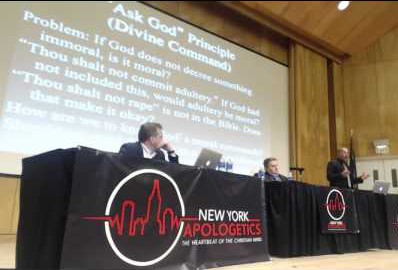
Atheist Michael Shermer tries to rationally ground morality in debate with Frank Turek

Michael Shermer debates Frank Turek: atheism and morality

The topic of the debate was on the grounding of morality – which worldview (theism or atheism) is better at grounding morality?

And here is the MP3 for the cross-examination only, which is what I will be summarizing. (12.5 Mb)

The full debate can be seen here and can be heard here.

Turek’s cross-examination period starts at 74m22s and ends at 89m20s.

Shermer’s cross-examination period starts at 89m50s and ends at 105m0s.

Topics of Turek’s cross-examination:

  • evolution produces Shermer’s moral sense and Hitler’s moral sense
  • why does Shermer think his is better than Hitler’s, since both were produced by the same evolution?
  • what makes right or wrong if evolution is the source of morality?
  • why is Stalin’s opinion of right and wrong less valuable than the herd’s opinion of right and wrong?
  • do the Founding Fathers ground inalienable rights in a Creator, or in evolution?
  • can atheism ground the existence of inalienable rights?
  • can you ground objective moral values and objective moral duties by asking people how they feel?
  • can you ground objective human rights on atheism by shouting like a madman and interrupting?
  • how can you trust your thinking if they are the result of an unguided, random process of evolution?
  • how can you have rational thoughts if materialism is true, and you are a machine made out of meat?
  • can you ground objective moral values and objective moral duties on personal preferences?
  • how do the personal preferences of some individuals create an objective moral duty for other individuals?
  • does naturalistic evolution orient human beings toward survival or truth?
  • on materialism, what is the chemical composition of justice?

Topics of Shermer’s cross-examination:

  • Radical muslims are exactly the same as evangelical Christians, and have the same God (Allah is the same as the Triune Christian God)
  • Radical muslims would assert that their God is the same as the Triune Christian God, with Jesus and the Holy Spirit also being God
  • Therefore, we can lay the blame for what radical muslims do on the backs of evangelical Christians
  • Radical muslims and evangelical Christians are the same, because “you’re enthusiastic, they’re enthusiastic”
  • The Bible’s notion of indentured servitude to pay off debt is the identical to the idea of slavery based on race
  • The Bible’s notion that masters and slaves are equal in the sight of God forms a basis for thinking they are unequal
  • The Bible teaches things that I disagree with, like the idea that marriage should provide children with a mother and a father
  • Gay marriage is solidly grounded in evolution, even though the morality that evolution produces varies by time and place
  • Atheists can ground objective moral values and objective moral duties by asking people how they feel
  • Can atheists who want to legalize gay marriage because “they’re in love” prohibit polygamy or incest as marriage?
  • Is shouting “you’re on the wrong side of history” a way to rationally ground morality in an accidental atheistic universe?
  • Is it loving for atheists to celebrate a lifestyle that exposes gay men to sickness and premature death?
  • Is it “bigotry” for the Center for Disease Control to warn men who have sex with men about higher health risks?
  • How do Christians decide what is right and wrong when they are confronted with a moral dilemma?
  • How do humans sense the objective moral standard that is required for them to make moral judgments
  • Can enlightenment philosophers who merely imagine human rights actually create those human rights?
  • If revelations change over time for Mormons, does that undermine the need for God to ground objective morality?

I apologize for the poor quality of the video and audio. The moderator was extremely ineffective, letting Shermer go on and on making speeches instead of asking questions during his questioning time. Also, Shermer apparently thought that shouting at Turek and waving his finger at Turek was a good strategy to defend against Turek’s use of logic and evidence.

My thoughts on Michael Shermer

I do want to make some general comments about what Shermer said. Shermer’s view of morality is “what is best for the greatest number of people”. There are no inalienable rights that act as a break on the will of the majority. Shermer has no objection to anything that the majority has decided in any time or in any place. If he were there, he would agree that whatever they decided was morally right.

Two hundred years ago, Shermer would have endorsed slavery. And if he were in Germany 50 years ago, he would have endorsed the Holocaust. If he lived in a Pakistan today, he would endorse stoning women for wearing the wrong clothes. Atheists always think that whatever the majority is doing in a particular time and place is right for them. There are no inalienable human rights that exist apart from human opinions, on atheism.

Another problem is that Shermer is constantly making moral judgments when his own view is that morality is constantly changing in different times and places. He condemns the moral values of other times and places without having any standard in his worldview that can decide between different moral values and duties. It is like saying that lunch is better than breakfast because lunch is here and now, and breakfast was then and there. That is literally what atheists do when they make moral judgments. They have no standard that applies to different times and places, just the ever evolving opinions of the majority of people in different times and places.

Is Michael Shermer concerned about morality?

Finally, I want people to understand what kind of person Michael Shermer is. You can read a post by PZ Myers on his blog Pharyngula to get the picture. I think it’s useful to know about Shermer’s own morality since he seems to like to make moral judgments so much during debates. In my own experience in dealing with atheists, although they will talk about slavery and the Crusades, there is nothing in an atheist’s moral system that makes things wrong for all times and all places. They bring it up to stop you from judging them about the things that they care about. When an atheist says “the Crusades! Slavery!” what they really mean is “I need to shame you for having a basis for moral judgments against me, so that you won’t say anything about me getting married women drunk then raping them”. That’s what atheistic use of moral language is really about.

What atheists really think about morality

Atheist Richard Dawkins says atheists have no objective moral standards:

In a universe of blind physical forces and genetic replication, some people are going to get hurt, other people are going to get lucky, and you won’t find any rhyme or reason in it, or any justice. The universe that we observe has precisely the properties we should expect if there is, at bottom, no design, no purpose, no evil and no good, nothing but blind, pitiless indifference… DNA neither knows nor cares. DNA just is. And we dance to its music. (Richard Dawkins, River Out of Eden: A Darwinian View of Life (1995))

So, when Shermer tries to shame Christians for behaviors in other times and places which our society here and now disagrees with, what he really means is “morality, objectively speaking, is nonsense, but I will use your moral sense that comes from your non-atheistic worldview to shame you, so that you won’t have the confidence to judge me for my immoral behavior”. And we need to get used to understanding this about atheists. Morality is nonsense to them, and their real goal is to get you off their back for their hedonism. For atheists, morality is just complying with arbitrary social customs which vary by time and place. There is nothing more to it than aping their neighbors (at least when their neighbors are watching). And they would have aped slave-owners, widow-burners and Nazi prison guards too, if they lived in that time and place. And shouted at Christians for disagreeing with them, just like Shermer did about gay marriage.

If you like the way that Frank Turek debates, then be sure and check out his new book “Stealing From God“. I highly recommend it.


Are Latter Day Saints (LDS) doctrines supported by philosophy, science and history?

A conflict of worldviews

This post presents evidence against Mormonism/LDS in three main areas. The first is in the area of science. The second is in the area of philosophy. And the third is in the area of history.

The scientific evidence

First, let’s take a look at what the founder of Mormonism, Joseph Smith, believes about the origin of the universe:

“The elements are eternal. That which had a beggining will surely have an end; take a ring, it is without beggining or end – cut it for a beggining place and at the same time you have an ending place.” (“Scriptural Teachings of the Prophet Joseph Smith”, p. 205)

“Now, the word create came from the word baurau which does not mean to create out of nothing; it means to organize; the same as a man would organize materials and build a ship. Hence, we infer that God had materials to organize the world out of chaos – chaotic matter, which is element, and in which dwells all the glory. Element had an existance from the time he had. The pure principles of element are principles which can never be destroyed; they may be organized and re-organized, but not destroyed. They had no beggining, and can have no end.”
(“Scriptural Teachings of the Prophet Joseph Smith”, p. 395)

A Mormon scholar named Blake Ostler summarizes the Mormon view in a Mormon theological journal:

“In contrast to the self-sufficient and solitary absolute who creates ex nihilo (out of nothing), the Mormon God did not bring into being the ultimate constituents of the cosmos — neither its fundamental matter nor the space/time matrix which defines it. Hence, unlike the Necessary Being of classical theology who alone could not not exist and on which all else is contingent for existence, the personal God of Mormonism confronts uncreated realities which exist of metaphysical necessity. Such realities include inherently self-directing selves (intelligences), primordial elements (mass/energy), the natural laws which structure reality, and moral principles grounded in the intrinsic value of selves and the requirements for growth and happiness.” (Blake Ostler, “The Mormon Concept of God,” Dialogue: A Journal of Mormon Thought 17 (Summer 1984):65-93)

So, Mormons believe in an eternally existing universe, such that matter was never created out of nothing, and will never be destroyed. But this is at odds with modern cosmology.

The Big Bang cosmology is the most widely accepted cosmology of the day. It is based on several lines of evidence, and is broadly compatible with Genesis. It denies the past eternality of the universe. This peer-reviewed paper in an astrophysics journal explains. (full text here)

Excerpt:

The standard Big Bang model thus describes a universe which is not eternal in the past, but which came into being a finite time ago. Moreover,–and this deserves underscoring–the origin it posits is an absolute origin ex nihilo. For not only all matter and energy, but space and time themselves come into being at the initial cosmological singularity. As Barrow and Tipler emphasize, “At this singularity, space and time came into existence; literally nothing existed before the singularity, so, if the Universe originated at such a singularity, we would truly have a creation ex nihilo.

[…]On such a model the universe originates ex nihilo in the sense that at the initial singularity it is true that There is no earlier space-time point or it is false that Something existed prior to the singularity.

Christian cosmology requires such a creation out of nothing, but this is clearly incompatible with what Mormons believe about the universe. The claims about the universe made by the two religions are in disagreement, and we can test empirically to see who is right, using science.

Philosophical problems

Always Have a Reason contrasts two concepts of God in Mormonism: Monarchotheism and Polytheism. It turns out that although Mormonism is actually a polytheistic religion, like Hinduism. In Mormonism, humans can become God and then be God of their own planet. So there are many Gods in Mormonism, not just one.

Excerpt:

[T]he notion that there are innumerable contingent “primal intelligences” is central to this Mormon concept of god (P+M, 201; Beckwith and Parrish, 101). That there is more than one god is attested in the Pearl of Great Price, particularly Abraham 4-5. This Mormon concept has the gods positioned to move “primal intelligences along the path to godhood” (Beckwith and Parrish, 114). Among these gods are other gods which were once humans, including God the Father. Brigham Young wrote, “our Father in Heaven was begotten on a previous heavenly world by His Father, and again, He was begotten by a still more ancient Father, and so on…” (Brigham Young, The Seer, 132, quoted in Beckwith and Parrish, 106).

[…]The logic of the Mormon polytheistic concept of God entails that there is an infinite number of gods. To see this, it must be noted that each god him/herself was helped on the path to godhood by another god. There is, therefore, an infinite regress of gods, each aided on his/her path to godhood by a previous god. There is no termination in this series. Now because this entails an actually infinite collection of gods, the Mormon polytheistic concept of deity must deal with all the paradoxes which come with actually existing infinities…

The idea of counting up to an actual infinite number of things by addition (it doesn’t matter what kind of thing it is) is problematic. See here.

More:

Finally, it seems polytheistic Mormonism has a difficulty at its heart–namely the infinite regress of deity.

[…]Each god relies upon a former god, which itself relies upon a former god, forever. Certainly, this is an incoherence at the core of this concept of deity, for it provides no explanation for the existence of the gods, nor does it explain the existence of the universe.

Now let’s see the historical evidence against Mormonism.

The historical evidence

J. Warner Wallace explains how the “Book of Abraham”, a part of the Mormon Scriptures, faces historical difficulties.

The Book of Abraham papyri are not as old as claimed:

Mormon prophets and teachers have always maintained that the papyri that was purchased by Joseph Smith was the actual papyri that was created and written by Abraham. In fact, early believers were told that the papyri were the writings of Abraham.

[…]There is little doubt that the earliest of leaders and witnesses believed and maintained that these papyri were, in fact the very scrolls upon which Abraham and Joseph wrote. These papyri were considered to be the original scrolls until they were later recovered in 1966. After discovering the original papyri, scientists, linguists, archeologists and investigators (both Mormon and non-Mormon) examined them and came to agree that the papyri are far too young to have been written by Abraham. They are approximately 1500 to 2000 years too late, dating from anywhere between 500 B.C. (John A. Wilson, Dialogue: A Journal of Mormon Thought, Summer 1968, p. 70.) and 60 A.D. If they papyri had never been discovered, this truth would never have come to light. Today, however, we know the truth, and the truth contradicts the statements of the earliest Mormon leaders and witnesses.

The Book of Abraham papyri do not claim what Joseph Smith said:

In addition to this, the existing papyri simply don’t say anything that would place them in the era related to 2000BC in ancient Egypt. The content of the papyri would at least help verify the dating of the document, even if the content had been transcribed or copied from an earlier document. But the papyri simply tell us about an ancient burial ritual and prayers that are consistent with Egyptian culture in 500BC. Nothing in the papyri hints specifically or exclusively to a time in history in which Abraham would have lived.

So there is a clear difference hear between the Bible and Mormonism, when it comes to historical verification.

Further study

There is a very good podcast featuring J. Warner Wallace that summarizes some other theological problems with Mormonism that I blogged about before. And if you want a nice long PDF to print out and read at lunch (which is what I did with it) you can grab this PDF by Michael Licona, entitled “Behold, I Stand at the Door and Knock“.

Advice for pro-lifers who want to do sidewalk counseling

I'm Scheming Unborn Baby, and I approve this study
I’m Scheming Unborn Baby, and I approve this resource

Not from me, of course. I’m no lawyer. But here is a good resource about your legal rights, from the Alliance Defending Freedom (ADF).

Description:

Over the past 24 years, a surging pro-life movement has forced the closure of 75 percent of surgical abortion businesses in America. But the work is not done. Over 500 abortion facilities still exist in the United States.

That’s where you come in.

As a sidewalk counselor, you can bring hope and clarity to women and men facing an unplanned or crisis pregnancy by connecting with them and empowering them to choose life. To do this work faithfully and effectively, however, you should familiarize yourself with your rights.

Alliance Defending Freedom (ADF) created this manual to educate you about your legal rights when engaging in sidewalk counseling. We pray this resource will help you be better equipped to serve the women and men entering abortion clinics every day.

ADF has taken on cases where the right to advise women considering abortion was attacked. For example, they had to fight the Democrat governor and attorney general of Massachusetts at the Supreme Court:

On Nov. 13, 2007, Massachusetts Gov. Deval Patrick signed into law S.B. 1353, which created the buffer zone. The U.S. Supreme Court agreed to hear McCullen v. Coakley in June of last year.

Coakley is the Democrat attorney general of Massachusetts, one of the most liberal states in the nation.

Here’s a snip from the decision:

“It is no accident that public streets and sidewalks have developed as venues for the exchange of ideas,” the Supreme Court wrote in its opinion. “Even today, they remain one of the few places where a speaker can be confident that he is not simply preaching to the choir…. In light of the First Amendment’s purpose ‘to preserve an uninhibited marketplace of ideas in which truth will ultimately prevail…,’ this aspect of traditional public fora is a virtue, not a vice.”

ADF won the case 9-0.

There is a bit more about the woman who brought the case against the pro-abortion Democrats in this post.

It says:

The young married couple slide quickly out of their car and onto the busy sidewalk, eyes fixed on the dark glass doors of the huge Planned Parenthood abortion center. Half a block long and three stories high, its imposing facade looms over the busy stream of students milling up and down the mile-long stretch of Commonwealth Avenue near Boston University.

Suddenly, a small figure nudges into the couple’s tunneled vision, moving to engage them.

“Good morning,” she says, arms wide and inviting, in the cheerful tones of someone who actually believes that it is. “I’m Eleanor. How can I help you this morning?’

They quickly brush past her and into the building. Minutes later, the husband comes back out to put money in the meter.  The small woman is still there, still beaming. “Can I help you?”

“You can’t help me,” he says, pulling change from his pocket. To her fine-tuned ear, he sounds as though he’s trying to convince himself, more than her.

“Well, okay. But I just want to ask you—do you know when the baby’s heart starts beating?”

He sighs, but he answers. “Three months.”

“No … not three months. Twenty-one days. Do you know when the brain waves begin to form?”

Fishing for another quarter, he flashes her an expression that mingles surprise, annoyance, and curiosity in about equal measure. “Six months,” he guesses.

“Ten weeks,” she tells him. Their eyes meet.

“Really?”

“Yes.”

He turns back toward the building—then, almost in spite of himself, asks her a question … something about the baby’s DNA. In a moment, they’re deep in conversation. Too deep, to the woman’s mind. She is counting precious minutes, even as her genuine smile and tone warm and envelop the stranger. She fixes him with a clear, sober expression.

“You have to go in there and get her.”

He looks at her for a moment. “All right,” he says at last. “I will.” He runs for the door. Ten minutes later, he’s back, tears in his eyes.

“She’s already in the back. I can’t get to her. They won’t let me speak to her.” He’s visibly upset. “I can’t believe I brought her here.”

A thought seizes her: “Do you have a cell phone? Call her. Tell her there’s help out here and to stop this.”

Incredibly, Planned Parenthood staff members have brought the woman into the procedure room with her cell phone. She answers his call. “You have to come out!” he cries, pleading.

“And she did,” Eleanor says, with a smile that could light up the whole Boston skyline. “I have their little boy’s picture. It’s on my refrigerator.”

There are a lot of pictures on Eleanor McCullen’s refrigerator. All of them children who owe their lives, in large measure, to this 78-year-old woman’s willingness to stand on a Boston curbside five hours a day, two days a week—rain, shine, snow, or sleet—for the last 14 years.

She’s got the facts, and she’s not afraid to use them.

So, if this sounds like something you would be interested in, then listen to the interview with Eleanor, download the ADF guide about legal issues for sidewalk counselors, and then get started saving lives.